Winemaking Techniques
“Where every bottle tells a story”
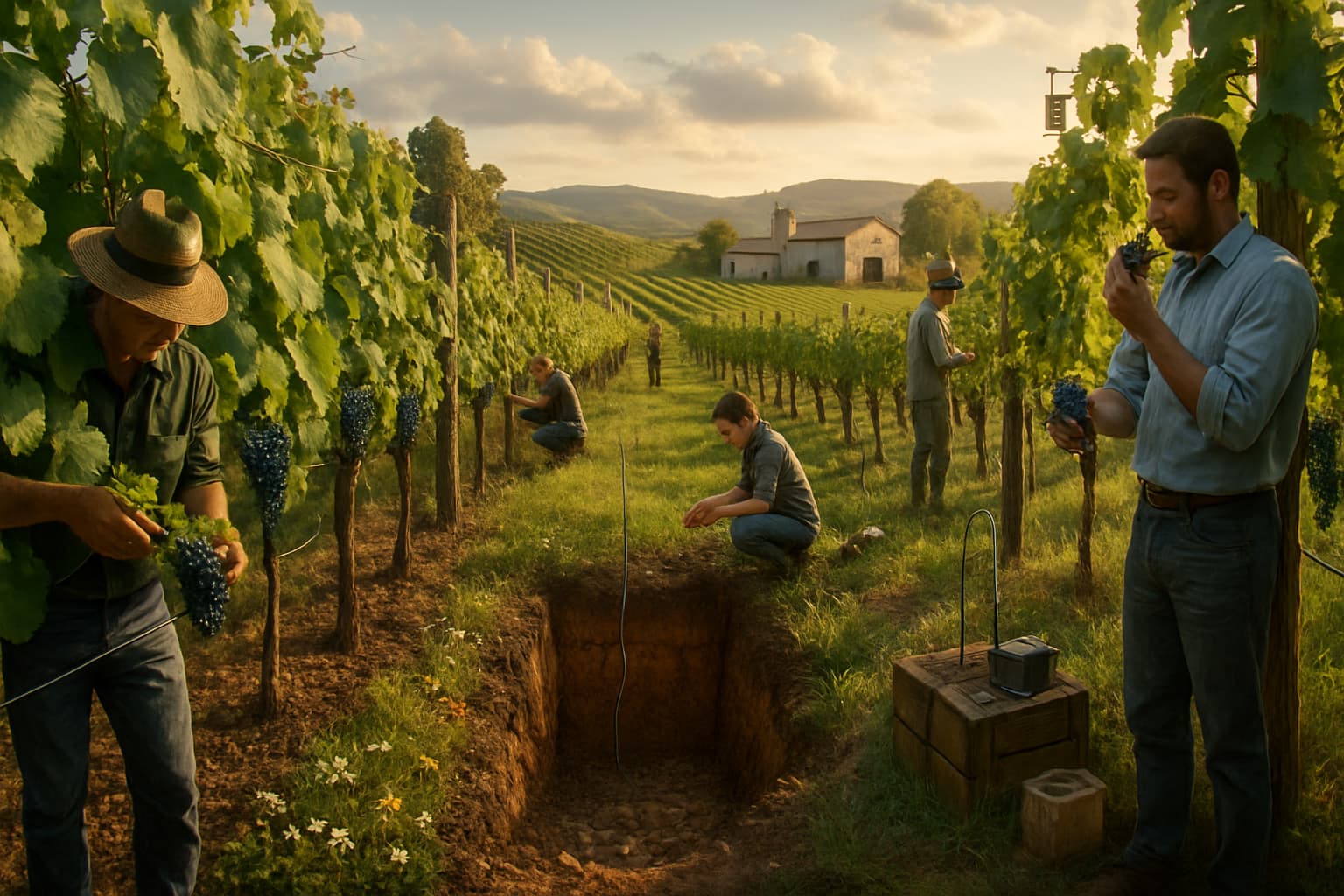
It is a truth very generally acknowledged—though less often acted upon than one might wish—that a wine of distinguished character must be in want of a well‑managed vineyard. To attribute excellence solely to the genius of the cellar is a romantic folly suitable only to those who judge a wine by its label rather than its lineage. In reality, the virtues of a noble vintage are conceived long before the grape meets the press, in the quiet, exacting discipline of the field.
Let us, therefore, turn our attention from the candlelit tasting room to the open air and observe how an integrated approach to vineyard management forms the very foundation of wine quality. We shall discover that true refinement in the glass is less a miracle than the reward of numerous small, well‑considered decisions—each made in concert with soil, climate, vine, and human judgment.
No lady or gentleman of sense would imagine that a household prospers by attending to only one of its concerns while neglecting the rest. In like manner, a vineyard cannot be properly directed by studying its pests and forgetting its soils, nor by pampering its vines while disregarding the weather that daily instructs them. Integrated vineyard management regards the estate as a living society, in which every member—soil microbe, cover crop, vine, insect, and human hand—plays a role in the final harmony or discord of the wine.
Rather than pursuing single solutions to isolated problems, this philosophy pursues balance: between growth and restraint, vigor and stress, protection and exposure. The aim is not merely to keep vines alive, but to guide them—firmly yet gently—towards producing grapes of concentration, complexity, and grace.
Just as a person’s early education shapes their later conversation, so the soil forms the character of the grape. An integrated approach begins not with the pruning shears, but with the ground itself.
A careful vintner acquaints themselves with:
Such knowledge is not acquired by idle speculation, but by soil pits, analyses, and patient observation over seasons.
In place of the violent alternation between neglect and over‑indulgence so common in human affairs, the integrated manager pursues steady improvement:
Healthy soils produce vines that are neither languid nor hysterical, but composed—capable of ripening fruit fully without excessive yields or watery flavors. In the glass, this translates into wines of greater texture, length, and what the more poetic call “minerality.”
If soil is the mind of the vineyard, the canopy is its outward manner—visible to all, and in constant need of tactful correction. An integrated strategy regards the vine’s foliage not as a wild profusion to be admired or despised, but as a structure to be composed with the same care as a well‑designed drawing room.
Key practices include:
Too dense a canopy produces grapes that are shaded, herbaceous, and prone to rot; too sparse a one leaves berries scorched and unbalanced. The careful manager aims for dappled light, moderate exposure, and good air movement—conditions that encourage color, tannin, and aroma development while discouraging mildew and botrytis.
The consequences of canopy decisions are later read in the wine:
In short, the vine’s summer deportment, managed by thoughtful hands, determines whether the wine will speak in a clear, confident tone or mumble indistinctly.
There are few errors more common, in life as in viticulture, than imagining that if a little is good, more must be better. Vines, like sensible people, thrive on sufficiency rather than excess.
Where irrigation is employed, an integrated approach uses it as a scalpel, not a floodgate:
Wines from thoughtfully irrigated vineyards often show greater intensity and more polished tannins than those from vines indulged with constant, generous watering.
Fertilization is guided by:
Over‑fed vines produce abundant foliage and generous yields, but wines of thin character and indistinct flavor. Moderately nourished vines, by contrast, yield fewer grapes of greater concentration—proof that restraint, when wisely applied, is a kindness rather than a cruelty.
It is a melancholy habit of some growers to treat every insect as a villain and every fungus as a scandal. Integrated pest and disease management (IPDM) adopts a more nuanced society: it distinguishes between adversaries and allies, and reserves its strongest measures for the former.
An integrated program begins with:
This approach replaces habitual spraying with considered response, reducing both expense and environmental burden.
Rather than attempting to sterilize the vineyard, the integrated manager cultivates a more refined company:
Where sprays are necessary, preference is given to:
The result is not merely a cleaner conscience, but often cleaner fruit—less damaged, less diseased, and more suitable for producing wines of purity and finesse.
It is a common misfortune that vineyards, like certain social climbers, are tempted to do too much at once. A vine that attempts to ripen an immoderate number of clusters divides its strength so thinly that none achieve distinction.
Integrated vineyard management attends carefully to:
The proper crop load is not a universal constant, but depends upon site vigor, variety, and desired wine style. Yet the principle remains: a balance between leaf area and fruit weight must be maintained if ripeness is to be achieved without sacrificing freshness.
The integrated manager resists both the vanity of extreme low yields for their own sake and the greed of over‑cropping. Instead, they pursue the yield that best expresses the vineyard’s character while sustaining its economic and ecological health.
All previous labors in the vineyard converge upon one solemn question: when shall we pick? To harvest too early is to trap the wine in green, angular youth; too late, and it sinks into overripe languor, robbed of energy and precision.
An integrated approach considers:
Sampling is done from numerous parts of the vineyard, and, where warranted, blocks are picked separately to respect their differing tempos of development.
Harvest timing is also integrated with:
In this way, the vineyard and winery do not behave as estranged relations but as correspondents in regular, intelligent communication.
There is a quiet morality in integrated vineyard management, one that extends beyond the year’s bottlings. By preserving soil health, encouraging biodiversity, and moderating inputs, the grower not only secures the present vintage but bequeaths a more resilient estate to future hands.
Wines born of such vineyards often possess a quiet depth—a sense of place and continuity—which the discerning drinker may not be able to define but will certainly feel.
To speak of wine quality while ignoring vineyard management is as absurd as praising a novel while denying the existence of its author. The cellar may refine, elevate, and preserve, but it cannot conjure greatness from indifferent fruit. Integrated vineyard management—embracing soil, canopy, water, nutrients, pests, yields, and harvest timing—forms the continuous thread that binds the year’s labors to the character of the final wine.
By treating the vineyard as a living, interrelated society rather than a mere factory for grapes, the thoughtful grower cultivates not only healthier vines but more articulate wines—wines that express their origin with clarity, balance, and poise. Such bottles do not shout; they converse. They reflect the patience of the winter pruning, the judgment of the summer thinning, the restraint of the irrigation schedule, and the courage of the harvest decision.
In an age fond of shortcuts and spectacles, integrated vineyard management is almost old‑fashioned in its insistence upon observation, moderation, and respect for nature’s own designs. Yet, like all truly good manners, it never goes out of style. And in the quiet moment when a glass is raised and its contents reveal depth, harmony, and grace, one may be sure that somewhere, behind the curtain, a well‑conducted vineyard is making its modest curtsy.
Tannins are astringent compounds found in wine that contribute to its texture and aging potential, often causing a drying or puckering sensation in the mouth. They are derived from grape skins, seeds, and stems, as well as from oak barrels used during aging.
/ˈtænɪnz/
Malic acid is a naturally occurring organic acid found in grapes that contributes to the tart, green apple-like flavor and crispness in wine. It plays a significant role in the taste and acidity of wine.
/mælɪk ˈæsɪd/
Listen up, wine enthusiasts. Today, we're diving into the world of pruning techniques. That's right, we're not just sipping on that fancy fermented grape juice; we're getting our hands dirty, right...
Filtration in winemaking is the process of removing solid particles from wine to clarify and stabilize it before bottling, using various types of filters to achieve different levels of clarity and remove unwanted elements like yeast, bacteria, and sediment.
/fɪlˈtreɪʃən/
Oxidation in wine is a chemical reaction between the wine and oxygen that can change its flavor, aroma, and color. This process can be beneficial or detrimental depending on the extent and context of the exposure.
/ˌɒksɪˈdeɪʃən/
Microclimate refers to the unique climate conditions of a small, specific area within a larger region, significantly influencing grapevine growth and the characteristics of the resulting wine.
/ˈmīkrōˌklīmit/
Get weekly wine recommendations, vineyard news, and exclusive content delivered to your inbox.