-b5f3495e.webp&w=3840&q=75)
Wine Terminology
“Where every bottle tells a story”
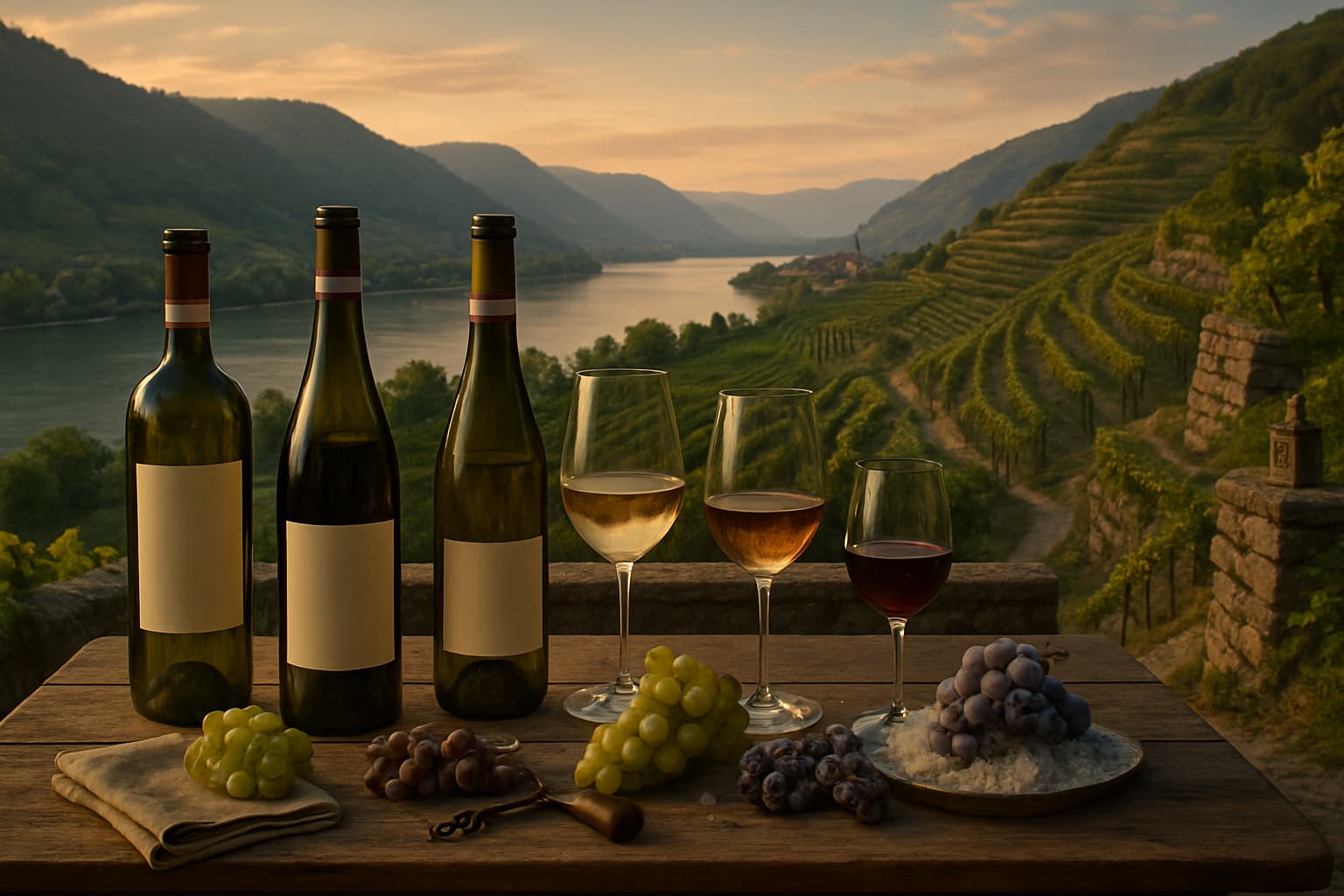
There’s a quiet dignity to a glass of Austrian wine.
It doesn’t shout. It doesn’t need to.
It simply waits… and when you’re ready, it tells you a story.
A story of steep terraced vineyards above the Danube, of cold Alpine nights and warm summer days, of families who’ve worked the same soils for generations. And behind every one of those bottles is a classification system—precise, layered, and deeply connected to the land—that helps you understand what you’re drinking and why it tastes the way it does.
Tonight, let’s walk slowly through that system together.
Wine classification, especially in a country like Austria, is not about snobbery. It’s a map.
It tells you:
In Austria, this map is unusually clear and disciplined. The country may be small, but its wine laws are among the strictest in the world. That’s not an accident. It’s a reaction born out of crisis.
In the 1980s, Austria’s wine industry was shaken by scandal—some producers adulterated wines, and the world turned away. The country responded not with excuses, but with reform. It built one of the most rigorous quality systems in Europe, centered on transparency, origin, and purity.
Today, that system guides every bottle that leaves an Austrian cellar. Let’s start at the foundation.
At the heart of Austrian wine classification is the Wine Law of 2009 (and its updates), which organizes wines into broad legal categories. Think of this as the skeleton on which everything else is built.
At the very bottom lies Tafelwein, or table wine.
These wines:
You won’t usually see “Tafelwein” proudly displayed; it’s the most basic category, and in Austria, it’s a small slice of production. The real story begins one step higher.
Landwein is the next level up, comparable to “country wine” in other regions.
Key traits:
On a label, you’re more likely to see the name of the large region than the word “Landwein” itself.
Now we arrive at the heart of Austrian wine: Qualitätswein.
These wines:
You’ll often see the official red-and-white striped banderole on the bottle neck—a seal of approval from the Austrian authorities.
Within Qualitätswein, there are two important branches:
We’ll explore both in turn.
Austria’s Prädikatswein system is closely related to Germany’s, focusing on the natural sugar content of the grapes at harvest. The higher the sugar, the higher the “Prädikat” level.
These wines are almost always sweet (though a few styles can be made off-dry or even dry in rare cases). They must not be chaptalized—no adding sugar to boost alcohol.
Here are the main rungs of that ladder:
“Late harvest.”
Spätlese is where dessert wine begins to whisper.
“Select harvest.”
Auslese is dessert wine with intention—structured, age-worthy, and contemplative.
“Selected berries.”
This is liquid gold in a glass, often sold in half-bottles, meant to be savored slowly.
“Selected dried berries.”
TBA is not an everyday wine. It’s an experience—rare, precious, and unforgettable.
“Ice wine.”
Eiswein captures winter itself in a bottle: cold, pure, and shimmering.
While Prädikatswein focuses on the ripeness of grapes, dryness is another axis entirely. Austrian labels often use terms like:
Most of Austria’s famous Grüner Veltliner and Riesling in the Wachau, Kamptal, and Kremstal are dry. The sweetness ladder (Spätlese, Auslese, etc.) mostly lives in the realm of dessert wines.
So a wine can be:
If Qualitätswein is the backbone, DAC is the soul.
DAC stands for Districtus Austriae Controllatus—Austria’s version of controlled appellations, similar in spirit to France’s AOC or Italy’s DOC.
A DAC wine is all about origin and style:
The goal is simple: when you see a DAC name, you should have a clear expectation of what’s in the glass.
Some of the best-known DACs include:
Each DAC has its own rules about:
DAC is Austria saying: “This place matters. This style belongs here.”
Even within Austria’s neat classifications, there are local traditions that stand apart. One of the most famous comes from the Wachau.
Historically, the Wachau used its own system to classify dry white wines by natural alcohol potential, which reflects grape ripeness:
Named after a local grass that grows among the vineyards, light and feathery in the wind.
The name evokes the falconry once practiced along the Danube—falcon “play.”
Named after the emerald-green lizards that bask on the sun-warmed stone terraces.
While the Wachau is now a DAC and has aligned much of its classification with national rules, these three traditional terms still carry cultural and stylistic meaning. When you see “Smaragd” on a label, you know you’re in for something serious.
Austrian wine classification doesn’t stop at quality level and sweetness. It also cares deeply about where within a region the grapes grow.
You can think of it as a pyramid of origin:
In recent years, Austria has emphasized the word “Ried” to highlight single vineyards, much like “Cru” in France. When you see it, you’re looking at a wine that expresses a specific piece of land, not just a region.
Classification in Austria is closely intertwined with grape varieties. Some grapes are almost synonymous with certain regions and DACs.
A few key players:
The classification system doesn’t just tell you where the wine comes from; it often hints at which grapes are inside and how they should behave in the glass.
Standing in front of a shelf of Austrian wine can feel like staring at a foreign language. But once you know the code, it becomes a conversation instead of a puzzle.
A typical label might show:
Each word is a clue. Put them together, and you know:
What begins as a label becomes a story of place, time, and intention.
Beneath all the numbers, terms, and legal phrases, there’s a quiet philosophy at work in Austrian wine classification.
It says:
Most of all, it says that wine is not just a product; it’s a reflection of landscape and culture. A hillside above the Danube. A foggy morning in Burgenland. A cold night in Steiermark. All of it, captured in rules that try, in their own bureaucratic way, to honor something deeply human: our relationship with the land.
When you next pour an Austrian wine, let your eyes linger on the label for a moment longer.
See the word Qualitätswein, and you’ll know the wine has passed through strict gates.
Spot a DAC, and you’re hearing the voice of a specific region.
Find Ried and a vineyard name, and you’re standing in a single patch of earth, often farmed by the same family for decades.
Notice Spätlese, Auslese, or Eiswein, and you’re stepping into the world of sweetness and concentration, where time moves slower and flavors grow deeper.
The Austrian classification system is not meant to intimidate. It’s meant to guide—a quiet compass, pointing you toward wines of character, authenticity, and place.
And somewhere, high above the Danube, on a stone terrace warmed by the afternoon sun, a vine is doing what it has always done: turning light and soil into something we can share, sip, and remember.
All you have to do… is follow the map.
Tannins are astringent compounds found in wine that contribute to its texture and aging potential, often causing a drying or puckering sensation in the mouth. They are derived from grape skins, seeds, and stems, as well as from oak barrels used during aging.
/ˈtænɪnz/
Malic acid is a naturally occurring organic acid found in grapes that contributes to the tart, green apple-like flavor and crispness in wine. It plays a significant role in the taste and acidity of wine.
/mælɪk ˈæsɪd/
Region (Weinbaugebiet)
District / DAC
Village (Ort)
Single Vineyard (Ried)
Grüner Veltliner
Riesling
Blaufränkisch
Zweigelt
Filtration in winemaking is the process of removing solid particles from wine to clarify and stabilize it before bottling, using various types of filters to achieve different levels of clarity and remove unwanted elements like yeast, bacteria, and sediment.
/fɪlˈtreɪʃən/
Oxidation in wine is a chemical reaction between the wine and oxygen that can change its flavor, aroma, and color. This process can be beneficial or detrimental depending on the extent and context of the exposure.
/ˌɒksɪˈdeɪʃən/
Microclimate refers to the unique climate conditions of a small, specific area within a larger region, significantly influencing grapevine growth and the characteristics of the resulting wine.
/ˈmīkrōˌklīmit/
Get weekly wine recommendations, vineyard news, and exclusive content delivered to your inbox.
-02e8ead1.webp&w=3840&q=75)
-d95a5857.webp&w=3840&q=75)