Wine Terminology
“Where every bottle tells a story”
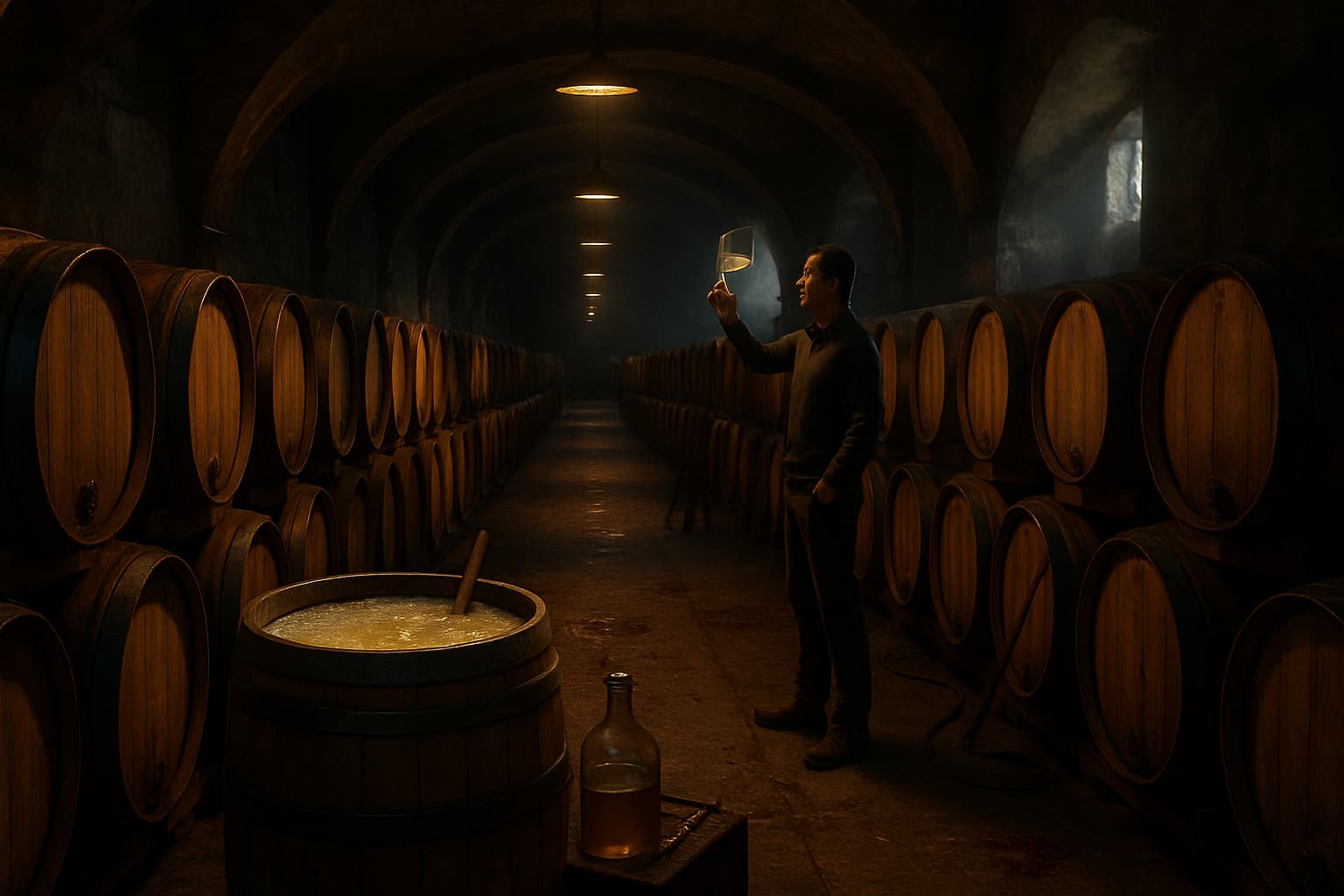
You’re standing in a cold cellar that smells like wet stone, old wood, and a little bit of regret. Rows of barrels stretch off into the dark, quiet as a church but a lot more honest. Somewhere inside those toasted oak caskets, grape juice is turning into something with a story, a backbone, and maybe a little attitude.
This is where barrel fermentation happens. Not in some sterile stainless-steel spaceship, but in wood that leaks, breathes, and occasionally screws everything up. It’s messy, it’s risky, and when it works, it’s the difference between “yeah, that’s fine” and “holy hell, what is this?”
Let’s walk through it like grown-ups: no marketing fluff, no wine-snob Latin. Just what’s actually going on when a winemaker decides to throw their precious juice into a barrel and let the chaos begin.
Strip away the romance and barrel fermentation is simple: instead of fermenting grape juice in stainless steel tanks, concrete, or plastic, the winemaker ferments it directly in oak barrels. The yeast goes to work converting sugar to alcohol inside the barrel itself, not after the fact.
Two big things are happening at once:
Barrel fermentation is not the same as just aging wine in barrels. Aging in barrel is like finishing school: polish, refinement, smoothing the rough edges. Barrel fermentation is more like being born in a bar fight. The flavors, textures, and structure of the wine are shaped from day one by the wood, the oxygen, and the yeast.
Why you should care: if you like wines that feel layered, textured, creamy, smoky, nutty, or just more interesting than the usual clean, safe, stainless-steel stuff, barrel fermentation is part of that story.
Barrel fermentation isn’t some nostalgic “old world” affectation. It does real, tangible things to the wine.
Barrel-fermented wines often feel richer and rounder. Not sweet, not heavy—just more there.
Think of a lean, sharp, tank-fermented white as sashimi. Barrel-fermented? That’s buttery roast chicken with crispy skin.
Oak brings its own pantry of flavors:
When the winemaker doesn’t screw it up, these flavors wrap around the fruit instead of crushing it. Done badly, it tastes like someone dumped a vanilla milkshake into your glass and set it on fire.
Barrels aren’t airtight. They let in tiny amounts of oxygen through the wood and the seams. This matters:
Stainless steel is like keeping wine in a vacuum-sealed bag. Barrel fermentation is more like letting it breathe just enough to become interesting—without turning it into vinegar.
You can age wine in barrel without fermenting it there. That’s the safer, more controlled option. So what’s different when you ferment in barrel?
This can build:
Both methods have their place. But barrel fermentation is more like cooking something in the pan sauce rather than just pouring sauce over it at the end.
If you’ve ever had one of those big, rich, layered Chardonnays that taste like toasted hazelnuts, baked apples, and buttered toast—there’s a good chance it was barrel-fermented.
Chardonnay is the grape that takes barrel fermentation like a champ. It’s relatively neutral on its own, which means:
Classic regions:
If you pick up a white wine that smells like toasted nuts, vanilla, smoke, or pastry, and feels creamy and broad on the palate, there’s a good chance barrel fermentation was involved.
Most red wines are fermented in tanks, then aged in barrel. Fermenting reds in barrel is a logistical nightmare:
Still, some winemakers do it, usually with:
More often, you’ll see partial barrel fermentation:
The goal is the same: better integration of oak, more texture, more nuance—without turning the winery into an ergonomic horror show.
Let’s get into the mechanics. It’s not magic; it’s controlled chaos.
Not all barrels are created equal. Decisions here change the wine:
For whites:
For reds (if used at all):
Yeast goes to work, sugar drops, alcohol rises, temperature climbs.
Challenges:
Winemakers might:
After fermentation, the wine sits on lees—dead yeast, grape solids, all the stuff that settles to the bottom.
Stirring the lees (bâtonnage) adds:
It’s a textural play as much as a flavor one.
As the wine ages in barrel:
Barrel-fermented wines might stay in wood for months to over a year, depending on style and ambition.
This is not a low-risk move. Things that can go wrong:
When a winemaker chooses barrel fermentation, they’re signing up for more work, more risk, and more stress. If they’re doing it just because “that’s what premium wine does,” you can taste the laziness.
Labels don’t always say “barrel fermented,” but when they do, it’s a flex. Clues:
If you’re tasting blind and the white in your glass smells like toasted nuts, brioche, and baked apples, and feels like silk rather than glass—you’re probably in barrel-fermented territory.
You don’t always want wood in your life. Sometimes you want a cold, sharp, stainless-steel slap in the face.
You probably want barrel-fermented wine when:
You probably don’t want it when:
This isn’t about “better” or “worse.” It’s about tools. Barrel fermentation is a hammer. Sometimes you need a scalpel.
Barrel fermentation is the winemaking equivalent of cooking over open flame instead of using a microwave. It’s less predictable, more work, and you can absolutely screw it up. But when it’s done by someone who knows what they’re doing—and isn’t afraid of a little risk—you get wines with:
You don’t have to worship it. You don’t have to pretend every oaky Chardonnay is a revelation. But if you like wines with scars, stories, and a bit of swagger, barrel fermentation is one of the reasons they exist.
Next time you’re staring at a wine list and see “barrel fermented” on a Chardonnay or a serious white, don’t just gloss over it like another marketing line. That phrase means someone chose the hard road. Order a glass. See if it tastes like the risk was worth it.
Tannins are astringent compounds found in wine that contribute to its texture and aging potential, often causing a drying or puckering sensation in the mouth. They are derived from grape skins, seeds, and stems, as well as from oak barrels used during aging.
/ˈtænɪnz/
Malic acid is a naturally occurring organic acid found in grapes that contributes to the tart, green apple-like flavor and crispness in wine. It plays a significant role in the taste and acidity of wine.
/mælɪk ˈæsɪd/
Oak origin
Barrel size
Toast level
There’s a moment, when you pour a glass of wine, that feels almost indecently intimate. The bottle tips, the liquid arcs, and then—before you even bring the glass to your lips—you give it that little...
Filtration in winemaking is the process of removing solid particles from wine to clarify and stabilize it before bottling, using various types of filters to achieve different levels of clarity and remove unwanted elements like yeast, bacteria, and sediment.
/fɪlˈtreɪʃən/
Oxidation in wine is a chemical reaction between the wine and oxygen that can change its flavor, aroma, and color. This process can be beneficial or detrimental depending on the extent and context of the exposure.
/ˌɒksɪˈdeɪʃən/
Microclimate refers to the unique climate conditions of a small, specific area within a larger region, significantly influencing grapevine growth and the characteristics of the resulting wine.
/ˈmīkrōˌklīmit/
Get weekly wine recommendations, vineyard news, and exclusive content delivered to your inbox.
-e4b2322f.webp&w=3840&q=75)
-012baf26.webp&w=3840&q=75)