-e4b2322f.webp&w=3840&q=75)
Wine Terminology
“Where every bottle tells a story”
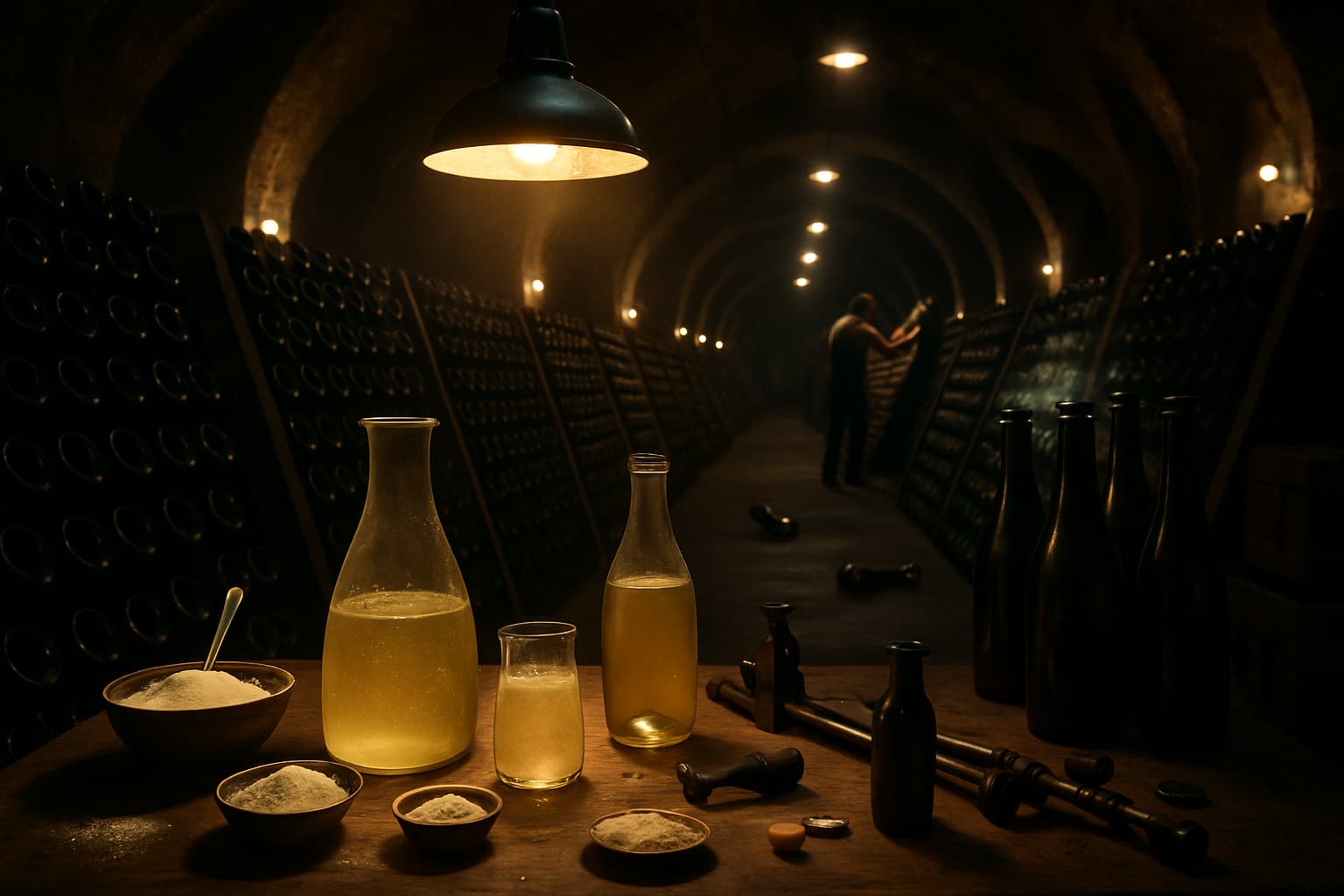
If you drink sparkling wine and don’t know this term, you’re basically enjoying the fireworks without ever asking who lit the fuse.
Let’s fix that.
This is the story of the quiet little potion that turns a perfectly respectable still wine into something volatile, dangerous, and celebratory enough to spray all over locker rooms and wedding dance floors. It’s the behind-the-scenes grunt worker of Champagne and traditional-method bubbles. It doesn’t get its name on the label. It doesn’t get thanked in speeches. But without it, your “fine bottle of Champagne” is just… wine with trust issues.
We’re talking about liqueur de tirage. And it’s a lot more interesting than it sounds.
Strip away the fancy French and you’re left with something beautifully simple, almost crude: a sugar-and-yeast cocktail added to a base wine to kick off a second fermentation in the bottle.
That’s it. No unicorn dust. No secret monk incantations.
Technically, it’s a mixture of:
You add this stuff to a still wine, bottle it, seal it, and then you wait while the yeast goes to town on the sugar, burps out carbon dioxide, and dies a noble death. The CO₂ has nowhere to go, so it dissolves into the wine and—boom—bubbles.
No liqueur de tirage, no second fermentation.
No second fermentation, no traditional-method sparkling wine.
No sparkling wine, and your New Year’s Eve suddenly looks like a sad work meeting.
Liqueur de tirage isn’t just some technical winemaking term you memorize to sound smart. It’s the key turning point where a wine decides what it wants to be when it grows up.
Before tirage, you’ve got:
After tirage, you’ve got:
In other words, liqueur de tirage is the line in the sand. It’s the moment the wine stops being just fermented grape juice and starts the long, slow transformation into something you open when you have something to say—or something to forget.
Let’s walk through the process like you’re trailing a winemaker in muddy boots, not reading a sanitized brochure.
To get to tirage, you start with a base wine:
Nobody’s sitting around sipping this stuff for fun. It’s raw material. The dough before the bake.
The winemaker mixes up the tirage:
This isn’t some mystical chef’s-secret kind of recipe. It’s more like engineering: precise, controlled, and boringly essential.
The liqueur de tirage gets added to the base wine in tank, mixed in thoroughly, and then:
From this point on, each bottle is a tiny fermentation tank, quietly doing its thing in the dark.
Inside each bottle, the yeast wakes up, sees the sugar, and gets to work:
This is the moment where liqueur de tirage earns its paycheck. It doesn’t just make bubbles; it sets up the entire next chapter: aging on lees.
After tirage and second fermentation, the wine sits on its lees for months, years, sometimes decades. This is where the magic happens.
Those dead yeast cells break down slowly, releasing compounds that:
All those fancy tasting notes—“brioche,” “croissant,” “biscuit,” “toasted hazelnut”—that people love to throw around? You can trace a lot of that back to the decision to:
No tirage = no second fermentation.
No second fermentation = no lees aging.
No lees aging = no depth, no complexity—just fizzy wine that tastes like fruit soda with an attitude problem.
Here’s where people screw this up: there’s another French term floating around—liqueur d’expédition (or dosage)—and it’s not the same thing.
Liqueur de tirage
Liqueur d’expédition (dosage)
One gets the party started. The other cleans up the room and sets the mood lighting.
Mix them up in front of a Champagne grower and they’ll correct you gently. Mix them up in front of a grumpy old-school cellar master and you’ll get that look—the one that says, “Drink, don’t talk.”
Any sparkling wine made by the traditional method uses some version of liqueur de tirage. That includes:
If it says:
…then somewhere in that winery, someone mixed up liqueur de tirage and turned still wine into a pressure bomb.
What doesn’t typically use it?
Here’s the thing no glossy winery brochure wants to lean into: this step is risky.
When you add liqueur de tirage and bottle the wine, you’re:
If:
…you can end up with:
Traditional sparkling wine cellars used to be war zones: flying glass, sticky floors, unpredictable explosions. All because of that simple mix of sugar and yeast.
Liqueur de tirage isn’t romantic. It’s controlled danger.
Indirectly, it changes almost everything.
The liqueur de tirage itself doesn’t usually add flavor in the way a spice or herb would. You’re not supposed to taste “sugar” or “yeast” from it directly. But because it:
…it affects:
The quality of the tirage—cleanliness, yeast choice, sugar level, timing—can be the difference between a wine that whispers and a wine that sings.
You don’t need to corner a sommelier and demand to know the yeast strain used in tirage. Don’t be that guy.
But knowing what liqueur de tirage is gives you:
If you see:
…you can mentally rewind the tape and picture that moment of tirage: the sugar, the yeast, the bottling line, the quiet rows of sleeping bottles turning into live ammunition.
Every time someone pops a bottle at midnight, smashes a saber against a neck, or floods a podium with foam, they’re celebrating the result of a decision made long before:
someone chose to add liqueur de tirage.
They chose:
Liqueur de tirage is the uncredited line cook in the back, sweating over the stove while the front-of-house smiles and takes the compliments. It’s the stagehand pulling the ropes so the curtain rises on cue.
You don’t see it. You don’t taste it directly. But every fine bead of mousse, every creamy, toasty, layered glass of real-deal traditional-method sparkling wine owes its existence to that humble, nerdy little mixture of sugar and yeast.
So next time you hear that satisfying pop and watch the foam creep up the neck of the bottle, remember:
the party started the day someone quietly dosed that wine with liqueur de tirage and locked it in the dark, trusting time, microbes, and pressure to do something beautiful—and just dangerous enough.
Tannins are astringent compounds found in wine that contribute to its texture and aging potential, often causing a drying or puckering sensation in the mouth. They are derived from grape skins, seeds, and stems, as well as from oak barrels used during aging.
/ˈtænɪnz/
Malic acid is a naturally occurring organic acid found in grapes that contributes to the tart, green apple-like flavor and crispness in wine. It plays a significant role in the taste and acidity of wine.
/mælɪk ˈæsɪd/
Filtration in winemaking is the process of removing solid particles from wine to clarify and stabilize it before bottling, using various types of filters to achieve different levels of clarity and remove unwanted elements like yeast, bacteria, and sediment.
/fɪlˈtreɪʃən/
Oxidation in wine is a chemical reaction between the wine and oxygen that can change its flavor, aroma, and color. This process can be beneficial or detrimental depending on the extent and context of the exposure.
/ˌɒksɪˈdeɪʃən/
Microclimate refers to the unique climate conditions of a small, specific area within a larger region, significantly influencing grapevine growth and the characteristics of the resulting wine.
/ˈmīkrōˌklīmit/
Get weekly wine recommendations, vineyard news, and exclusive content delivered to your inbox.
-012baf26.webp&w=3840&q=75)
-595adc09.webp&w=3840&q=75)