Wine Terminology
“Where every bottle tells a story”
-595adc09.webp&w=3840&q=75)
There are moments in the life of a wine when time seems to slow, when nothing appears to be happening, and yet, within the quiet darkness of a cellar, a profound transformation is underway. One such moment is the mysterious, almost meditative phase known as lees aging—sur lie—where wine rests upon its spent yeast cells and other fine sediments and, in doing so, acquires depth, texture, and character that it could never gain alone.
To understand this process is to glimpse one of the more subtle wonders of the vinous world: a partnership between life and decay, between stillness and change, that shapes some of the most beguiling wines on Earth.
After grapes are harvested, crushed, and fermented, a living drama unfolds. Yeasts—microscopic organisms—feast upon grape sugars, releasing alcohol and carbon dioxide and, in the process, give birth to wine. When their work is done, they die and slowly drift downwards, forming a soft layer at the bottom of the barrel, tank, or bottle.
This layer is known as the lees.
There are two main types:
It is upon these fine lees that winemakers may choose to leave their wines, allowing them to rest, sometimes for months, sometimes for years. To the eye, the wine appears motionless. But under the surface, chemistry, time, and biology conspire to weave new layers of aroma, texture, and complexity.
Sur lie, French for “on the lees,” describes the practice of aging wine in contact with its fine lees after fermentation is complete. At first glance, it might seem a curious decision: why leave a delicate liquid on dead cells? Yet, as in so many natural systems, what seems like an ending is in fact a beginning.
When yeast cells die, they do not simply vanish. They undergo a slow process called autolysis—literally, self-digestion—where their cell walls break down and release a host of compounds into the wine:
Over time, these released components interact with the wine’s acids, alcohol, and aromatic compounds, gradually reshaping its personality. What might have been a simple, bright, perhaps even sharp young wine can evolve into something richer, rounder, and more layered.
Here, decay becomes creation. It is a reminder that in the natural world, endings and beginnings are rarely separate events.
In many cellars, the process of lees aging is not entirely left to chance. Winemakers may periodically stir the lees, a practice known in French as bâtonnage.
Using a long rod or paddle, they gently agitate the wine, lifting the fine lees back into suspension. This simple act has several effects:
Yet bâtonnage is not a blunt tool. It is used with restraint and intuition. Too much stirring, and the wine may become heavy or lose its precision. Too little, and the benefits of lees contact may not fully emerge. Like a conductor guiding an orchestra, the winemaker must sense when to intervene and when to let the music play on its own.
To taste a wine that has rested sur lie is to encounter a subtle metamorphosis. The effects are not always loud or obvious; often they are felt more than seen, like the resonance of a distant drumbeat.
1. Texture and Mouthfeel
Perhaps the most immediate influence of lees aging is tactile:
In cool regions, where grapes can produce wines of piercing acidity, sur lie aging can act like a gentle, natural buffer—polishing the edges without erasing the structure.
2. Aromas and Flavors
Lees aging can introduce or enhance a range of subtle aromas:
Importantly, lees aging does not obliterate the original fruit; rather, it frames it, adding background harmonies to the main melodic line of grape variety and terroir.
3. Freshness and Longevity
Counterintuitively, time on lees can help a wine remain fresh for longer:
For this reason, lees aging is a cornerstone of many wines intended for aging, from serious white Burgundies to the finest sparkling wines.
Across the wine world, certain regions and styles have embraced lees aging as a defining trait, each using it to express their unique landscapes.
Muscadet (Loire Valley, France)
Near the cool, windswept Atlantic coast, the Melon de Bourgogne grape can yield light, bracingly acidic wines. Here, lees aging transforms simplicity into subtlety:
In this maritime setting, lees aging feels almost inevitable, echoing the interplay of sea air, stone, and time.
White Burgundy and Other Fine Chardonnays
In Burgundy, and in many of the world’s great Chardonnay-producing regions, lees aging is employed to craft wines of remarkable nuance:
Here, sur lie is not a trick, but a tool for revealing the depth that Chardonnay can hold when grown in noble soils.
Sparkling Wines: Champagne and Beyond
Perhaps nowhere is lees aging more celebrated than in traditional-method sparkling wines:
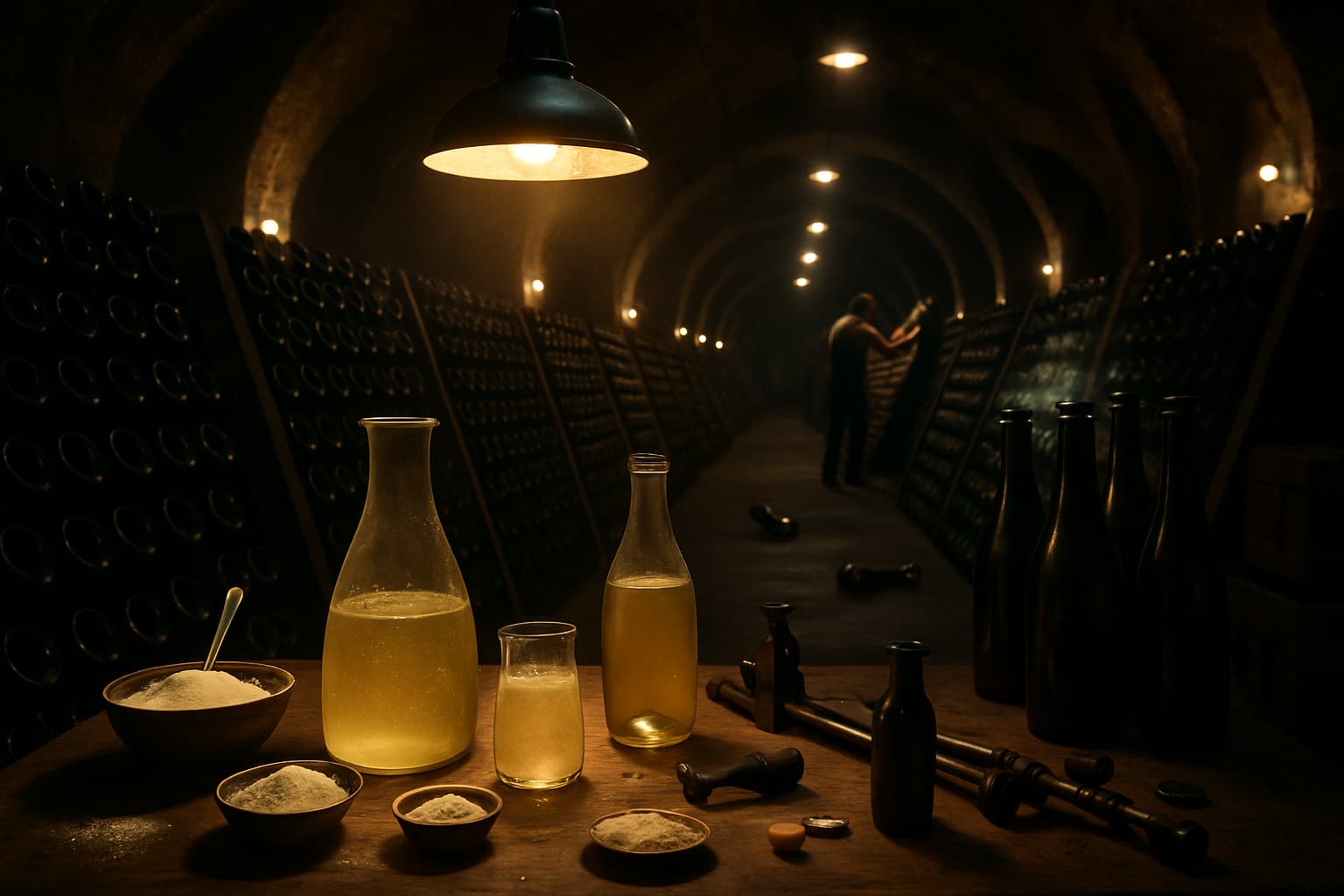
In the chalky cellars of Champagne, bottles lie in seemingly endless rows, sleeping upon their lees. When at last they are awakened and disgorged, they carry with them the memory of that long, silent communion.
Like all powerful techniques, lees aging carries risks. If mishandled, it can lead to:
Thus, sur lie is not a universal remedy, nor is longer always better. It demands:
It is, in essence, a dialogue between winemaker and wine, guided by patience and sensitivity rather than rigid formula.
At first glance, one might imagine that leaving wine on lees is a kind of human imposition upon nature. Yet, when we look more closely, we see that lees aging is deeply rooted in the natural cycle of fermentation, decay, and transformation.
Yeast, after all, are part of the vineyard’s ecosystem. Some may come from the very skins of the grapes, others from the cellar’s ambient flora. In life, they carry out fermentation; in death, they shape the wine they helped create. Lees aging, then, is not an artificial add-on, but a way of allowing the full arc of fermentation to complete itself.
In this sense, sur lie is a quiet celebration of terroir—not only of soil and climate, but of the living organisms that inhabit the vineyard and cellar. It reminds us that wine is not merely a beverage, but a living record of relationships: between grape and ground, between microbe and must, between human intention and natural process.
For the curious drinker, recognizing the signature of lees aging can be a rewarding pursuit. When you encounter a wine described as “sur lie” or known for lees contact, look for:
Pair these wines thoughtfully: creamy, lees-aged whites with seafood, poultry, or dishes featuring butter and cream; lees-aged sparkling wines with everything from oysters to aged cheeses. In such combinations, the textural richness and savory undertones of sur lie aging find their natural companions.
In the end, lees aging is a story of patience and trust. The winemaker must trust in time, in the unseen work of microscopic life, and in the subtle chemistry of decay. The wine must endure its long rest, seemingly inactive yet constantly evolving. And we, as drinkers, are invited to taste the outcome of this quiet alchemy.
Within each glass of a well-crafted lees-aged wine lies a testament to nature’s capacity for transformation: the journey from grape to must, from must to wine, from youthful brightness to layered maturity—all guided by organisms so small we cannot see them, yet whose influence is profound.
To raise such a glass is to acknowledge that, beneath the apparent stillness of a barrel in a dark cellar, an entire universe of change is at work. And in that universe, on a bed of fine lees, flavor, texture, and time weave themselves into something greater than the sum of their parts—a liquid record of life, death, and the beauty that can arise between the two.
Tannins are astringent compounds found in wine that contribute to its texture and aging potential, often causing a drying or puckering sensation in the mouth. They are derived from grape skins, seeds, and stems, as well as from oak barrels used during aging.
/ˈtænɪnz/
Malic acid is a naturally occurring organic acid found in grapes that contributes to the tart, green apple-like flavor and crispness in wine. It plays a significant role in the taste and acidity of wine.
/mælɪk ˈæsɪd/
There’s a moment, when you pour a glass of wine, that feels almost indecently intimate. The bottle tips, the liquid arcs, and then—before you even bring the glass to your lips—you give it that little...
Filtration in winemaking is the process of removing solid particles from wine to clarify and stabilize it before bottling, using various types of filters to achieve different levels of clarity and remove unwanted elements like yeast, bacteria, and sediment.
/fɪlˈtreɪʃən/
Oxidation in wine is a chemical reaction between the wine and oxygen that can change its flavor, aroma, and color. This process can be beneficial or detrimental depending on the extent and context of the exposure.
/ˌɒksɪˈdeɪʃən/
Microclimate refers to the unique climate conditions of a small, specific area within a larger region, significantly influencing grapevine growth and the characteristics of the resulting wine.
/ˈmīkrōˌklīmit/
Get weekly wine recommendations, vineyard news, and exclusive content delivered to your inbox.
-e4b2322f.webp&w=3840&q=75)
-012baf26.webp&w=3840&q=75)