Wine Terminology
“Where every bottle tells a story”
-44b45743.webp&w=3840&q=75)
The first thing you notice is the light. It breaks in the glass in quick flashes. The wine is pale gold or copper or almost silver. But what holds your eye is not the color. It is the movement. Tiny points of light rise and fall. They gather and break apart. They live and die in a second. This is the bead.
People will talk about vintages and terroir and dosage. They will argue about oak and malolactic fermentation and disgorgement. But when the bottle is open and the wine is in the glass, they look at the bead. They do not always know they are doing it. But they do.
The bead is the soul of sparkling wine made visible.
“Bead” is the word used for the stream of bubbles in a glass of sparkling wine. It is the line of rising pearls that starts from the bottom and climbs to the top. It is the way the bubbles move, how they form, how long they last. It is not just the foam on top. It is not only the first rush when the wine is poured. It is the steady life of the wine in the glass.
People use other words. They say “mousse” for the froth that forms on the surface, like a thin white crown. They speak of “perlage,” a French and Italian term that means the same thing as bead: the necklace of small bubbles that rise in chains.
Bead is simpler. It sounds like what it is: small, round, bright, and in a string.
When a sommelier says a wine has a fine bead, it means the bubbles are very small, even, and persistent. When they say the bead is coarse or rough, it means the bubbles are large, irregular, and often short-lived.
The bead is not a trick. It is a sign. It tells you about the pressure inside the bottle, the method of making the wine, the age, the glass, and the care taken in the cellar.
Bubbles are nothing more than carbon dioxide trying to escape. The gas is dissolved in the wine under pressure. When you open the bottle, the pressure drops. The gas wants out. It needs a place to start: a rough spot, a speck of dust, a scratch, a tiny imperfection. The gas gathers there and forms a bubble. The bubble grows until it is big enough to break free and rise.
This is how the bead is born.
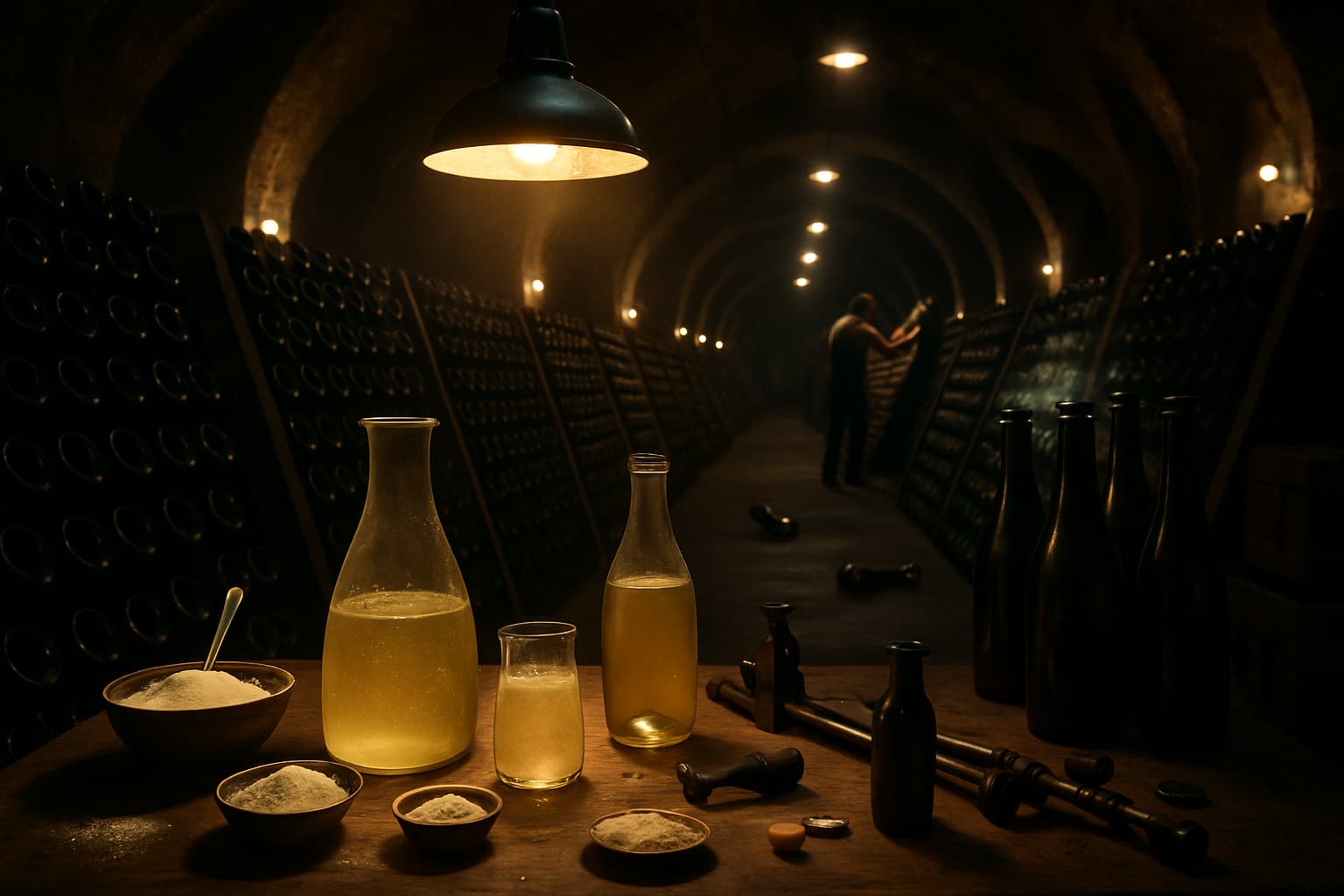
In wine made by the traditional method—like Champagne, Cava, and many good sparkling wines—the gas comes from a second fermentation in the bottle. Yeast eats sugar and makes alcohol and carbon dioxide. There is no place for the gas to go, so it dissolves into the wine. It waits there, bound and invisible, until the cork is pulled.
In wines made by the tank method, like many Proseccos, the second fermentation happens in a pressurized tank. The gas still dissolves into the wine, but the way it is held and the pressure level are different. The bead will often be a little coarser, more open, more easy-going.
In wines where gas is simply injected, as in cheap sparkling wines or soda-like drinks, the bubbles can be large and aggressive. They rush up and vanish. The bead is loud but not deep.
The bead, then, is not only about looks. It is about how the gas was born and how it lives in the wine.
You judge a horse by the way it moves. You judge a sparkling wine by the way its bead moves.
A fine bead means the bubbles are very small, almost like dust or pinpricks of light. They rise in thin, straight lines from the bottom of the glass. They do not break apart or wander. They go up in a steady, quiet stream.
A persistent bead means the bubbles keep coming—not just at the start, when the wine is first poured, but long after. The glass sits on the table. People talk. The food comes and goes. Still the bubbles climb. The wine does not go flat. It keeps its life.
A delicate bead is fine and persistent but not violent. The bubbles are gentle. They do not roar out of the glass. They do not assault the nose. They lift the aromas slowly and carry them up.
A coarse bead is the opposite. The bubbles are big. They come up in bursts, like heavy rain instead of mist. They vanish quickly. The wine feels rough in the mouth. It prickles and stings instead of caressing.
A lazy bead is one that dies young. The bubbles start strong and then fade. After a few minutes the glass is almost still. The wine has lost its song.
When tasters write about sparkling wine, they often use the bead as a measure of quality. A great Champagne may have a bead so fine it looks like smoke in the glass. A simple sparkling wine may show big, scattered bubbles that tell you it was made quickly and cheaply.
Still, there are styles and purposes. Not all wines need the same bead. A lively, fruity Prosecco with an open, cheerful bead can be perfect on a hot day. A deep, old vintage Champagne with a whisper-fine bead is made for quiet talk and slow drinking. The bead should match the wine’s character.
The bead is not only for the eyes. It is for the tongue.
When you drink, the bubbles break in the mouth. They carry aromas up into the nose. They bring a sense of lift and cut through fat and salt and richness in food. They cleanse the palate. This is why sparkling wine works so well with oysters, fried foods, and creamy dishes. The bead does the work.
A fine bead feels creamy. The bubbles are so small and close together that they give a sensation of silk or velvet. They roll across the tongue. They do not stab it.
A coarse bead feels sharp and sometimes harsh. The bubbles explode with more force. They can bring a sense of bitterness or bite. This can be good with certain foods, but it is less elegant.
The pressure in the bottle matters. Classic Champagne has about 5 to 6 atmospheres of pressure. This gives a strong, firm bead. Some sparkling wines, like frizzante styles, have lower pressure, around 2.5 to 3.5 atmospheres. Their bead is softer, more relaxed. It whispers instead of shouts.
Age changes the bead. A young wine may have a vigorous, almost wild bead. As it ages on the lees—the dead yeast cells left from fermentation—the bubbles grow finer and the texture grows creamier. The bead becomes more noble, more composed. In very old bottles, the pressure can fall. The bead grows more gentle, sometimes fragile, like the breath of an old person who has seen much and speaks softly.
The same wine can show a different bead in different glasses. The glass is not innocent.
A flute, tall and narrow, concentrates the bead. The bubbles rise in tight lines. The column looks high and strong. A coupe, wide and shallow, lets the bubbles spread out and die quickly. The bead seems weaker, though the wine is the same. A tulip-shaped glass, with a narrow opening and a broader bowl, can be a good middle ground. It shows the bead while also holding the aromas.
Some glasses are etched at the bottom. They have tiny laser-made points that act as perfect bubble-nucleation sites. These spots help create a steady, showy bead. They make the wine look lively. This is not a lie, but it is a kind of stage light. A plain, smooth glass may show fewer visible bubbles even if the wine itself holds the same gas.
Cleanliness matters. Grease, detergent residue, or lipstick can kill the bead. The gas clings to the film on the glass and does not rise in clear lines. Or it rises in big, sluggish blobs. A glass washed only in hot water and left to air-dry will often show a better bead than one scrubbed with strong soap and wiped with a cloth that leaves lint.
If you think a wine has no bead, sometimes it is not the wine. It is the glass.
The bead speaks of the winemaker’s skill and decisions.
In the traditional method, the winemaker chooses how long to age the wine on the lees. Longer aging often leads to a finer bead and more complex flavors of bread, brioche, and nuts. Too short, and the bead may be coarse and the wine simple. Too long, and the pressure can drop, the bead softens, and the wine becomes more for contemplation than for bright celebration.
The level of dosage—the sugar solution added after disgorgement—also affects the perception of bead. A very dry wine (brut nature) with high acidity and strong pressure can feel very sharp if the bead is coarse. The same bead in a wine with a touch more sweetness can feel more balanced.
The grape varieties matter too. Chardonnay often gives a lighter, more delicate bead. Pinot Noir and Meunier can give more weight and breadth. In some regions, local grapes give their own texture to the bead—Glera in Prosecco, Xarel·lo and Macabeo in Cava, and others.
Even the choice of tank versus bottle for the second fermentation is a choice about bead. Tank method gives a broader, simpler bubble, suited to fresh, fruity wines meant to be drunk young. Bottle method gives a tighter, more complex bead, suited to wines that can age and deepen.
In all this, the bead is both result and message. It is the visible trace of invisible work.
You do not need to be a critic to read the bead. You only need to pay attention.
Pour the wine gently into a clean glass. Watch the first rush of bubbles, but do not judge on that alone. Let it settle. Then look at the bottom. Are there clear points where streams of bubbles begin? Do they rise in fine lines or in scattered clumps? Do they keep coming after a minute, after three, after five?
Lift the glass. Look at the surface. Is there a thin ring of foam at the edge? Does it last? A stable ring can be a sign of good structure and fine bead.
Smell the wine. Then take a small sip and hold it. Feel the bubbles. Are they soft or harsh? Do they fill the mouth or vanish at once? Do they help the flavors linger, or do they distract?
You do not need to put words like “fine perlage” or “persistent mousse” to it, unless you want to. You can simply say: the bubbles were kind, or they were rough; they stayed, or they fled. The bead is there to be felt.
In the end, bead is only gas and liquid and light. It is physics and chemistry. But it is also time, and care, and the hand of the maker.
Men and women work in cold cellars, turning bottles by hand or by machine, waiting years for a wine to be ready. They measure pressure and sugar and temperature. They taste and spit and taste again. All of that labor rises in the glass in those small, bright chains.
When the cork is pulled, the wine has its short life in the open air. The bead is the sign of that life. It is the wine breathing out after years in the dark.
You raise the glass. The bubbles climb. They break at the surface and disappear. You drink, and they are gone. But for a moment you see the whole story of the wine in those lines of light—the land, the season, the cellar, the waiting, the opening, the drinking.
That is what bead is: the brief, shining proof that the wine is alive, and so are you, and that neither of you will last forever.
Tannins are astringent compounds found in wine that contribute to its texture and aging potential, often causing a drying or puckering sensation in the mouth. They are derived from grape skins, seeds, and stems, as well as from oak barrels used during aging.
/ˈtænɪnz/
Malic acid is a naturally occurring organic acid found in grapes that contributes to the tart, green apple-like flavor and crispness in wine. It plays a significant role in the taste and acidity of wine.
/mælɪk ˈæsɪd/
There’s a moment, when you pour a glass of wine, that feels almost indecently intimate. The bottle tips, the liquid arcs, and then—before you even bring the glass to your lips—you give it that little...
Filtration in winemaking is the process of removing solid particles from wine to clarify and stabilize it before bottling, using various types of filters to achieve different levels of clarity and remove unwanted elements like yeast, bacteria, and sediment.
/fɪlˈtreɪʃən/
Oxidation in wine is a chemical reaction between the wine and oxygen that can change its flavor, aroma, and color. This process can be beneficial or detrimental depending on the extent and context of the exposure.
/ˌɒksɪˈdeɪʃən/
Microclimate refers to the unique climate conditions of a small, specific area within a larger region, significantly influencing grapevine growth and the characteristics of the resulting wine.
/ˈmīkrōˌklīmit/
Get weekly wine recommendations, vineyard news, and exclusive content delivered to your inbox.
-e4b2322f.webp&w=3840&q=75)
-012baf26.webp&w=3840&q=75)