Wine Terminology
“Where every bottle tells a story”
It is a truth perhaps not yet universally acknowledged that a person in possession of a sound palate must be in want of a sparkling wine—yet not invariably of Champagne. There exists, in the quietly industrious provinces of France, a family of effervescent wines that, though less ostentatious in name, are often equal in charm, more amiable in price, and frequently more obliging in variety. These are the wines known as crémant; and if you have hitherto neglected their acquaintance, allow me to introduce you properly.
Far from being a mere understudy to Champagne, crémant possesses a character, a history, and a society of its own. To understand it is to enlarge one’s circle of sparkling friends and to discover that elegance and good breeding are not confined to a single celebrated district of France, however much that district may have been praised in ballrooms and dining rooms alike.
Before we may form a proper opinion of crémant, we must first define it with accuracy, lest we be misled by vague report or careless conversation.
Crémant is a French (and, in some cases, Luxembourgish or Belgian) sparkling wine made outside the Champagne region, yet produced according to the same traditional method as Champagne: a second fermentation in the bottle, followed by aging on its lees. It is not a lesser Champagne, nor an imitation, but a regulated category with its own rules, regions, and styles.
It is, however, distinguished from ordinary sparkling wine by several important conditions:
Thus, if Champagne is the duchess of sparkling wines—enthroned, admired, and occasionally overbearing—crémant may be considered its well-bred cousins: perhaps less titled, but often more approachable, and sometimes more delightful in private conversation.
The word crémant once referred not to geography, but to texture. Historically, it described a style of sparkling wine with softer, creamier bubbles—less pressure in the bottle, resulting in a gentler effervescence. Over time, however, the term was drawn into the complicated politics of French wine law.
Champagne producers, desirous of protecting their illustrious name, gradually restricted the use of Champagne-related terminology. The word crémant, once used in Champagne itself, was ceded to other regions under a new understanding: it would no longer denote a style of Champagne, but rather a category of quality sparkling wines made beyond Champagne’s borders, using the same traditional method.
By the late 20th century, the European Union and French authorities had bestowed upon crémant the dignity of an official Appellation d’Origine Contrôlée (AOC) designation. No longer a vague compliment, it became a protected title, with legal obligations and regional identities. Thus, what began as a descriptive adjective matured into a formal rank in the hierarchy of sparkling wines.
To speak of crémant in the singular is something of an imprecision. There are many crémants, each with its own manners, accent, and society. Let us make the acquaintance of the principal ones.
If any crémant may be called the most popular at present, it is Crémant d’Alsace. Produced along the eastern frontier of France, in a region of steep slopes, half-timbered villages, and a climate that encourages both ripeness and freshness, it is admired for its lightness and charm.
It is the sort of wine that may be invited to luncheons, garden parties, and informal suppers, where its vivacity and good humour are particularly valued.
From the venerable vineyards of Burgundy comes Crémant de Bourgogne, which may be considered among the more serious and contemplative of the crémant family.
If you favour wines of some gravity and depth, yet do not wish to incur the expense of Champagne on every occasion, Crémant de Bourgogne is a most suitable companion.
The Loire Valley, with its castles, gardens, and gentle river, offers Crémant de Loire, a wine as varied as its landscape.
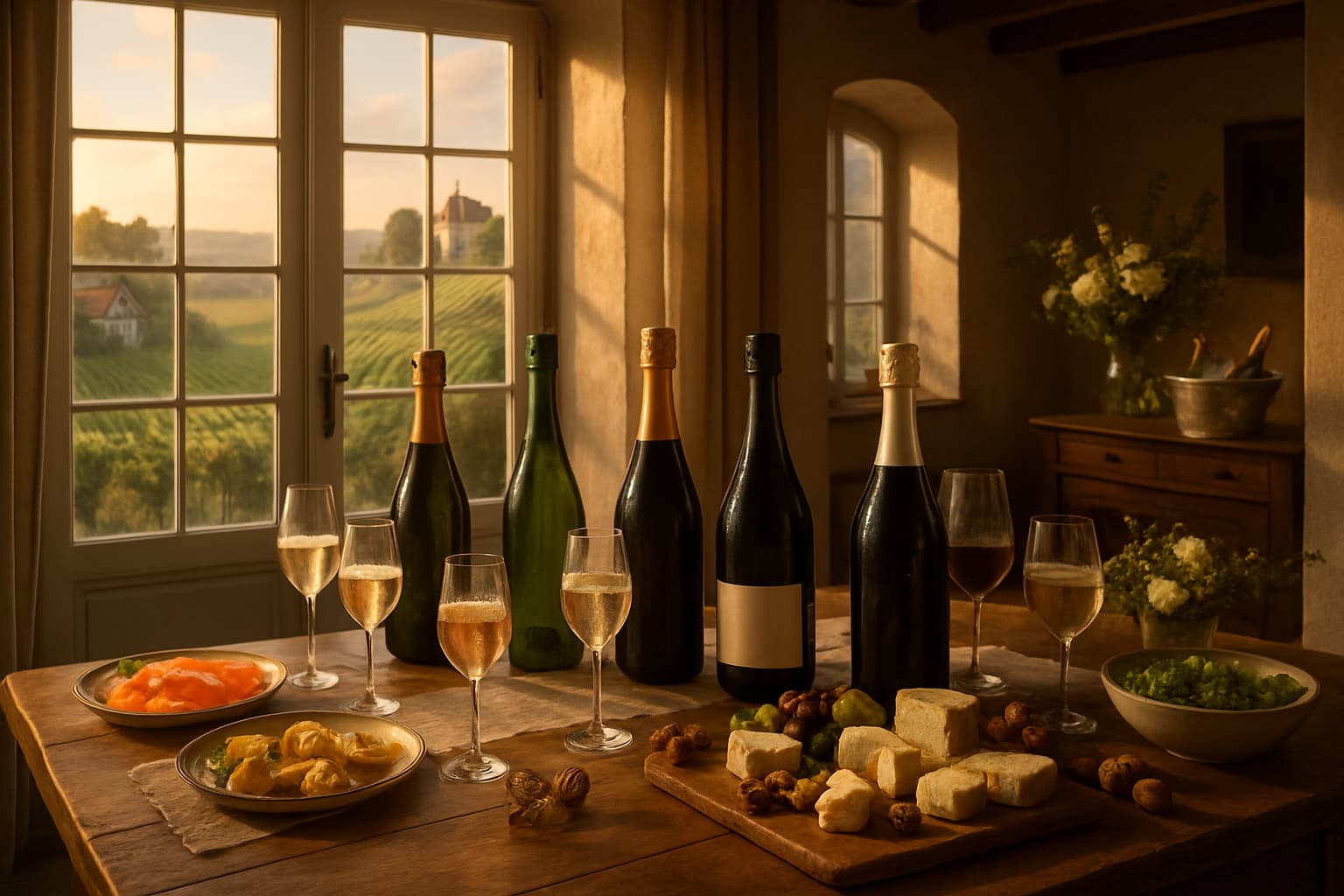
Crémant de Loire behaves admirably at table, pairing with fish, poultry, and many a cheese, and is therefore an excellent ally for the practical host or hostess.
In the south of France, near the Pyrenean foothills, we find Crémant de Limoux, born in a region that claims some of the earliest sparkling wines in history.
For those who enjoy a slightly fuller, more opulent style of sparkling wine, Crémant de Limoux may prove exceedingly agreeable.
There are further members of the family, each with its own personality:
Each of these deserves its own acquaintance, but even a brief introduction reveals how diverse the society of crémant truly is.
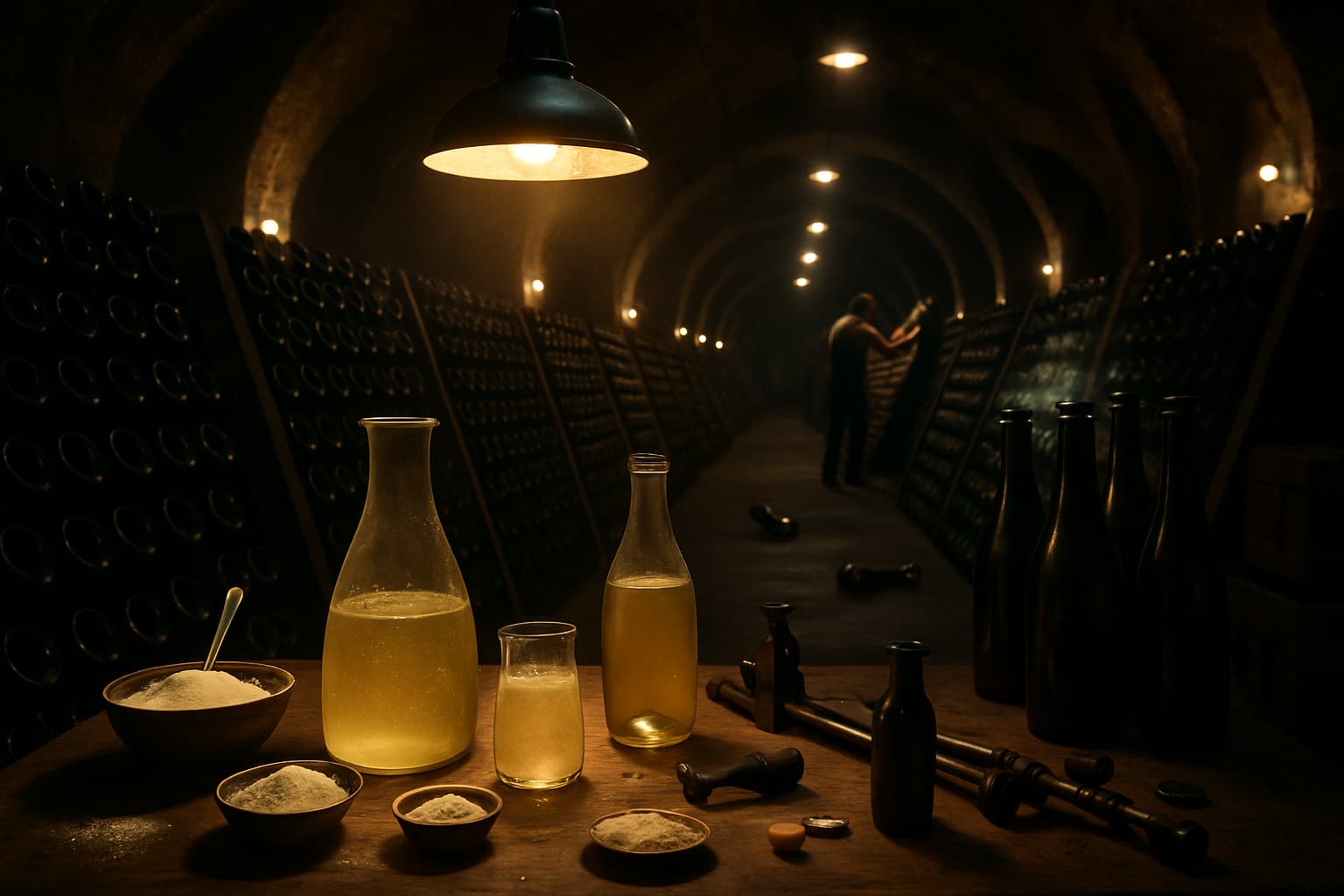
To comprehend why crémant can be so refined, we must examine, however briefly, the method of its upbringing.
This is the same method used for Champagne, and it is one of the principal reasons why crémant can display such fine bubbles and such admirable finesse.
Crémant, like Champagne, may assume various degrees of sweetness, which are indicated on the label. The terminology, alas, is not always intuitive, but one must learn it, as one learns the more obscure rules of a complicated card game.
Most crémant encountered at social gatherings will be brut, which is generally safe to serve to a mixed company of tastes.
It would be unjust to pretend that Champagne and crémant are indistinguishable; they are not. But it would be equally unjust to assume Champagne always superior and crémant invariably inferior. The truth, as in most matters of character, is more nuanced.
Similarities:
Differences:
It is, perhaps, like comparing a famous London salon with a lesser-known but very agreeable country house party: the former may be more renowned, but the latter may offer equal pleasure, and sometimes more genuine comfort.
To derive the greatest satisfaction from crémant, one must treat it with the same consideration one would extend to any well-bred guest.
In short, there are few social arrangements in which a well-chosen crémant would not behave with propriety and grace.
To ignore crémant is to deprive oneself of a most useful category of wine: one that combines elegance, variety, and economy. It offers:
In an age when appearances are often overvalued, crémant reminds us that true distinction lies not in the loudness of one’s reputation, but in the quality of one’s character. It does not shout its name from the rooftops; it introduces itself more modestly, and allows its conversation—its flavour, its texture, its balance—to win you over.
If Champagne is the wine one may feel obliged to serve on certain grand occasions, crémant is the wine one may choose to drink on many happy ones. And that, after all, is perhaps the more important distinction.
Tannins are astringent compounds found in wine that contribute to its texture and aging potential, often causing a drying or puckering sensation in the mouth. They are derived from grape skins, seeds, and stems, as well as from oak barrels used during aging.
/ˈtænɪnz/
Malic acid is a naturally occurring organic acid found in grapes that contributes to the tart, green apple-like flavor and crispness in wine. It plays a significant role in the taste and acidity of wine.
/mælɪk ˈæsɪd/
There’s a moment, when you pour a glass of wine, that feels almost indecently intimate. The bottle tips, the liquid arcs, and then—before you even bring the glass to your lips—you give it that little...
Filtration in winemaking is the process of removing solid particles from wine to clarify and stabilize it before bottling, using various types of filters to achieve different levels of clarity and remove unwanted elements like yeast, bacteria, and sediment.
/fɪlˈtreɪʃən/
Oxidation in wine is a chemical reaction between the wine and oxygen that can change its flavor, aroma, and color. This process can be beneficial or detrimental depending on the extent and context of the exposure.
/ˌɒksɪˈdeɪʃən/
Microclimate refers to the unique climate conditions of a small, specific area within a larger region, significantly influencing grapevine growth and the characteristics of the resulting wine.
/ˈmīkrōˌklīmit/
Get weekly wine recommendations, vineyard news, and exclusive content delivered to your inbox.
-e4b2322f.webp&w=3840&q=75)
-012baf26.webp&w=3840&q=75)