Wine Terminology
“Where every bottle tells a story”
It is a truth very generally acknowledged that a person in possession of a little fortune, and a considerable fondness for wine, must be in want of an opinion on en primeur. Whether that opinion be founded upon knowledge or merely upon the vanity of appearing informed is another matter entirely. Yet, as the fashion of purchasing wine before it is properly born into the world has spread from the châteaux of Bordeaux to the drawing rooms and dining tables of many nations, it becomes indispensable that we examine this curious practice with the seriousness it deserves.
Let us, therefore, lift the veil upon en primeur: a custom half romance, half speculation, and wholly revealing of human character—its hopes, its fears, and its inclination to anticipate pleasure long before it is ready to be enjoyed.
En primeur is the practice of purchasing wine while it is still in barrel, long before it is bottled and released to the general market. It is, if you will, the engagement period of the wine world: the promise is made, the terms are agreed, but the marriage between cork and glass is yet to be solemnized.
In plainer terms:
The custom is most famously associated with Bordeaux, though Burgundy, the Rhône, and other regions have adopted similar practices with varying degrees of enthusiasm and decorum.
To purchase en primeur is to place one’s confidence—sometimes wisely, sometimes extravagantly—in the future character of a wine that one has not yet fully known. It is a courtship conducted on the strength of reputation, promise, and a few early impressions.
In an age when communication moved at the speed of a horse and carriage, châteaux did not always have the means or inclination to sell their wines directly to distant consumers. Instead, they relied upon a class of merchants—the négociants of Bordeaux—who undertook the risks and labours of trade.
Over time, these merchants began to purchase wine not only after it was bottled, but while it was still in barrel. The arrangement suited all parties:
With the rise of international trade, the institution of the Bordeaux “Place” (the system of châteaux, courtiers, and négociants), and the increasing fascination of the world with fine wine, this early-purchase custom evolved into the modern en primeur campaign: a yearly spectacle in which critics, merchants, and collectors descend upon Bordeaux to taste the latest vintage still in barrel, and to determine, with great solemnity and no little self-importance, what the future shall think of it.
The process of en primeur is as ceremonious and structured as any well-conducted ball, though the participants are more inclined to ink-stained ledgers than to dancing slippers.
The year’s weather—its sun and rain, its heat and hail—has done its work. Grapes are harvested, fermented, and the young wine is placed into barrels. It is still raw, spirited, and in some cases rather unruly, like a promising youth not yet broken to the saddle of society.
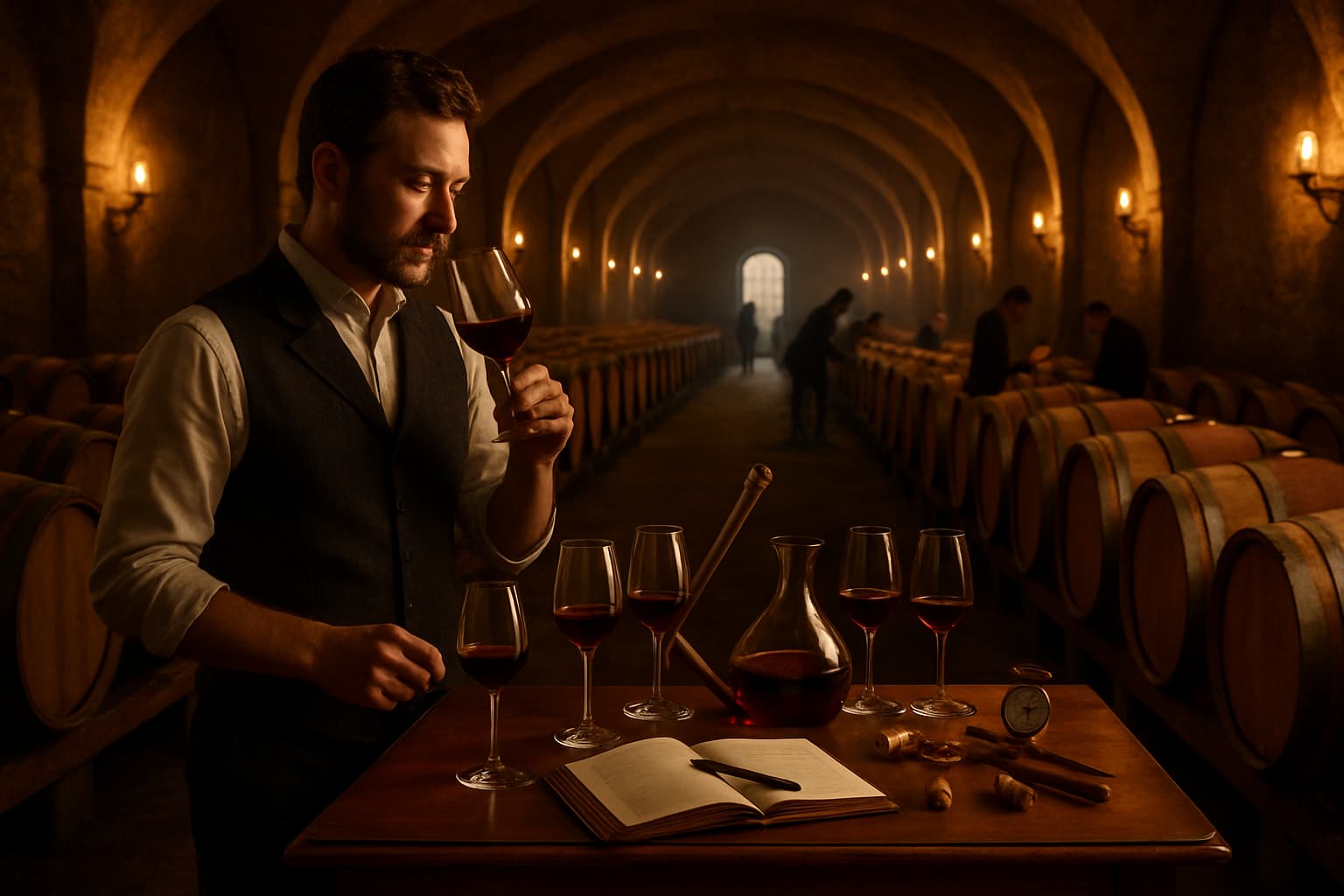
In the spring following the harvest—often March or April—Bordeaux throws open its cellar doors. Critics, merchants, and selected importers taste barrel samples. These samples are not quite the finished article, but a serious draft of it.
They swirl, sip, spit, and scribble; points are awarded, adjectives bestowed, reputations shaped. A high score from a notable critic can raise a château’s fortunes as swiftly as a favourable mention in a lady’s letter can elevate a gentleman’s prospects.
Once the murmurs of approval or disapproval have settled, châteaux release their opening prices to the négociants, who in turn offer the wines to merchants and private clients around the world. The prices reflect:
It is a delicate dance between pride and prudence. Ask too much, and one risks being left alone upon the dance floor; ask too little, and one may later regret the modesty.
Consumers—whether private individuals or wine merchants in other countries—subscribe to these wines en primeur, often paying in full (or nearly so) for bottles they will not see for two or three years. Their money is committed; their reward lies in the future.
The château continues to mature the wine in barrel, then bottles it. Only after this patient period—typically two years after the harvest—are the wines shipped to those who subscribed. At last, the long engagement ends in a quiet, dignified marriage of bottle to cellar.
One might reasonably ask why anyone would commit money to a wine not yet finished, much less tasted in its final form. The reasons, like the motives for matrimony, are many and not always wholly rational.
Traditionally, en primeur offered the prospect of acquiring great wines at lower prices than they would command once in bottle. A successful subscription could see a wine’s value rise handsomely by the time of delivery.
Thus, en primeur has often been presented—sometimes with more zeal than scruple—as both a means of pleasure and a species of investment.
Some wines are produced in such limited quantity, and desired by so many, that to delay is to be disappointed. En primeur allows:
It is, in effect, a reservation made in advance at a very exclusive table.
There is also a more sentimental motive. To follow a wine from its infancy in barrel to its maturity in bottle is to form a sort of acquaintance with it over time. One reads of the harvest, the vintage reports, the critics’ notes; one awaits the delivery; one tastes it young, and again as it matures.
For certain temperaments—those inclined to patient pleasure rather than instant gratification—this drawn-out enjoyment is its own reward.
Yet, as with any arrangement entered into upon promise rather than proof, en primeur is not without its hazards.
Barrel samples are but a glimpse of the future, not its guarantee. A wine that appears charming in youth may grow awkward; another that seems austere may blossom. The château’s skill, the élevage (maturation) in barrel, and even the final blend can alter its character.
To buy en primeur is to trust:
One commits funds years in advance. In that time:
Thus, while some speak of en primeur as a kind of investment, it is an investment of a most uncertain and liquid nature.
In earlier decades, the advantage of en primeur pricing was more apparent. In recent years, however, châteaux have demonstrated a lively awareness of their own prestige and have sometimes priced wines so ambitiously at release that little benefit remains for the early subscriber.
The prudent purchaser therefore asks:
Though Bordeaux is the grand theatre of en primeur, other regions have adopted similar practices, each with its own peculiarities.
The spirit is the same: early commitment in exchange for access, sometimes price advantage, and always a measure of risk.
For those who are tempted by this practice, a little prudence may serve as well as a great deal of enthusiasm.
En primeur is, at its heart, an institution built upon faith: faith in the land, in the producer, in the merchant, and in time itself. It appeals to those who are willing to exchange present certainty for future pleasure, and who find in the waiting a charm of its own.
In a world increasingly impatient for instant gratification, there is something almost old-fashioned—one might say Regency—in the idea of committing to a wine years before one may properly enjoy it. It requires patience, discernment, and a willingness to accept that not every promise will be perfectly fulfilled.
Yet when it succeeds—when the bottles finally arrive and the cork is drawn on a wine one first encountered only as a whispered rumour and a pale barrel sample—there can be a quiet satisfaction as deep as the wine’s colour and as long as its finish. One has not merely bought a drink; one has accompanied a vintage from its youth to its first maturity.
If, therefore, you choose to engage in en primeur, do so not merely as a speculator, but as a companion to the wine’s story. Approach it with clear eyes, a steady hand, and a palate more loyal to its own judgement than to the fashions of the day. In such a spirit, this curious practice may reward you—not only with bottles in your cellar, but with the more lasting pleasure of anticipation well placed and patience well rewarded.
Tannins are astringent compounds found in wine that contribute to its texture and aging potential, often causing a drying or puckering sensation in the mouth. They are derived from grape skins, seeds, and stems, as well as from oak barrels used during aging.
/ˈtænɪnz/
Malic acid is a naturally occurring organic acid found in grapes that contributes to the tart, green apple-like flavor and crispness in wine. It plays a significant role in the taste and acidity of wine.
/mælɪk ˈæsɪd/
Know the Producer
Favour estates with a track record of consistency. In wine, as in character, past behaviour is often the best predictor of future conduct.
Choose Reliable Merchants
Purchase only from merchants of established reputation, sound finances, and transparent terms. A low price from a dubious source is as suspect as an over-eager suitor with no references.
Consider Your Own Cellar and Tastes
Do not buy a wine merely because critics praise it if its style does not suit you. It is no triumph to own a case of something you do not enjoy.
Compare En Primeur Prices with History
Examine how previous vintages of the same wine have been priced and how they now trade. This can reveal whether you are genuinely favoured or merely flattered.
Accept That Uncertainty Is Part of the Bargain
En primeur is not a contract for perfection; it is an agreement to embrace uncertainty in return for potential advantage and the delight of anticipation.
There’s a moment, when you pour a glass of wine, that feels almost indecently intimate. The bottle tips, the liquid arcs, and then—before you even bring the glass to your lips—you give it that little...
Filtration in winemaking is the process of removing solid particles from wine to clarify and stabilize it before bottling, using various types of filters to achieve different levels of clarity and remove unwanted elements like yeast, bacteria, and sediment.
/fɪlˈtreɪʃən/
Oxidation in wine is a chemical reaction between the wine and oxygen that can change its flavor, aroma, and color. This process can be beneficial or detrimental depending on the extent and context of the exposure.
/ˌɒksɪˈdeɪʃən/
Microclimate refers to the unique climate conditions of a small, specific area within a larger region, significantly influencing grapevine growth and the characteristics of the resulting wine.
/ˈmīkrōˌklīmit/
Get weekly wine recommendations, vineyard news, and exclusive content delivered to your inbox.
-e4b2322f.webp&w=3840&q=75)
-012baf26.webp&w=3840&q=75)