Wine Terminology
“Where every bottle tells a story”
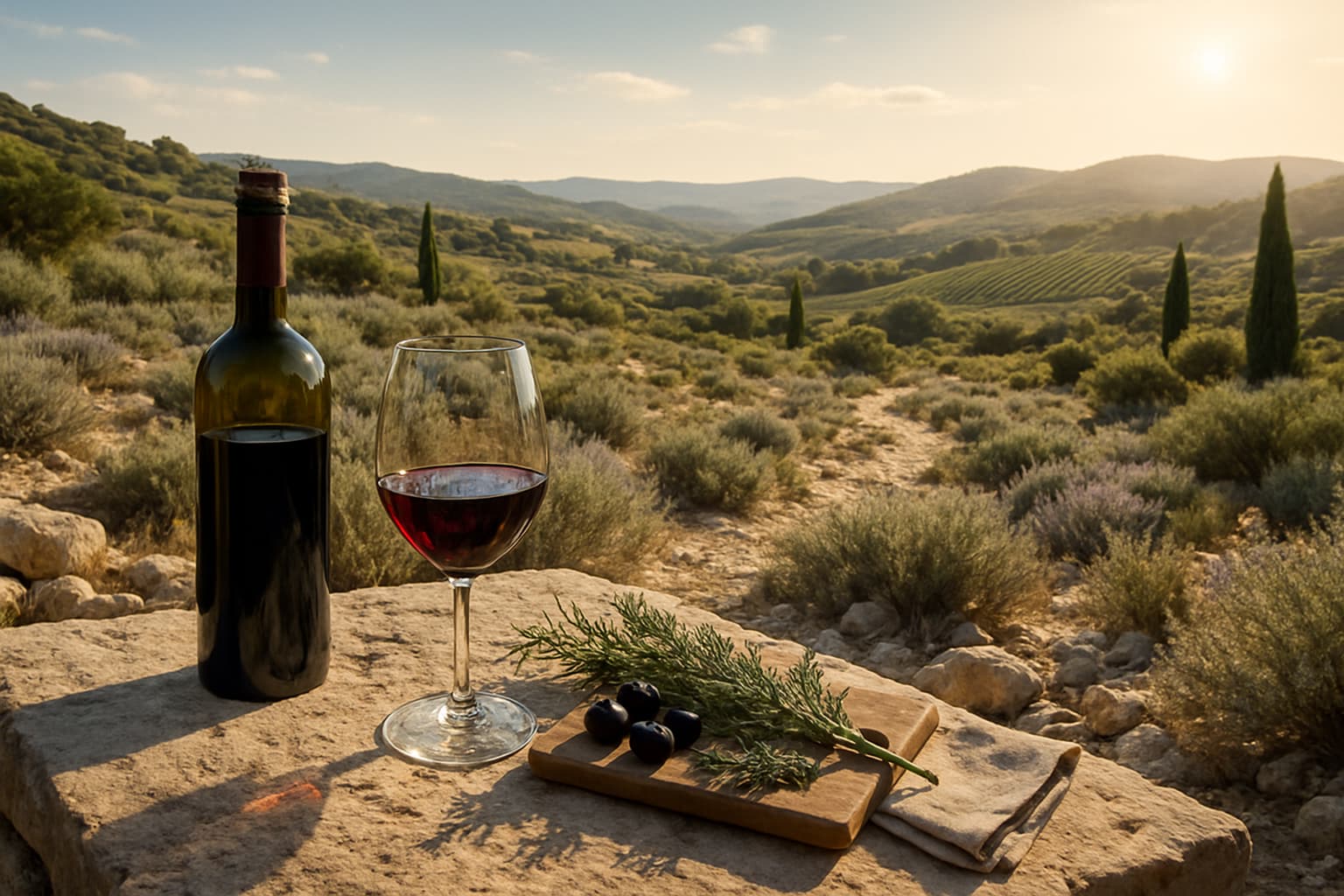
On a warm, wind-swept afternoon in the Mediterranean, you might walk through a stony hillside and notice a curious symphony of aromas: wild thyme crushed underfoot, resinous pine in the air, lavender brushing your fingertips, and the faint, haunting scent of sun-baked earth. You are not merely in a landscape; you are in a living library of scents and textures.
And if you were to pour a glass of wine grown in this place and raise it to your nose, you might be astonished to find that very landscape rising from the glass. This, in the language of wine, is garrigue.
It is more than a word, more than a flavor. It is an ecosystem, a climate, a culture—and a reminder that wine is, at its heart, a story that the land tells in liquid form.
In everyday French, garrigue refers to a type of wild, low-growing Mediterranean scrubland. It is found primarily in southern France—especially Languedoc, the southern Rhône, and Provence—on dry, limestone-rich soils, swept by wind and bathed in harsh sunlight.
In the language of wine, however, garrigue has taken on a second life. It has come to describe a distinctive aroma and flavor profile in wines, particularly red blends from the Mediterranean basin. When a sommelier says a wine has “notes of garrigue,” they are invoking the scent of that sun-drenched scrubland: dried herbs, wild thyme, rosemary, lavender, juniper, bay leaf, pine needles, and often a touch of warm, dusty earth.
Thus, garrigue is both:
To understand garrigue in the glass, we must first walk through garrigue on the ground.
The garrigue landscape is unforgiving. Summers are hot and dry, rain is sporadic, and the soils are poor, stony, and often shallow. The bedrock is typically limestone, fractured and pale, reflecting the sun’s rays. Plants that survive here must be hardy, adapted to drought, and capable of withstanding relentless winds such as the mistral in the Rhône or the tramontane in Languedoc.
Yet in this apparent austerity, life flourishes in miniature. Low shrubs and herbs cling to the ground, their leaves small and tough, often coated in aromatic oils to reduce water loss and deter grazing. These oils, when warmed by the sun or crushed underfoot, release a heady fragrance that defines the atmosphere of the place.
The garrigue plant community is not uniform, but it typically includes a familiar Mediterranean ensemble:
Together, these plants create a sensory tapestry, a kind of natural perfume that hangs in the air and seeps into memory. When wine professionals speak of garrigue, they are conjuring this composite fragrance: sun-dried herbs, resin, and earth.
It is tempting to imagine that the aromas of garrigue simply drift into the grapes, perfuming them like a sachet in a wardrobe. The reality is more complex, more subtle, and more interesting.
The concept that binds landscape to flavor is terroir: the interplay of soil, climate, topography, and human practice that influences how a wine tastes. Garrigue is a vivid example of terroir in action.
Key elements include:
The aromatic herbs themselves do not simply infuse the fruit like tea. Instead, the same environmental conditions that shape the herbs—sun, drought, wind, soil—also shape the vines. The result is that wines from such regions often develop similar aromatic signatures: dried herbs, resinous notes, and a certain wild, untamed character.
On a molecular level, many of the aromas we associate with garrigue—thyme, rosemary, lavender—are produced by compounds such as terpenes and phenolics. Grapes and wines also contain families of related compounds. While the exact pathways are intricate, it is no coincidence that a wine grown among such plants, in such conditions, might evoke their scent.
In other words, garrigue in wine is not magic, but a kind of echo: the vine and the shrub responding to the same environment, speaking in related aromatic dialects.
The term garrigue is most commonly used in the context of southern French wines, but its spirit extends across much of the Mediterranean.
In appellations such as Châteauneuf-du-Pape, Gigondas, Vacqueyras, and Côtes du Rhône Villages, garrigue is a hallmark.
Typical grapes include:
Here, garrigue often appears as:
In the wild, rugged hills of Languedoc and Roussillon, vineyards are frequently interwoven with garrigue scrub. Many wines from appellations such as Faugères, Corbières, Minervois, and Coteaux du Languedoc display this wild herbal profile.
Expect:
In Provence, red and rosé wines often carry more delicate garrigue nuances:
While the word garrigue is French, similar herbal-tinged profiles appear in other Mediterranean regions:
In these regions, tasters may use local terms, but the sensory experience—the mingling of wild herbs, sun, and stone—is remarkably familiar.
To detect garrigue, one must slow down and listen, as one might in a quiet forest, to the subtle sounds beneath the obvious.
Over time, as you taste more wines from garrigue-rich regions, you begin to recognize this signature as one recognizes a friend’s voice in a crowded room.
Wines that carry garrigue in their aroma are natural companions to foods that share its flavors. In pairing, we are, in essence, reuniting elements of the same landscape.
Ideal partners include:
In such pairings, the wine does not merely accompany the food; it completes a circle, bringing the hillside, the vineyard, and the kitchen into a single, coherent experience.
In the world of wine, language often overlaps, and it is useful to distinguish garrigue from related descriptors:
Think of garrigue as a particular accent within the broader language of herbal and savory wine descriptors.
To some, garrigue might seem a minor detail—a poetic flourish in a tasting note. Yet it represents something profound.
It reminds us that:
Wine is a landscape translated into flavor.
When you taste garrigue, you are tasting the echo of a place: its plants, its soils, its winds, and its sun.
Nature is not a backdrop, but a co-author.
The shrubs and herbs that cling to those stony hillsides are not passive scenery. They share the same struggles as the vines, shaped by the same forces, and their presence is felt in the character of the wine.
In a world where wines can sometimes seem interchangeable, garrigue stands as a gentle defiance—a reminder that some bottles still smell of somewhere, not just of something.
Imagine, once more, that sunlit hillside. The stones are warm beneath your hand. The air hums with insects. A breeze moves through thyme and rosemary, releasing their oils into the shimmering air. Above, the sky is a hard, brilliant blue.
Years later, perhaps thousands of miles away, you open a bottle from that place. You pour a glass, raise it to your nose, and there it is again: thyme, lavender, pine, warm dust, and stone. The garrigue has found you.
In that moment, wine becomes what it has always had the potential to be: a time capsule, a messenger of landscapes, a liquid memory of wild hills under a Mediterranean sun.
To learn the meaning of garrigue is not merely to add a new word to your wine vocabulary. It is to recognize, in each sip, the quiet, persistent voice of the land itself.
Tannins are astringent compounds found in wine that contribute to its texture and aging potential, often causing a drying or puckering sensation in the mouth. They are derived from grape skins, seeds, and stems, as well as from oak barrels used during aging.
/ˈtænɪnz/
Malic acid is a naturally occurring organic acid found in grapes that contributes to the tart, green apple-like flavor and crispness in wine. It plays a significant role in the taste and acidity of wine.
/mælɪk ˈæsɪd/
Start with the nose
Swirl the wine gently and inhale. Beyond the immediate fruit—cherry, blackberry, plum—ask:
Consider the palate
On the tongue, garrigue often appears as:
Notice the aftertaste
The finish of a garrigue-marked wine can linger with:
Language deepens appreciation.
To know the word garrigue is to notice what might otherwise go unnoticed. It sharpens perception, turning a vague impression of “something herbal” into a vivid, place-specific image.
There’s a moment, when you pour a glass of wine, that feels almost indecently intimate. The bottle tips, the liquid arcs, and then—before you even bring the glass to your lips—you give it that little...
Filtration in winemaking is the process of removing solid particles from wine to clarify and stabilize it before bottling, using various types of filters to achieve different levels of clarity and remove unwanted elements like yeast, bacteria, and sediment.
/fɪlˈtreɪʃən/
Oxidation in wine is a chemical reaction between the wine and oxygen that can change its flavor, aroma, and color. This process can be beneficial or detrimental depending on the extent and context of the exposure.
/ˌɒksɪˈdeɪʃən/
Microclimate refers to the unique climate conditions of a small, specific area within a larger region, significantly influencing grapevine growth and the characteristics of the resulting wine.
/ˈmīkrōˌklīmit/
Get weekly wine recommendations, vineyard news, and exclusive content delivered to your inbox.
-e4b2322f.webp&w=3840&q=75)
-012baf26.webp&w=3840&q=75)