Wine Literature and Media
“Where every bottle tells a story”
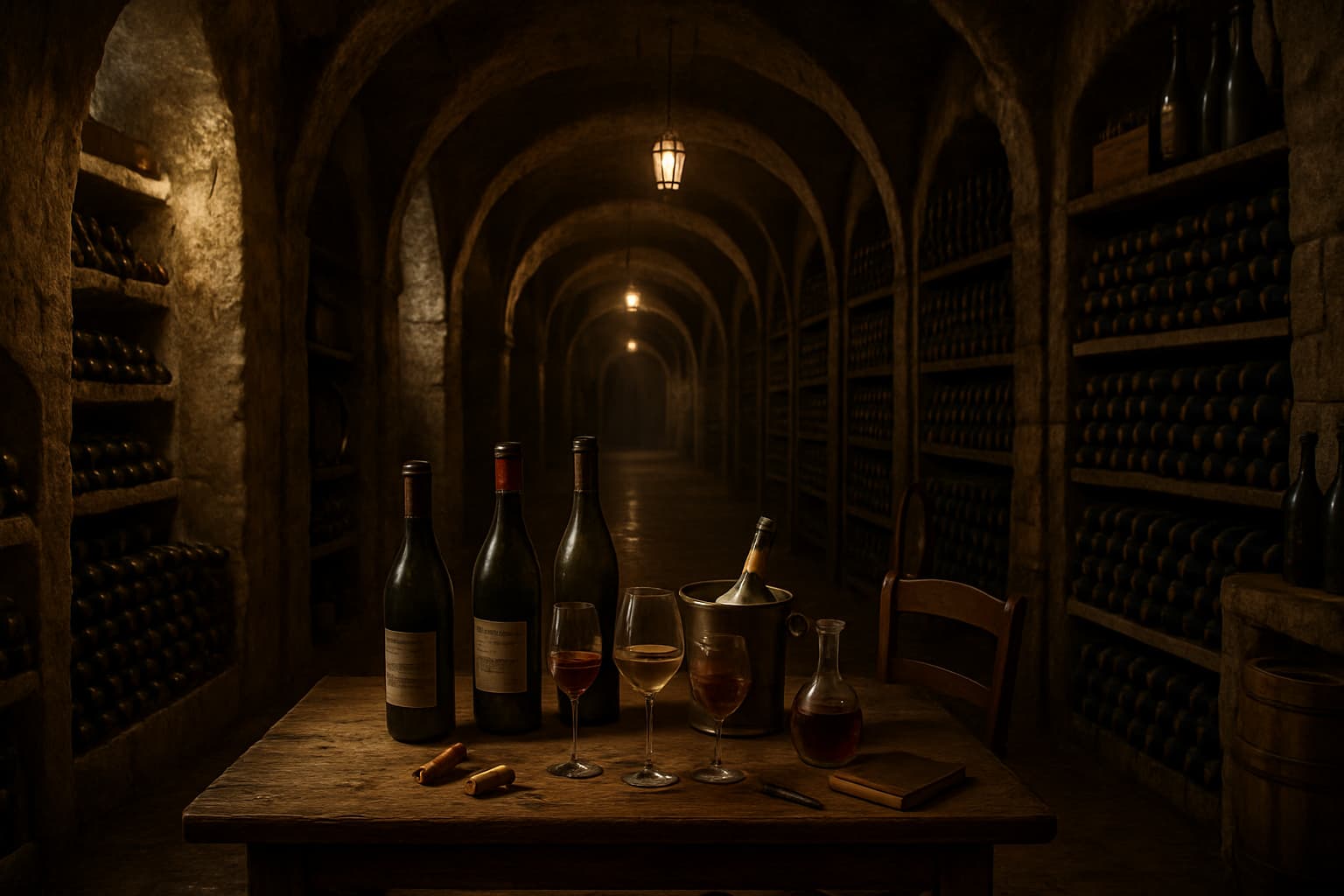
There are some stories that can only be told slowly, like an old record spinning on a well‑worn turntable… or a bottle of wine breathing in the shadows of a stone cellar. The story of Europe’s great wine collections is one of those tales. It’s not just about bottles and labels, or even about taste. It’s about time itself—captured, corked, and quietly waiting.
So let’s walk down those cool, echoing stairways together. Let’s open heavy doors, feel the hush of old stone, and visit the great European wine collections where history sleeps in glass.
Before we name châteaux and cellars, we need to understand what a great wine collection really is.
A wine collection is not just an accumulation of expensive bottles. It’s a library of moments. Each bottle is a chapter: a particular year’s weather, a winemaker’s choices, a region’s traditions, and the collector’s own judgment about what is worth preserving.
Great European wine collections have three things in common:
In Europe, where vineyards have been tended for hundreds, even thousands of years, wine collections become more than personal hobbies. They’re cultural memory—liquid archives of human persistence.
If you want to understand European wine collections, Bordeaux is a natural place to start. The great châteaux of the Left and Right Bank are not just producers; they are guardians of their own histories.
In Pauillac, stone towers and gravelly soils give birth to Cabernet Sauvignon with a backbone like iron and a soul that softens over decades. Estates like Château Latour and Château Lafite Rothschild maintain vertical collections—bottles of the same wine from many different years, sometimes stretching back into the 19th century.
These collections are not assembled for vanity alone. They serve a purpose:
In the quiet of those cellars, you’ll find bottles blackened by dust, labels faded to ghosts. Some are no longer sold. Some may never be opened. They exist as proof that once, in a particular year, these vines bore fruit, and that fruit became something worth saving.
Beyond the châteaux, Bordeaux has long been the playground of collectors—merchants in London, bankers in Zurich, industrialists in Germany and Belgium. Many of Europe’s most extraordinary Bordeaux collections sit behind private doors:
These private collections are not always about drinking. Some are investments, others trophies. But the greatest among them are built with a quiet reverence—for the land, for the craft, and for the long arc of time.
If Bordeaux is a cathedral, Burgundy is a chapel—more intimate, more fragile, and often more mysterious.
Here, vineyards are divided into tiny parcels, sometimes no larger than a backyard. A few rows of vines can carry a name that makes collectors’ hearts race: Romanée‑Conti, La Tâche, Musigny, Chambertin, Montrachet.
Among the most storied collections in Europe are those that include Domaine de la Romanée‑Conti (DRC). Bottles from this small estate in Vosne‑Romanée are so rare, so sought after, that they move like whispers through the world’s finest cellars.
Great Burgundy collections tend to have:
In the dim cellars of old Burgundian domaines, long rows of bottles lie under mold‑streaked arches. Some are so old that no one living remembers the harvest. The labels crumble at a touch. But in those bottles, the spirit of a lost season survives.
Long before modern collectors, there were monks. In Burgundy, the Cistercian and Benedictine orders tended vines, tasted, and took notes. They discovered, through quiet repetition, that one patch of earth produced better wine than another.
In a way, those early monks were the first curators of European wine collections. Their cellars were not built for auctions or status, but for contemplation and sacrament. Yet the logic is the same: keep what is best, protect it, and pass it on.
Travel north and the earth changes character. In Champagne, the ground is chalk—soft enough to carve, firm enough to stand. Under cities like Reims and Épernay lie miles of crayères, ancient chalk quarries turned into vast cellars.
Here, some of Europe’s most remarkable wine collections rest in the cool, constant darkness.
The great Champagne houses are not just producers; they are custodians of time in a different form.
Their collections include:
Walking through those chalk tunnels, you may see hundreds of thousands of bottles stacked in silence. Dust settles like snowfall. Temperature never changes. Here, time doesn’t rush; it breathes.
Champagne’s great collections are not just about what is kept, but when it is revealed.
A bottle might rest on its lees—its spent yeast—for 20, 30, even 40 years before being disgorged. Those long years in the dark give it flavors of brioche, honey, hazelnut, and smoke. The house decides when the wine is ready to speak.
In that decision lies a philosophy: that some things cannot be hurried, and that anticipation is part of the pleasure.
Cross the Alps and the language changes, but the reverence for wine does not.
Italy’s greatest collections are scattered across Piedmont, Tuscany, and beyond—places where families have made wine for generations, and where the bottle is as much a part of the table as bread.
In the rolling hills of the Langhe, Nebbiolo grapes yield wines that are pale in color but immense in structure. Barolo and Barbaresco are wines that need time—sometimes decades—to show their full character.
Great collections here often include:
These collections illustrate a deep Italian truth: that slowness is not a flaw, but a virtue. A 40‑year‑old Barolo is not an artifact; it’s a conversation partner who has had a long time to think.
Farther south, in Tuscany, you’ll find other kinds of greatness resting in old stone cellars.
Italian collections are often deeply personal. Family names on the labels match the names on the mailbox. The cellar is not a museum; it’s an inheritance.
To the west, in the Iberian Peninsula, wine collections tell a different kind of story—one of endurance and quiet, long‑forgotten casks.
In Jerez, in southern Spain, Sherry producers keep what may be the most unusual wine collections in Europe.
Instead of rows of bottles, they maintain soleras—tiered systems of barrels where old wine is blended with younger wine over many years. Some soleras contain trace amounts of wine that began its journey in the 19th century.
This is a collection that is never fully bottled, never fully exhausted. It is a continuous memory, renewed with each passing year.
In the cellars of Porto and on the island of Madeira, you find another kind of endurance.
These collections are monuments to resilience. They’ve survived wars, economic crashes, even the rise and fall of empires. And yet, in a small glass, they still taste alive.
Not all great European wine collections belong to estates and houses. Many of the most extraordinary are private—hidden under townhouses in Paris, London, Zurich, or Vienna; beneath country homes in the Loire or the Wachau.
What sets these cellars apart is not always money, but intention.
A thoughtful private collection often has:
In these cellars, you’ll find dusty treasures beside simple weeknight wines. Because even the grandest collector must remember: the purpose of wine is not to sit forever in the dark. It is to be shared.
Behind the romance of great collections lies a more practical truth: wine is fragile. Heat, light, vibration, and neglect can undo decades of patience.
That’s why serious collections, whether in a château or a city basement, focus on:
There’s also a moral question: How long should we keep things meant to be enjoyed? A collection that is never opened becomes a kind of mausoleum. The greatest European cellars, public and private, understand that preservation and sharing must walk hand in hand.
A bottle opened at the right moment, with the right people, is not a loss. It is the fulfillment of the wine’s purpose.
You may never set foot in the chalk tunnels of Champagne, or in the private cellar of a Burgundian vigneron. You may never hold a bottle of 1945 Bordeaux or pre‑phylloxera Madeira.
But the existence of these collections still touches your glass.
They shape the standards by which wine is judged. They guide winemakers who taste their own history and decide how to craft their future. They influence the styles, the prices, the reputations that ripple through the global wine world.
Most of all, they remind us of something simple and profound: that we, too, are passing through time. That what we plant today, we may never fully see. That some of the best things we do are not for ourselves, but for those who come after us.
A great European wine collection is more than a hoard of rare bottles. It is a testament to patience, memory, and hope.
Somewhere, right now, in the cool dark of a European cellar, a bottle is waiting. The year on its label might be older than you are. It has survived storms, wars, and the quiet erosion of days. One evening—maybe years from now—someone will lift it gently from its rack, cut the foil, turn the corkscrew.
There will be a soft pop, a breath of ancient air, and the scent of another time will rise into the present.
In that moment, all the long work of the vineyard, the cellar, and the collector will come together in a single glass.
And that, in the end, is what these great collections are: not monuments to possession, but bridges—between past and present, land and hand, patience and joy.
Tannins are astringent compounds found in wine that contribute to its texture and aging potential, often causing a drying or puckering sensation in the mouth. They are derived from grape skins, seeds, and stems, as well as from oak barrels used during aging.
/ˈtænɪnz/
Malic acid is a naturally occurring organic acid found in grapes that contributes to the tart, green apple-like flavor and crispness in wine. It plays a significant role in the taste and acidity of wine.
/mælɪk ˈæsɪd/
Filtration in winemaking is the process of removing solid particles from wine to clarify and stabilize it before bottling, using various types of filters to achieve different levels of clarity and remove unwanted elements like yeast, bacteria, and sediment.
/fɪlˈtreɪʃən/
Oxidation in wine is a chemical reaction between the wine and oxygen that can change its flavor, aroma, and color. This process can be beneficial or detrimental depending on the extent and context of the exposure.
/ˌɒksɪˈdeɪʃən/
Microclimate refers to the unique climate conditions of a small, specific area within a larger region, significantly influencing grapevine growth and the characteristics of the resulting wine.
/ˈmīkrōˌklīmit/
Get weekly wine recommendations, vineyard news, and exclusive content delivered to your inbox.