Wine Terminology
“Where every bottle tells a story”
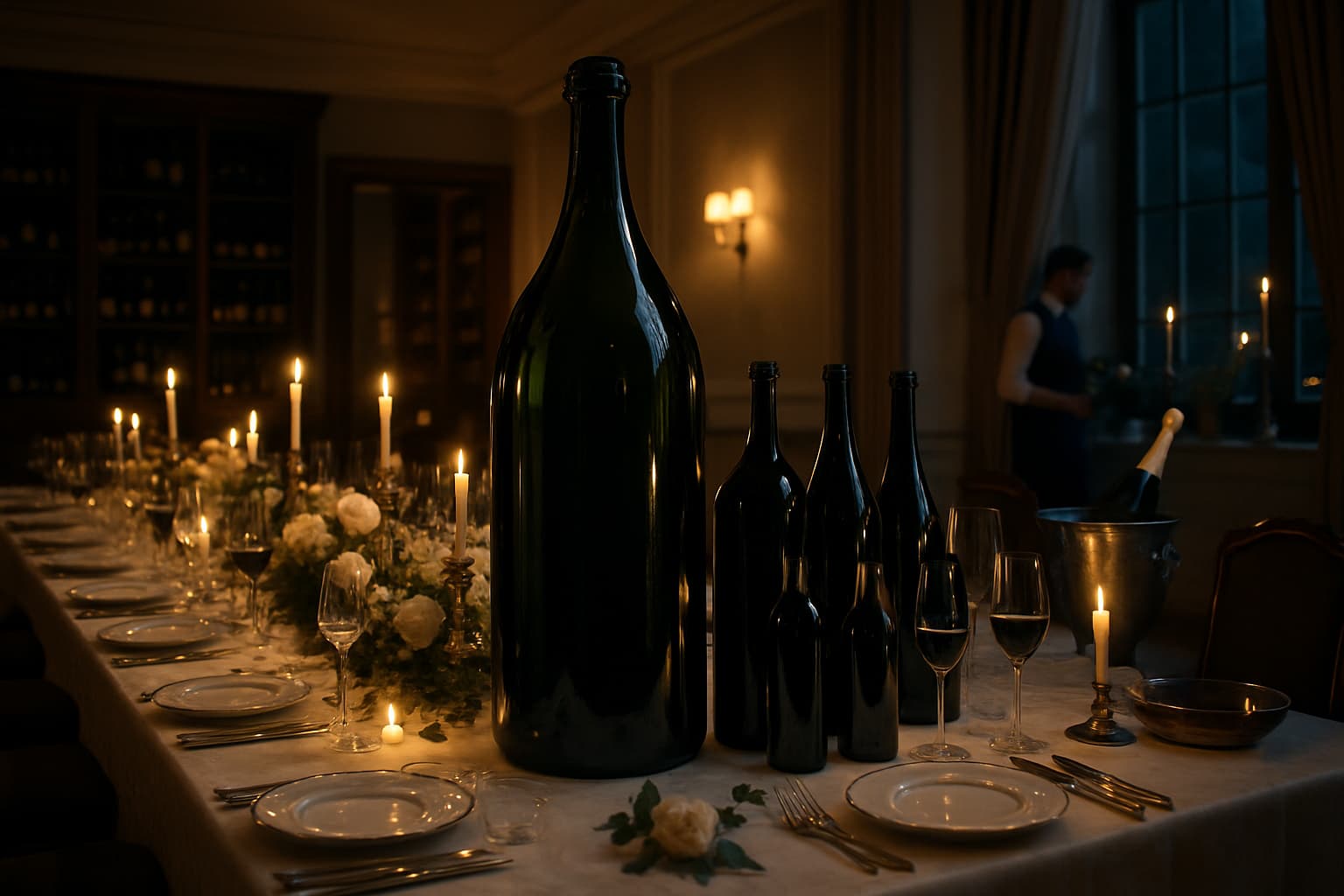
It is a truth very generally acknowledged among those who delight in wine that a bottle of more than ordinary size must be in want of an occasion. Yet, as in many matters of society, people are often content to admire from afar what they do not quite understand. Such is the fate of that most imposing of vessels, the Jeroboam—a name that sounds as though it ought to belong to a biblical patriarch, a minor king, or at the very least an elderly uncle of formidable dignity, rather than to a bottle standing in the corner of a dining room, glittering with promise.
And yet, it is precisely this alliance of grandeur, history, and conviviality that makes the Jeroboam so worthy of our attention. To understand it is to understand not only a piece of wine terminology, but also something of human vanity, ceremony, and the art of celebration itself.
The first inquiry any sensible mind must make is: Why should a bottle be called Jeroboam? Why not Thomas, or William, or any other gentleman of established respectability?
The answer lies, as so many oddities do, in the Bible. Jeroboam was the name of two kings of ancient Israel—Jeroboam I and Jeroboam II. In the whimsical tradition of wine merchants and glassmakers, certain large-format bottles of wine were christened with the names of biblical kings whose reigns, real or reputed, were marked by power, prosperity, or excess. One may suppose that a king accustomed to ruling over multitudes might find his counterpart in a vessel ruling over many ordinary bottles.
Thus we find, in the hierarchy of enlarged bottles, not merely Jeroboam, but also Methuselah, Salmanazar, Balthazar, and Nebuchadnezzar, among others. It is a veritable court of glass monarchs, presiding over cellars with silent, noble gravity.
Alas, our subject is not so simple as to submit to a single, universal definition. The Jeroboam, like certain gentlemen of fortune, alters his character according to the company he keeps and the region he inhabits.
In the realm of Champagne—a place of elegance, excess, and occasional confusion—a Jeroboam is traditionally:
Thus, if one were to invite twelve respectable guests to dinner, and to allot each of them a generous measure of Champagne (allowing for the usual mishaps and second helpings), a Jeroboam might very well suffice to bestow upon the occasion an air of luxury and abundance.
The matter grows more complicated when we pass from sparkling to still wines. In Bordeaux and many other regions, a Jeroboam is often defined as:
In Burgundy, however, and in some other traditions, what others call a Jeroboam may be more nearly aligned in size with what is elsewhere termed a Double Magnum (3 litres). The conventions are not entirely uniform, and one must be wary of assuming that every Jeroboam one encounters is of identical capacity. Merchants, like matchmakers, occasionally take liberties with labels.
For practical modern purposes, most wine lovers encounter the Jeroboam in two principal forms:
It is therefore prudent, when ordering such a bottle, to ascertain its precise volume, lest one be surprised either by an excess or a deficiency of wine.
To better appreciate the Jeroboam, it is useful to place it within its proper society—that of the large-format bottle. Just as no lady is properly judged without reference to her family, so no bottle should be considered without some sense of its relations.
For Champagne and many sparkling wines, the common progression is:
For still wines, the naming may shift, especially around the 3 L and 5 L sizes. In some traditions:
The precise structure varies by region and producer, but in all these gradations, the Jeroboam occupies a comfortable middle rank: grand, but not outlandishly so; impressive, yet still manageable at table.
It would be an error to suppose that a Jeroboam is merely a theatrical contrivance, designed only to impress the eye. Its size has real consequences for the wine it contains.
Wine ageing in bottle is governed, in part, by the relationship between the volume of liquid and the amount of air in the closure and neck—the so-called surface-to-volume ratio. Larger bottles, such as magnums and Jeroboams, offer:
For fine wines intended to age—Bordeaux, Burgundy, Champagne, and other serious bottles—a Jeroboam may be considered a most desirable format. Many producers release a limited number of such large bottles specifically for cellaring, confident that time will treat them kindly.
One might say that a Jeroboam allows the wine to mature with dignity and deliberation, rather than being hurried along like a young lady pushed too soon into society.
There is no denying the theatricality of a Jeroboam. It is as much an object of spectacle as of consumption, and its entrance into a dining room is seldom a quiet event.
A Jeroboam is rarely uncorked for solitary reflection or modest suppers. It appears instead at:
The Jeroboam, in short, is a bottle that presumes company. It is the enemy of restraint and the ally of conviviality.
Though the spectacle is considerable, there are also practical reasons to favour a Jeroboam:
Of course, its weight and awkwardness are not to be dismissed. One does not pour from a Jeroboam with the same ease as from a modest bottle. A certain strength of wrist—and preferably a well-trained sommelier—are of great assistance.
To witness a Jeroboam being opened and poured is something of a performance, and not every host is equal to the task.
A few points of etiquette and practicality:
To pour from a Jeroboam with elegance is a skill much admired and, like all social accomplishments, best acquired with practice rather than attempted for the first time in front of a critical audience.
In the circles of serious collectors, the Jeroboam holds a special allure. It combines rarity, grandeur, and the promise of superior ageing.
Producers usually bottle only a small number of their wines in large formats. A Jeroboam from a celebrated château or domaine is therefore:
At auction, the presence of a Jeroboam in a lot may excite considerable competition, especially if it hails from a great vintage and has been well stored. Provenance—its history of ownership and cellaring—becomes all the more important when so much wine is at stake in a single bottle.
To purchase a Jeroboam is to make a declaration: one intends to keep this wine, to age it, and to share it on an occasion of consequence. It is not the choice of the impulsive, but of the patient and the hopeful.
In our own age, which is alternately enamoured of spectacle and anxious about excess, the Jeroboam occupies an ambiguous position. To some, it appears as a charming emblem of festivity and generosity; to others, a vulgar display of wealth and indulgence.
Yet the bottle itself is innocent. It is merely a vessel, and the moral character of its use depends entirely upon the company in which it is opened. A Jeroboam shared thoughtfully among many friends, at a table filled with conversation and goodwill, is no more an emblem of excess than a single bottle hoarded in sullen solitude.
Indeed, there is a certain democratic virtue in such a large bottle: it insists upon being shared. One cannot, with any decency, drink a Jeroboam alone.
For those contemplating the acquisition of such a bottle, a few considerations may be useful:
If these questions can be answered satisfactorily, a Jeroboam may prove to be not merely a curiosity, but the very thing your celebration requires.
In the end, the Jeroboam is more than a measure of liquid; it is a measure of intention. It tells the world that the host has planned not a trifling gathering, but a true occasion. Its biblical name reminds us of kings and kingdoms long vanished; its glass form reminds us that, while all feasts must end, they may at least end beautifully.
To speak of a Jeroboam, then, is to speak not only of litres and labels, but of the human desire to mark our moments—marriages, milestones, reunions—with objects that embody our hopes for abundance, continuity, and shared delight.
If a standard bottle is a quiet conversation, a Jeroboam is a well-attended ball: more elaborate, more demanding, but also, when well conducted, infinitely more memorable. And though not every dinner, any more than every dance, requires such magnificence, there are times in life when only a bottle of truly royal stature will do. On those evenings, the Jeroboam stands ready, in all its solemn splendour, to preside over the table and to pour not merely wine, but a little grandeur into the glasses of all who partake.
Tannins are astringent compounds found in wine that contribute to its texture and aging potential, often causing a drying or puckering sensation in the mouth. They are derived from grape skins, seeds, and stems, as well as from oak barrels used during aging.
/ˈtænɪnz/
Malic acid is a naturally occurring organic acid found in grapes that contributes to the tart, green apple-like flavor and crispness in wine. It plays a significant role in the taste and acidity of wine.
/mælɪk ˈæsɪd/
Number of Guests
Nature of the Event
Service Capabilities
Ageworthiness of the Wine
There’s a moment, when you pour a glass of wine, that feels almost indecently intimate. The bottle tips, the liquid arcs, and then—before you even bring the glass to your lips—you give it that little...
Filtration in winemaking is the process of removing solid particles from wine to clarify and stabilize it before bottling, using various types of filters to achieve different levels of clarity and remove unwanted elements like yeast, bacteria, and sediment.
/fɪlˈtreɪʃən/
Oxidation in wine is a chemical reaction between the wine and oxygen that can change its flavor, aroma, and color. This process can be beneficial or detrimental depending on the extent and context of the exposure.
/ˌɒksɪˈdeɪʃən/
Microclimate refers to the unique climate conditions of a small, specific area within a larger region, significantly influencing grapevine growth and the characteristics of the resulting wine.
/ˈmīkrōˌklīmit/
Get weekly wine recommendations, vineyard news, and exclusive content delivered to your inbox.
-e4b2322f.webp&w=3840&q=75)
-012baf26.webp&w=3840&q=75)