Wine Technology and Innovation
“Where every bottle tells a story”
There are few spectacles in Europe more pleasing to the contemplative mind than a well-ordered vineyard: the rows of vines marching with military regularity across a hillside, the leaves trembling in the breeze, and the grapes—those modest globes of promise—ripening towards their appointed destiny in bottle and glass. Yet, for all this pastoral charm, the modern vineyard is no longer governed solely by the instincts of a wise vigneron pacing his fields with mud upon his boots and a pruning knife in his hand. No, indeed. It is now increasingly attended by satellites, drones, and algorithms—an assembly of companions that, if not quite as diverting as a lively country ball, is at least as determined to improve the prospects of the estate.
It is this union of tradition and technology—of vine and voltage—that forms the subject of our present reflections: the rise of precision viticulture and remote sensing in European vineyards, and the many ways in which they promise to reform, refine, and occasionally vex the venerable art of winegrowing.
In former days, a vineyard manager’s chief instruments were experience, observation, and, in some cases, a certain stubborn confidence that the weather would eventually do as it was told. Today, these are joined by precision viticulture: a suite of practices that employ data, measurement, and spatial analysis to understand and manage the vineyard not as a uniform field, but as a mosaic of varied and capricious parcels.
At its heart, precision viticulture rests upon three beliefs which, in another age, might have been considered quite radical:
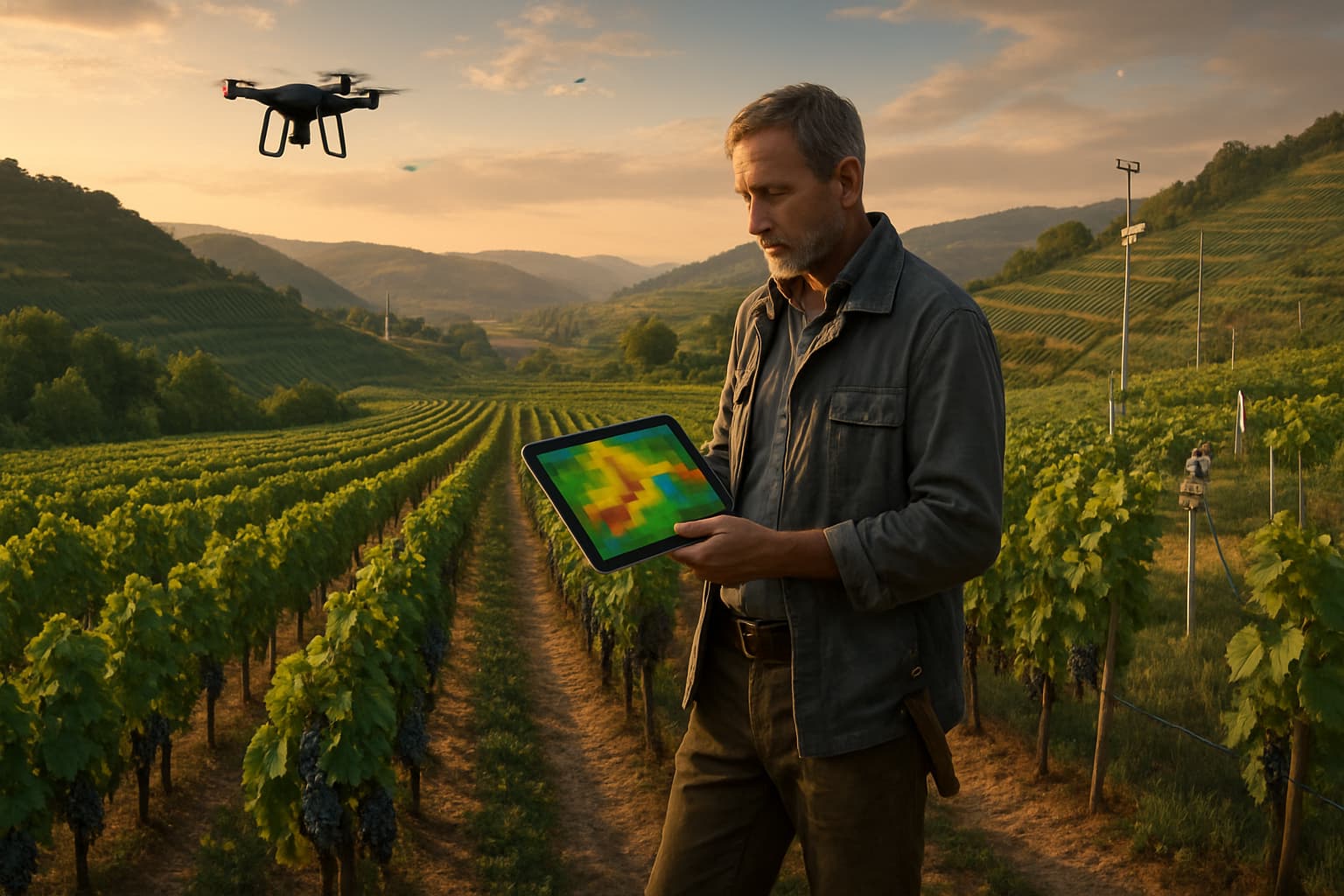
To this end, the modern European winegrower may consult not only soil pits and weather diaries, but also spatial maps of vine vigour, soil moisture, temperature, and disease risk, each rendered in a palette of colours more expressive than any landscape painter.
If precision viticulture is the philosophy, remote sensing is one of its principal instruments. It is, in essence, the art of observing vineyards from a distance—most often from satellites, aircraft, or drones—by measuring the light they reflect.
A vine, despite its modesty, is a most talkative plant when seen in the right wavelengths. Leaves reflect and absorb light in patterns that reveal their health, vigour, and water status. By capturing these patterns, remote sensing allows winegrowers to see the invisible—those differences and disturbances that an ordinary stroll among the rows might conceal.
The chief forms of remote sensing in European vineyards are:
One might object that such an array of flying machines over the peaceful Loire or the restrained slopes of Burgundy would disturb the serenity of the countryside. Yet they are, in practice, rather discreet, and their intrusion is more than compensated by the clarity they bring.
Remote sensing does not speak in words but in numbers—pixels, bands, and indices. Yet these numerical languages can be translated into insights that even the most tradition-minded proprietor must acknowledge as useful.
Among the most celebrated of these indices is the Normalized Difference Vegetation Index (NDVI). Without troubling the reader with equations, it may be said that NDVI compares the amount of red and near-infrared light reflected by the canopy. Healthy, vigorous vines reflect near-infrared strongly and absorb red light; stressed vines do the opposite. Thus:
These NDVI maps, when draped over the vineyard like a quilt, reveal zones of difference that might otherwise pass unnoticed. From them, the vintner may infer:
Thermal imagery, meanwhile, offers an elegant means of assessing vine water status. A well-watered vine cools itself by transpiration; a water-stressed vine, unable to transpire freely, becomes warmer. By measuring canopy temperature, drones and satellites can highlight those parcels where drought is beginning to bite, long before the leaves droop in a manner dramatic enough to catch the human eye.
Europe’s vineyards are not vast, uniform plains; they are intricate tapestries of slope, aspect, soil, and microclimate. A single estate in the Rhône or the Wachau may encompass:
In such circumstances, the notion that one might treat the vineyard as though it were a single, obedient entity is as ill-founded as the idea that all members of a family share precisely the same temperament.
Remote sensing and precision viticulture prove particularly suited to this Old World complexity:
Thus, the very heterogeneity that once demanded generations of patient observation now becomes legible in a season, provided one has the wit to interpret the images correctly.
A map, however beautiful, is only useful if it leads to action. In the best European estates, remote sensing is not an ornament but a guide. Its chief applications include:
Once variations are revealed, they may be addressed with a delicacy worthy of the most refined hostess arranging her seating plan:
Remote sensing allows winemakers to sample intelligently:
The result is a more precise expression of terroir, and in some cases, separate vinification of distinct zones within a single vineyard—a practice that delights those who enjoy comparing subtleties in the glass.
By detecting unusual changes in canopy reflectance and temperature, remote sensing can:
Europe, with its long history and occasionally stern regulatory temperament, views vineyards not only as commercial enterprises but as cultural and environmental assets. Precision viticulture and remote sensing are therefore welcomed not merely for their contributions to profit, but for their assistance in meeting broader obligations.
Among their virtues:
Thus, what might at first appear to be a coldly technical enterprise proves, on closer examination, to be a tool of environmental courtesy—helping vineyards remain both productive and decorous members of their landscapes.
It would be disingenuous to pretend that every European grower greets drones and satellite maps with the same enthusiasm. Some, particularly in regions where tradition is a badge of honour, regard these innovations with a suspicion usually reserved for speculative marriages and dubious cousins.
The principal reservations include:
Yet, in many of the most respected European regions, a compromise is emerging: technology as servant, not master. The experienced vigneron does not surrender judgement to an index, but uses it as another voice in the conversation, much as a prudent landowner might consult both the steward and the tenants before deciding on improvements.
As remote sensing and precision viticulture mature, their role is likely to shift from mere observation to informed anticipation.
We may reasonably expect:
In a Europe increasingly challenged by climate change—earlier harvests in Burgundy, drought in Spain, new disease pressures in Italy—such foresight may prove not merely convenient but essential to the continued production of wines that are both distinctive and dignified.
The vineyard has always been an exercise in stewardship: of soil, of plants, of landscape, and of time. The introduction of remote sensing and precision viticulture does not alter this fundamental truth; it merely equips the steward with sharper eyes and more refined tools.
If employed with wisdom, these technologies can:
In the end, it is not the drone that decides when to harvest, nor the satellite that chooses which parcel will become the estate’s grand vin. Those decisions remain, as they always have, in human hands—hands that may now be better informed, but must still exercise judgement, taste, and a certain moral responsibility towards the land.
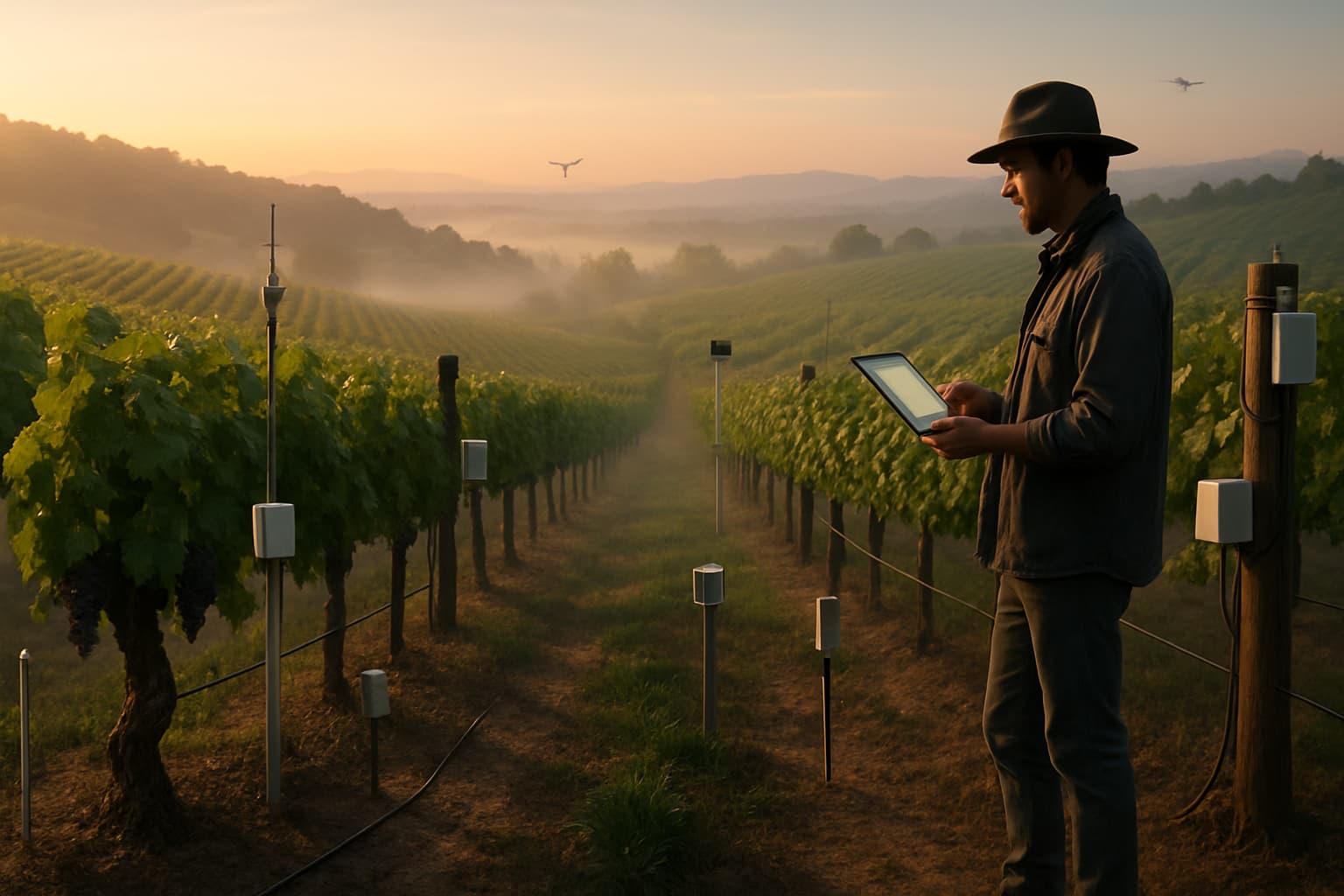
Thus, the future of European wine will likely be neither a blind surrender to machines nor a stubborn refusal of innovation, but a conversation between past and present: tradition lending meaning to data, and data lending precision to tradition. And if, in some quiet September twilight, a vineyard manager stands amidst the vines, tablet in hand, contemplating a colourful map while tasting a berry from the cluster, we may observe that this union of intellect and sensation, of measurement and memory, is very much in the spirit of progress—properly understood and politely conducted.
Tannins are astringent compounds found in wine that contribute to its texture and aging potential, often causing a drying or puckering sensation in the mouth. They are derived from grape skins, seeds, and stems, as well as from oak barrels used during aging.
/ˈtænɪnz/
Malic acid is a naturally occurring organic acid found in grapes that contributes to the tart, green apple-like flavor and crispness in wine. It plays a significant role in the taste and acidity of wine.
/mælɪk ˈæsɪd/
Satellite imagery:
High above Bordeaux, the Mosel, Rioja Alavesa, and the Douro, satellites pass with unromantic regularity, collecting images in visible and near-infrared bands. Their advantages are:
Aerial photography and multispectral flights:
Light aircraft or helicopters, equipped with specialised cameras, may be engaged for more detailed surveys. They offer:
Drones (Unmanned Aerial Vehicles):
The newest and perhaps most fashionable member of the viticultural entourage, drones provide:
Filtration in winemaking is the process of removing solid particles from wine to clarify and stabilize it before bottling, using various types of filters to achieve different levels of clarity and remove unwanted elements like yeast, bacteria, and sediment.
/fɪlˈtreɪʃən/
Oxidation in wine is a chemical reaction between the wine and oxygen that can change its flavor, aroma, and color. This process can be beneficial or detrimental depending on the extent and context of the exposure.
/ˌɒksɪˈdeɪʃən/
Microclimate refers to the unique climate conditions of a small, specific area within a larger region, significantly influencing grapevine growth and the characteristics of the resulting wine.
/ˈmīkrōˌklīmit/
Get weekly wine recommendations, vineyard news, and exclusive content delivered to your inbox.