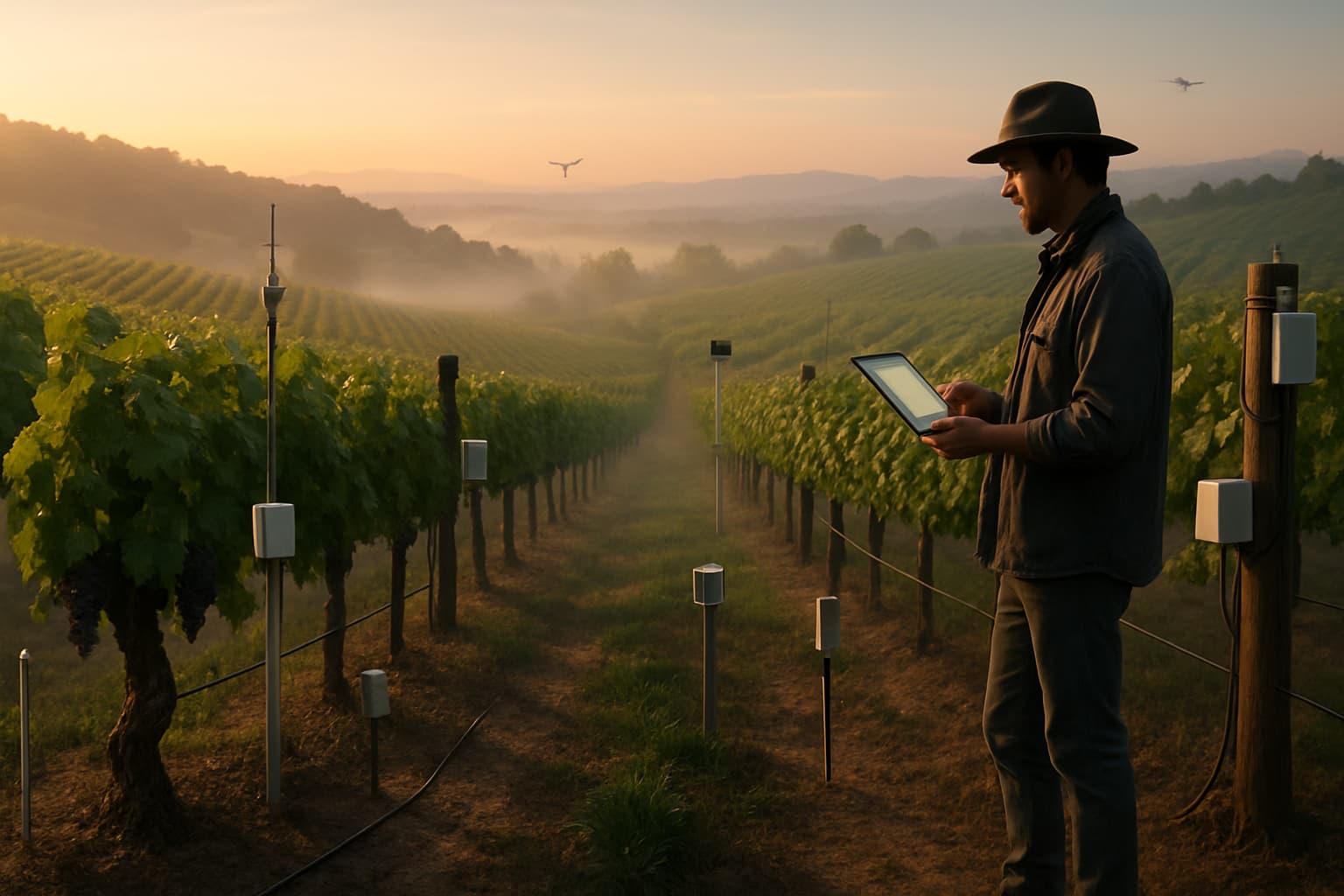
At first light, when the mist still clings to the contours of the land and the vines stand silent in rows of patient green, an ancient craft meets a very modern kind of magic. Here, in the vineyard, where generations have watched the seasons turn and the grapes slowly swell with promise, a quiet revolution is underway. It is not heralded by clanging machinery or flashing lights, but by small, almost invisible sentinels: networks of sensors, listening to the soil, the air, the leaves, and the fruit.
This is the age of precision viticulture—where the timeless art of growing grapes for wine is being gently, but profoundly, reshaped by technology. And if we listen closely, we discover that the story these sensors tell is not one of cold calculation, but of a deeper, more intimate understanding of the living vineyard itself.
From Intuition to Insight: The Evolution of Vineyard Stewardship
For thousands of years, viticulture has been guided by the senses of the grower: the feel of the soil between the fingers, the scent of the air before a storm, the colour and texture of a ripening berry. These instincts, honed over lifetimes, are the foundation of great wine.
Yet even the most experienced vigneron is limited by what the human eye can see and the human hand can touch. A vine stressed by lack of water may not show its distress until the damage is already done. A fungal disease may spread silently between leaves before its presence is betrayed by spots and blemishes. A heatwave may subtly alter the balance of sugar and acidity in a grape long before the palate can detect it.
Precision viticulture does not replace the wisdom of the grower. Rather, it extends their senses—down into the soil, across the canopy, and through the shifting layers of climate and weather. It transforms the vineyard into a living network of information, where every vine has a voice and the land itself speaks in data.
The Vineyard as a Living Network
Walk through a modern, technology-enabled vineyard and, at first glance, you may see only vines and posts, wires and leaves. But look more closely, and you may notice small weather stations stationed among the rows, slender probes sunk into the earth, and discreet boxes attached to trellis posts or irrigation lines.
These are the components of a vineyard sensor network, a distributed system of devices that continuously measure the conditions in which the vines live:
- Soil moisture sensors probe the earth, recording how much water is available to the roots at various depths.
- Temperature and humidity sensors capture the microclimate between the rows and within the canopy, where disease and ripening are decided.
- Leaf wetness sensors detect the presence of moisture on the vine’s surfaces, a critical factor for the development of fungal diseases.
Each sensor is a tiny observer, recording the subtle shifts that occur hour by hour, day by day. Together, connected by wireless networks and often powered by small solar panels, they form a nervous system for the vineyard—constant, attentive, and unblinking.
Mapping the Invisible: Variability as the Key to Precision
To the casual observer, a vineyard may appear uniform: neat rows, evenly spaced, stretching across a hillside. Yet beneath this apparent order lies a tapestry of variation. The soil may be deeper in one corner, stonier in another. A shallow depression may trap cold air, while a ridge catches more wind. Water may drain swiftly from one slope and linger in another. Even the microbiological life in the soil—the invisible community upon which the vine depends—can differ from one few metres to the next.
Traditional viticulture often treated this landscape as a single entity, applying water, fertiliser, and treatments evenly across the entire block. Precision viticulture, guided by sensor networks and spatial data, reveals a more nuanced reality.
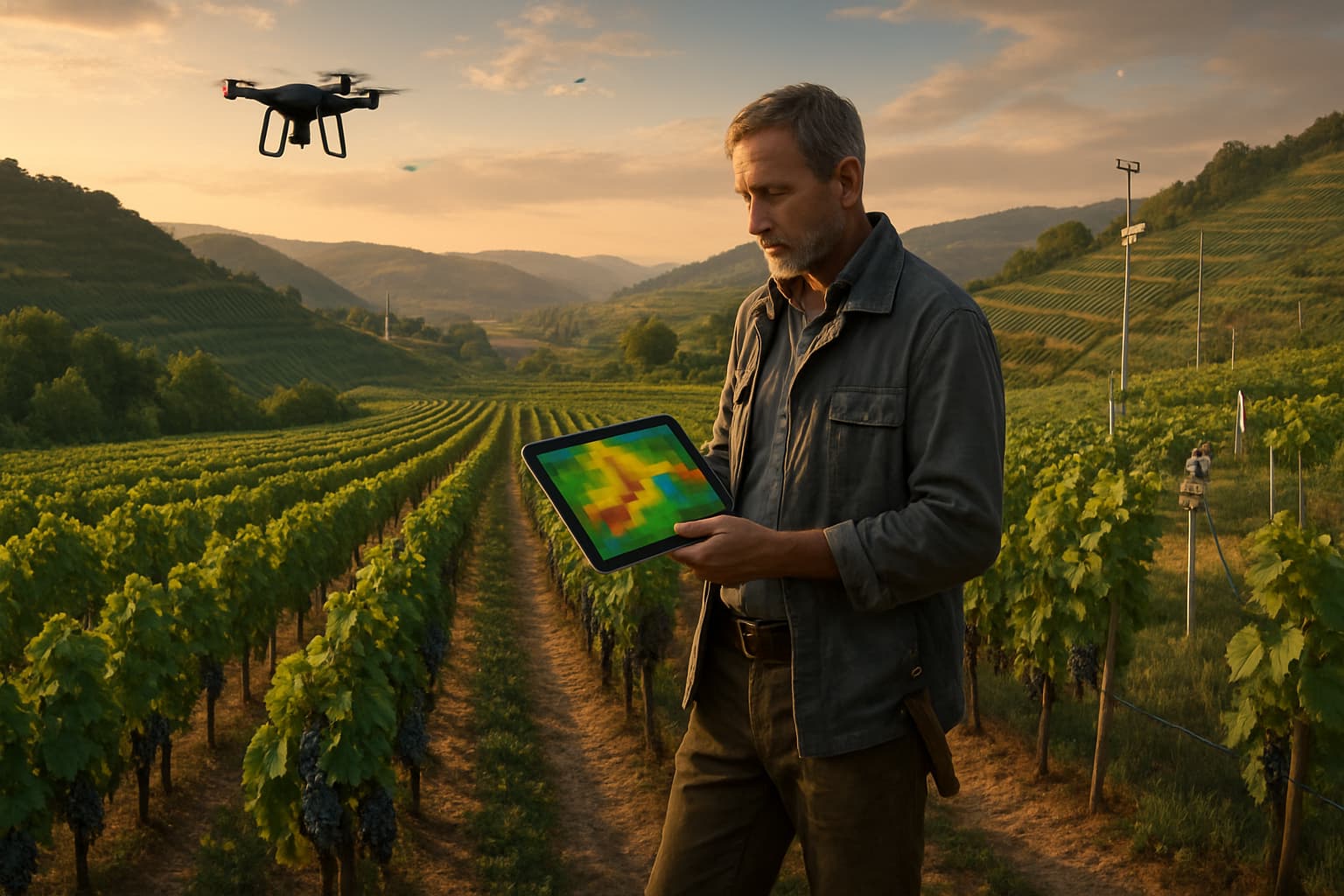
Using information from sensors, satellite imagery, drones, and GPS mapping, growers can create high-resolution maps of their vineyards:
- Soil moisture maps show where vines are thirsting and where they are comfortably supplied.
- Temperature maps reveal hot spots and cool pockets, shaping ripening patterns.
- Vigour maps, often derived from aerial imagery, illustrate where the canopy is lush and where it is sparse.
- Yield maps, collected at harvest, reveal how different areas of the vineyard contribute to the final crop.
These maps transform the vineyard from a uniform field into a mosaic of micro-terroirs, each with its own character and needs. With this knowledge, the grower can act with precision rather than approximation.
Water, the Most Precious Thread
In an age of changing climate and growing scarcity, water has become one of the vineyard’s most precious resources. Vines are resilient, but they are also exquisitely sensitive to the availability of moisture in the soil. Too little, and they shut down, sacrificing growth and fruit. Too much, and their roots suffocate, their berries swell, and flavours become diluted.
Sensor networks play a crucial role in precision irrigation:
- Soil moisture sensors at multiple depths show not only how wet the surface is, but whether water has reached the deeper roots where older vines feed.
- Plant-based sensors, such as those measuring sap flow or stem water potential, indicate how hard the vine is working to draw water from the soil.
- Weather sensors and forecasts predict how quickly water will be lost through evaporation and transpiration.
With this information, irrigation can be tailored to the needs of specific blocks, or even specific zones within a block. Drip lines can be controlled remotely; water can be delivered at night to reduce evaporation; and stress can be applied at just the right moment to concentrate flavours without harming the vine.
In some regions, this precision is not merely a matter of quality, but of survival. As droughts lengthen and heatwaves intensify, the ability to use water sparingly yet effectively will determine which vineyards endure.
Guarding Against Invisible Enemies
Among the greatest threats to the vineyard are diseases—particularly those caused by fungi such as powdery mildew, downy mildew, and botrytis. These organisms thrive in specific combinations of temperature, humidity, and leaf wetness. For centuries, growers have combated them with preventative sprays, often applied on a calendar schedule, in the hope of staying one step ahead.
Sensor networks allow a more refined approach. By continuously measuring:
- Temperature and relative humidity
- Leaf wetness duration
- Rainfall and dew formation
and combining this data with disease prediction models, growers can identify when conditions are truly favourable for infection. Rather than spraying by habit, they can spray by necessity—reducing chemical use, cost, and environmental impact.
Some systems go further, integrating weather forecasts and real-time data to issue alerts when risk levels rise, allowing timely intervention. In organic and biodynamic vineyards, where options for treatment are more limited, this precision can mean the difference between a healthy harvest and a devastating loss.
Harvest: Choosing the Perfect Moment
If there is a single decision that defines the character of a wine, it is the moment of harvest. Grapes harvested too early may be sharp and green; too late, and they may be heavy, alcoholic, and lacking in vibrancy. The ideal balance of sugar, acidity, tannin, and flavour is fleeting—arriving perhaps over only a few days.
Here, too, sensor networks lend their quiet assistance. By tracking:
- Temperature patterns leading up to harvest
- Sunlight exposure and heat accumulation (often expressed as growing degree days)
- Soil moisture and vine stress, which influence how quickly grapes ripen
growers can better anticipate when different parts of the vineyard will reach their peak. Combined with sampling and tasting in the field, this data supports a more nuanced harvest strategy: picking cooler, slower-ripening plots later; warmer, earlier areas sooner; and, where desired, harvesting in multiple passes to capture different expressions of the same site.
In some advanced operations, yield monitors on harvesters record the quantity of fruit removed from each row, linking that data back to the maps created earlier in the season. Over years, a picture emerges of how each corner of the vineyard behaves—its strengths, its weaknesses, its personality.
The Subtle Art of Less: Sustainability Through Precision
At first glance, technology in the vineyard might seem an intrusion into a pastoral idyll. Yet its most profound contribution may be to help growers do less—less watering, less spraying, less waste, less guesswork.
By applying treatments only where and when they are needed, precision viticulture:
- Reduces water consumption, vital in drought-prone regions.
- Lowers chemical inputs, improving soil health and biodiversity.
- Cuts fuel use and machinery passes, decreasing the vineyard’s carbon footprint.
- Protects the long-term vitality of the land on which generations of vines—and families—depend.
In this way, sensor networks become tools not of domination, but of restraint. They allow the grower to intervene lightly, respectfully, in harmony with the rhythms of the place.
Human Hands, Digital Eyes: The Future of the Craft
It is tempting, when confronted with such technology, to imagine a future of fully automated vineyards, where algorithms make every decision and machines tend every vine. Yet the reality, in the most thoughtful estates, is quite different.
The data gathered by sensor networks is interpreted not in isolation, but in conversation—with the grower’s experience, with the winemaker’s goals, and with the unique history and culture of the estate. A sensor may indicate that a block is under mild water stress; only the grower, walking among the vines, can decide whether that stress is beneficial for flavour or harmful to the plant.
In this sense, precision viticulture is not a replacement for human intuition, but its partner. It provides a clearer view of the vineyard’s inner life, allowing the grower to act with greater confidence, subtlety, and care.
Looking ahead, we see this partnership deepening. Machine learning models that predict yield and quality, drones that scan the canopy for early signs of disease, robots that selectively remove leaves or weeds—all will rely on the same foundation: detailed, continuous data from the vineyard itself.
Yet at the heart of it all remains a simple, ancient goal: to understand this piece of earth well enough to guide it, gently, towards its finest expression in the glass.
A New Kind of Listening
Stand once more at the edge of the vineyard at dusk. The sun sinks low, painting the rows in gold. The vines, their day’s work of gathering light complete, begin to rest. Beneath the surface, roots explore the soil, trading sugars for nutrients with the unseen fungi that share their world. In the air, temperature falls, humidity rises, and the first stars appear overhead.
Somewhere among the posts, a sensor records the cooling air. Another notes the slow decline of soil moisture. A weather station measures a faint breeze. These are simple observations, each one almost trivial. But taken together, over days and months and years, they form a story—a story of stress and relief, of heat and cold, of abundance and scarcity.
This is what precision viticulture and vineyard sensor networks truly offer: a new way of listening. Not to replace the grower’s own senses, but to deepen them. Not to strip the mystery from wine, but to honour it with understanding.
For wine is, in the end, a conversation between earth, climate, vine, and human hand. And in this quiet technological revolution, we are learning to listen more closely than ever before—to the land, to the vines, and to the delicate balance upon which every harvest depends.