Sustainable and Organic Wine
“Where every bottle tells a story”
The land remembers everything.
It remembers the years of plenty and the years of rot. It remembers the hard boots that trampled it and the gentle hands that cared for it. In the vineyard, the soil keeps the score. The wine only tells the truth.
Sustainable viticulture begins with this understanding. You are not just growing grapes; you are entering into a long conversation with a piece of earth. You can shout at it with chemicals and steel and deep cuts, or you can listen. If you listen, it will give back. Not quickly. Not easily. But honestly.
This is the work: to grow vines in a way that keeps the land alive, the people healthy, and the wine worth drinking. Not just this year, but for the next generation, and the one after that.
A grapevine is not a quick crop. It is a promise that stretches across decades. A vineyard planted today will outlive the hands that set the young vines in the ground. That alone demands a different kind of thinking.
Sustainable viticulture means you do not farm as if each harvest is your last. You farm as if your grandchildren will walk these rows. You protect the soil, the water, and the air because you know the vine is a long memory on a fragile stage.
So the first principle is simple and hard:
You do not take more than the land can afford to give. You do not break the soil to win one good year and lose the next ten.
The soil is not a medium. It is not a neutral sponge for roots and fertilizer. It is alive.
In a healthy vineyard, the soil is full of worms, fungi, bacteria, and unseen threads that tie roots to minerals and water. Sustainable viticulture begins here, in this dark world under your boots.
There are several ways to keep the soil alive:
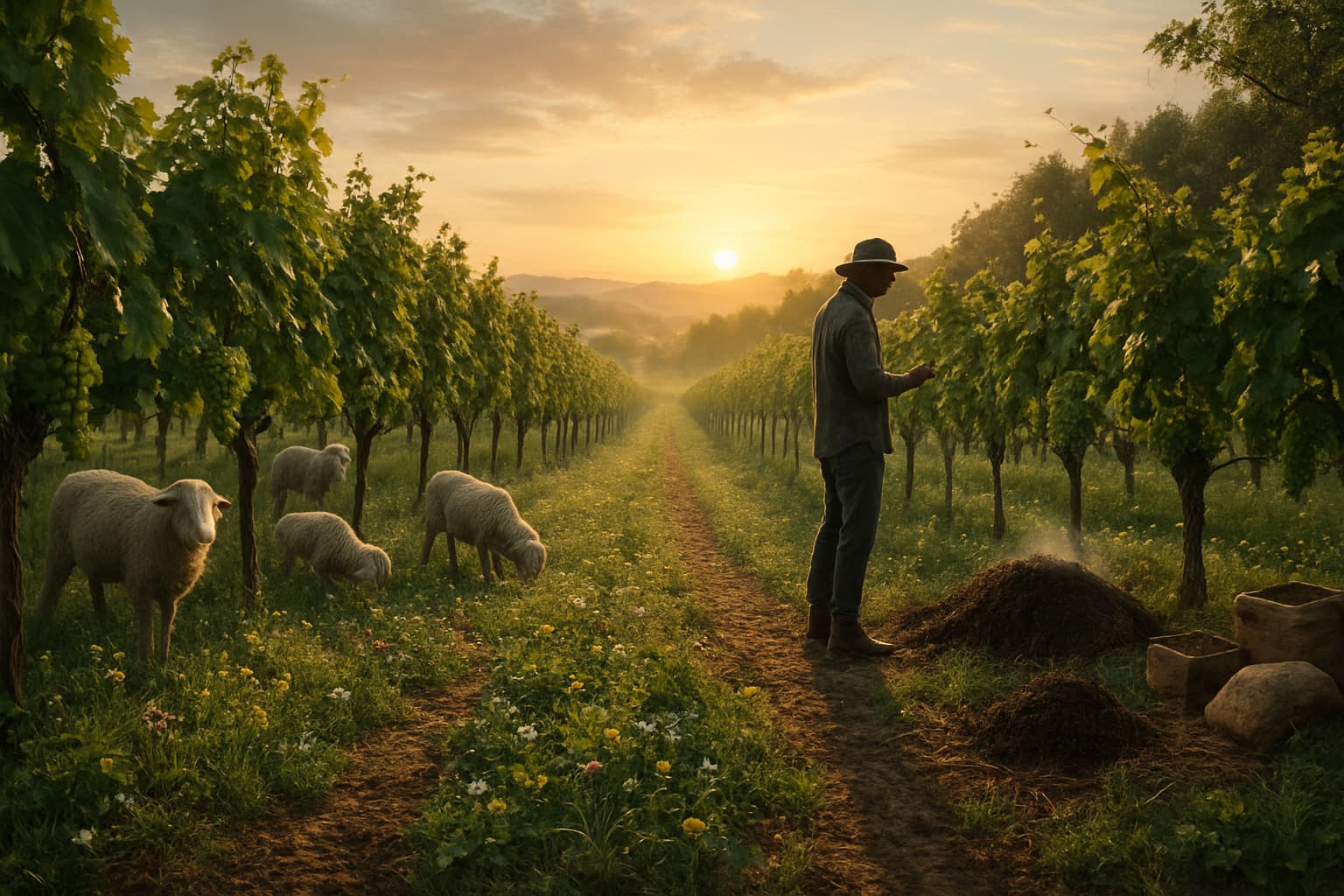
Minimal tillage: Constant plowing tears up the structure of the soil. It breaks fungal networks and lets carbon escape into the air. Sustainable growers plow less, and when they do, they do it shallow and with care. Sometimes they mow instead of plow. Sometimes they let the grass grow and only open narrow strips for the vines.
Cover crops: Between the rows, they sow clover, vetch, rye, fava beans, wildflowers. These plants hold the soil in place, fix nitrogen, and feed insects. Their roots open channels for water. When they die and are rolled down, they become food for the soil, a quiet green compost.
: Compost, manure, shredded prunings – these go back to the land. Nothing is wasted. The goal is to build humus, that dark, rich matter that holds water and nutrients. In dry years, humus keeps the vines alive. In wet years, it drinks in the excess and keeps the roots from drowning.
The soil is not something you dominate. It is something you tend, like a fire that can go out if you stop feeding it.
Vines grow in places where life is often a little short on water. That is part of their nature. A vine that struggles a bit for water sends roots deep. It learns the shape of the land. It pulls character from stone and clay.
Sustainable viticulture respects this struggle, but does not abuse it.
The principles are clear:
Efficient irrigation: Where water is needed, it is delivered by drip lines, not by flooding. The water goes to the roots, not to the tractor tracks. Sensors in the soil and the leaves help decide when to water. Guesswork is replaced by observation.
Dry farming where possible: In some regions, the vines can live on the rain that falls from the sky and the water stored in the subsoil. When the roots go deep, the vine becomes part of the place. This is risky, but it is honest. Not every site can do this. A sustainable grower knows the difference.
Protecting water quality: Runoff from the vineyard must not poison streams and rivers with fertilizers and pesticides. Grassed rows and cover crops slow the water down. Buffer zones of wild plants catch sediment and filter impurities. What leaves the vineyard should not kill what lives beyond it.
Water is not just a tool. It is a shared lifeline. To waste it is to steal from your neighbors and from the future.
A vineyard can be a green desert or a living tapestry. The choice is deliberate.
In the old days, many believed that every plant that was not the vine was an enemy. They sprayed and plowed until only the rows of grapes remained, marching in sterile formation. The wine might have been clean, but the land was empty.
Sustainable viticulture takes another path.
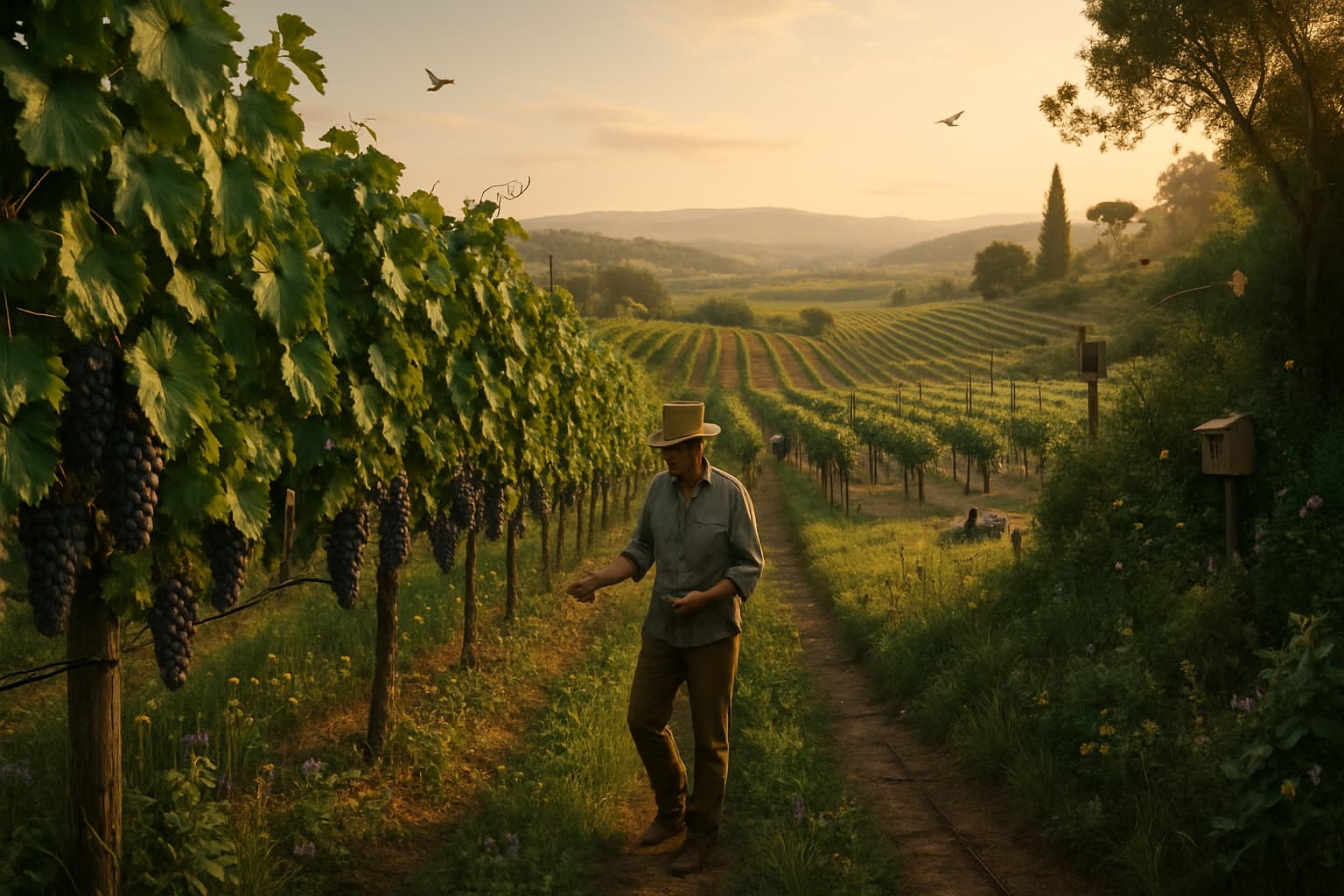
Hedgerows and wild borders: At the edges of the vineyard, trees and shrubs are left or planted: hawthorn, oak, pine, olive, wild roses. These give shelter to birds and insects. They break the wind and soften the sun. They make the vineyard part of a larger web of life.
Insects as allies: Not all insects are enemies. Ladybirds eat aphids. Parasitic wasps lay their eggs in pests. Spiders weave their traps among the leaves. To help them, farmers plant flowers that give nectar and pollen. They reduce broad-spectrum insecticides that kill everything, good and bad.
Birds and bats: Nesting boxes and perches invite owls, bats, and songbirds. These hunters keep rodents and moths in check. They become part of the vineyard’s defense system, a quiet army that works at night and at dawn.
The more life there is in and around the vineyard, the more stable it becomes. Pests still come, but they are checked by their enemies. Disease still threatens, but a healthy ecosystem does not fall apart so easily.
For a long time, vineyards were treated as battlefields. The weapons were synthetic fertilizers, herbicides, fungicides, and insecticides. The enemy was everything that moved or grew in the wrong place. The goal was control.
Sustainable viticulture changes the goal. It is not about total control. It is about balance.
Instead of spraying on a schedule, growers watch and measure:
Monitoring: Traps catch insects. Leaves are checked for signs of disease. Weather data is studied to predict outbreaks of mildew or rot. Nothing is done blindly.
Thresholds: A few insects do not trigger a spray. Only when populations reach a level that threatens the crop does the grower act. Even then, the least harmful tool is used first: pheromone confusion for moths, biological agents, and targeted products that spare beneficial life.
Reducing dependence: Over time, as soil and biodiversity improve, the need for harsh chemicals drops. The vineyard becomes more resilient. The grower is less a soldier and more a caretaker.
Organic and biodynamic growers go further, refusing synthetic chemicals altogether and relying on copper, sulfur, plant teas, compost, and strict attention to timing and canopy management. Their path is narrower and more demanding, but it follows the same principle: the vineyard must be a living system, not a sterile factory.
Sustainability is not only in the soil and the leaves. It is also in the fuel burned, the steel dragged, and the noise made in the early morning.
Tractors compact the soil. They drink diesel and spit out fumes. Sprayers hum through the rows. Harvesters shake the vines. All of this has a cost.
Thoughtful growers:
But machines are not the whole story. There are the people.
Sustainable viticulture includes the workers who prune in winter, tuck shoots in spring, and pick in the heat of harvest. They must be paid fairly, housed decently, and kept safe from toxic sprays and dangerous machines. A vineyard that abuses its workers is not sustainable, no matter how green its labels.
The land and the people who work it are bound together. If one is exploited, both will suffer.
A sustainable vineyard is not just a set of rules. It is a way of seeing.
The grower walks the rows each week, or each day. They look at the color of the leaves, the way the shoots grow, the way the clusters hang. They taste berries. They feel the soil in their hand. They know each block and its moods.
Canopy management is part of this quiet craft. Leaves are thinned to let in air and light, but not too much. Shade is left where the sun is harsh. The goal is to create a microclimate around the fruit that keeps rot and mildew at bay without relying on constant sprays.
Yields are kept in check. Too many clusters tire the vine and dilute the wine. Too few create imbalance. Sustainable viticulture respects the natural capacity of the vine and the limits of the site. It does not chase volume at the cost of health.
There are many seals now: organic, biodynamic, sustainable, regenerative. Each comes with standards and inspections. Some measure inputs – what you are allowed to use. Others measure outcomes – soil carbon, biodiversity, water use, worker welfare.
Certification can be useful. It forces discipline. It gives the consumer a signal. But a logo on a label is not the whole story.
Some of the best work is done by quiet growers who do not talk much and do not chase marketing trends. They simply try, year after year, to leave their land better than they found it.
In the end, the wine itself is the only honest witness. A vineyard farmed with care tends to make wines with depth, freshness, and a certain calm. Such wines do not shout. They do not taste of the laboratory. They taste of where they come from.
Sustainable viticulture is not a trick or a fashion. It is a return to an older wisdom sharpened by modern knowledge.
It accepts that vineyards sit in a living landscape, not on a dead stage. It accepts that the soil has limits, that water is precious, and that insects, birds, and people are all part of the same fragile web. It understands that the vine is a long story, and that each year is only one page.
You can farm for yield and speed and short-term gain. Many do. The land will give for a while, and the wine will fill bottles, and the money will come in. Then the soil will thin, the roots will weaken, the vines will tire, and the cost will arrive.
Or you can farm as if you will be buried in this ground one day, and your children will drink the wine that grows above you.
You plant cover crops. You feed the soil. You watch the water. You welcome birds and insects. You treat your workers as partners, not tools. You use machines wisely. You spray less, observe more, and accept that nature is not a servant but a companion.
In time, the vineyard becomes something steady and strong. It weathers storms. It survives droughts. It yields grapes that carry the mark of their place with clarity.
The land remembers everything.
If you care for it, it will remember that too.
And in the quiet weight of a glass of wine, you will taste that memory – clean, honest, and alive.
Tannins are astringent compounds found in wine that contribute to its texture and aging potential, often causing a drying or puckering sensation in the mouth. They are derived from grape skins, seeds, and stems, as well as from oak barrels used during aging.
/ˈtænɪnz/
Malic acid is a naturally occurring organic acid found in grapes that contributes to the tart, green apple-like flavor and crispness in wine. It plays a significant role in the taste and acidity of wine.
/mælɪk ˈæsɪd/
Filtration in winemaking is the process of removing solid particles from wine to clarify and stabilize it before bottling, using various types of filters to achieve different levels of clarity and remove unwanted elements like yeast, bacteria, and sediment.
/fɪlˈtreɪʃən/
Oxidation in wine is a chemical reaction between the wine and oxygen that can change its flavor, aroma, and color. This process can be beneficial or detrimental depending on the extent and context of the exposure.
/ˌɒksɪˈdeɪʃən/
Microclimate refers to the unique climate conditions of a small, specific area within a larger region, significantly influencing grapevine growth and the characteristics of the resulting wine.
/ˈmīkrōˌklīmit/
Get weekly wine recommendations, vineyard news, and exclusive content delivered to your inbox.