-44d111a7.webp&w=3840&q=75)
Wine Terminology
“Where every bottle tells a story”
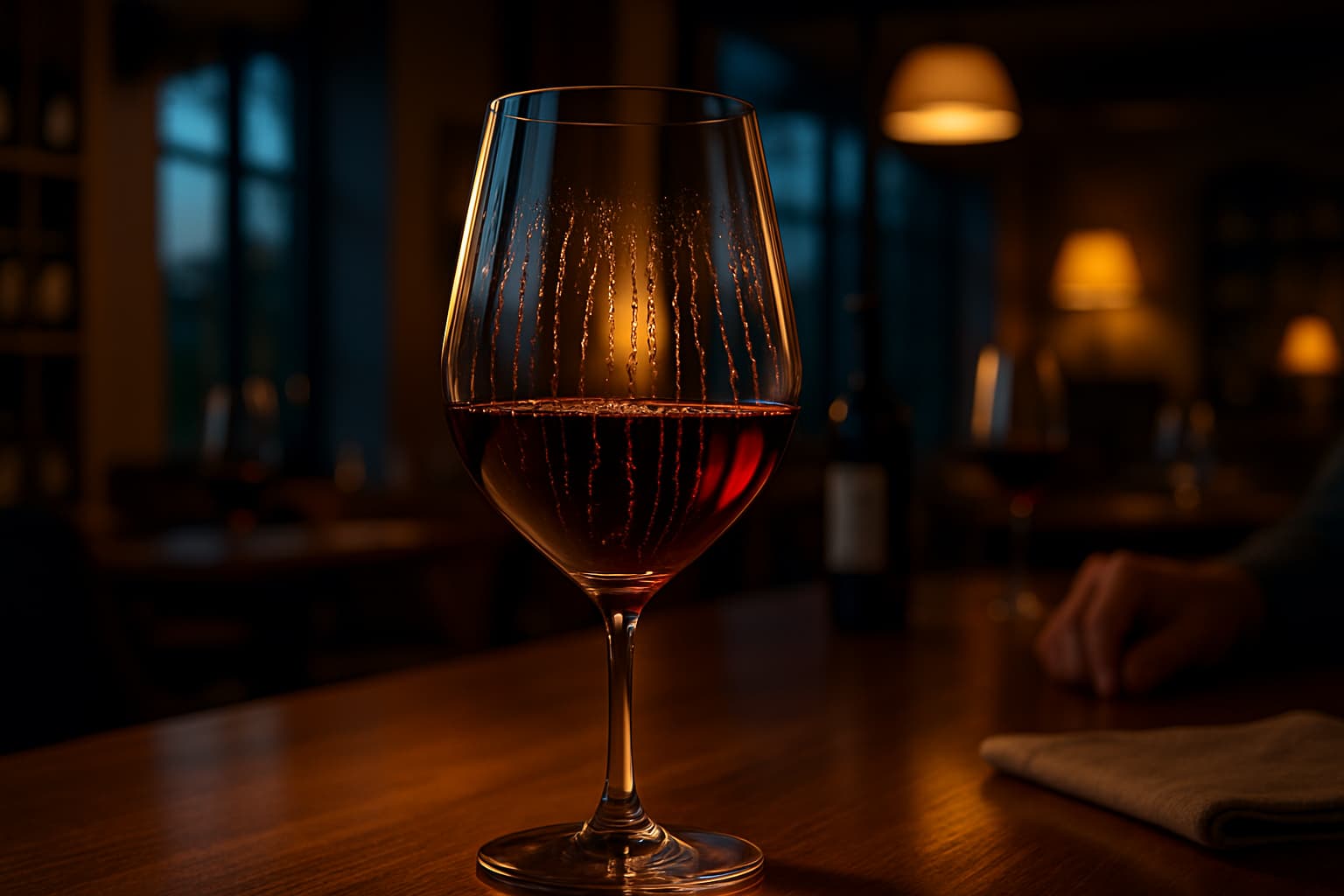
In the soft glow of a tasting room, a glass of wine is gently swirled. The liquid rises, clings to the glass, and then, with unhurried grace, descends in delicate trails. These shimmering rivulets are watched with quiet fascination, as if they are revealing some ancient secret of the vine. Many have seen them; fewer truly understand them. Yet in these simple streaks of liquid, we witness a small but beautiful drama of physics, chemistry, and human imagination.
Welcome to the world of wine legs.
Observe a glass of wine at rest: a still pool of color, ruby or gold, catching the light. Now introduce motion—just a gentle swirl. The wine climbs the inner wall of the glass, forming a thin film. Then, as if exhausted by its ascent, the film gathers into droplets that slowly slide downward, leaving trails behind. These are the so‑called “legs,” sometimes called “tears of wine.”
For centuries, drinkers have gazed at these legs and woven stories: that they reveal quality, price, age, or even the winemaker’s skill. It is a romantic notion, and romance has long been a faithful companion to wine. But beneath the poetry lies a more prosaic, yet no less wondrous, explanation: the interplay of alcohol, surface tension, and evaporation.
At their simplest, wine legs are the streaks or droplets that form on the inside of a glass after swirling. They appear when a thin film of wine creeps up the glass, then breaks into beads that slide or “walk” back down.
They are not:
Instead, they are a visible consequence of how alcohol and water behave together when they encounter air and glass. In other words, wine legs are a small, elegant demonstration of physics at play in your hand.
To understand wine legs, we must step briefly into the realm of physical science, into a phenomenon known as the Marangoni effect—a process found in soap bubbles, industrial coatings, and even in the behavior of tears on a windowpane.
Wine is a mixture, primarily of water and ethanol (alcohol), along with sugars, acids, and aromatic compounds. Alcohol and water do not evaporate at the same rate. Alcohol evaporates more quickly and has a lower surface tension than water.
When you swirl the wine:
This continuous cycle of evaporation, surface tension change, upward flow, and downward fall creates the mesmerizing dance of wine legs. It is not magic, nor mysticism, but a delicate interplay of forces—an everyday miracle made visible in a glass.
While wine legs do not reveal quality in the way many once believed, they are not entirely silent. They can hint at certain characteristics of the wine, if interpreted with care.
The most reliable connection is to alcohol by volume (ABV). In general:
This is because a higher alcohol concentration intensifies the evaporation difference between alcohol and water, strengthening the Marangoni effect.
Some tasters notice that wines with a fuller body—often richer, denser wines—appear to have “heavier” legs. This can be influenced by:
These substances can make the wine feel more viscous, and sometimes this is reflected in how the legs move: slower, thicker, more languid. Yet this is a subtle effect and not always reliable.
High‑alcohol wines often come from warmer climates, where grapes ripen more fully and accumulate more sugar, which then ferments into alcohol. Thus, pronounced legs may hint at:
But this is inference, not certainty. Many exceptions exist, shaped by winemaking choices and grape varieties.
The world of wine is rich in myth, and wine legs have inspired their share of legends. It is important to separate romance from reality.
Wine legs do not reliably indicate:
Quality
A simple, inexpensive wine with high alcohol can show dramatic legs.
A subtle, exquisitely crafted wine with moderate alcohol may show very modest legs.
To judge a wine’s true character, we must turn to our senses: sight, yes, but also smell and taste. Legs are but a prelude, not the performance itself.
If one approaches a glass of wine as a field biologist might approach a forest, with patience and curiosity, even the smallest details become fascinating. To observe wine legs with care:
In these quiet observations, one begins to see wine not only as a beverage, but as a living system of forces and reactions, shaped by sun, soil, yeast, and time—and, finally, by the laws of physics.
Why have wine legs been so misunderstood? Perhaps because they are visible, mysterious, and easy to ascribe meaning to. Humans have always read omens in the sky, in the flight of birds, in the pattern of leaves. It is no surprise that we look for secrets in the sides of a glass.
There is a certain romance in believing that these delicate trails reveal a wine’s soul. In truth, they reveal its alcohol, and to a lesser extent its texture. Yet this does not diminish their beauty. On the contrary, it underscores a deeper wonder: that something as abstract as surface tension—an invisible property of molecules—can manifest itself in such a graceful, almost theatrical display.
In the end, wine legs are a reminder that even our most familiar pleasures are governed by forces we seldom consider. Every swirl of the glass is a small experiment, every droplet a quiet testament to the laws of nature.
The phenomenon you witness in wine is not confined to vineyards and cellars. Similar patterns appear in many corners of the natural world:
All are influenced by differences in surface tension, by the Marangoni effect, by the eternal tug‑of‑war between gravity and molecular forces. When you gaze at wine legs, you are, in a sense, observing a tiny echo of patterns that shape rivers, clouds, and even the delicate films that coat living cells.
Thus, the glass in your hand becomes a miniature laboratory, a lens through which to glimpse universal principles.
If legs are not a shortcut to quality, how should one approach a glass of wine?
Wine legs may be your first impression, but they should not be the last word. Think of them as the opening lines of a much longer, richer narrative.
In a world of rushing and noise, it is a rare pleasure to pause and watch something as quiet as wine legs forming and falling. They remind us that, even in the everyday act of lifting a glass to our lips, we are surrounded by subtle wonders.
Within that glass lies the labor of vines reaching deep into the earth, of grapes ripening under sun and star, of yeast transforming juice into something far more complex. And atop this grand story of biology and geology, another layer of beauty appears: the dance of molecules, the whisper of evaporation, and the silent pull of surface tension.
Wine legs do not tell us if a wine is great or ordinary, expensive or modest. But they do tell us that nature is always at work, even in the smallest, most overlooked details. To notice them is to be reminded that science and poetry are not adversaries, but partners—two voices describing the same delicate trails on the side of a glass.
And so, the next time you swirl your wine and see those slender streaks descending, you might pause, just for a moment, to marvel. For in those fleeting tears of wine, you behold not only a drink, but the quiet choreography of the universe itself.
Tannins are astringent compounds found in wine that contribute to its texture and aging potential, often causing a drying or puckering sensation in the mouth. They are derived from grape skins, seeds, and stems, as well as from oak barrels used during aging.
/ˈtænɪnz/
Malic acid is a naturally occurring organic acid found in grapes that contributes to the tart, green apple-like flavor and crispness in wine. It plays a significant role in the taste and acidity of wine.
/mælɪk ˈæsɪd/
A thin film forms
The swirling motion spreads a thin coat of wine up the inner walls of the glass.
Alcohol begins to evaporate
At the top of this film, exposed to the air, alcohol evaporates more rapidly than water.
As it leaves, the local alcohol concentration in that upper region decreases.
Surface tension changes
With less alcohol and relatively more water, the surface tension at the top of the film becomes higher than at the bottom, where alcohol concentration remains slightly greater.
Liquid begins to flow
Liquid tends to move from areas of low surface tension to areas of high surface tension.
So the wine is drawn upward along the glass, defying gravity for a moment, pulled by this invisible gradient.
Droplets form and fall
Eventually, gravity reasserts itself. The accumulating film of wine becomes too heavy to cling. It breaks into droplets—these are the “legs”—which then slide back down the glass.
Age
Old wines do not necessarily have more pronounced legs than young ones. Age affects color, aroma, and flavor far more than the behavior of legs.
Price
A costly bottle is not guaranteed to have “better” legs. Price is determined by land, labor, rarity, and reputation—not by the thickness of streaks on a glass.
Complexity of flavor
Aromatic complexity arises from a symphony of compounds, grape variety, terroir, and winemaking. Legs alone cannot reveal this intricate music.
Use a clean, clear glass
Any residue of detergent or grease can interfere with the formation of legs. A tulip‑shaped wine glass, narrowing at the top, provides an ideal stage.
Pour a modest amount
One‑third full or less allows room for swirling and observation.
Swirl gently
Rotate the glass slowly, coating the inner walls. No need for violent motion; subtlety reveals more.
Hold the glass still and watch
Observe how the film gathers, how droplets form, how quickly they begin to fall. Are the legs fine and delicate, or thick and dramatic? Do they slide swiftly or creep slowly?
Compare different wines
Place a light, low‑alcohol white wine beside a robust, high‑alcohol red. Swirl both. The contrast in their legs can be striking, a simple experiment in your own home.
Filtration in winemaking is the process of removing solid particles from wine to clarify and stabilize it before bottling, using various types of filters to achieve different levels of clarity and remove unwanted elements like yeast, bacteria, and sediment.
/fɪlˈtreɪʃən/
Oxidation in wine is a chemical reaction between the wine and oxygen that can change its flavor, aroma, and color. This process can be beneficial or detrimental depending on the extent and context of the exposure.
/ˌɒksɪˈdeɪʃən/
Microclimate refers to the unique climate conditions of a small, specific area within a larger region, significantly influencing grapevine growth and the characteristics of the resulting wine.
/ˈmīkrōˌklīmit/
Get weekly wine recommendations, vineyard news, and exclusive content delivered to your inbox.
-361a711c.webp&w=3840&q=75)
-8dd86257.webp&w=3840&q=75)