Wine Literature and Media
“Where every bottle tells a story”
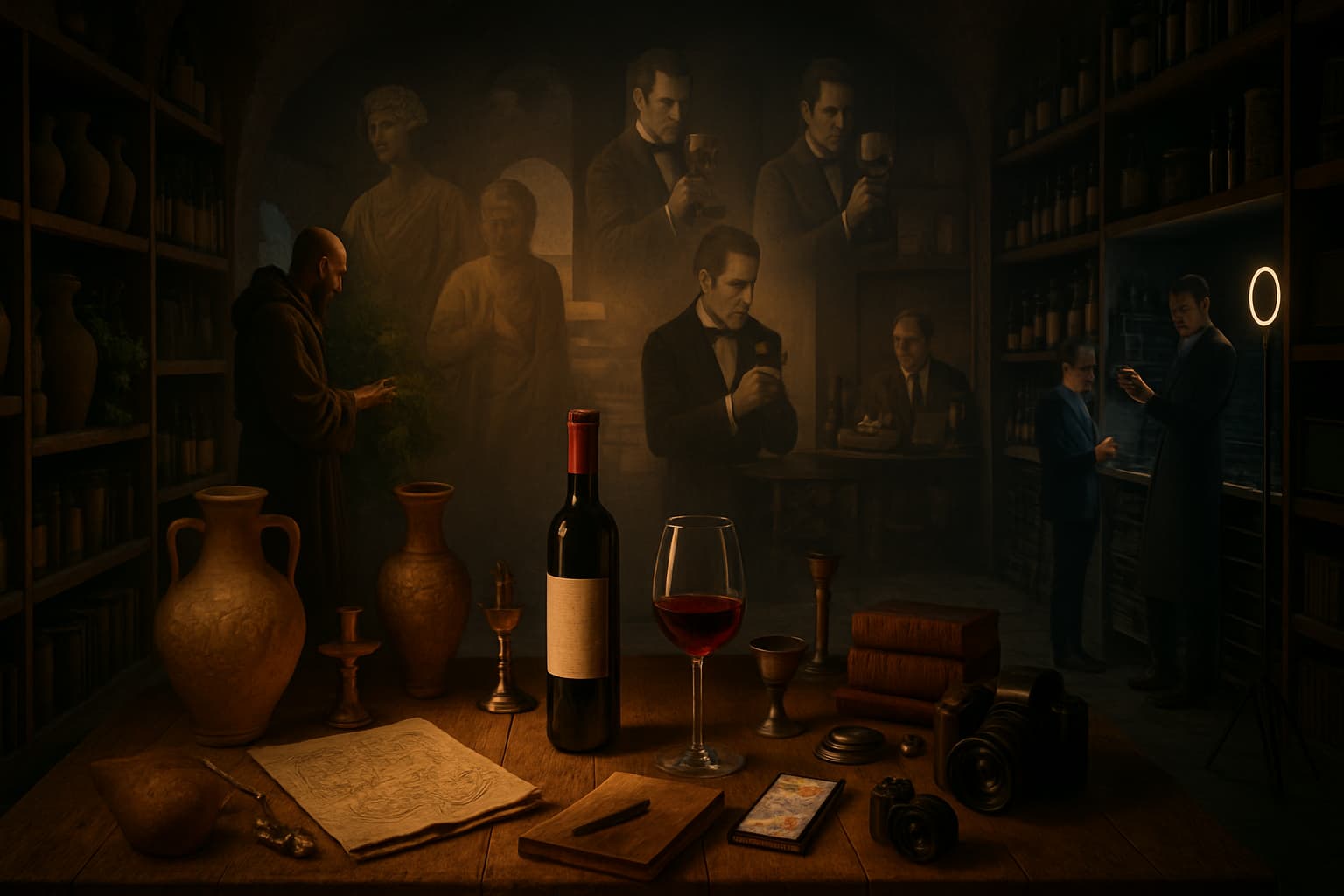
There’s a certain point in every drinker’s life when the glass stops being just a glass and suddenly becomes a portal. One minute you’re sipping fermented grape juice; the next you’re standing knee‑deep in 3,000 years of human madness—priests, poets, emperors, frauds, monks, critics, and marketing departments all clawing at the same bottle like starving rats in a grain silo.
Wine is not just a beverage. It’s a psychotropic historical archive. And the only way to understand how we talk about it now—the tasting notes, the “hints of gooseberry and wet river stone,” the scores, the Instagram somms—is to trace the long, deranged evolution of wine in literature and media. This is the story of how a simple agricultural product became a fully weaponized cultural hallucination.
Let’s light the fuse.
Long before glossy magazines and sommelier documentaries, wine lived in the fever dreams of gods and prophets.
The ancient Greeks weren’t writing “wine reviews”; they were composing hymns to Dionysus, the original patron saint of ecstatic chaos. In Homer’s Iliad and Odyssey, wine is everywhere—dark, heavy, “wine‑dark sea” and all that—less a drink than a divine lubricant for war, hospitality, and bad decisions. It’s a symbol of civilization, but always with a razor in its shoe.
The Greeks, and later the Romans, wrote about wine as part of the cosmic order. Hesiod talks about when to harvest the grapes. Pliny the Elder catalogs wines and regions in Naturalis Historia like a proto‑wine geek on clay tablets, ranking vineyards around the Mediterranean with the same obsessive mania you see on modern wine forums. He notes which wines age, which fall apart, which are fit for emperors and which are for the poor bastards working the fields.
Then the Bible staggers into the room with a hangover and a sermon. Noah plants a vineyard and gets drunk. Jesus turns water into wine, and suddenly the whole Christian project is infused with this sacramental, symbolic juice. Wine becomes blood, literally, in the Eucharist—nothing subtle about that. Religious texts treat wine as both blessing and danger: divine joy on one side, moral collapse on the other. That tension—between rapture and ruin—becomes the heartbeat of wine writing for centuries.
Early wine “literature” is not about flavor; it’s about meaning. Wine is a metaphor for life, death, salvation, and sin. No one is talking about “subtle notes of cassis.” They’re talking about God, fate, and whether your soul is going to fry.
As the Roman Empire dissolves into chaos, the monks step in like quiet, robe‑wearing control freaks and save European wine from historical oblivion.
Medieval monastic orders—Benedictines, Cistercians—start meticulously documenting vineyards, soils, slopes, and methods in manuscripts and cellar books. They’re not writing for fun or for the masses; they’re writing for continuity, for the glory of God, and for the smooth operation of their estates. Still, this is early terroir writing: a recognition that one patch of earth produces something different from another patch a few meters away.
These monks, in their cold stone cloisters, are early data‑driven wine nerds. Burgundy’s later obsession with climats and crus is born here, inked in Latin by men who believed that understanding a hillside was a form of prayer.
Outside the monasteries, wine appears in medieval poetry and tales—Chaucer’s Canterbury Tales throws wine into the mix as social glue and moral test—but again, it’s not about bouquet; it’s about behavior. Wine in literature is a character witness: it exposes who you really are.
As Europe claws its way out of the Dark Ages and into the Renaissance, wine starts to appear more in secular texts, travel diaries, and medical treatises. Doctors prescribe it. Philosophers drink it. Poets praise it.
By the 17th and 18th centuries, the French and the British are building the foundations of modern wine culture—and its literature. The British, with their unfortunate climate and fortunate naval power, become importers and commentators. They write about Bordeaux, Port, Madeira, and Sherry in letters and merchant records. Wine writing becomes entangled with trade, politics, and class.
The Enlightenment loves classification, and wine is ripe for the scalpel. In 1855, at the demand of Napoleon III, Bordeaux gets its famous Classification for the Exposition Universelle in Paris. This is not a book, but it might as well be: a ranked list of châteaux that functions as a permanent, printed social hierarchy in liquid form. The idea that wine can be systematically ranked and codified becomes gospel.
Literature of the period—Fielding, Austen, Balzac—uses wine as a social signifier. What you drink, how you serve it, and how you talk about it reveal your class and character. Wine moves from sacred symbol to status symbol.
Somewhere in the 19th century, writers start looking at wine not as an object of classification, but as a weapon against the suffocating boredom of industrial civilization.
The Romantics and their descendants turn to intoxication as both subject and method. Baudelaire, in Les Fleurs du mal, writes about wine as a pathway to altered states: “Il faut être toujours ivre” (“You must always be drunk”). On wine, poetry, or virtue—just don’t be sober. Wine is no longer just a drink; it’s a revolutionary act against the tyranny of rationality.
In Russia, Tolstoy and Dostoevsky lace their novels with scenes of drinking that expose human frailty and desperation. In America, Walt Whitman writes about “the maddening wine” of life. Wine is not described in technical terms; it’s described as a force—something that loosens the seams of the soul.
This is also when early wine books start to appear in English and French aimed at the educated layperson—guides to regions, grapes, and styles. They’re still relatively dry, but the idea of wine as a topic worthy of standalone books—rather than a footnote in religious or scientific texts—takes hold.
The 20th century drags wine out of dusty cellars and throws it under the harsh fluorescent lights of mass media.
Before World War II, wine writing is mostly the domain of merchants, aristocrats, and a few eccentric scholars. British writers like André Simon and later Michael Broadbent chronicle vintages, estates, and auctions with a restrained, almost surgical precision. These are men taking notes in cold tasting rooms, not shouting into cameras.
Their books and articles—often published in club journals, trade magazines, or limited‑run volumes—lay the groundwork for modern tasting language: structure, balance, finish, typicity. They help codify the idea that wine can be described systematically, even if their metaphors remain relatively tame.
After World War II, Western economies boom, air travel expands, and suddenly the middle class wants in on the fun. Wine shifts from aristocratic hobby to aspirational lifestyle. This is where wine literature and media metastasize.
Magazines like Decanter (founded 1975) and Wine Spectator (1976 as a tabloid, then magazine in 1979) start pumping out ratings, profiles, and glossy vineyard porn. Newspaper columns pop up in major cities—wine coverage becomes a regular feature, not an exotic curiosity.
In the U.S., a few pivotal books hit the scene:
This era is educational and aspirational. The tone is: “Let us teach you, dear reader, how not to embarrass yourself in front of the sommelier.”
Then comes Robert M. Parker Jr., like a well‑intentioned meteor.
In the late 1970s, a Baltimore lawyer launches The Wine Advocate, an independent newsletter with a simple, brutal innovation: the 100‑point rating scale, adapted from American school grading. Wine is no longer just described; it is scored, quantified, weaponized.
Parker’s influence in the 1980s and 1990s is thermonuclear. A high score in his publication can make or break a wine, a vintage, or an entire region’s reputation. Wineries chase his palate—ripe, powerful, heavily oaked reds. Critics call it “Parkerization”: the global shift toward big, dense, high‑alcohol wines built to impress in blind tastings and on paper.
From a media perspective, this is the triumph of shorthand. The 100‑point score is the perfect tool for a frantic, information‑overloaded world. You don’t need to read paragraphs—you just need the number. Nuance is flattened into a metric.
Around Parker, a whole ecosystem of critics and publications rises: Wine Spectator, Wine Enthusiast, Decanter, Gambero Rosso, and many more. Wine literature becomes a hybrid of journalism, guidebook, and market report. The language grows more baroque—“notes of cassis, cigar box, graphite, and crushed violets”—as if the critic is in a death match with the thesaurus.
This is wine media as centralized authority: a small priesthood of experts issuing scores from the mountaintop.
By the late 20th and early 21st century, cracks appear in the temple walls. A new wave of writers emerges, less interested in numerical domination and more interested in stories, people, and the absurdity of the whole circus.
Kermit Lynch’s Adventures on the Wine Route (1988) reads like a road novel with barrels. He writes about French vignerons as characters in a wild ecosystem of tradition, stubbornness, and quiet rebellion. Alice Feiring charges into print as a fierce advocate for “natural wine,” attacking manipulation in winemaking with a kind of puritanical ferocity that feels almost religious.
Then there’s the punk fringe: writers who treat wine less like a sacred cow and more like a slightly deranged friend. They swear, they rant, they tell you about hangovers and heartbreak. Blogs in the 2000s explode with this energy—independent voices snapping at the heels of the big magazines. Suddenly, anyone with a keyboard and a corkscrew can publish tasting notes and diatribes.
The tone shifts from “let me instruct you” to “come drink with me and see what happens.”
Literature alone isn’t enough for this beast. Wine seeps into film and television, mutating again.
TV shows and streaming series—travel‑meets‑wine formats, vineyard dramas, reality competitions—turn wine into entertainment content. The focus is less on what’s in the glass and more on who’s holding it and what’s at stake: love, money, status, identity.
Wine media becomes character‑driven. The bottle is now a prop in the ongoing theater of human neurosis.
The internet doesn’t just disrupt wine media; it shreds it into a thousand pieces and scatters them across the digital landscape.
Wine blogs in the 2000s democratize opinion. Some are brilliant; many are deranged. But together they do something important: they break the monopoly of the big critics. Forums like Wine Berserkers and CellarTracker reviews let ordinary drinkers log their notes, building vast crowdsourced databases.
Wine apps—Vivino, Delectable—turn every smartphone into a pocket critic. Scan the label, see the average rating, read a few notes, and decide. The 100‑point scale mutates into a 5‑star system and a hive mind.
Influencers on Instagram and TikTok arrive with perfectly lit glasses, vineyard selfies, and short, punchy reels. The aesthetic shifts: less text, more image; less analysis, more vibe. The narrative becomes: “Here’s how wine fits into your aspirational lifestyle.”
Digital media also amplifies new movements and marginalized voices. Natural wine—low‑intervention, often cloudy, sometimes volatile—gets championed by writers and creators who see it as an anti‑industrial, anti‑Parker rebellion. Zines, newsletters, and niche sites spring up, half manifestos, half tasting notes.
Writers start examining wine through lenses of labor, climate change, colonial history, gender, and race. Who owns the land? Who picks the grapes? Who gets to be called a “vigneron” versus a “worker”? Wine writing becomes political, philosophical, and occasionally unhinged.
The old, sanitized narrative—romantic château, noble family, timeless tradition—gets interrogated, dismantled, and rebuilt.
Across this whole deranged timeline, the language used to describe wine has mutated like a virus.
Today’s tasting note—those florid lists of fruits, flowers, spices, plus references to obscure minerals and childhood memories—is a late invention. It’s a hybrid of scientific description, poetic inflation, and marketing spin. It pretends to be objective, but it’s deeply subjective, culturally loaded, and often ridiculous.
Yet beneath the absurdity, there’s a real human urge: to pin down an experience that is fleeting and complex, to translate sensation into language, to share a moment in the glass with someone who isn’t there.
That’s what all wine literature and media are really trying to do: make the ephemeral permanent, the personal communal.
We’ve reached a point where the noise is deafening. Critics, bloggers, influencers, brand accounts, documentary filmmakers, TikTok sommeliers, AI tasting bots—everyone is screaming into the same digital void about acidity and tannin and “crunchy red fruit.”
The irony is brutal: never in history has there been more information about wine, and never has it been harder for a normal human to make sense of it.
But there’s something hopeful in the chaos. The monopoly of a few gatekeepers is broken. A small producer in Georgia or Chile can find an audience through a well‑timed article, a documentary cameo, or a viral post. A young writer can bypass traditional magazines and build a following with a newsletter that reads like a fever dream from a barstool in Beaujolais.
The best modern wine writing and media don’t pretend to be neutral. They admit their biases, their obsessions, their blind spots. They tell stories of failure and confusion alongside ecstasy. They acknowledge the hangover.
If you strip away the scores, the jargon, the glossy photos, the influencer poses, and the ancient hymns, you’re left with something simple and unnervingly human:
Wine is how we talk about ourselves without admitting it.
Every era’s wine literature and media reveal its neuroses and dreams:
In the end, all the tasting notes and documentaries and breathless Instagram captions are just variations on the same wild, recurring question: What does it mean to be alive, briefly, on this planet, with this bottle, in this moment?
You open a wine and it’s already dying. You drink it and it’s gone. The only things that remain are the memory and the words you choose to pin it down. That’s why we keep writing about wine, filming it, arguing over it, turning it into poetry and propaganda.
Because for a few minutes, with the right glass and the right company, the world tilts, the noise fades, and something honest slips through. And then, like every great story and every great bottle, it’s over.
So we reach for another. And we keep writing.
Tannins are astringent compounds found in wine that contribute to its texture and aging potential, often causing a drying or puckering sensation in the mouth. They are derived from grape skins, seeds, and stems, as well as from oak barrels used during aging.
/ˈtænɪnz/
Malic acid is a naturally occurring organic acid found in grapes that contributes to the tart, green apple-like flavor and crispness in wine. It plays a significant role in the taste and acidity of wine.
/mælɪk ˈæsɪd/
Filtration in winemaking is the process of removing solid particles from wine to clarify and stabilize it before bottling, using various types of filters to achieve different levels of clarity and remove unwanted elements like yeast, bacteria, and sediment.
/fɪlˈtreɪʃən/
Oxidation in wine is a chemical reaction between the wine and oxygen that can change its flavor, aroma, and color. This process can be beneficial or detrimental depending on the extent and context of the exposure.
/ˌɒksɪˈdeɪʃən/
Microclimate refers to the unique climate conditions of a small, specific area within a larger region, significantly influencing grapevine growth and the characteristics of the resulting wine.
/ˈmīkrōˌklīmit/
Get weekly wine recommendations, vineyard news, and exclusive content delivered to your inbox.