Wine Literature and Media
“Where every bottle tells a story”

The first thing you learn, if you survive long enough, is that most of the wine in the world is lying to you.
It smiles from the shelf with a pastoral label—little sketch of a vineyard, a smug château, maybe a crest or a crow—and behind that thin paper skin is a chemical Frankenstein, a laboratory beverage dressed up like a countryside dream. People toast anniversaries with it. They pair it with ethically sourced cheese. They call it “terroir” and “expression” and “craft.”
What they don’t call it—at least not often enough—is what it really is: industrial agriculture in a glass.
Somewhere along the way, wine stopped being fermented grape juice and turned into a lifestyle accessory. But there’s a countercurrent now: a ragged, half-mad army of growers and winemakers trying to drag the thing back to its roots. Call it natural wine, authentic wine, sustainable wine—the names are fuzzy, the rules are fuzzier, and the debates are vicious. But underneath the marketing slogans and the Instagram haze is a real, ugly, beautiful fight over what wine is and what it should be.
This is not a gentle story. It’s a story about soil and rot and sulfur and mold and money and ideology. It’s a story about people who are either saving wine’s soul or running a cult, depending on who you ask.
Let’s go in.
To understand what “authentic” means, you have to look first at the machine.
Most wine is made like most processed food: at scale, with precision, and with an almost religious fear of unpredictability. Industrial vineyards are monoculture deserts—the same clone of the same grape, row after row, sprayed with a chemical alphabet soup: herbicides to kill the weeds, fungicides to kill the mold, insecticides to kill the bugs, fertilizers to keep the vines pumping out high-yield fruit like factory workers on a double shift.
Then the grapes roll into the winery, and the real wizardry begins. You don’t like the color? Adjust it. You don’t like the flavor? Correct it. You want more oak? Fake it. You want consistency across millions of bottles, year after year, in a world where the weather is losing its mind? There are tools for that. Enzymes, cultured yeasts, fining agents, acidification, deacidification, tannin powder, reverse osmosis, sterile filtration, Mega Purple. A pharmacopoeia of control.
The labels don’t tell you this. They’re not required to. Wine is one of the last great black boxes of the grocery aisle: a “natural” product that can legally contain dozens of additives without a whisper of disclosure.
Most people don’t know. Many don’t want to know. The bottle is pretty. The wine tastes “smooth.” The price is right. The system hums along.
But in the cracks of that system, something feral has been growing.
“Natural wine” is a phrase that inspires more eye-rolling in certain circles than “crypto” or “influencer.” It’s vague, it’s abused, it’s trendy. But at its core, the idea is disarmingly simple: wine made from grapes grown without synthetic chemicals, fermented with native yeasts, with as little intervention as possible.
That’s it. That’s the bomb in the cathedral.
Because if you strip away the chemicals, the designer yeast, the corrections and manipulations, you’re left with something dangerous: variability. Vintage. Place. The raw, unfiltered personality of grapes that actually lived somewhere instead of being grown like plastic tomatoes under fluorescent light.
There’s no single global rulebook, but most serious natural winemakers orbit a few core principles:
To the industrial world, this sounds like madness. To the natural camp, it sounds like sanity.
The great lie of the supermarket shelf is that wine is a thing you make in a tank. The great truth of authentic wine is that it’s something that happens in the vineyard and in the microbial jungle you allow—or refuse—to exist.
The authentic winemaker’s war starts with the ground.
Healthy soils are not a romance-novel concept; they’re a microbial city-state. Fungi, bacteria, worms, beetles, all working in a delirious underground economy, trading nutrients, balancing water, building structure. This is where the whole idea of terroir stops being a poetic French word and becomes a biological fact: the specific mix of life in a specific place, interacting with vines in a specific way.
You kill that system with chemicals, you still get grapes. But you lose complexity, resilience, nuance. You start managing symptoms instead of ecosystems.
Authentic growers—organic, biodynamic, regenerative, whatever banner they march under—bet on complexity over control. They:
It’s slower. It’s riskier. It’s more labor-intensive. And it’s the only way to make wine that actually tastes like somewhere instead of nowhere.
Once the grapes come in, the real gamble begins.
In a conventional winery, the goal is control. You kill off the native yeasts with sulfur and sometimes other agents, then inoculate with a lab yeast strain designed to give you “tropical fruit” or “red berry” or “clean ferment in cold conditions.” You add nutrients so the yeast don’t stall. You adjust acidity. You manage temperature like a paranoid helicopter parent.
You get predictability. You get a brand.
In a natural cellar, you’re closer to a séance than a science lab. You crush or press the grapes, and you wait to see which yeasts wake up—the ones that survived in the vineyard and the cellar. The weirdos. The locals.
Native yeast fermentations are messy:
This is where the word “authentic” starts to feel less like a slogan and more like a dare. Are you willing to let the wine be what it wants to be? Or are you going to drag it back into line with tools and powders?
Even the most hardcore natural winemakers intervene sometimes: temperature control so the whole tank doesn’t cook itself to death; gentle pump-overs or punch-downs so you don’t grow a botrytis swamp; hygiene, for the love of all that ferments.
Authenticity is not the absence of technique. It’s the refusal to use technique as a muzzle.
You can’t talk about natural and sustainable wine without stepping into the sulfur minefield.
Sulfur dioxide (SO₂) is the wine world’s favorite villain and indispensable bodyguard. It:
Used in sane amounts, it’s a safety net. Used in obscene amounts, it’s a straightjacket. Industrial wines often rely on heavy sulfur doses to protect a fragile product that’s been pushed and processed to its limits.
The natural camp splits into factions:
Authenticity here isn’t about hitting some magic number of parts per million. It’s about honesty of intent: Are you using sulfur as a scalpel or a sledgehammer? As a preservative or as a way to erase flaws you created upstream?
“Natural” and “authentic” are sexy words. “Sustainable” sounds like a corporate training manual. But this is where the rubber hits the road, because if your “authentic” wine is wrecking the land and torching the climate, it’s just another vanity project.
Sustainable winemaking is a three-headed beast:
Certifications—organic, biodynamic, sustainable, carbon-neutral—are attempts to codify this chaos. They help. They also create paperwork, costs, and loopholes. Some of the most honest growers never certify; some of the slickest marketing operations are covered in stamps.
The only real test is to go there. Walk the vineyard. Talk to the people. Smell the cellar. Authenticity is hard to fake up close.
Natural and authentic wine has become a scene—bars with neon-orange glasses, labels that look like indie band posters, tasting notes full of “kombucha,” “mouse,” and “crunchy red fruit.” There is hype. There is dogma. There are people who will forgive any flaw as long as the wine was made by a tattooed vigneron in a reclaimed warehouse.
The backlash came right on schedule:
Some of this is true—about some bottles, some producers, some idiots. There are wines out there that are oxidized, mousy, volatile, and microbial disasters, protected from criticism by a cloak of ideology.
But to dismiss the whole movement because of its worst excesses is like dismissing all literature because you hate Twitter threads.
The best authentic wines—call them natural, call them sustainable, call them honest—are not fashion statements. They are:
They are not perfect. They are not consistent. They are not safe.
That’s the point.
If you want to support authentic, natural, sustainable wine without getting lost in the jargon and the cults, a few hard-won rules:
In the end, this isn’t just a debate about sulfur levels or yeast strains or bottle weights. It’s a philosophical knife fight over reality itself.
Do you want wine to be a perfectly controlled, repeatable, branded experience—a smooth, predictable anesthetic for the late-capitalist nervous system?
Or do you want it to be what it was for most of human history: an agricultural gamble, a fermented expression of soil and weather and human judgment, sometimes glorious, sometimes flawed, always tethered to something real?
Authentic, natural, sustainable winemaking is not a trend; it’s a rebellion against the idea that everything we consume must be optimized, standardized, denatured, and sold back to us as “lifestyle.” It’s a refusal to let wine become just another soft drink with a better label.
You don’t have to drink cloudy orange skin-contact wine out of a Zalto glass and post it on social media to take a side. You just have to care—however quietly—about where your pleasure comes from, and what it costs the land, the people, and your own capacity to taste something that hasn’t been sanded smooth.
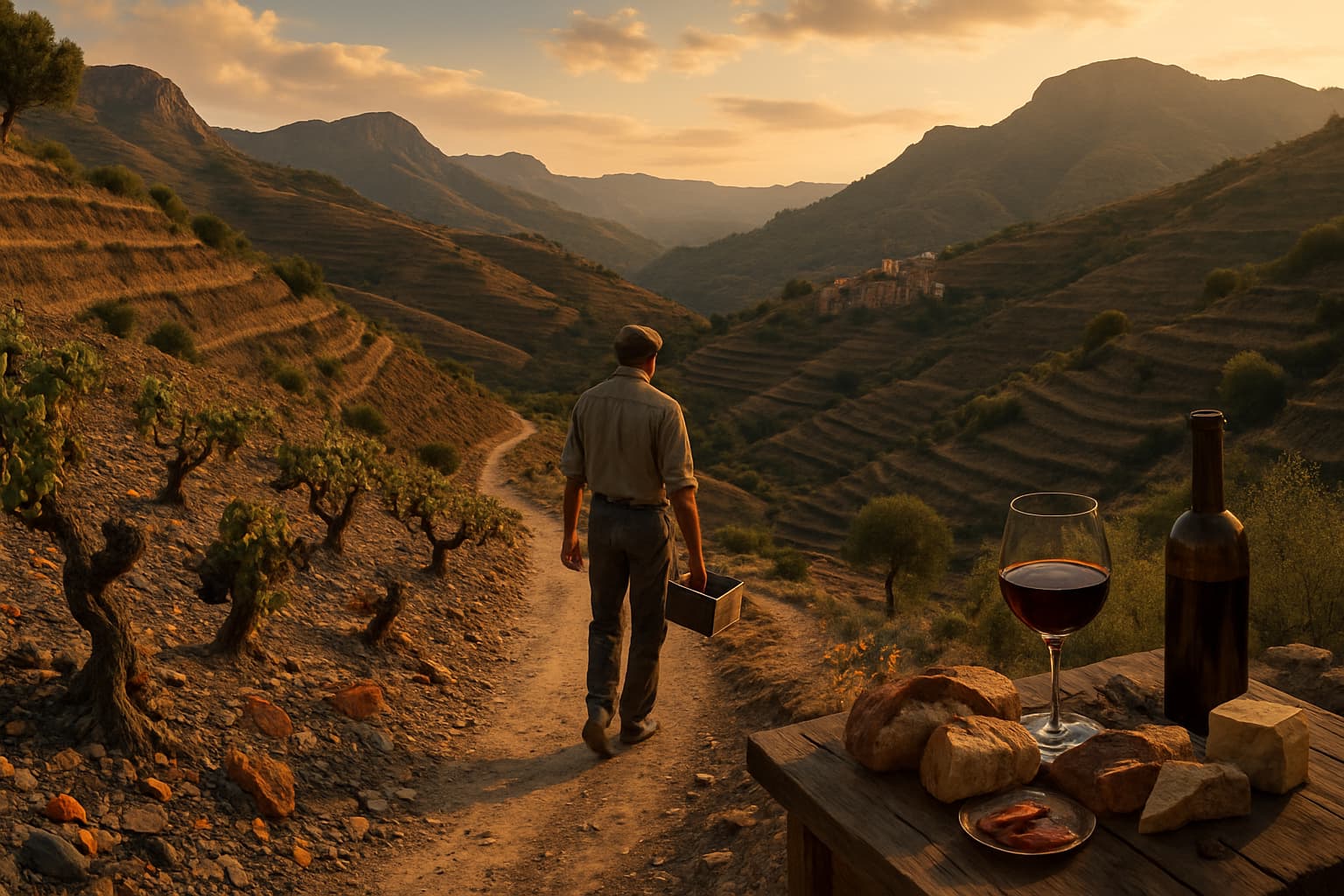
Somewhere right now, a farmer is walking between rows of vines that haven’t seen a drop of herbicide in years. The soil is dark and crumbly. There are spiders in the canopy, birds in the air, cover crops underfoot. Harvest is coming. The grapes will come in sticky and imperfect. The cellar will smell like yeast and fear and hope.
A few years from now, you might open that bottle. It may not be flawless. But if they did their job, and you do yours, you’ll taste more than fruit and oak. You’ll taste a place. A season. A set of decisions that refused the easy way out.
In a world hallucinating on its own simulations, that kind of reality is rare. And it’s worth drinking to.
Tannins are astringent compounds found in wine that contribute to its texture and aging potential, often causing a drying or puckering sensation in the mouth. They are derived from grape skins, seeds, and stems, as well as from oak barrels used during aging.
/ˈtænɪnz/
Malic acid is a naturally occurring organic acid found in grapes that contributes to the tart, green apple-like flavor and crispness in wine. It plays a significant role in the taste and acidity of wine.
/mælɪk ˈæsɪd/
Environmental
Social
Economic
Follow growers, not labels
Learn names. Look for people farming their own vineyards, talking about soil more than stainless steel. When in doubt, ask: “How are the vines farmed?” If nobody knows, that’s your answer.
Trust importers and retailers with a spine
Good importers and shops are the filters in this madness. They taste thousands of wines so you don’t have to. Find the ones who can talk farming and winemaking without reading from a press release.
Accept variability
Authentic wine is like weather. Some days are perfect; some days are weird. You’re not buying a product; you’re buying a story with a few missing pages.
Question the greenwashing
“Eco,” “sustainable,” “clean,” “low-intervention”—none of these words are regulated. Ask what they mean. If the answer is vague, move on.
Pay what it’s worth
Real farming and careful cellar work cost money. If a bottle claims to be hand-harvested, organic, small-production, shipped across the world, and it costs less than a cocktail, somebody’s lying or suffering.
Filtration in winemaking is the process of removing solid particles from wine to clarify and stabilize it before bottling, using various types of filters to achieve different levels of clarity and remove unwanted elements like yeast, bacteria, and sediment.
/fɪlˈtreɪʃən/
Oxidation in wine is a chemical reaction between the wine and oxygen that can change its flavor, aroma, and color. This process can be beneficial or detrimental depending on the extent and context of the exposure.
/ˌɒksɪˈdeɪʃən/
Microclimate refers to the unique climate conditions of a small, specific area within a larger region, significantly influencing grapevine growth and the characteristics of the resulting wine.
/ˈmīkrōˌklīmit/
Get weekly wine recommendations, vineyard news, and exclusive content delivered to your inbox.