Wine Literature and Media
“Where every bottle tells a story”
There are some pleasures in life that feel almost embarrassingly simple: the sound of a cork easing its way out of a bottle, the first swirl of garnet or pale gold in a glass, the way a room seems to soften as the first sip is taken. Wine, for all its centuries of history and its sometimes intimidating vocabulary, is really about that moment: a quiet, private thrill, shared with others or stolen for yourself at the end of the day.
If you live in Europe, you are already steeped—whether you know it or not—in a continent that has been marinating in wine for millennia. Vines crawl over stone walls in Portugal, cling to impossibly steep slopes on the Rhine, bask in the Mediterranean sun in Greece, and huddle against Atlantic winds in Galicia. Wine is not just a drink here; it’s a landscape you can pour into a glass, a culture you can sip.
This is an introduction, not a lecture. Think of it as being invited into a warm kitchen where a bottle has just been opened, and someone is saying, “Taste this, and let me tell you a story.”
Wine in Europe is not merely fermented grape juice; it is history you can taste.
The ancient Greeks and Romans were already drinking wine while pondering philosophy and empire. They carried vines with them as they travelled and conquered, planting them like signatures across the continent. Monks in medieval monasteries tended vineyards with devotional care, mapping out the best plots of land—what the French call terroir—long before anyone thought to put it on a label.
Today, the European Union may have its regulations, appellations, and acronyms, but at heart, wine here is still deeply local. A carafe of house red in a Tuscan trattoria, a chilled Vinho Verde in a Portuguese bar, a sturdy Carignan in a French village bistro: each is a small, drinkable postcard from a very specific somewhere.
When you drink European wine, you’re not just choosing a flavour; you’re choosing a place and a story. And that, I think, is where the magic begins.
Before we gallop into grape varieties and regions, it’s worth slowing down and luxuriating in the simple act of drinking wine. You don’t need to become a sommelier. You just need to pay the kind of attention you might give to a lover’s voice, or the smell of bread just out of the oven.
Hold your glass up—ideally against a white background, but a napkin or the tablecloth will do. You’re not being pretentious; you’re being curious.
As wine ages, whites often deepen in colour, while reds tend to lighten and turn more brick-like at the rim. Think of it as watching time in liquid form.
Bring the glass to your nose, but don’t bury yourself in it; this is seduction, not suffocation. Give it a gentle swirl—like rolling a silk scarf between your fingers—and then inhale.
You might catch:
You don’t have to name everything. Just notice. The joy lies in the noticing.
Take a small mouthful and let it roll around your tongue. Don’t gulp; let it linger.
Ask yourself:
This is not an exam. It’s a guided flirtation with your senses.
You may hear wine people talk about “Old World” and “New World” wines. Europe, of course, is the Old World: France, Italy, Spain, Germany, Portugal, Greece, Austria, and their neighbours. New World wines come from places like Australia, Chile, South Africa, the United States, Argentina, and New Zealand.
Very broadly—and we must always allow exceptions, because wine loves to surprise us:
Old World wines tend to be:
New World wines often:
If Old World wine is a quietly smouldering glance, New World can be an exuberant embrace. Living in Europe, you have the enviable luxury of being close to the source of so many Old World classics, but that doesn’t mean you must shun the rest of the world. Think of it as expanding your social circle.
White wine in Europe is not a single idea; it’s a spectrum.
Rosé has been unfairly dismissed as frivolous, but it is, in fact, the perfect bridge between red and white: chilled, refreshing, and yet charmingly versatile.
Rosé is what you pour when you don’t know what everyone wants. It’s the diplomatic wine, but with flair.
Red wine in Europe ranges from delicate and translucent to dark and brooding.
European wine labels can seem like cryptic crossword clues, but once you know a few basics, they become friendly, if occasionally eccentric, guides.
In much of Europe, especially France, Italy, and Spain, the label often tells you where the wine is from, not what grape it’s made from.
Once you learn a few of these place–grape relationships, the shelves become less of a mystery and more of an invitation.
Different countries have their own systems, but a few common terms:
Think of these not as rigid hierarchies but as clues about style and structure.
You don’t need a tasting room or a spittoon. A kitchen table, a glass, and a bit of curiosity are enough.
Compare two wines side by side Pour, say, a Portuguese Vinho Verde and a French Sancerre. Sip each. Which feels leaner? Which more aromatic? Which makes you hungrier?
In a supermarket or wine shop, the shelves can loom. Here is a quietly reassuring approach:
Wine doesn’t demand a cellar; it just prefers not to be mistreated.
Storage
In the end, wine is not about status, or scores, or being able to recite the difference between left bank and right bank Bordeaux (unless you enjoy that sort of thing). It is about pleasure—quiet, persistent, everyday pleasure.
Living in Europe, you are surrounded by vineyards you may never see, but whose work arrives in your glass. Each bottle is a little act of time travel, a way of touching another place, another season, another person’s labour and hope.
Let wine be your companion, not your master. Let it sit on the table with your bread and cheese, your stew and salad, your solitary bowl of pasta at midnight. Swirl it, sniff it, sip it. Learn a little, forget a little, and remember that the most important question is never “Is this a great wine?” but always, “Do I like this, right now, with this food, in this moment?”
If the answer is yes, then you have already mastered more about wine than many who can pronounce every appellation perfectly. And that, I think, deserves another glass.
Tannins are astringent compounds found in wine that contribute to its texture and aging potential, often causing a drying or puckering sensation in the mouth. They are derived from grape skins, seeds, and stems, as well as from oak barrels used during aging.
/ˈtænɪnz/
Malic acid is a naturally occurring organic acid found in grapes that contributes to the tart, green apple-like flavor and crispness in wine. It plays a significant role in the taste and acidity of wine.
/mælɪk ˈæsɪd/
Crisp and zesty
Aromatic and expressive
Rich and creamy
Light and lively
Medium and versatile
Full-bodied and intense
France:
Italy:
Spain:
Taste with food
Wine is a companion, not a soloist. Try:
Keep a very casual “memory”
No need for formal notes unless you enjoy them. Just remember: “That Spanish Albariño we had with the mussels—I want that feeling again.” Wine is as much about memory as flavour.
Decide the mood, not the grape
Look for clues of style on the back label: words like “crisp,” “fruity,” “oaked,” “full-bodied,” “dry.” They’re imperfect but useful.
Don’t be afraid of price, but don’t worship it either
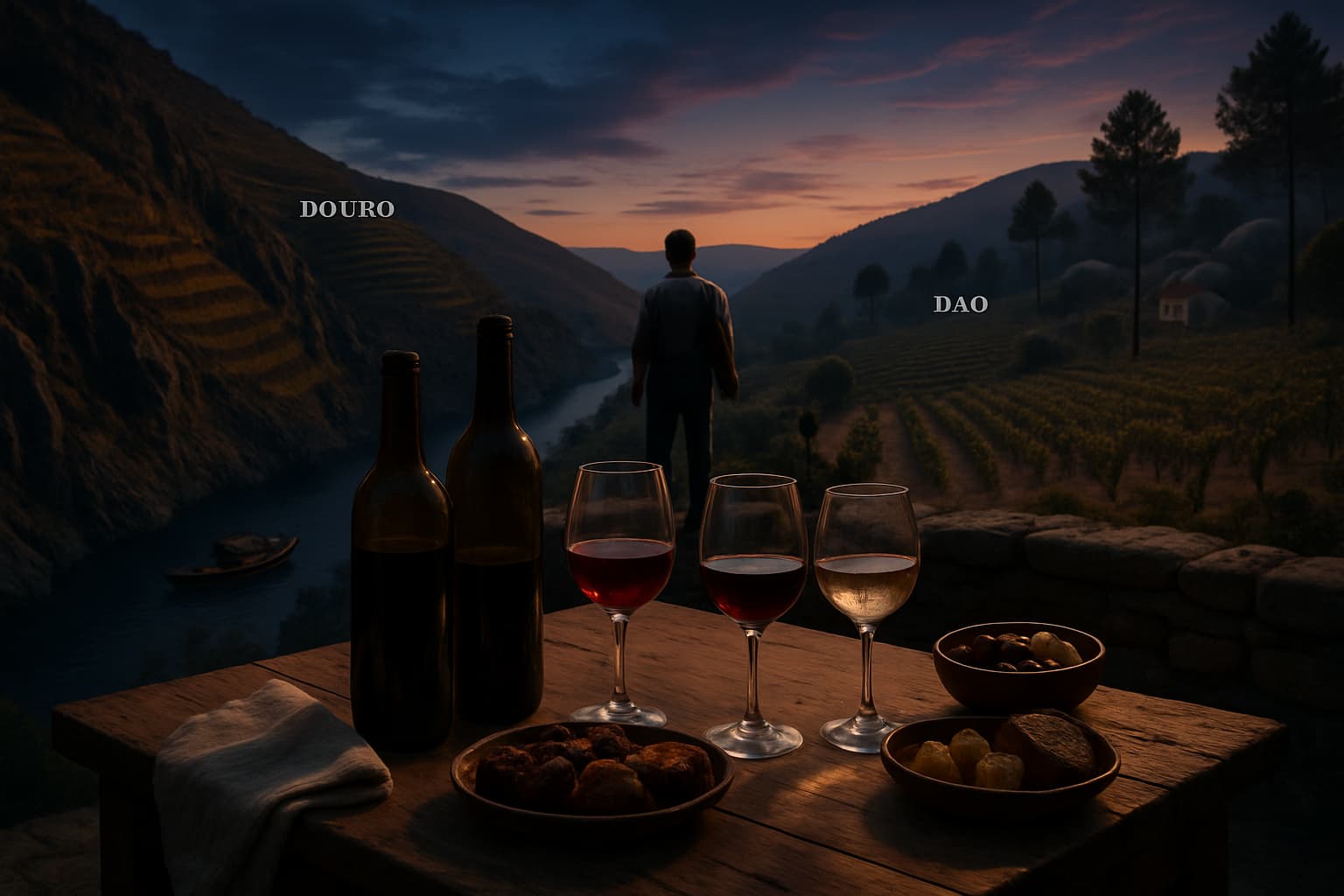
In Europe, a modestly priced bottle from a lesser-known region (like Portugal’s Dão, Spain’s Bierzo, Italy’s Marche, or France’s Languedoc) can be far more rewarding than a famous name at the same price.
Ask for help
In a decent wine shop, say: “I’m making roast chicken and potatoes; I’d like a red that’s not too heavy, around this price.” This is not an exam; it’s a collaboration.
Temperature
Glasses
Use whatever you have, but if you can, choose glasses that taper slightly at the top to trap the aromas. They don’t need to be expensive; they just need to let the wine breathe and your nose in.
Filtration in winemaking is the process of removing solid particles from wine to clarify and stabilize it before bottling, using various types of filters to achieve different levels of clarity and remove unwanted elements like yeast, bacteria, and sediment.
/fɪlˈtreɪʃən/
Oxidation in wine is a chemical reaction between the wine and oxygen that can change its flavor, aroma, and color. This process can be beneficial or detrimental depending on the extent and context of the exposure.
/ˌɒksɪˈdeɪʃən/
Microclimate refers to the unique climate conditions of a small, specific area within a larger region, significantly influencing grapevine growth and the characteristics of the resulting wine.
/ˈmīkrōˌklīmit/
Get weekly wine recommendations, vineyard news, and exclusive content delivered to your inbox.