Wine Literature and Media
“Where every bottle tells a story”
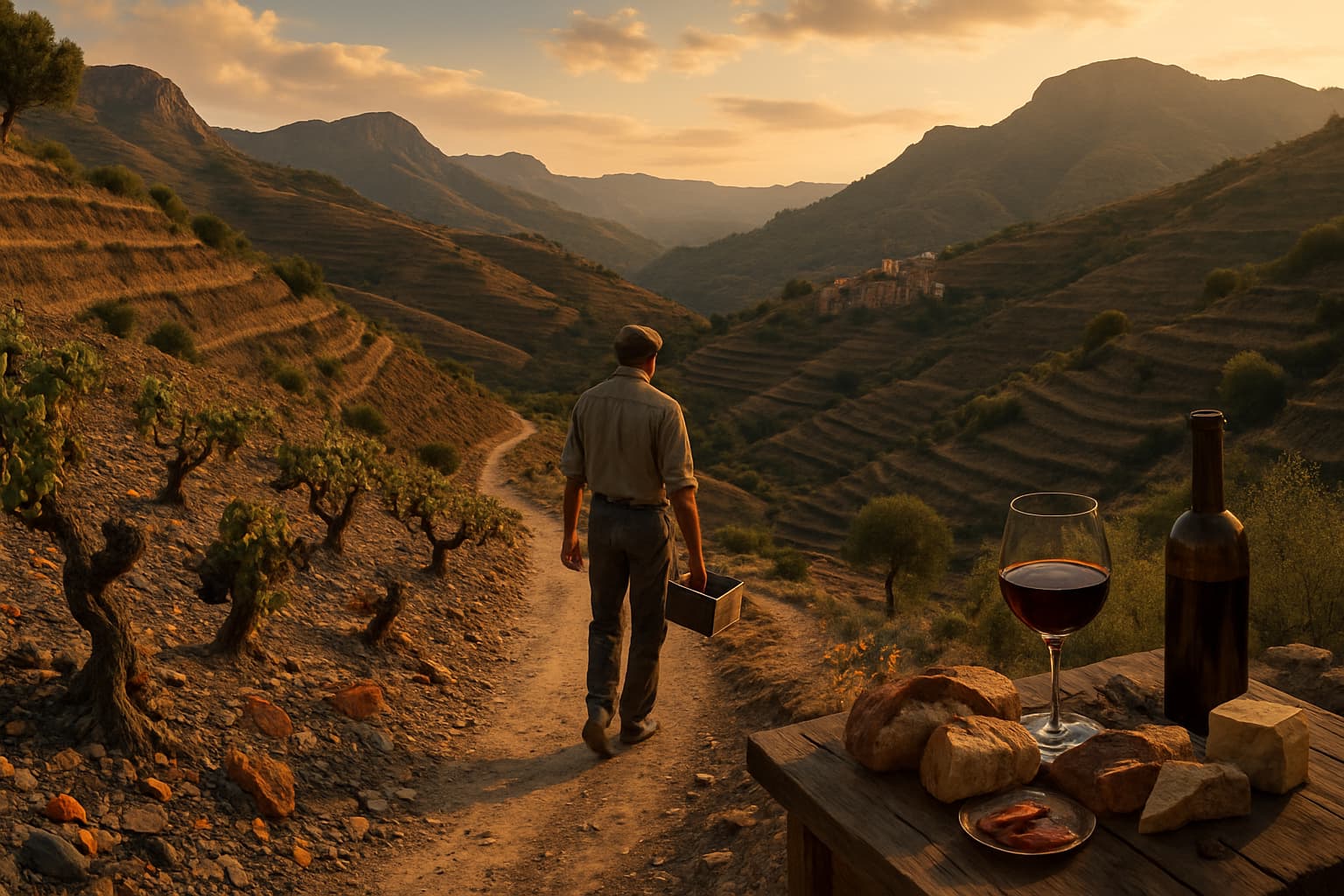
The road wound up from the coast in slow turns. The sea fell away behind and the land closed in. The hills were not gentle. They were hard and broken and the color of old blood and rust and dried bones. The men who worked them were the same. They did not talk much. They worked and they drank the wines that came from those hills, and they knew that both the work and the wine were honest.
This is Priorat and Montsant. The names sound like stones in the mouth. They should. The wines come from stone.
The first thing is the ground. If you do not understand the ground, you cannot understand the wine.
In Priorat they call the soil llicorella. It is dark slate and broken quartz, sharp and layered like pages of a burned book. It breaks under your hands and slides under your boots. When the sun is high it holds the heat and throws it back. The vines grow in cracks that do not look like enough to keep a weed alive. But the roots go down. They go down ten meters, fifteen, hunting for water in a place where the sky is stingy with rain.
Montsant wraps around Priorat like a rough arm. The soil is not just one thing there. There is slate too, and limestone, and clay, and gravel. The old riverbeds leave stones that bake in the sun. The mountains hold the vineyards in a crooked ring. The winds come down from the north and up from the sea and cross in the dry air.
It is not a soft country. The hills are steep. The terraces cling to the slopes. In summer the heat presses on your back and the light is white and hard. In winter the wind cuts. The vines twist and hunch low to the ground as if they know better than to stand tall.
This is not a place for easy wines.
The vines in Priorat and Montsant are not young. Many were planted before wars that people now only remember in old photographs and bitter stories. Some are more than eighty years old. You see them, thick and gnarled, with arms like the hands of men who have swung picks their whole lives.
They are mostly Garnacha and Cariñena. In other places they call them Grenache and Carignan and make light wines or sharp ones. Here they are different. The yields are low. The vines do not give much fruit. What they give is small and concentrated, like a man who has worked all day and says little because he has no breath left for lies.
Garnacha brings heat and flesh and the taste of ripe red fruit: cherries, plums, sometimes strawberries that have sat in the sun. Cariñena brings backbone, acidity, darker fruit, and a certain bitterness that feels clean, like the edge of a good knife.
In the late years of the twentieth century, men came from the cities and the outside world and saw these old vines and this wild land. They were not fools. They knew what could be done with such things if you had patience and some money and a kind of stubbornness that does not quit when the first harvest does not pay.
They bought or rented vineyards that others had abandoned. They worked the terraces. They used old vines and new barrels. They made wines that were dense and dark and strong. People far away noticed. They wrote about Priorat. They gave high scores. The prices rose. The name became known.
Montsant watched. It had the same sky, some of the same stones, old vines too. The growers there did not have the old prestige of the monks of Scala Dei or the new fame of the big names in Priorat. But they had their land and their grapes and their own kind of quiet hunger. So they worked as well, and their wines began to speak.
Priorat is a small place. The villages are few: Gratallops, Porrera, Scala Dei, La Vilella Alta, La Vilella Baixa, Torroja, and the others. You can drive between them in an afternoon if the road is clear and your car is strong enough for the hills. But the vineyards are broken up, scattered, terraced, hidden in folds of the land. It is not a neat patchwork. It is a map drawn by struggle.
The climate is Mediterranean, but a harsh version: hot summers, cold nights. The slate keeps the heat and gives it back to the vines when the sun is gone. The wind dries the grapes after rain. Disease does not find it easy here. The struggle is with heat and drought and the steepness of the slopes.
The wines are not shy. In the glass they are dark, nearly black at times, with deep purple edges. They smell of black cherries, plums, blackberries, dried herbs, anise, smoke, and stone dust. Sometimes there is the sweetness of ripe figs, the bitterness of cocoa, the scent of hot earth after rain. The alcohol can be high—fifteen percent is not rare—but in the best bottles the heat is carried well by the fruit and the structure.
You drink a good Priorat and it is like drinking the land itself. It is intense and thick but not clumsy. There is weight, and there is a kind of vertical pull from the acidity and the minerality. The slate shows itself in a taste that is hard to name but easy to feel. It is like iron and salt and smoke all at once, with no one of those things taking over.
These are wines made for long meals and long nights. They stand up to meat that has seen flame and bone: lamb roasted until the fat crisps, beef grilled over vine cuttings, stews that have simmered half a day. They are not wines for delicate fish and pale sauces. They are wines for when you are hungry and tired and want something that will not fail you.
Montsant surrounds Priorat in a rough circle, like a younger brother who has worked in the same fields but has not yet been called to the front of the room. The name comes from the holy mountain. The old hermits and monks knew these hills before wine critics did. They came to be alone with God. Now the vines keep them company.
The vineyards spread wider here. The soils change as you go. In some places the slate is like Priorat’s, dark and sharp. In others the limestone is pale and crumbling, giving the wines a different line of freshness. There are pockets of sandy soils where phylloxera never bit as deep, and old vines survived on their own roots.
Montsant’s climate is a little softer in some spots, a little cooler in others. The wines reflect that. They are often a shade lighter than Priorat, but not weak. They have red and black fruits—cherries, raspberries, blackberries—with spice and herbs: rosemary, thyme, fennel that grows wild by the roadside. The best have a firm spine and a clear voice. They are not trying to be Priorat. They are themselves.
You can find Garnacha and Cariñena here too, and also Tempranillo, Syrah, and Cabernet Sauvignon. Some producers blend the French grapes in. Others hold to the old varieties. Many of the wines are more approachable when young than their neighbors from Priorat. They can be drunk with pleasure without waiting ten years. They are good with grilled sausages, cured meats, stews with beans, hard cheeses. They belong on a rough wooden table with bread that has a crust you can break your teeth on.
Montsant has given something important to the wine world: honesty at a fair price. While Priorat climbed in fame and cost, Montsant held the line for people who wanted the taste of these hills without paying for the glory of a name. In the right bottle you can feel the same sun, the same wind, the same struggle of roots in stony ground, and you can drink it on an ordinary night.
In both places the grapes are often harvested by hand. The slopes demand it. Machines cannot cling to those terraces. Men and women go up and down with crates on their backs in the heat. They pick early in the morning or late in the evening. They know each vine. They know which bunches to leave and which to take.
In the cellars the styles differ. Some winemakers use new French oak barrels and long aging. The wood gives spice and toast and a polished frame. Others use old barrels, foudres, or concrete, letting the fruit and the stone speak more plainly. There are those who chase power and extraction, and those who seek balance and freshness. Over time, the fashion has moved away from thick and heavy to something more precise. But the land does not change. It still gives intensity.
White wines are made too. People often forget that. In Priorat there is Garnacha Blanca, Macabeo, Pedro Ximénez, even a little Chenin Blanc and others. In Montsant, Garnacha Blanca and Macabeo are common. These whites are not pale ghosts. They are full, with weight on the tongue, flavors of white peach, almond, fennel, citrus peel, sometimes a salty edge. They can age, growing nutty and complex. They taste like the light of the place, bright but not soft.
There are also sweet wines, made from late-harvest grapes or sun-dried ones. Old people in the villages will tell you stories of rancio wines, kept in old barrels under the roof, dark and oxidative, smelling of walnuts and dried figs and burnt sugar. These wines do not care about modern fashion. They are the memory of another time.
If you want to know these wines, do not drink them in a hurry. They are not for quick thirst. Open the bottle and let it breathe. Pour a little in the glass. Look at the color. Smell it once, and then again after a minute. The wine will open like a man who does not trust you yet and then decides you are worth talking to.
Drink them with food that has weight and fat and salt: lamb, beef, pork from pigs that have walked and rooted and eaten acorns. Dishes with beans and chorizo. Game if you can get it. Rabbit stewed in wine and herbs. These wines need something to push against. Then they show their strength without seeming brutal.
If you keep bottles, these are good to lay down: five years, ten, sometimes fifteen or more for the best Priorats. With time the fruit calms and the structure smooths. The flavors turn from fresh berries to dried fruits, spices, leather, tobacco, and that deep taste of stone and earth that stays when the fruit has stepped back.
Montsant can age too, though many of its wines are made for earlier drinking. The better ones will show well after five to eight years, gaining depth and losing any rough edges.
Wine is only fermented grape juice. Men say this when they want to sound tough or wise. But it is more than that when it is honest. It carries the weight of the land and the work of the hands that made it. It remembers the sun and the cold nights and the years when there was too much rain and the years when there was not enough.
In Priorat you taste a place that was almost forgotten. The old terraces were left to weeds when people left the hills to work in factories or on the coast. Then the vines were brought back to life and the world looked again. It is a story of ruin and return. The wines are like that—dark, powerful, marked by hardship, but alive.
In Montsant you taste a place that stood in the shadow and did not complain. It kept working. It did not have the old fame of the monks or the new glory of the critics. It had its vineyards and its people and the long, slow discipline of farming. Its wines speak more softly, but they are no less true.
You can drink wines from many places that are smooth and clean and say nothing. They are made to be liked and forgotten. The wines of Priorat and Montsant are not like that. They are not always easy. They are not always perfect. But when they are good, they stay with you. You remember the taste of slate and sun and dried herbs. You remember the sense that the wine has come from somewhere real.
In the end that is what matters. A wine should be like a man or a woman who has lived and has scars and does not hide them. Priorat and Montsant give you such wines. They are wines of stone and heat and work. You drink them and you know something more about the world, and about yourself, than you did before you pulled the cork.
Tannins are astringent compounds found in wine that contribute to its texture and aging potential, often causing a drying or puckering sensation in the mouth. They are derived from grape skins, seeds, and stems, as well as from oak barrels used during aging.
/ˈtænɪnz/
Malic acid is a naturally occurring organic acid found in grapes that contributes to the tart, green apple-like flavor and crispness in wine. It plays a significant role in the taste and acidity of wine.
/mælɪk ˈæsɪd/
Filtration in winemaking is the process of removing solid particles from wine to clarify and stabilize it before bottling, using various types of filters to achieve different levels of clarity and remove unwanted elements like yeast, bacteria, and sediment.
/fɪlˈtreɪʃən/
Oxidation in wine is a chemical reaction between the wine and oxygen that can change its flavor, aroma, and color. This process can be beneficial or detrimental depending on the extent and context of the exposure.
/ˌɒksɪˈdeɪʃən/
Microclimate refers to the unique climate conditions of a small, specific area within a larger region, significantly influencing grapevine growth and the characteristics of the resulting wine.
/ˈmīkrōˌklīmit/
Get weekly wine recommendations, vineyard news, and exclusive content delivered to your inbox.