Wine Literature and Media
“Where every bottle tells a story”
The madness started with a glass of red that smelled like a rockslide.
Not the polite, curated nonsense you swirl in a crystal bowl while some dead-eyed sommelier whispers about “forest floor.” No. This was granite, gunpowder, sunburned vines, and the ghost of a mule that died hauling barrels uphill in August. It hit the nose like a memory of violence and the mouth like a confession.
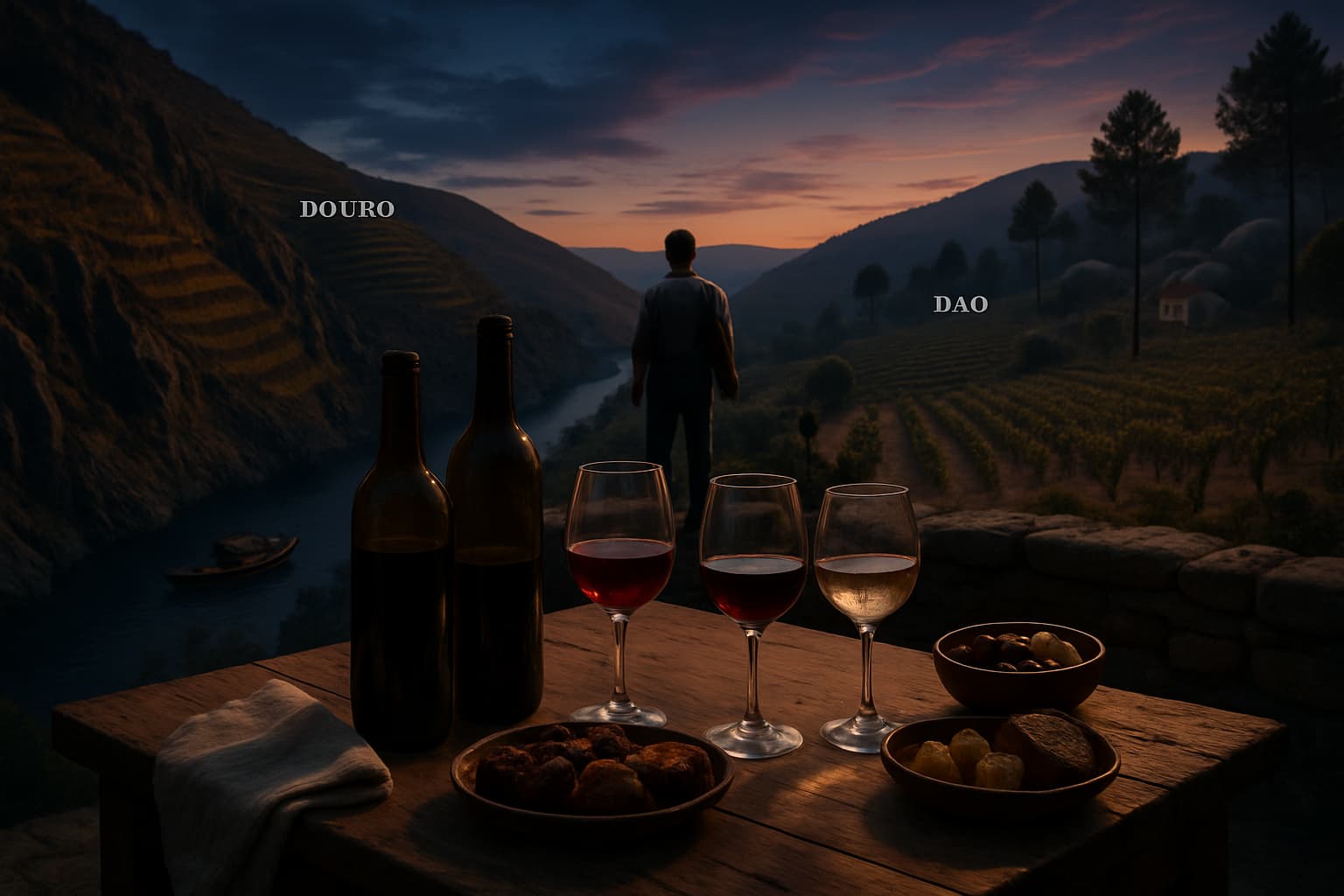
That’s when I realized: the Douro and the Dão are not wine regions. They are controlled substances with appellations.
These are not easy places. They are not gentle. They did not come here to please you. The Douro is a canyon of stone and heat; the Dão is a pine forest that decided to ferment its own secrets. Both are Portuguese, which means they’ve spent centuries being ignored by the international wine-industrial complex while quietly producing bottles that could dismantle your worldview on a Tuesday night.
Let’s go find them.
The Douro is where wine goes to prove it can survive hell.
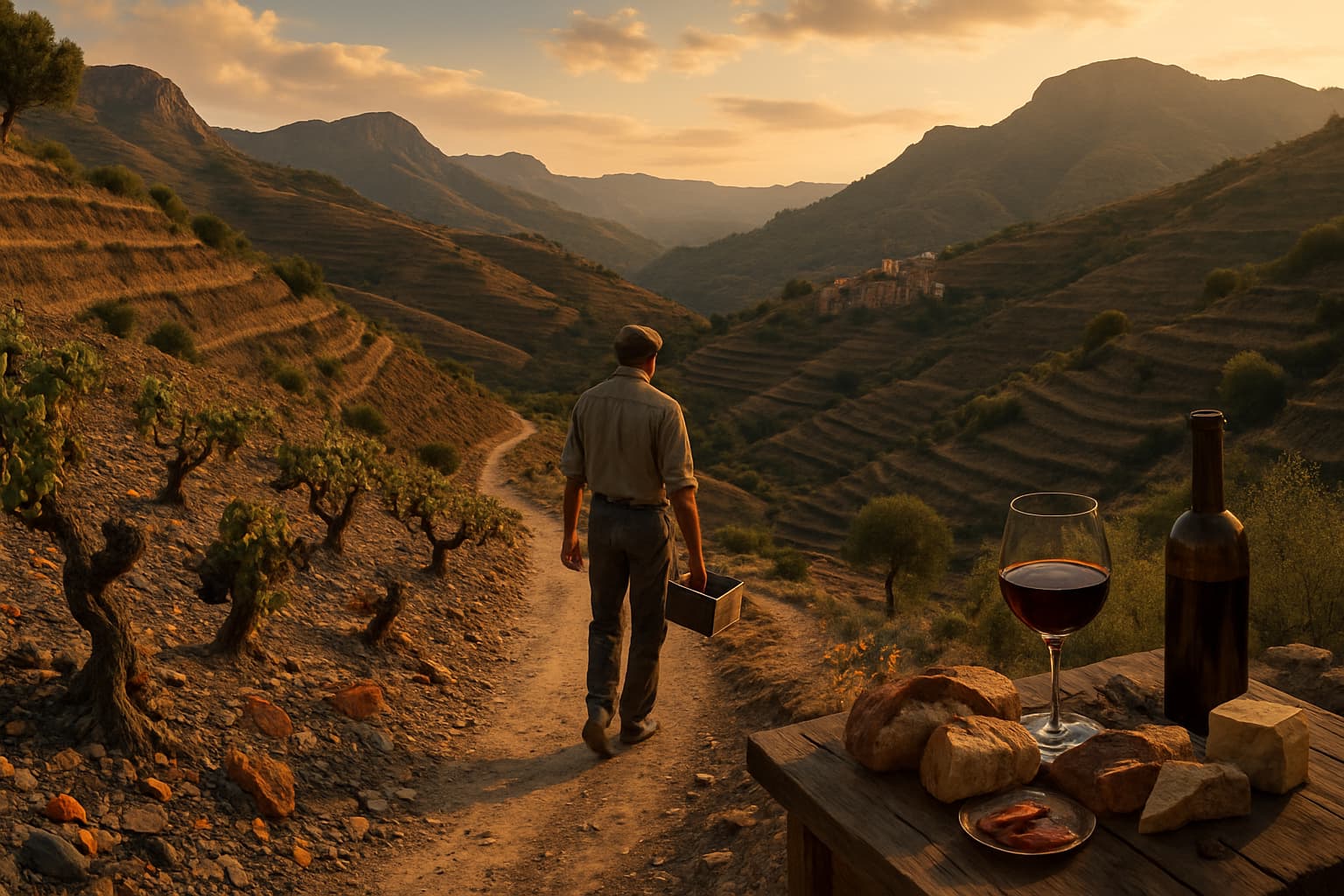
Picture this: a river clawing its way from Spain to the Atlantic, ripping a scar through the earth so deep the sun gets trapped in it. Terraces carved into slopes so steep you’d need a death wish and a decent pair of boots just to stand upright. Schist and granite stacked like broken teeth. Vines clinging to the rock like they’re trying not to fall into oblivion.
This is not a postcard. This is a survival scenario.
For centuries, the Douro has been the engine room of Port—fortified wine, a chemical weapon disguised as dessert. The English, drunk and desperate, made a pact with this landscape in the 17th century: “We’ll drink whatever you can grow, just make it strong enough to survive the trip to London.” They fortified the wines with brandy, shipped them downriver in barrel-laden boats called rabelos, and stumbled into history with purple teeth and ruined livers.
But that’s only half the story. The real revolution is what happened when the Douro stopped being just a Port factory and began bottling its red and white wines straight—unfortified, unfiltered, unrepentant. That’s when the region started to show its true, unmedicated personality.
The Douro is not Burgundy. Nobody here is whispering about Pinot Noir like it’s a fragile poet. This is a region of field blends and hard-knock grapes that taste like they’ve done time.
You will hear the same names in both Douro and Dão, but they wear different masks depending on where they grow and how much sunlight tried to kill them.
Key red conspirators:
White grapes, often ignored but not to be trusted:
In the Douro, these grapes are often blended. Field blends—multiple varieties planted together, harvested together, fermented together—are not a rustic accident; they are a deliberate, ancestral act of chaos management. The old-timers knew that diversity in the vineyard meant complexity in the glass and insurance against the wrath of weather.
Douro reds, at their best, are not “nice.” They are intense, structured, and unapologetically serious. You’re looking at:
The whites are a different sort of insanity:
If the Douro is a furnace, the Dão is a cathedral.
Drive south and inland, climb into the granite highlands, and the whole mood shifts. Pine forests. Granite boulders scattered like the gods were drunk when they built the place. Altitude. Fog. The light is different here—softer, more diffused, like the region is trying to hide something.
The Dão is older than your wine textbooks admit. It’s one of Portugal’s classic regions, but for decades it was shackled by a cooperative system that squeezed individuality out of the wines like juice from a cheap lemon: generic blends, industrial mediocrity, grapes crushed into anonymity.
Then the revolution came. Small growers broke ranks. Winemakers started listening to their vines instead of bureaucrats. Old vineyards were resurrected. The Dão began to remember what it was capable of.
Where the Douro is heat and schist, the Dão is granite and altitude. Those two words matter.
The Dão’s climate is continental but moderated by the surrounding mountains, which act like a paranoid security perimeter, blocking Atlantic storms and Iberian extremes. This gives the region a longer, more reflective growing season. The wines show it.
The names overlap with the Douro, but the performance is different.
White wines in the Dão are where things get quietly dangerous:
If Douro reds are a rock concert, Dão reds are a string quartet with a flask in the violin case.
Dão whites, especially Encruzado-based:
These regions are not rivals; they’re parallel answers to the same deranged question: “What happens if we plant vines in places that really don’t want humans around?”
Douro:
Dão:
Both regions share grapes, history, and a national habit of understatement. But in the glass, they tell different stories about the same country—one shouted from a canyon wall, the other whispered in a forest clearing.
If you’re going to dive into the Douro and Dão, you need a plan—or at least a flexible relationship with sobriety.
Wine regions like the Douro and Dão are not just agricultural zones. They’re arguments against the modern disease of standardization.
The world keeps trying to flatten everything—same grapes, same styles, same critic-approved flavor profiles, same soulless tasting rooms with reclaimed wood and curated playlists. Against that gray tide, the Douro and Dão stand like two scarred old fighters who never learned to box pretty but refuse to go down.
They are:
To drink these wines is to accept that not everything exists to be easy, smooth, or instantly legible. Some things are jagged, layered, and slow to reveal themselves. Some bottles demand patience, food, and a tolerance for ambiguity.
In a world hooked on instant gratification, that’s almost a revolutionary act.
The Douro and Dão are not for everyone. They are not Instagram wines. They do not come with simple tasting notes or clever hashtags. They are places where vines cling to stone, people cling to tradition, and the wines cling to your memory long after the bottle is empty.
You should care because:
Find a Douro red that smells like heated rock and wild berries. Find a Dão Encruzado that hums like an electric wire under a granite sky. Drink them with people who don’t mind silence between sips.
And when someone asks you what they taste like, don’t say “black fruit” or “good acidity.” Say:
“They taste like a river cutting through stone and a forest that refuses to explain itself.”
Then pour another glass. The night is young, the hills are old, and the wines of the Douro and Dão are just getting started.
Tannins are astringent compounds found in wine that contribute to its texture and aging potential, often causing a drying or puckering sensation in the mouth. They are derived from grape skins, seeds, and stems, as well as from oak barrels used during aging.
/ˈtænɪnz/
Malic acid is a naturally occurring organic acid found in grapes that contributes to the tart, green apple-like flavor and crispness in wine. It plays a significant role in the taste and acidity of wine.
/mælɪk ˈæsɪd/
Start with the dry wines.
Forget Port for a moment (blasphemy, yes, but necessary). Begin with:
Taste them side by side. Feel the difference in weight, in acidity, in the way the tannins behave.
Then move to the whites.
Add Port as the night bends.
Once you understand Douro’s dry side, circle back to Port:
Remember: this is fortified wine. It will rearrange your evening.
Eat like a local or suffer.
These wines are built for food:
Filtration in winemaking is the process of removing solid particles from wine to clarify and stabilize it before bottling, using various types of filters to achieve different levels of clarity and remove unwanted elements like yeast, bacteria, and sediment.
/fɪlˈtreɪʃən/
Oxidation in wine is a chemical reaction between the wine and oxygen that can change its flavor, aroma, and color. This process can be beneficial or detrimental depending on the extent and context of the exposure.
/ˌɒksɪˈdeɪʃən/
Microclimate refers to the unique climate conditions of a small, specific area within a larger region, significantly influencing grapevine growth and the characteristics of the resulting wine.
/ˈmīkrōˌklīmit/
Get weekly wine recommendations, vineyard news, and exclusive content delivered to your inbox.