Wine Literature and Media
“Where every bottle tells a story”
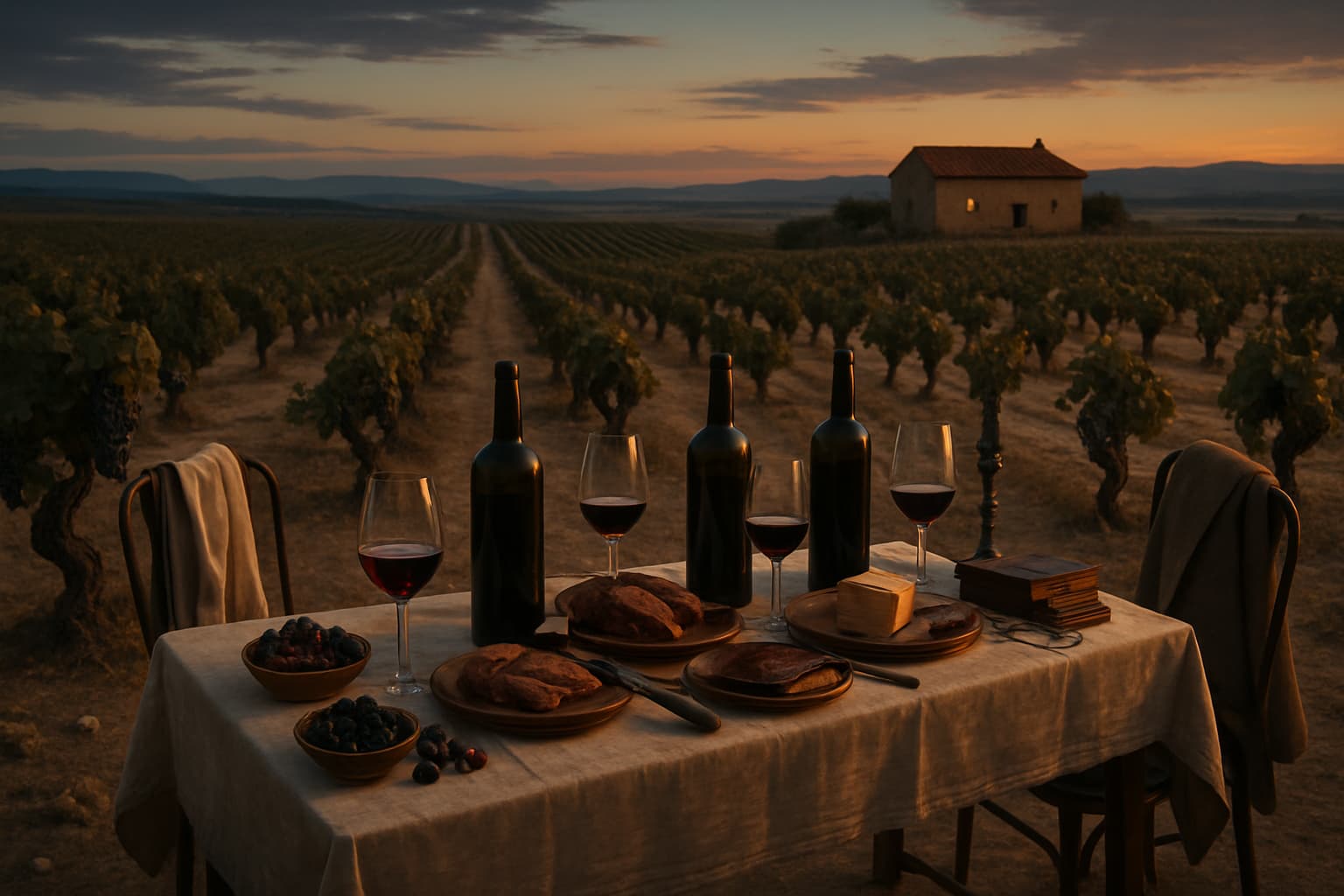
It is a truth very generally acknowledged, that a gentleman or lady in possession of a well-laid table must be in want of a suitable wine. Yet, while many a bottle flatters the eye and deceives the tongue, there are certain regions whose character is so fixed, whose temper so decided, that acquaintance with them soon becomes intimacy, and intimacy, in time, ripens into esteem. Among these, Ribera del Duero holds a place of singular distinction; and though it may not yet have attained the universal celebrity of its more talkative cousin, Rioja, it possesses a gravity, a depth, and a restrained passion that render it most worthy of our contemplation.
Allow me, therefore, to introduce you to this noble region, whose wines possess all the ardour of a Spanish romance, yet are conducted with the decorum and structure that would satisfy even the strictest English palate.
Ribera del Duero, as its name so modestly confesses, lies along the banks of the Duero River, in the elevated heart of Castilla y León in northern Spain. One might suppose that so central a situation would have long ago secured it the admiration of the world; yet, like a quiet country gentleman whose merits remain unsuspected until some accident reveals them, Ribera del Duero only obtained official recognition as a Denominación de Origen (DO) in 1982.
This, however, must not mislead any careful observer into imagining that its wines are a recent fancy. Vines have adorned this harsh, high plateau for centuries—indeed, since at least the Middle Ages, when monastic orders, more devout in their wine-making than perhaps in their vows of abstinence, cultivated vineyards to supply the sacrament and, one suspects, their own modest refreshment.
The landscape is one of extremes:
Such conditions might appear, at first glance, inhospitable. Yet it is precisely this severity that gives the wines of Ribera del Duero their firm character—like a heroine formed under strict circumstances, who learns to conceal her ardour beneath an appearance of composure.
Every good tale requires a principal character, and in Ribera del Duero that role is played by Tempranillo, though here it often goes by its local, affectionate names: Tinto Fino or Tinta del País. It is the same noble variety that appears in other Spanish regions, but as with any individual, its manners are shaped by its surroundings.
In Ribera del Duero, Tempranillo tends to produce wines that are:
The harsh climate and high altitude ensure that grapes ripen fully, accumulating colour and flavour, while the cool nights preserve acidity. The result is a most agreeable tension between ripeness and freshness—a quality that, in human society, we might describe as passion moderated by good sense.
Though Tempranillo is the undisputed star, the regulations of the DO permit small supporting roles for other varieties such as Cabernet Sauvignon, Merlot, Malbec, and the charmingly rustic Garnacha. Their contributions are usually discreet, adding a touch of structure or perfume without ever threatening to overshadow the native lead.
It is impossible to understand the wines of Ribera del Duero without considering the climate, which exhibits all the fervour of a Spanish summer and all the severity of a Castilian winter. The region’s high plateau, exposed to the elements, experiences:
These conditions produce grapes of great intensity, but they also demand careful judgement from the grower. Harvest too early, and the wines may be austere and unyielding; too late, and they risk heaviness, their charms becoming overblown and fatigued.
The best estates have learned to manage this balance with admirable tact, much as a sensible chaperone allows a degree of flirtation without ever permitting impropriety.
If the vineyard gives the wine its character, the cellar bestows its education. Spain, with its fondness for order and gradation, has long employed a system of ageing categories, and Ribera del Duero is no exception. These categories, though sometimes displayed with a certain flourish upon labels, are not mere ornament; they indicate how the wine has been schooled in oak and time.
The principal classifications are:
These wines are like lively younger siblings—charming, spirited, occasionally a little impetuous, but rarely dull.
Crianza wines may be compared to a well-brought-up young gentleman or lady: still youthful, but already showing polish and good breeding.
A Reserva is a person of experience—still vigorous, but with a past that has left agreeable traces.
Such wines are like elder statesmen or grand ladies of the old school: their charms may be less obvious to the impatient, but to those who listen, they tell the most fascinating stories.
As in any respectable neighbourhood, Ribera del Duero boasts its great houses, whose reputations are spoken of with something approaching awe, alongside more modest estates whose virtues may be quieter but no less sincere.
Among the most celebrated is Vega Sicilia, often regarded as the region’s grandest estate, whose wines—particularly the famed Único—have acquired an almost legendary status. Here, Tempranillo is joined by a measure of Cabernet Sauvignon, and the ageing process is conducted with such patience that vintages may slumber for a decade or more before being deemed fit to face the world.
Other notable names include:
One need not always dine at Pemberley to enjoy good conversation; nor must one always drink the rarest wines to find pleasure and satisfaction. Ribera del Duero offers a range of expressions, from the stately to the straightforward.
It would be quite improper to consider wine without considering food, for the two are destined, like certain couples in novels, to bring out each other’s best qualities.
The robust structure and dark fruit of Ribera del Duero wines make them excellent companions for:
Yet even in more modest households, a simple roast chicken, a well-seasoned stew, or a plate of cured meats may find its dignity enhanced by a well-chosen bottle from Ribera del Duero. These wines do not demand extravagance, though they are well able to support it.
For those newly introduced to this region, a few general observations may be of service:
In short, treat these wines as you would any person of strong character: give them time, space, and proper conditions, and they will reward you with conversation of the most engaging kind.
Though Ribera del Duero’s vineyards have ancient roots, its modern fame is comparatively young. It is, in many ways, a region still writing its own narrative—experimenting with styles, refining viticulture, and discovering how best to express the singularity of its high plateau and its beloved Tempranillo.
Some producers favour powerful, opulent wines with generous new oak; others seek greater freshness, elegance, and a more discreet hand in the cellar. This diversity, though it may perplex the impatient, is a sign of vitality. A region that has ceased to question itself is in danger of becoming dull, and Ribera del Duero shows no such inclination.
For the attentive wine lover, this presents an agreeable opportunity: to follow the region’s progress, to taste its evolving expressions, and to form, over time, one’s own opinions—perhaps even to disagree with the prevailing fashion, which can be one of life’s more innocent pleasures.
If one were to liken wine regions to characters in a novel, Ribera del Duero might be that initially reserved figure who, once known, proves to possess a most captivating mixture of strength and sensitivity. Its wines combine intensity with structure, power with poise, and warmth with a certain Castilian austerity that keeps sentiment in check.
To make their acquaintance is not merely to add another name to one’s list of wines tasted; it is to enter into a relationship with a place of extremes—of hot days and cold nights, of ancient vines and modern ambition, of monastic origins and worldly aspirations. Such a relationship, like any of true value, deepens with time and conversation.
Those who prefer wines that declare themselves instantly and exhaust their charms in a single glass may perhaps look elsewhere. But for readers and drinkers who relish character, development, and the slow unfolding of complexity—who enjoy seeing strength tempered by refinement, ardour moderated by discipline—Ribera del Duero offers a courtship well worth pursuing, one bottle, one vintage, and one thoughtful evening at a time.
Tannins are astringent compounds found in wine that contribute to its texture and aging potential, often causing a drying or puckering sensation in the mouth. They are derived from grape skins, seeds, and stems, as well as from oak barrels used during aging.
/ˈtænɪnz/
Malic acid is a naturally occurring organic acid found in grapes that contributes to the tart, green apple-like flavor and crispness in wine. It plays a significant role in the taste and acidity of wine.
/mælɪk ˈæsɪd/
Filtration in winemaking is the process of removing solid particles from wine to clarify and stabilize it before bottling, using various types of filters to achieve different levels of clarity and remove unwanted elements like yeast, bacteria, and sediment.
/fɪlˈtreɪʃən/
Oxidation in wine is a chemical reaction between the wine and oxygen that can change its flavor, aroma, and color. This process can be beneficial or detrimental depending on the extent and context of the exposure.
/ˌɒksɪˈdeɪʃən/
Microclimate refers to the unique climate conditions of a small, specific area within a larger region, significantly influencing grapevine growth and the characteristics of the resulting wine.
/ˈmīkrōˌklīmit/
Get weekly wine recommendations, vineyard news, and exclusive content delivered to your inbox.