Wine Literature and Media
“Where every bottle tells a story”
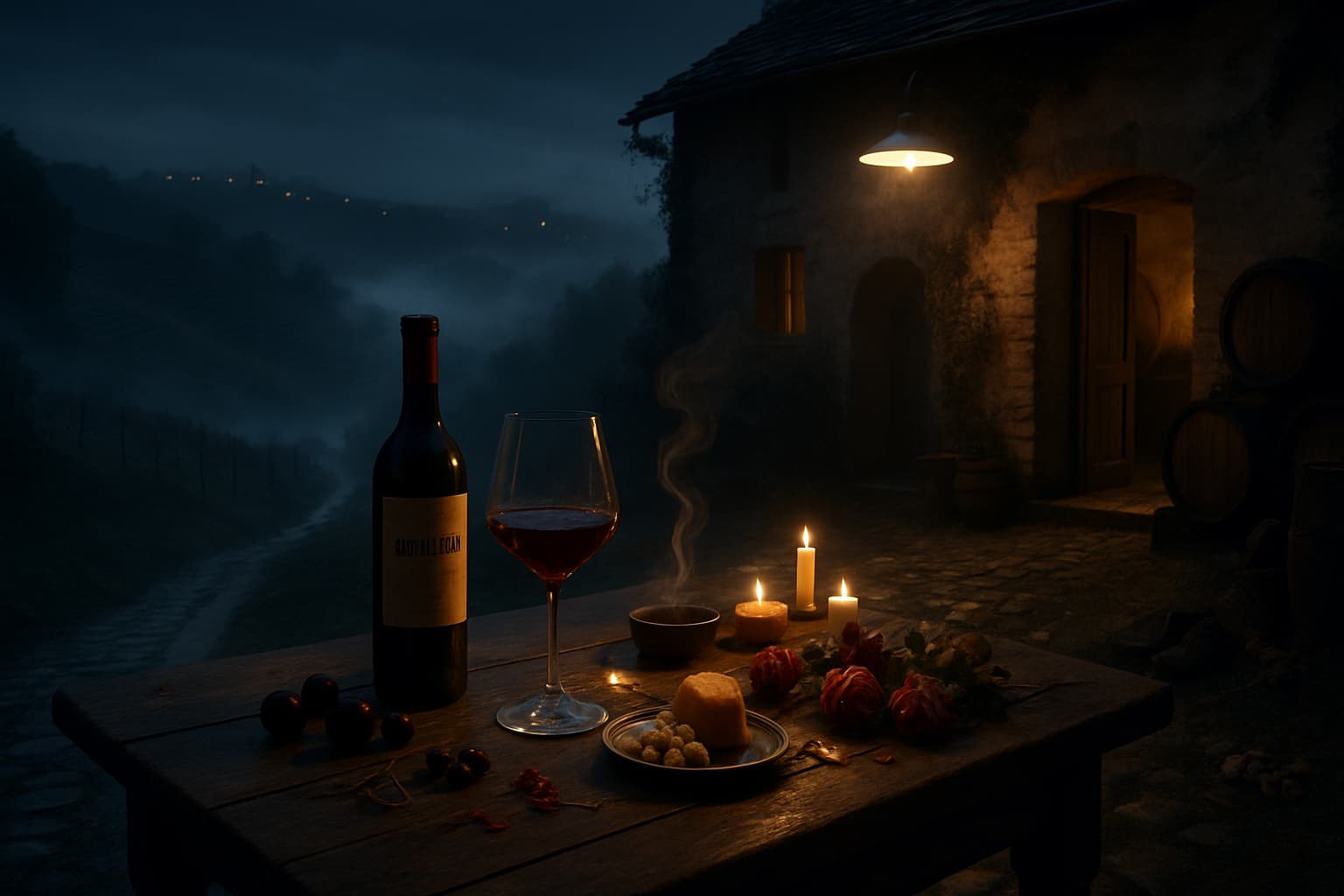
The first time you meet this thing, it doesn’t shake your hand. It grabs you by the lapels, slams you into a stone wall, and shoves a fistful of dirt, black cherries, and burning roses up your nose. People call it “tar and roses” like that makes it civilized. It is not civilized. It is Barolo, and it is one of the last great, unapologetic wines that still smells like the place it crawled out of: fog, blood, truffles, and the stubborn ghosts of Italian peasants who refused to plant anything easier.
You don’t “taste” Barolo. You survive it. And if you’re lucky, you come back for more.
To understand why this wine tastes like asphalt and flower petals in the same breath, you have to go to the hills of Piemonte in the northwestern corner of Italy. Not on a postcard, not on a tour bus—mentally, at least, you need to stand there in late October, in the Langhe, when the fog comes rolling in like a slow, white riot.
The grape is Nebbiolo, named from nebbia—fog—because harvest time is a ghost story. These are not friendly hills. They are steep, carved, and layered with soils that sound like geological insults: compact marl, sandstone, clay, ancient marine sediments that used to be some prehistoric seabed before the Alps punched through the sky and scared the water away.
Barolo isn’t a town in the way Paris is a city. It’s more like a jurisdiction of obsession—11 communes sanctioned by law and tradition, each with its own neuroses baked into the ground: La Morra, Serralunga d’Alba, Monforte d’Alba, Castiglione Falletto, and the rest of the gang. You look at those hills and you’re not seeing scenery; you’re seeing a thousand micro-arguments about how tannins should feel and how long a man should wait to drink his own damn wine.
This is where tar and roses are born: in a place where nothing is easy and everything takes too long.
Nebbiolo is not a friendly grape. It’s thin-skinned, late-ripening, and high-maintenance—like a diva who insists on performing only when the moon is in the right quadrant and the barometric pressure is emotionally supportive. It buds early, ripens late, and has the nerve to demand the best slopes with the best exposure, or it sulks and tastes like sour red brick dust.
But when Nebbiolo is happy—properly coddled on south-facing slopes, in the right soils, under the right murderous sun and chilling fog—it becomes a sort of aromatic lunatic:
The tannins are the real story. Young Barolo can feel like chewing a library of leather-bound law books. This is not a wine that cares if your gums survive the evening. But underneath that structural violence, there is perfume—delicate, floral, haunting. That’s the madness: asphalt and roses, brutality and elegance in the same glass.
So what the hell is “tar and roses,” really?
It’s not a marketing slogan. It’s a sensory paradox that should not exist. Tar is industrial, black, hot, and sticky. Roses are fragile, romantic, ephemeral. You don’t expect them to share a bedroom, let alone a bottle.
In Barolo, they do.
Tar: That dark, smoky, resinous note—somewhere between asphalt after rain and the inside of a mechanic’s jacket—is a mix of complex phenolic compounds and oak influence, amplified by long aging and Nebbiolo’s naturally high tannins. It’s not actual road tar, but it hits the same primitive button in your brain: burnt, bitter, elemental.
Roses: The floral side—rose petals, potpourri, violet—is driven by aromatic compounds (terpenes and their friends) that show up when Nebbiolo is grown in the right conditions and allowed to evolve in bottle. Over time, fresh flowers turn into dried petals and then into something almost incense-like.
Put together, the result is a kind of beautiful schizophrenia: one nostril gets flowers, the other gets smoke and asphalt. The mind tries to reconcile them and fails. That failure is where the magic lives.
Barolo is not just a wine; it’s a long-running civil war in oak barrels.
For decades, the traditionalists ran the show: long macerations (weeks on the skins), huge old Slavonian oak casks, and aging periods that felt like prison sentences. These wines came out of the cellar like chained beasts—rust-colored, tannic as a fist, and in no mood for conversation before at least 10 or 15 years of bottle sleep. The tar was strong; the roses came later, if at all.
Then came the modernists in the 1980s and ’90s, armed with small French barriques, shorter macerations, temperature control, and a vague idea that maybe people wanted to drink Barolo before retirement or death. They aimed for more fruit, softer tannins, more polish, less waiting. Some embraced new oak so hard the wine smelled like vanilla-scented leather upholstery in a sports car driven by a banker.
The battle lines were drawn:
In the middle of this chaos, the tar-and-roses character became a kind of ideological flag. Traditionalists claimed it as their badge of authenticity: “You want tar and roses? You wait. You suffer. You bleed on the corkscrew.” Modernists insisted you could have perfume and drinkability without sacrificing soul.
Now, the smartest producers have crawled out of the trenches and are quietly doing both: careful vineyard work, cleaner cellars, more precise extractions, less dogma. The best Barolos today can show tar and roses even when they’re young—just enough structure to scare you, just enough elegance to seduce you.
Barolo is not monolithic. It’s a patchwork of vineyards, each with its own psychosis. Over the last few decades, winemakers have started labeling single vineyards—crus—like Burgundy, and suddenly people act like they can taste topography.
You don’t need a doctoral thesis, but you should know this:
La Morra & Barolo (the communes)
Softer, more perfumed, often more approachable when young. More roses, red fruit, and charm. Tar is present but wears a silk tie.
Serralunga d’Alba & Monforte d’Alba
Darker, more structured, more severe. Tar in steel-toed boots. Roses show up late, after the tannins stop shouting.
Castiglione Falletto
A kind of middle ground: power and perfume holding hands, occasionally strangling each other.
Underneath, the soil types—Tortonian vs. Helvetian marls and sands—help nudge the wine toward either elegance or severity. But in the glass, what you feel is this: some Barolos are more rose, some are more tar, and some are a perfect, deranged balance of both.
This wine does not care about your schedule. It was built to outlive your weekend plans and maybe your liver.
Young Barolo is all angles and elbows—acid, tannin, sharp fruit, the tar note like a fresh wound. The roses are there but tight, like buds that refuse to open in public. Give it time, and the edges soften:
0–5 years: Intense, primary fruit, aggressive structure. Tar is fresh and sharp, roses are shy. You drink this now only if you’re eating a cow and enjoy dental pain.
5–10 years: The marriage begins. Tannins start to melt, roses emerge, tar becomes more like aged leather and smoke. Complexity multiplies.
10–20+ years: The real show. Dried roses, truffle, forest floor, tobacco, old leather, and that lingering, ghostly tar note that smells like memory itself. The wine stops being a beverage and starts being a time machine.
This is why Barolo has always attracted lunatics and obsessives. You’re not just buying a bottle; you’re entering a pact with the future. You are promising some future version of yourself that you’ll still be around, still curious, still thirsty enough to care.
If you’ve made it this far and still want to drink Barolo instead of just reading about it, proceed carefully.
We live in an age of smooth things. Smooth apps, smooth interfaces, smooth wines that taste like they were focus-grouped by a committee of exhausted accountants. Everything is designed not to offend, not to challenge, not to make you think too hard.
Barolo refuses this. It is not smooth. It is not easy. It does not care if you’re ready.
Tar and roses is more than a tasting note; it’s a philosophy. It says that beauty can coexist with brutality, that elegance can be born out of hardship, that a pale red liquid can taste like a war between asphalt and flower petals and still make sense.
When you drink a good Barolo—one that’s had time to find itself—you’re not just tasting fruit and oak and acid. You’re tasting:
In a world addicted to immediacy, Barolo is a raised middle finger wrapped in a velvet glove of roses, dipped in tar.
You don’t have to love it. But if you meet it honestly, with time and an open mind, you will not forget it. And on some future night, when the air smells like wet pavement and someone somewhere is burning incense or flowers, you might suddenly think of that glass—tar and roses locked in combat—and realize that for one brief moment, you tasted something that refused to be simple.
That, in the end, is the whole damned point.
Tannins are astringent compounds found in wine that contribute to its texture and aging potential, often causing a drying or puckering sensation in the mouth. They are derived from grape skins, seeds, and stems, as well as from oak barrels used during aging.
/ˈtænɪnz/
Malic acid is a naturally occurring organic acid found in grapes that contributes to the tart, green apple-like flavor and crispness in wine. It plays a significant role in the taste and acidity of wine.
/mælɪk ˈæsɪd/
Let It Breathe
Young Barolo needs air like a drowning man needs oxygen. Decant for a couple of hours—longer if it’s a monster. Older bottles are more fragile: decant gently, briefly, or just pour straight and let them open in the glass.
Use a Big Glass
This is not a wine for tiny, stingy glassware. You want a large bowl to let the aromatics go feral: roses, tar, spices, all crawling out of the glass and into your brain.
Pair It with Real Food
Barolo is not a cocktail. It demands fat, protein, and seriousness:
The tannins latch onto the fat and protein, and suddenly the wine stops trying to kill you and starts to dance.
Listen for the Tar and Roses
Don’t force it, but pay attention. On the nose: do you get blacktop after rain? Dried petals? On the palate: do you feel the grip, the bitterness, the lingering floral echo? That tension—that contradiction—is the entire point.
Filtration in winemaking is the process of removing solid particles from wine to clarify and stabilize it before bottling, using various types of filters to achieve different levels of clarity and remove unwanted elements like yeast, bacteria, and sediment.
/fɪlˈtreɪʃən/
Oxidation in wine is a chemical reaction between the wine and oxygen that can change its flavor, aroma, and color. This process can be beneficial or detrimental depending on the extent and context of the exposure.
/ˌɒksɪˈdeɪʃən/
Microclimate refers to the unique climate conditions of a small, specific area within a larger region, significantly influencing grapevine growth and the characteristics of the resulting wine.
/ˈmīkrōˌklīmit/
Get weekly wine recommendations, vineyard news, and exclusive content delivered to your inbox.