Wine Literature and Media
“Where every bottle tells a story”
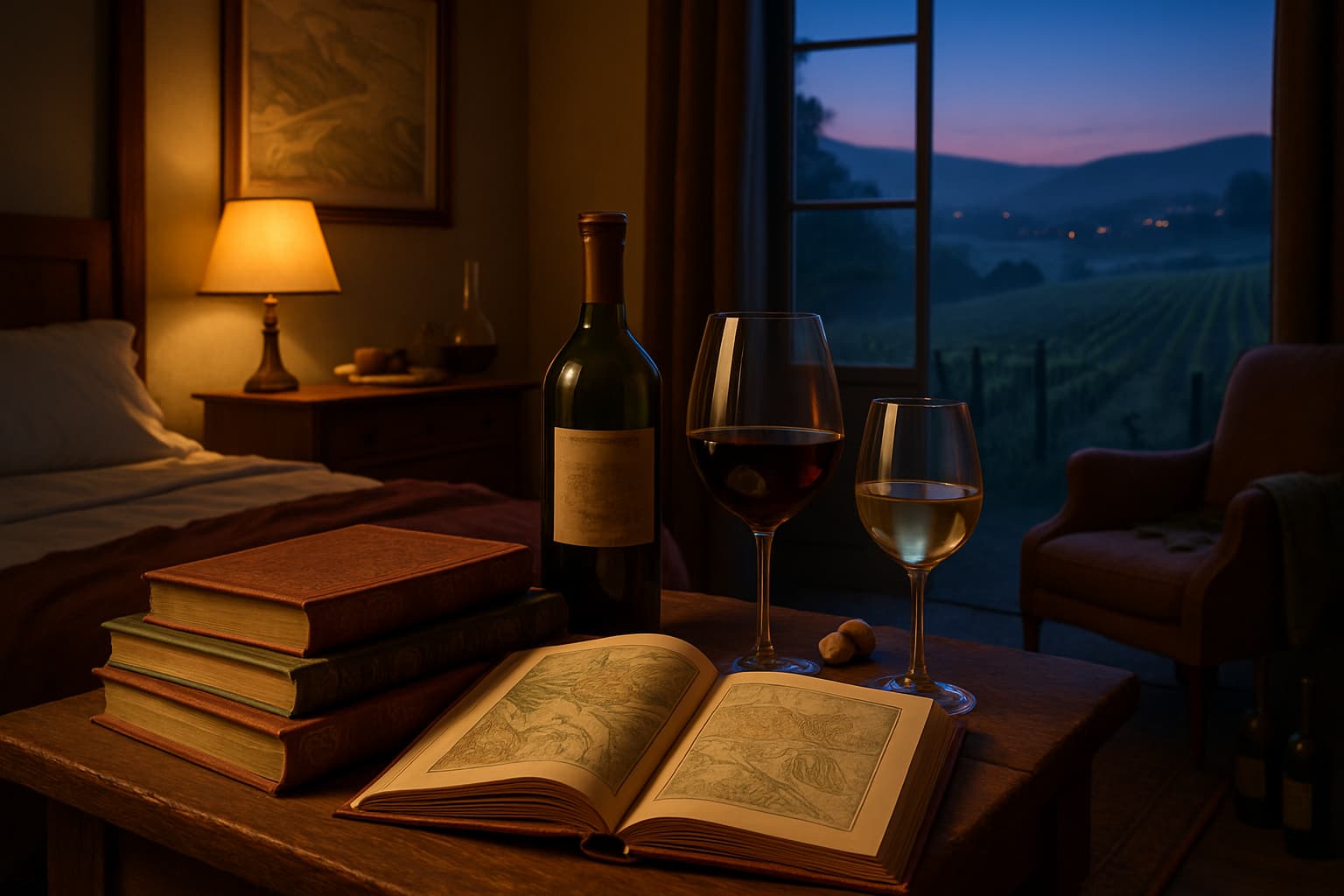
There are books you sip at and books you gulp, but some you decant, letting them breathe on the bedside table, returning to them again and again as you might to a beloved bottle in the cellar. The great books about wine belong to this last category. They are not mere manuals or buying guides, though they may help you choose a bottle; they are invitations—to travel, to taste, to remember, and above all to linger.
Wine writing at its best is not really about wine at all. It is about longing and landscape, about time and loss, about pleasure and the sweet ache of things that cannot last. It is about the way a glass in your hand can hold not just fermented grape juice but weather, soil, history, and human stubbornness. The classics of wine writing understand this, and that is why they endure, long after prices, vintages, and fashions have changed.
Let us wander through some of these books as though we were strolling through a vineyard at dusk: unhurried, observant, and with the quiet thrill of knowing there’s a glass waiting at the end.
It’s tempting to think wine books are for the initiated: the cork-sniffers, the cellar-keepers, the people who say “Bordeaux” as if it were a private club. But the true classics of wine writing are not exclusionary. They are hospitable. They open the door and usher you in, offering you a chair and a glass and a story.
What these books share is a certain generosity of spirit. They don’t merely list tasting notes—those often rather bloodless strings of descriptors: “blackcurrant, cedar, tobacco, medium-plus acidity.” Instead, they tell you how it feels to drink a particular wine at a particular moment, with particular people, in a world that will never be exactly the same again.
Wine writing matters because it preserves these fleeting experiences. A great bottle is like a perfect evening: you cannot have it twice. But you can remember it, and in the remembering, you can taste it again. The classics of wine literature are, in a sense, love letters to ephemerality.
If there is a single name that whispers through any conversation about wine books, it is Hugh Johnson. His prose is as elegant and understated as a well-aged Burgundy: never showy, always precise, with a quiet shimmer of wit.
Co-authored in later editions with Jancis Robinson, The World Atlas of Wine is the book that turned wine from a bewildering list of labels into a map you could read. It is, quite literally, a cartography of pleasure.
The Atlas doesn’t just tell you that a wine is from the Mosel or the Médoc; it shows you the slopes, the rivers, the folds in the land that shape the taste in your glass. It’s a reminder that wine is geography you can drink. Even if you never set foot in Barolo or the Barossa, you can travel there by turning its pages.
This book is a classic not because it is exhaustive—though it is impressively thorough—but because it connects the intellectual to the sensual. You begin to understand that the line of a hillside, the angle of the sun, the stubbornness of a winemaker are all there, shimmering in your glass.
If the Atlas is a map, The Story of Wine is a richly embroidered tapestry. Johnson traces wine from ancient amphorae to modern estates, weaving in myth, archaeology, politics, and gossip with enviable lightness of touch.
You learn that wine is as old as civilization itself, that amphorae still lie in shipwrecks at the bottom of the Mediterranean, that Roman soldiers drank rough wine sweetened with honey, that monks in Burgundy quietly, patiently, defined what we now call terroir. It’s history, certainly, but never dusty. It’s as alive as a glass of Champagne that has just been poured.
If Hugh Johnson writes like a poet, Jancis Robinson writes like an enchantingly clever friend who happens to know everything, but never makes you feel small for not knowing it yourself.
At first glance, The Oxford Companion to Wine looks forbidding: a fat, weighty tome, dense with entries from “acidity” to “Zweigelt.” But open it, and you find yourself drawn in as if into a vast, bustling kitchen, full of clatter and aroma and anecdote.
This is not a book you read from cover to cover (though some do); it is a book you fall into. Look up “Champagne” and you may find yourself, several pages later, reading about glassware or dosage or the chemistry of bubbles. It is gloriously, addictively digressive.
What makes it a classic is not just the breadth of information, but the voice: wry, precise, occasionally mischievous. Jancis manages to be authoritative without ever being authoritarian. She gives you the facts, but she also gives you the context, the arguments, the controversies. You come away not just informed, but initiated.
If the previous books are, in their different ways, reference works and histories, Kermit Lynch’s Adventures on the Wine Route is something else entirely: a memoir, a travelogue, and a love story.
Lynch is an American wine merchant who fell, irretrievably, for French wine and the people who make it. His book is a series of journeys through France in the 1970s and 1980s, visiting small growers, tasting in cellars, arguing about sulphur and filtration, being occasionally exasperated and frequently enchanted.
What makes this book such a classic is its unapologetic subjectivity. Lynch is not neutral; he is gloriously opinionated. He rails against industrial winemaking, against over-manipulation, against wines that taste of the cellar more than the soil. He celebrates eccentric vignerons who make wines that are sometimes flawed but often unforgettable.
You can almost smell the damp stone of the cellars, feel the chill of the barrels, taste the rough country food served alongside the wines. It’s a book that makes you want to get on a train, find a small producer, and drink whatever they pour, trusting in their hands and their land.
Gerald Asher’s writing is like a long lunch that begins with a glass of something pale and crisp and ends, many courses later, with coffee and the sense that you have been both fed and gently transformed.
His collections—On Wine, The Pleasures of Wine, and others—are made up of essays originally written for Gourmet magazine. Each piece is a small, perfectly formed world: part history, part anecdote, part commentary, threaded together with a prose style that is elegant without ever being fussy.
Asher is less interested in telling you what to drink than in telling you stories about how people have drunk, and why, and with what consequences. He writes about sherry in Edwardian England, about the wines of the Rhône, about forgotten bottles rediscovered and shared. His work has a reflective, almost meditative quality: you read an essay, you pause, you pour yourself a glass, you think.
In an age of hurried recommendations and numbered scores, Asher’s measured, thoughtful voice is a balm. His writing reminds you that wine is not a race or a contest; it is a conversation across time.
Long before tasting notes became a genre of their own, there was George Saintsbury, a Victorian scholar who wrote Notes on a Cellar-Book—a title as modest as the book is quietly revelatory.
Published in 1920, it is, on the surface, a record of what Saintsbury drank and when. But beneath this practical accounting lies a deeper sense of gratitude for the consolations of the table. He writes of claret and port, of Burgundy and hock, with an affectionate particularity that feels almost like gossip about old friends.
The language can be archaic, the references sometimes obscure, but there is a charm in this very distance. Reading Saintsbury is like opening a bottle from another era: the label is faded, the cork fragile, but the wine inside still speaks, in its own accent, of a world that has gone.
His book is a reminder that wine has always been about memory as much as flavour. We drink, we note, we remember. The cellar-book is, in its way, a diary of a life lived with attention to pleasure.
Running through all these classics is a shared understanding: wine is not a subject to be mastered and then set aside; it is a companion to the art of living.
Wine writing, at its most enduring, does not lecture. It seduces. It invites you to care—not about the correct pronunciation of “Gewürztraminer,” but about the way a particular wine can make a simple supper feel like a celebration, or turn a grey evening into something glowing and golden.
These books also remind us that wine is always a collaboration between nature and culture. The vine grows where it can, but it is human beings who decide to prune, to harvest, to ferment, to bottle. Every classic of wine writing is, in some sense, about this relationship: between people and place, between tradition and innovation, between the desire for consistency and the acceptance of variation.
There is, too, a quiet lesson about humility. No matter how much you learn, there will always be another region, another grape, another vintage that surprises you. The best writers do not pretend otherwise. They remain curious, open, willing to be wrong, willing to be delighted.
You do not need to read these books with a notebook and a sense of duty. In fact, it’s better if you don’t. Read them as you might read a beloved cookbook: for inspiration, for comfort, for the joy of imagining flavours you may one day taste.
Keep The World Atlas of Wine by the armchair and open it at random, letting your eye drift from the curves of the Loire to the sunburnt plains of Australia. Dip into The Oxford Companion when a word puzzles you or a curiosity pricks. Take Adventures on the Wine Route to bed and fall asleep dreaming of small French villages and long, argumentative lunches. Let Gerald Asher’s essays accompany you on a quiet Sunday afternoon. Visit Saintsbury when you feel like stepping into another time.
And always, if you can, read with a glass nearby. It doesn’t need to be grand. A simple, honest wine will do. The act of sipping as you read completes the circle: words becoming flavours, flavours becoming memories.
What makes a wine classic is not just its quality, but its capacity to linger in your mind long after the last drop has gone. The same is true of wine writing. The books that endure do so because they leave traces: a phrase that returns to you when you open a bottle, an image that flickers in your mind as you swirl and sniff, a story that turns an ordinary glass into something quietly luminous.
These classics do not demand that you become an expert. They simply ask that you pay attention: to where your wine comes from, to who made it, to how it makes you feel. They teach you that knowledge is not the enemy of pleasure but its deepening.
In the end, the greatest compliment you can pay any of these books is not to quote them, or to memorise them, but to live a little differently because of them: to choose a wine you might not have chosen, to linger a little longer at the table, to treat each glass as a small, shimmering moment in time.
So pour yourself something—ruby, garnet, straw-gold, or the palest blush of pink—and open one of these books. Let the words rise like aroma from the page. Breathe them in. Sip slowly. And allow yourself the indulgence of knowing that, for as long as there are people to write and read and drink, the story of wine will never be finished.
Tannins are astringent compounds found in wine that contribute to its texture and aging potential, often causing a drying or puckering sensation in the mouth. They are derived from grape skins, seeds, and stems, as well as from oak barrels used during aging.
/ˈtænɪnz/
Malic acid is a naturally occurring organic acid found in grapes that contributes to the tart, green apple-like flavor and crispness in wine. It plays a significant role in the taste and acidity of wine.
/mælɪk ˈæsɪd/
Filtration in winemaking is the process of removing solid particles from wine to clarify and stabilize it before bottling, using various types of filters to achieve different levels of clarity and remove unwanted elements like yeast, bacteria, and sediment.
/fɪlˈtreɪʃən/
Oxidation in wine is a chemical reaction between the wine and oxygen that can change its flavor, aroma, and color. This process can be beneficial or detrimental depending on the extent and context of the exposure.
/ˌɒksɪˈdeɪʃən/
Microclimate refers to the unique climate conditions of a small, specific area within a larger region, significantly influencing grapevine growth and the characteristics of the resulting wine.
/ˈmīkrōˌklīmit/
Get weekly wine recommendations, vineyard news, and exclusive content delivered to your inbox.