Wine Literature and Media
“Where every bottle tells a story”
Let’s be honest: most wine awards are boring as hell.
A ballroom full of suits, a stage with bad lighting, a presenter mispronouncing the name of some poor winemaker who’s been up since 4 a.m. picking grapes. Polite applause. Maybe a flute of lukewarm Prosecco if you’re lucky. Then everyone goes home and forgets who won what.
But imagine this instead:
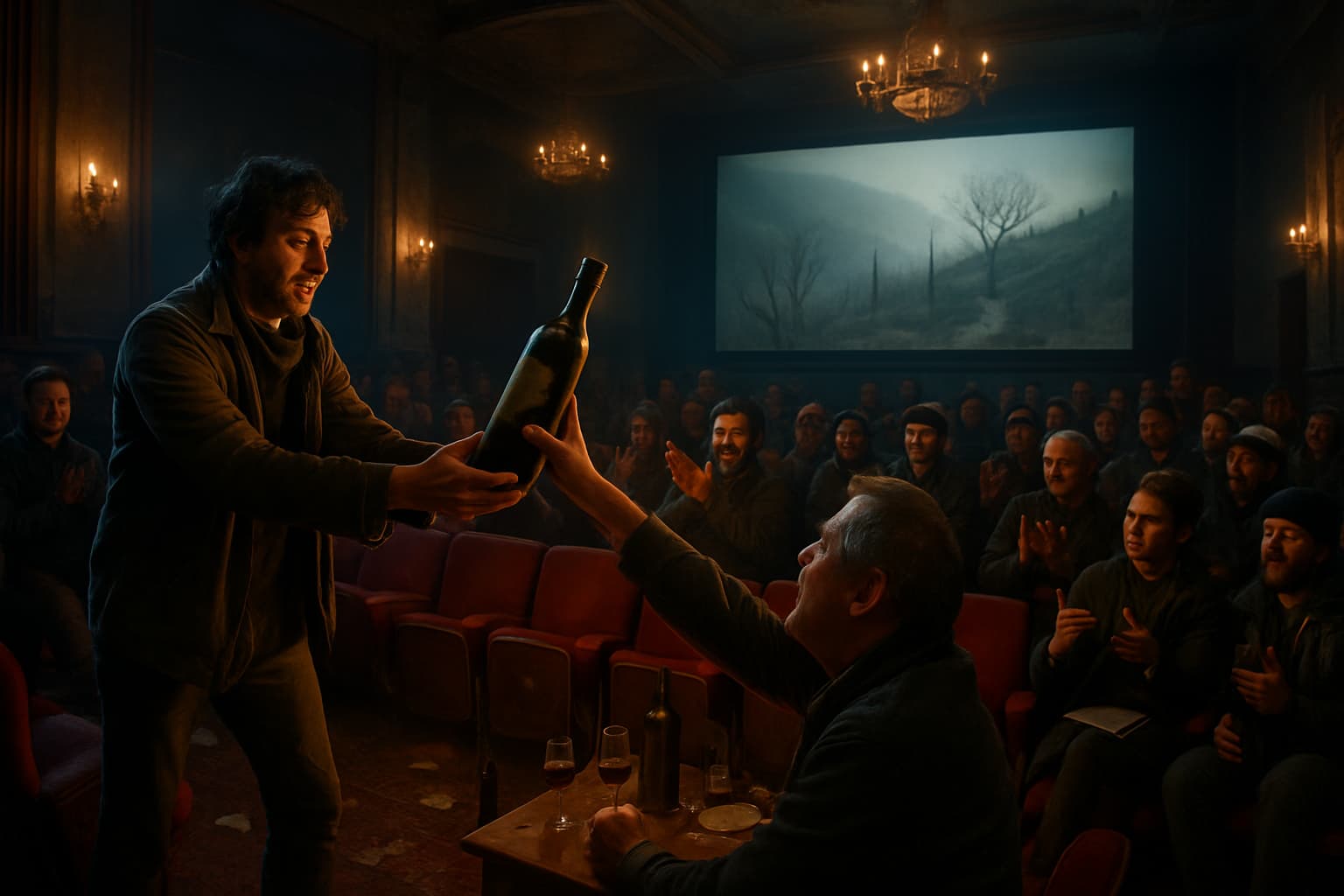
A dark cinema in Berlin or San Sebastián. The smell of popcorn, spilled beer, and someone’s slightly damp wool coat. On screen: a Basque txakoli grower hanging off a cliffside vineyard in the rain, cursing the weather and laughing anyway. A Georgian grandmother in Kakheti crushing grapes by foot, singing something that sounds like a prayer and a threat at the same time. A sommelier in a cramped Paris cave arguing about whether natural wine is a revolution or a scam.
The lights come up. People are sniffling, arguing, hungry, thirsty. Then someone hands a scruffy director a bottle instead of a golden statue, and the room explodes.
That’s the spiritual neighborhood where the idea of a “European Wine Film Awards” lives: halfway between a film festival, a bar fight, and a late-night tasting in a damp cellar. Less red carpet, more stained barrel.
And it’s exactly what the wine world needs.
Wine is supposed to be about people, place, memory, and time. But most of what passes for “wine content” is a parade of tasting notes and glamour shots: swirl, sniff, “hints of blackcurrant and tobacco,” cut to a drone shot of a vineyard at sunset. It’s like filming a punk band and only shooting the guitar pedals.
Film, when it’s honest, doesn’t let you get away with that. A good wine film shows the mud under the fingernails, the busted tractors, the hailstorms that destroy a year’s work in 15 minutes. It shows the arguments at the dinner table, the border disputes, the family feuds, the economic pressure, the quiet desperation, and the occasional miracle.
Europe is ground zero for that kind of story. This is a continent where:
Film can capture all of that in a way that no tasting note or Instagram post ever will.
So if you’re going to celebrate wine on screen, you don’t need another glossy award show. You need something with teeth—something that honors films that actually say something about land, power, labor, joy, and the weird human impulse to ferment grape juice and call it culture.
If you’re going to do this, you do it right. Not another industry back-patting session. Something that feels like a cross between Cannes, a workers’ co-op meeting, and a late-night bar in Lisbon.
Think of categories like these:
This is the heavy-hitter category—the long-form stories that follow a vintage, a person, or a region over time.
The good ones don’t just show pretty vineyards. They show:
These films ask ugly questions: Who really owns the land? Who gets rich? Who breaks their back? Who gets erased from the label?
This is where European wine cinema becomes less “food porn” and more “this is how the sausage is made, and by the way, the sausage is you.”
Short films are like a quick shot of grappa: small, sharp, and sometimes devastating.
Here you’d see:
Shorts are where you get weird, political, poetic. They don’t have to explain everything. They just have to hit you in the gut.
Most fiction about wine is either rom-com fluff or prestige nonsense where a bottle of Bordeaux is shorthand for “this person is rich and sad.”
Forget that.
The best fictional wine films use wine as a weapon, a confession, or a mirror:
Wine here isn’t the star. It’s the pressure cooker.
Streaming changed everything. Now you can follow a region, a producer, or a theme over multiple episodes.
Imagine:
Not glossy tourism. Not influencer junkets. Just honest, episodic storytelling about a continent trying to hang on to its identity while the planet warms and the market demands “brand stories.”
You can always tell when a wine film is made by someone who’s only seen vineyards from a helicopter. Everything is golden hour and lens flare.
The good stuff looks different:
Cinematography awards here should go to people who make you smell the must, feel the cold, and understand that “terroir” isn’t just a pretty French word—it’s mud, sweat, fog, and fear.
Europe is more than Bordeaux, Champagne, Tuscany, and Rioja. There are hundreds of regions you’ve never heard of making wines that will blow your head off and rearrange your prejudices.
This category would honor films that drag those places into the light:
These films aren’t just about wine. They’re about survival, reinvention, and stubbornness.
You can’t talk about European wine without talking about politics. Land is power. Labels are identity. Appellations are gatekeeping dressed up as tradition.
A serious wine film award would have to embrace that. It should celebrate films that:
Wine is never just wine. It’s class, history, power, and myth in a bottle. The best films don’t let you forget that.
If you’ve spent any time in European cellars, you’ve seen the holy wars:
A European Wine Film Awards worth a damn would highlight films that dive into those conflicts without picking easy sides. That’s where the drama is:
The cameras should be rolling when the old guy in the beret tells the tattooed 30-year-old that his orange wine tastes like “a mistake,” and the kid fires back that the old man’s barrique is “dead and fake.”
That’s cinema.
If this thing ever exists, it shouldn’t look like a standard film awards night. No tuxedos. No “gift bags.” No sponsored selfie walls.
Picture this instead:
The after-parties should be half film school reunion, half harvest party, half group therapy. Bottles passed around, subtitles forgotten, languages mixing. Directors arguing about framing while a vigneron explains why 2021 was a disaster. Someone opens a bottle from a region no one can pronounce. Someone else starts singing.
That’s the point: connection. Friction. Memory.
You might be thinking: who cares? It’s just wine. Just film. Just more people clapping for themselves.
But stories change how we see the world. And wine, for all its snobbery and bullshit, is one of the last everyday things that still connects us directly to land, weather, and human hands.
A European Wine Film Awards, done right, would:
Wine is memory in liquid form. Film is memory in light. Put them together and you get something dangerous: empathy. Context. Perspective. Maybe even change.
If you strip away the bullshit, wine is simple: people grow grapes somewhere specific, at a specific time, under specific conditions, and then try not to screw it up.
Film, at its best, is the same: someone points a camera at reality and tries not to lie too much.
Europe is overflowing with these realities—vineyards carved into volcanic rock, terraces built by hand centuries ago, co-ops born under dictatorships, families clinging to steep hillsides while their kids move to the city. There are winemakers who survived wars, borders that moved under their feet, and markets that don’t care about their stories—only their scores.
These people deserve more than being reduced to “ripe cherry, medium tannins, good length.”
They deserve to be seen. To be heard. To be argued about in dark theaters. To be remembered when the bottle is empty.
A European Wine Film Awards, if it ever comes to life, shouldn’t be a polite industry soirée. It should be a loud, messy love letter to the continent’s vineyards and the people stubborn enough to keep them alive—a place where the camera doesn’t flinch, the glass is never quite empty, and the stories linger long after the credits roll.
Pour something honest. Turn down the lights. Hit play.
Tannins are astringent compounds found in wine that contribute to its texture and aging potential, often causing a drying or puckering sensation in the mouth. They are derived from grape skins, seeds, and stems, as well as from oak barrels used during aging.
/ˈtænɪnz/
Malic acid is a naturally occurring organic acid found in grapes that contributes to the tart, green apple-like flavor and crispness in wine. It plays a significant role in the taste and acidity of wine.
/mælɪk ˈæsɪd/
Filtration in winemaking is the process of removing solid particles from wine to clarify and stabilize it before bottling, using various types of filters to achieve different levels of clarity and remove unwanted elements like yeast, bacteria, and sediment.
/fɪlˈtreɪʃən/
Oxidation in wine is a chemical reaction between the wine and oxygen that can change its flavor, aroma, and color. This process can be beneficial or detrimental depending on the extent and context of the exposure.
/ˌɒksɪˈdeɪʃən/
Microclimate refers to the unique climate conditions of a small, specific area within a larger region, significantly influencing grapevine growth and the characteristics of the resulting wine.
/ˈmīkrōˌklīmit/
Get weekly wine recommendations, vineyard news, and exclusive content delivered to your inbox.