Wine Literature and Media
“Where every bottle tells a story”
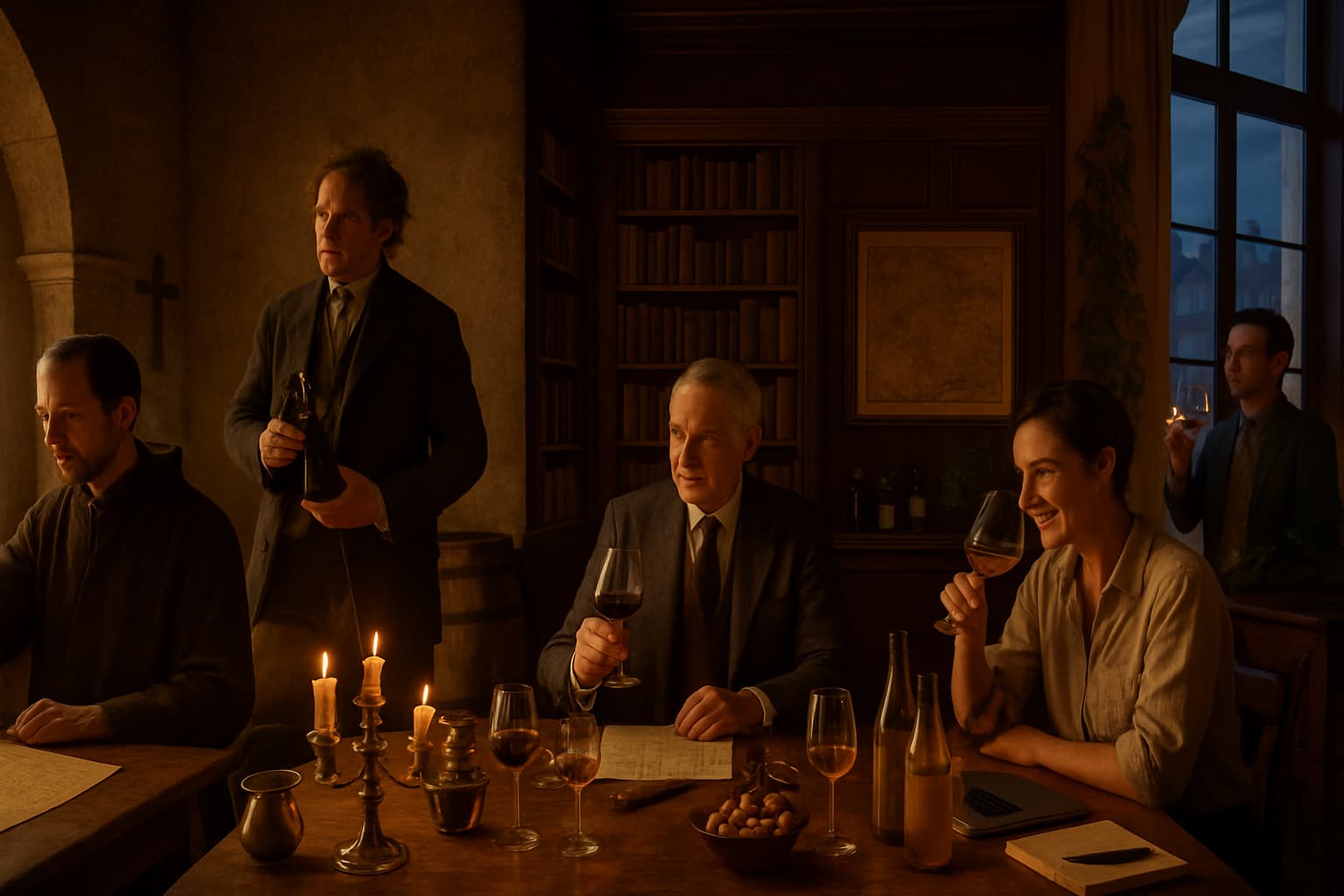
There’s a particular kind of madness that takes hold when human beings start writing about fermented grape juice as if it were a religious vision. Europe perfected that madness. Long before Instagram sommeliers and TikTok tasting notes, there were ink-stained maniacs prowling vineyards, scribbling in notebooks, arguing in cafés, and bleeding adjectives onto the page about wines that smelled like gunflint, wet dog, crushed violets, or the inside of a nun’s handbag.
Wine criticism in Europe is not just about rating bottles. It’s about class, war, religion, ego, and the simple terror of mortality—because nothing reminds you that time is passing quite like a cellar full of bottles that are either peaking, dying, or waiting for someone with enough nerve to pull the cork.
So let’s take a fast, dangerous ride through the history and the unhinged characters who built this strange cathedral of taste.
Before critics, there were monks. Medieval Europe ran on God, fear, and alcohol, and the Church had a monopoly on at least two of the three. Benedictine and Cistercian monks across Burgundy, Champagne, the Rhine, and beyond were the original terroir obsessives—mapping vineyards and cataloging differences between slopes, soils, and exposures centuries before anyone thought to score a wine out of 100.
They didn’t write “tasting notes” in the modern sense. They wrote about which vineyards produced wines “suitable for the altar,” which were “noble,” which aged gracefully. It was primitive wine criticism, wrapped in theology and land ownership. Their verdicts carried divine weight: if the monks said this hillside was special, that was that.
Then came the merchants and brokers—especially in places like Bordeaux, Porto, and Jerez. These people had skin in the game and barrels on the quay. In the 17th and 18th centuries, British and Dutch traders began to shape reputations with their ledgers, letters, and shipping records. They didn’t write purple prose, but they did something more powerful: they decided what was worth buying repeatedly.
When Thomas Jefferson toured European wine regions in the late 18th century, he wasn’t just sightseeing. He was absorbing a half-formed system of rankings, reputations, and whispered opinions. Europe’s wine hierarchy was already being written—just not yet bound in books or printed in newspapers. It lived in monasteries, in merchants’ accounts, and in the private letters of aristocrats who had the time and money to care which vineyard got more afternoon sun.
The 19th century took all that loose, floating opinion and nailed it to the wall.
In 1855, for the Exposition Universelle in Paris, Napoleon III ordered a classification of Bordeaux’s best wines. So the Bordeaux brokers—men whose income depended on wine prices—created a ranked list of châteaux from First Growths down to Fifth.
It wasn’t “criticism” in the modern sense; it was institutionalized snobbery, a codified price list masquerading as objective truth. But it became the backbone of European wine judgment. The idea that a wine could be officially ranked—a permanent aristocracy of bottles—was intoxicating. It turned critics into something quasi-political: interpreters of a system that fused money, land, and taste.
Critical discourse began to grow up around these classifications. Writers and commentators debated whether Latour was better than Lafite, whether the Right Bank deserved recognition, whether Burgundy’s patchwork of climats was more profound than Bordeaux’s grand estates.
Wine was no longer just a drink. It was a battlefield of reputations.
The 20th century arrived with phylloxera scars, world wars, and the slow birth of modern wine writing. Europe, especially France and Germany, began to produce a new breed of wine intellectuals—half scholar, half evangelist.
Émile Peynaud, a French oenologist, was not a critic in the newspaper-column sense, but he might be the most influential European wine thinker of the 20th century. Working in Bordeaux in the mid-1900s, he dragged winemaking into the modern era with science, hygiene, and ruthless clarity.
Peynaud preached that good wine was not an accident or a miracle; it was the result of careful viticulture, controlled fermentation, and cleanliness. He wrote books like The Taste of Wine that blended sensory analysis with technical precision. He didn’t just tell you that a wine smelled like blackcurrants—he explained why.
His impact on criticism was enormous: he gave critics a more precise language and framework. Instead of mystical babble, you could talk about ripeness, tannin quality, balance, and faults with something approaching rigor. Peynaud helped turn wine criticism from a parlor game into a quasi-profession.
If France made the wine, Britain made the mythology. London became the nerve center of European wine criticism in the mid-20th century. The British had money, a long tradition of importing wine, and a language that was rapidly becoming global.
André Simon, born in France but based in London, was one of the first great European wine communicators. In the early to mid-20th century, he wrote, lectured, and founded the Wine & Food Society. His tone was urbane, cultured, and relentlessly civil. He treated wine as a pillar of civilized life, something to be understood historically, geographically, and gastronomically.
Simon’s work helped transform wine from a trade commodity into a subject worthy of literature, clubs, and study. He wasn’t wild or unhinged—he was the respectable face of wine discourse. But behind that calm exterior, he helped build the infrastructure that would allow more radical voices to follow.
Michael Broadbent, working at Christie’s in London, was another towering figure. He tasted thousands of old bottles and recorded his impressions in meticulous, compact notes. His book Wine Tasting became a standard text.
Broadbent’s genius was in his memory and his willingness to write down everything—vintages from the 19th century, bottles opened in dusty cellars, wines that no longer exist. He bridged the gap between the old aristocratic cellars and the modern wine-collecting world. His criticism was calm, structured, British to the core—but it carried the weight of experience that few could match.
France didn’t just produce wines; it produced a certain style of wine writing—intense, philosophical, obsessed with place.
Aubert de Villaine, co-owner of Domaine de la Romanée-Conti, is not a “critic” in the usual sense, but his writings and interviews shaped how people think about Burgundy and terroir. He spoke of vineyards as living, almost sacred entities. He gave language to the idea that a few rows of vines on a particular slope could produce something fundamentally different—more profound—than vines a stone’s throw away.
Critics across Europe absorbed this Burgundy mysticism. Suddenly, wine writing wasn’t just about quality; it was about authenticity, sense of place, the spiritual charge of a vineyard with centuries of human and geological history behind it.
Kermit Lynch is American, but his impact on European wine discourse—especially in France and Italy—was enormous. His book Adventures on the Wine Route (published in the 1980s) reads like a travelogue written by someone half romantic, half deranged. He championed small growers, traditional methods, and wines that tasted like somewhere, not just something.
European critics and drinkers took notice. Lynch’s writing helped fuel the backlash against industrial winemaking and the rise of “authentic” wine—what would later bleed into natural wine culture. He was not European, but he held a cracked mirror up to Europe’s own vineyards and forced them to look.
By the late 20th century, the stage was set for a new kind of critic: global, data-driven, and terrifyingly competent.
Jancis Robinson, British and razor-sharp, may be the most influential European wine critic alive. She studied, wrote, and tasted her way into a position of extraordinary authority. Her Oxford Companion to Wine is essentially the encyclopedia of the wine world. Her World Atlas of Wine (with Hugh Johnson) mapped the planet’s vineyards with an obsessive cartographic eye.
Robinson’s style is precise, dryly witty, and grounded in fact. She rarely indulges in wild metaphor; she prefers clarity. But beneath that calm exterior is a radical idea: that wine knowledge should be democratized. Her website, tasting notes, and books opened up the secret codes of wine to anyone willing to read.
In Europe, her influence was double-edged. Producers craved her approval but also feared her honesty. She could praise an obscure Greek white and catapult it into the spotlight—or quietly question a grand château’s consistency and plant seeds of doubt.
Then came the punks.
In the late 20th and early 21st centuries, a wave of European growers—especially in France, Italy, and Spain—began making “natural” wines: low-intervention, often unfiltered, sometimes volatile, occasionally brilliant, frequently controversial.
A new generation of critics and writers emerged around them:
This movement blew a hole in the old idea of the critic as neutral arbiter. Natural wine writers embraced bias, declared their allegiances, and treated wine as an expression of politics, ecology, and personal ethics.
Hovering over all of this is the specter of the 100-point scale, popularized by Robert Parker (an American, but massively influential in Europe). European critics had to decide: embrace the numbers or resist them.
Many British and continental European writers—Robinson, Johnson, and others—used scores sparingly or with skepticism. They preferred prose, context, and comparison. But the market loved numbers. Importers and retailers in Europe slapped scores on shelf talkers like crack for the anxious consumer.
This created a tension that still defines European wine criticism:
The best European critics walk the tightrope: they may use scores, but they also insist on the story—who made the wine, where, and why it matters.
To navigate this jungle, you need at least a handful of names etched into your brain:
Wine criticism in Europe is a long, chaotic conversation between monks, merchants, aristocrats, scientists, and lunatics with notebooks. It has moved from cloisters to auction houses, from dusty libraries to hyperactive websites and social feeds.
What started as quiet judgments about which hillside made better altar wine has become a full-blown cultural battleground:
The irony is that for all the noise, the real act still happens in silence: one person, one glass, one moment in time. The critic—whether monk, merchant, Brit in a tweed jacket, or tattooed blogger in a Paris wine bar—is just trying to capture that fleeting collision of memory, chemistry, and place before it vanishes back into the bloodstream.
You don’t have to agree with them. In fact, you probably shouldn’t. The best thing you can do with European wine criticism is read it the way you drink the wine: skeptically, hungrily, with a sense of danger. Use the critics as guides, not gods. Let their arguments pull you into regions you’ve never heard of, growers you can’t pronounce, vintages that feel like messages in a bottle from another century.
Because buried under all the ratings, the reverence, and the ridiculous metaphors is a single, undeniable truth: this whole insane enterprise—centuries of ink and arguments and classifications—is just humanity’s way of dealing with the fact that some bottles are worth remembering, and most of our lives are not.
So open something European, preferably from a vineyard with a history longer than your bloodline, and drink with the ghosts: monks, merchants, scientists, and critics, all shouting their opinions from the bottom of the glass.
Tannins are astringent compounds found in wine that contribute to its texture and aging potential, often causing a drying or puckering sensation in the mouth. They are derived from grape skins, seeds, and stems, as well as from oak barrels used during aging.
/ˈtænɪnz/
Malic acid is a naturally occurring organic acid found in grapes that contributes to the tart, green apple-like flavor and crispness in wine. It plays a significant role in the taste and acidity of wine.
/mælɪk ˈæsɪd/
Filtration in winemaking is the process of removing solid particles from wine to clarify and stabilize it before bottling, using various types of filters to achieve different levels of clarity and remove unwanted elements like yeast, bacteria, and sediment.
/fɪlˈtreɪʃən/
Oxidation in wine is a chemical reaction between the wine and oxygen that can change its flavor, aroma, and color. This process can be beneficial or detrimental depending on the extent and context of the exposure.
/ˌɒksɪˈdeɪʃən/
Microclimate refers to the unique climate conditions of a small, specific area within a larger region, significantly influencing grapevine growth and the characteristics of the resulting wine.
/ˈmīkrōˌklīmit/
Get weekly wine recommendations, vineyard news, and exclusive content delivered to your inbox.