Wine Literature and Media
“Where every bottle tells a story”
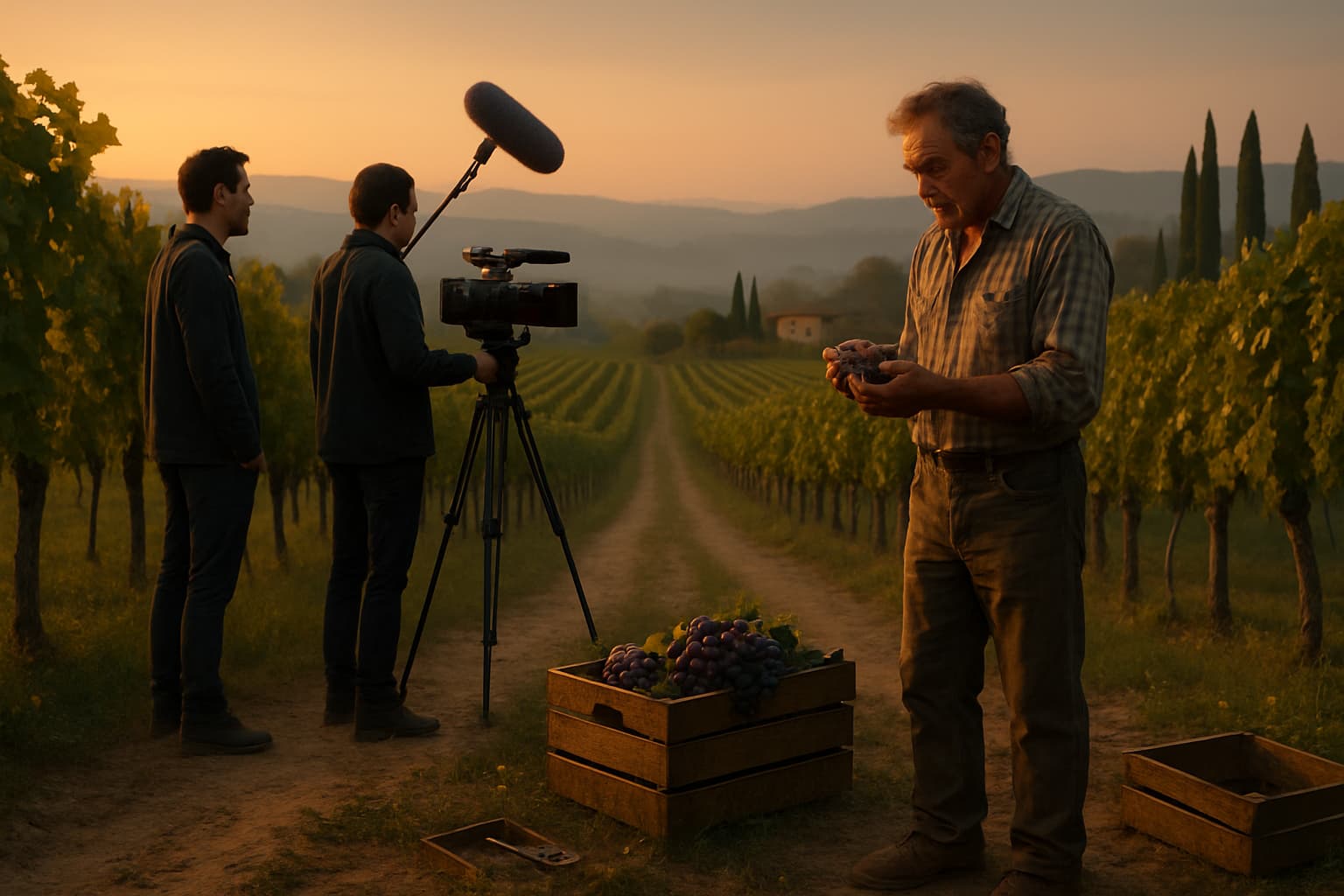
There’s a certain kind of silence you only find in an Italian vineyard at dusk.
The last tractor has gone home. The sun is sinking behind a line of cypress trees.
And somewhere, a camera’s red light flicks on.
That’s where the wine documentaries of Italy truly begin—not in a studio, not in a boardroom, but out there in the dirt and the vines, with people whose lives are measured in harvests, not headlines.
Tonight, I’d like to take you on a journey through those films. Not just as a list of titles, but as a map of stories—of families, regions, and traditions—that together form one long, patient conversation about what wine really is, and what it means to be Italian.
Wine, in Italy, is not merely a drink. It is memory in a bottle, history in a glass.
Every hill has a story, every grape a lineage. For centuries, those stories were passed down at kitchen tables and in dusty cellars, spoken in dialects that rarely crossed the valley.
Then came the camera.
Italian wine documentaries stepped into that old world with a quiet reverence. They didn’t try to replace the stories. They simply listened—and preserved them. These films do more than show you how wine is made. They show you why it’s made, and who is willing to give their life to it.
From the grand crus of Piedmont to the windswept terraces of Sicily, documentary filmmakers have become the new scribes of Italian wine culture. And if you listen closely, you can hear the land speaking through them.
Some documentaries try to capture the entire Italian wine universe in one sweeping frame. They travel from region to region, accent to accent, grape to grape, searching for the thread that ties it all together.
Though not exclusively about Italy, Mondovino is one of the first major documentaries to shine a harsh light on the tension between tradition and globalization in wine.
We meet Italian producers big and small, from powerful families in Tuscany to humble farmers in lesser-known corners of the country.
The film asks a simple, unsettling question:
What happens when the world starts asking wine to taste the same?
You see the rise of international consultants, the pressure to use certain barrels, certain grapes, certain styles. And you see resistance—stubborn, proud, sometimes desperate—by people who believe their land has its own voice, and they’re not about to let it be silenced.
Mondovino doesn’t give easy answers. Instead, it leaves you with a sense of fragility—that the old ways can be lost in a single generation if no one chooses to stand guard.
Up in the foggy hills of Piedmont, where Nebbiolo grapes cling to steep slopes, a quiet revolution once took place.
Barolo Boys tells that story: a group of young winemakers in the 1980s and 90s who decided that Barolo, the “wine of kings,” could be something more modern, more approachable, more international.
They changed everything—shorter macerations, new French oak barrels, a sleeker, fruitier style. The world loved it. Critics handed out high scores. Prices soared.
But in their success, they sparked a war of ideas.
On one side, the “modernists,” eager to push Barolo into the global spotlight.
On the other, the “traditionalists,” who believed that a wine should taste like its ancestors.
The film doesn’t pick a hero. It simply lays out what happens when a culture stands at a crossroads between memory and ambition. You see friendships strained, reputations made and broken, and a new generation trying to reconcile the two worlds.
Watching Barolo Boys is like standing in a cellar, torn between two barrels—one old, one new—and realizing that both, in their own way, belong to the same story.
In Italy, there’s a growing movement of winemakers who believe that the best way forward is, in fact, backward: fewer chemicals, less intervention, more trust in nature. The camera has followed them too.
Directed by Jonathan Nossiter, Natural Resistance returns to Italy with a sharper focus: small, rebellious producers who refuse to play by industrial rules.
These winemakers farm organically or biodynamically. They let native yeasts do the work. They accept cloudy wines, unpredictable fermentations, and the risk that comes with letting nature lead.
The film visits estates in Tuscany, Emilia-Romagna, and beyond, where vineyards coexist with orchards, forests, and wildflowers. There’s a sense that wine, here, is part of an ecosystem, not a product line.
But Natural Resistance is not just about farming. It’s about power.
It shows how regulations, market forces, and bureaucratic systems often favor the largest players, leaving small, authentic producers struggling to survive.
In their stubbornness, in their refusal to compromise, these winemakers become something more than artisans. They become guardians of diversity—of flavor, of culture, of landscape.
While Wine Calling focuses on natural wine in France and Spain, its spirit echoes strongly in Italy. Across the peninsula, countless small documentaries, festival shorts, and regional films—often never widely distributed—tell similar stories of Italian vignerons turning their backs on chemicals and convenience.
These smaller, often local productions, filmed in dialect and screened in village halls, might never make it to international streaming platforms. But they are the heartbeat of a movement. Together, they form a mosaic of resistance, each one capturing a single vineyard, a single family, a single stubborn dream.
Wine in Italy is rarely just a business. It’s a lineage. And where there is lineage, there is drama.
While Somm: Into the Bottle is global in scope, some of its most powerful moments come when the camera lingers in Italy. In a single film, you watch Barolo being poured beside Chianti, you see old cellars, dusty bottles, and winemakers whose faces look like they’ve been carved from the very hills they farm.
The Italian segments underscore a simple truth: wine here is not simply made; it is inherited. A bottle often contains not just fermented grape juice, but the decisions of grandparents, the mistakes of fathers, the hopes of sons and daughters.
In those quiet interviews, you can hear generations speaking at once.
Beyond the better-known international titles, Italy is rich with regional and local documentaries:
These films may not all have English subtitles. They may not have glossy posters or global marketing campaigns. But they contain something precious: unfiltered voices, unscripted lives, and landscapes shown as they are, not as tourists expect them to be.
At their best, Italian wine documentaries are not really about wine at all. They are about time.
They show you:
You see old men arguing over pruning methods like theologians debating scripture. You see young women taking over family estates, rewriting rules while honoring their roots. You see neighbors who haven’t spoken in years because of a dispute over barrels, or labels, or the color of a wine that once was lighter, or darker, or somehow “truer.”
In those moments, you understand: wine is just the surface. Underneath it lies a whole way of being.
If you decide to explore the wine documentaries of Italy, don’t rush them. They aren’t action movies. They’re more like a long dinner with an old friend.
A few ways to draw more from them:
Streaming platforms, specialized wine festivals, and independent distributors have made many of these films easier to access than ever before. Some appear on major services; others are found on niche platforms, winery websites, or through film festivals dedicated to food and wine.
In recent years, shorter formats—web series, YouTube documentaries, and Instagram mini-films—have joined the chorus. They may lack the sweep of a feature-length documentary, but they often bring you even closer, into the daily rhythm of pruning, bottling, and tasting.
Together, they form an unofficial archive of Italian wine life in the 21st century—a record of a world in transition, caught between the comfort of the past and the uncertainty of the future.
In the end, a wine documentary from Italy is not just asking you to learn. It’s asking you to care.
Care about a hillside in Piedmont where fog rolls in like a slow tide.
Care about a farmer in Sicily who refuses to spray chemicals, even if it means losing part of his crop.
Care about a family in Tuscany trying to keep an estate alive while the world around them changes faster than the vines can grow.
These films remind us that every bottle has a cost, and not all of it is printed on the label. There is the cost of time, of labor, of risk, of stubbornness. There is the cost of saying “no” when the world is begging you to say “yes” to shortcuts.
When the credits roll, the vineyards are still there. The next harvest is still coming. And somewhere in Italy, a winemaker is looking up at the sky, wondering if the weather will be kind this year.
If you listen closely, through the hum of projectors and the glow of screens, you can almost hear the land itself, telling its story in the only way it knows how—through the people who tend it, and the wines that carry its memory forward.
So the next time you pour an Italian wine, pause for a moment.
Behind that quiet liquid lies a chorus of voices, captured in documentaries, preserved on film—an entire country, speaking softly from the bottom of your glass.
Tannins are astringent compounds found in wine that contribute to its texture and aging potential, often causing a drying or puckering sensation in the mouth. They are derived from grape skins, seeds, and stems, as well as from oak barrels used during aging.
/ˈtænɪnz/
Malic acid is a naturally occurring organic acid found in grapes that contributes to the tart, green apple-like flavor and crispness in wine. It plays a significant role in the taste and acidity of wine.
/mælɪk ˈæsɪd/
Filtration in winemaking is the process of removing solid particles from wine to clarify and stabilize it before bottling, using various types of filters to achieve different levels of clarity and remove unwanted elements like yeast, bacteria, and sediment.
/fɪlˈtreɪʃən/
Oxidation in wine is a chemical reaction between the wine and oxygen that can change its flavor, aroma, and color. This process can be beneficial or detrimental depending on the extent and context of the exposure.
/ˌɒksɪˈdeɪʃən/
Microclimate refers to the unique climate conditions of a small, specific area within a larger region, significantly influencing grapevine growth and the characteristics of the resulting wine.
/ˈmīkrōˌklīmit/
Get weekly wine recommendations, vineyard news, and exclusive content delivered to your inbox.