Wine Literature and Media
“Where every bottle tells a story”
The first thing to understand about European wine literature is that it was never just about wine. It was about power, class, God, lust, war, and the slow, civilized poisoning of the human animal in the name of terroir. The books, the poems, the treatises—these were not tasting notes; they were manifestos disguised as dinner companions.
People like to pretend wine is gentle. It isn’t. It’s a controlled substance with better PR. And the European literary record is the long, feverish diary of a continent that chose fermented grape juice as its spiritual operating system. If you want to understand Europe, you don’t read the constitutions; you read the wine.
Let’s go.
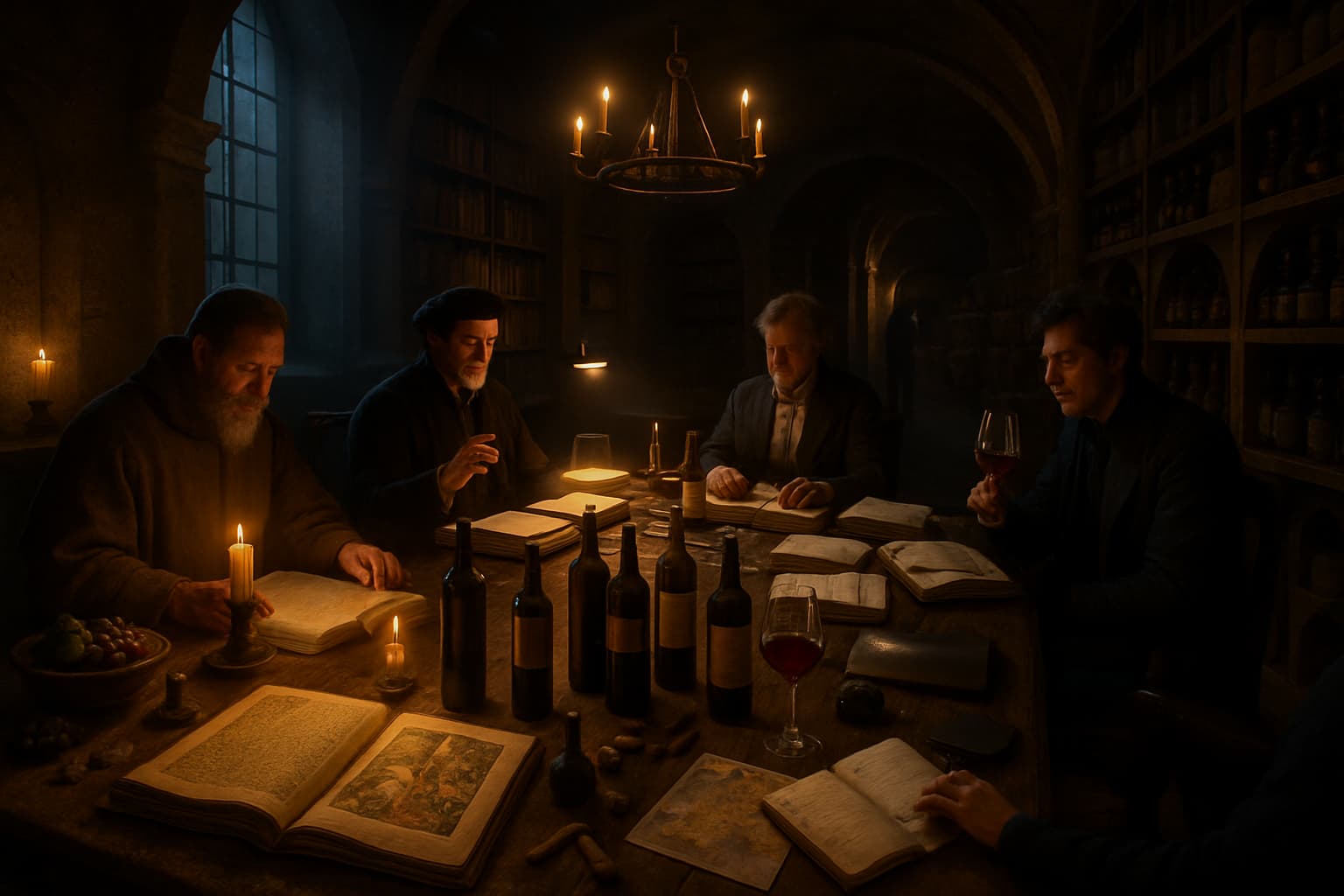
Before the critics, before the star ratings, before the Michelin-star sommeliers with their weaponized palates, there were monks—hooded, half-mad agrarian chemists in stone monasteries, cataloguing the mysteries of the vine as if they were decoding God’s private stash.
In medieval Europe, wine literature wasn’t “wine writing” as we know it; it was theology with a hangover.
In Latin texts and early vernacular poetry, wine appears as:
The early European wine text is a paradox: a warning label wrapped around a chalice.
By the time the Renaissance rolled in—printing presses chattering like caffeinated demons and humanism blowing the dust off Europe’s brain—wine grew legs and walked onto the literary stage as a fully formed character.
It shows up everywhere:
Wine in Renaissance literature is no longer just holy or sinful; it’s human:
Writers started to notice that different wines had different effects and different social meanings. A rough country red wasn’t the same as a refined courtly claret. Already, the seeds of classification and hierarchy were being planted—long before appellations and DOCGs, literature was ranking wines by the company they kept and the chaos they caused.
The Enlightenment liked to pretend it was sober. Don’t believe it. The salons of Paris and London were drenched in wine—Bordeaux, Burgundy, Madeira, Port—a liquid infrastructure connecting empires and ideas.
This era gives us the first systematic writing about wine:
Wine literature in this period becomes:
The British in particular turned wine into a kind of imperial fetish. They wrote about Port and Madeira as if they were bottled fragments of conquered territory. In their journals and letters, you see the birth of a new kind of wine writing: not devotional or poetic, but analytical, proto-critic, proto-nerd.
At the same time, the Enlightenment’s rationalist obsession created a backlash: writers who celebrated drunkenness as a necessary counterweight to sterile reason. Wine appears in essays and satires as the anti-logic, the necessary madness that keeps the human machine from seizing up.
Then the Romantics showed up and threw gasoline on the barrel.
In the 19th century, European literature turned wine into a symbol of:
Think of Baudelaire, staggering through Paris with his spleen and his verses, writing about intoxication as a metaphysical duty: “You must always be drunk.” Not just on wine, he said, but on something—poetry, virtue, vice—but wine was the most convenient and legally tolerated of the bunch.
In Romantic and post-Romantic literature:
This is where wine writing becomes deeply psychological:
The bottle becomes a mirror.
Fast forward to the late 19th and early 20th centuries. Europe is industrializing, urbanizing, mechanizing. Wine is no longer just local fuel; it’s a mass product, traded across borders, bottled, labeled, branded.
And with that, you get a new monster: the modern wine critic.
Early on, these were merchants and brokers, scribbling down impressions for clients:
But as print media expanded, these notes mutated into columns, guides, and annual reports. Wine literature morphed into:
European writers began to codify:
The tone was often authoritarian, almost priestly. The critic became the new monk, except the altar was a tasting table and the liturgy was printed in newspapers and books instead of sung in stone chapels.
World War II smashed Europe’s vineyards and its illusions in equal measure. The aftermath produced a wave of wine literature that was haunted, nostalgic, and strangely hopeful.
You see:
This is when European wine literature started to:
Books and essays from this period are full of:
Then came the New World wines, the flying winemakers, the stainless-steel tanks, the consultants, the scores, the global brands. Europe, suddenly, was not the only voice in the room.
European wine literature reacted in two main ways:
Defensive Traditionalism A wave of books and essays doubled down on:
In magazines, books, and long-form journalism, European wine literature became a battleground:
The writing grew sharper, more argumentative, more gonzo in spirit—even if it didn’t always admit it.
Today, the most interesting European wine writing isn’t the sanitized tasting note or the glossy tourist brochure. It’s the messy, hybrid stuff:
You’ll find:
This is wine literature as investigative journalism and personal exorcism. It’s not polite. It doesn’t pretend that wine is an innocent pleasure. It knows that every bottle is connected to:
And it writes accordingly—wild, suspicious, reverent, and furious all at once.
Look back across the centuries, and European wine literature—this vast, unruly anthology—keeps circling the same obsessions.
You can drink wine without reading a single line of European wine literature. Millions do. They buy the bottle with the nicest label or the highest score and get on with their lives.
But if you want to understand what’s in the glass—beyond fruit, acid, tannin, and oak—you eventually collide with the texts: the monks’ chronicles, the poets’ stanzas, the critics’ screeds, the travel writers’ delirious notebooks.
Because wine in Europe was never just agriculture. It was:
The historical anthology of European wine literature is not a tidy bookshelf; it’s a sprawling, half-burned library where:
And that’s the point.
Wine resists final description. Every time a writer thinks they’ve nailed it—this region, this grape, this vintage, this meaning—some farmer in a forgotten valley bottles something that blows the taxonomy to pieces. Then another writer shows up, notebook in one hand, glass in the other, trying to wrestle the experience into words.
The result, across a thousand years, is this great, chaotic chorus of European voices, all talking about the same thing and never quite talking about the same thing at all.
If you read them—not just the tasting notes, but the sermons, the poems, the rants, the travelogues—you start to see the pattern:
Wine is how Europe talks about itself when it’s too honest to pretend and too cowardly to confess directly.
So pour a glass, open a book, and understand that you’re not just drinking fermented grape juice. You’re swallowing an argument that’s been going on for centuries—between monks and merchants, poets and bureaucrats, farmers and billionaires, traditionalists and heretics.
And the only honest thing to do, standing in the middle of that storm, is to taste, read, and admit: the literature will never catch up with the wine, but it’s glorious watching it try.
Tannins are astringent compounds found in wine that contribute to its texture and aging potential, often causing a drying or puckering sensation in the mouth. They are derived from grape skins, seeds, and stems, as well as from oak barrels used during aging.
/ˈtænɪnz/
Malic acid is a naturally occurring organic acid found in grapes that contributes to the tart, green apple-like flavor and crispness in wine. It plays a significant role in the taste and acidity of wine.
/mælɪk ˈæsɪd/
The tone: “We are not Coca-Cola. We are not sunshine in a bottle. We are history in liquid form. Respect the rules or get out.”
Critical Self-Examination
Another current of writers started asking:
Wine as Power
Wine as Identity
Wine as Memory
Wine as Mask and Truth Serum
Wine as Controlled Madness
Filtration in winemaking is the process of removing solid particles from wine to clarify and stabilize it before bottling, using various types of filters to achieve different levels of clarity and remove unwanted elements like yeast, bacteria, and sediment.
/fɪlˈtreɪʃən/
Oxidation in wine is a chemical reaction between the wine and oxygen that can change its flavor, aroma, and color. This process can be beneficial or detrimental depending on the extent and context of the exposure.
/ˌɒksɪˈdeɪʃən/
Microclimate refers to the unique climate conditions of a small, specific area within a larger region, significantly influencing grapevine growth and the characteristics of the resulting wine.
/ˈmīkrōˌklīmit/
Get weekly wine recommendations, vineyard news, and exclusive content delivered to your inbox.