Wine Styles
“Where every bottle tells a story”
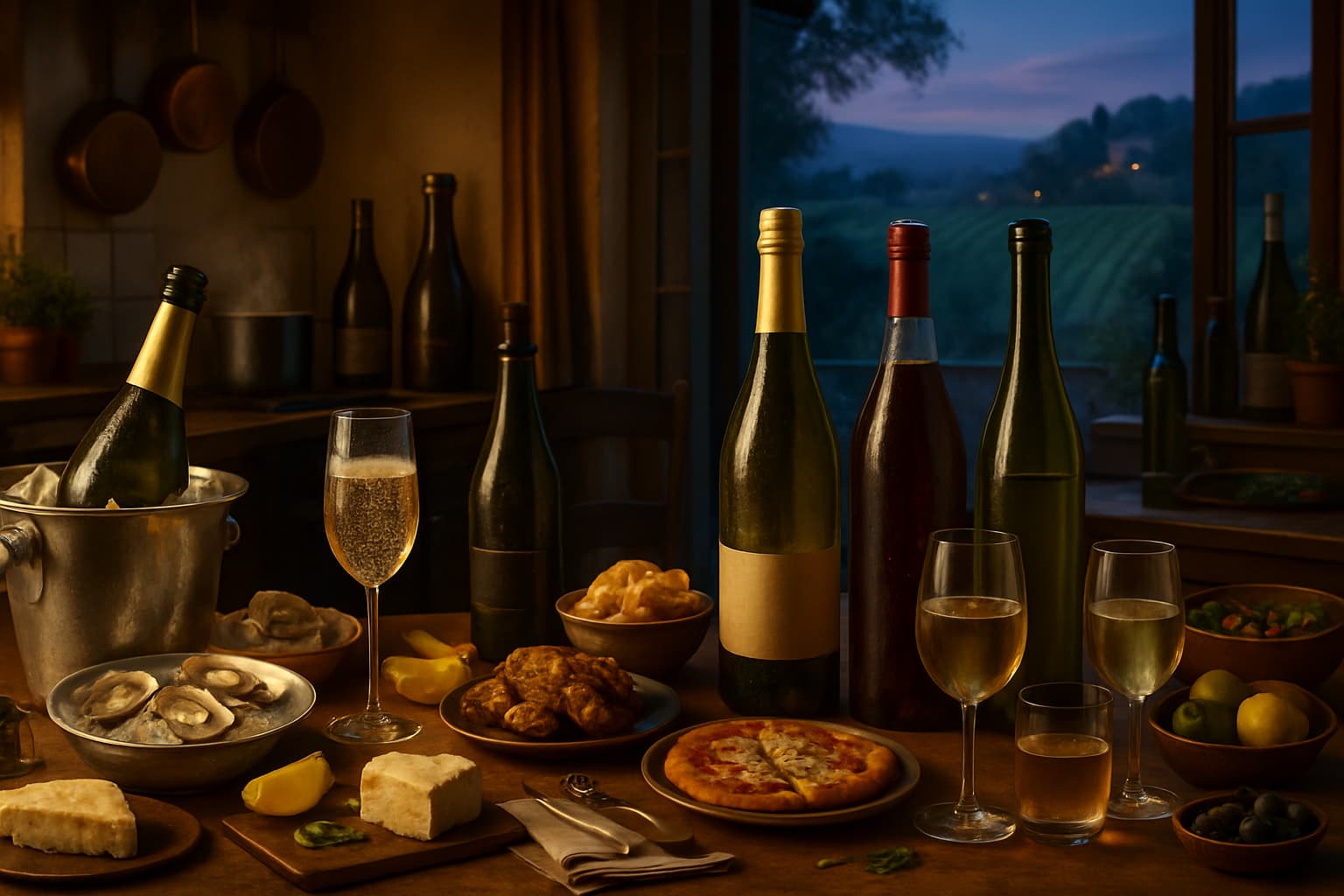
Oh, what a delicious topic! Bubbles in wine are like seasoning in cooking: too little and things fall flat; too much and you’ve blown the roof off the kitchen. Somewhere in between is pure delight. Today we’re going to wander through Europe’s cellars and vineyards and look at two broad families of bubbly wines: those made under high pressure—the full-throttle, cork-popping sparklers—and those that are lightly sparkling, delicately effervescent, like a gentle simmer rather than a rolling boil.
Pull up a chair, pour yourself a glass of something fizzy (even soda water will do in a pinch), and let’s talk bubbles.
In wine, bubbles are not just decoration. They change:
The key difference between high-pressure and lightly sparkling wines is, unsurprisingly, the amount of dissolved carbon dioxide. But that little technical detail changes everything—from how the wine is made to when and how you might want to drink it.
In European wine-speak, this is often described in terms of “pressure in the bottle,” measured in bars. Think of 1 bar as roughly the pressure of the air around you. Most fully sparkling wines are around 5–6 bars—quite a lot. Lightly sparkling wines are more like 1–2.5 bars—enough to tickle, not enough to explode.
Let’s start with the big band: the high-pressure wines. These are the bottles that fly out of ice buckets at weddings, hiss dramatically when opened, and shower victorious athletes.
Most classic European sparkling wines sit around 5–6 bars of pressure. That’s about the pressure in a bus tire. It’s why:
When you open one correctly—gently, slowly, with a sigh rather than a bang—you’re releasing a lot of energy. That energy is what gives you those fine, persistent streams of bubbles and that lively, dancing sensation on the tongue.
Here are some of the main European stars in the high-pressure category:
All of these are firmly in the “pop the cork, mind the chandelier” category.
The bubbles in high-pressure wines usually come from a second fermentation—the wine is fermented once to make a still wine, and then again to create bubbles.
There are two main ways:
This is the old-school, labor-intensive, and often more complex technique.
This method tends to produce finer, smaller bubbles and more complex flavors—like a sauce that’s been slowly reduced and enriched with butter.
This method is used for some high-pressure wines, especially when you want fresh fruit and floral notes rather than yeasty, bready flavors.
You get:
Certain styles of Prosecco can reach higher pressures and behave like classic sparkling wines, especially those labeled spumante.
Think of these wines as your “festive trumpets.” They’re perfect when:
High-pressure wines are like vigorous whisking: they aerate, lift, and brighten.
Now let’s turn down the heat a bit and talk about lightly sparkling wines. Instead of a full rolling boil, think of a pot just beginning to bubble around the edges—gentle, subtle, and often wonderfully refreshing.
In European terms, lightly sparkling wines often sit around 1–2.5 bars of pressure. Enough to:
They may be closed with:
The sensation in your mouth is more like a soft foam than a sharp spray.
There’s a delightful variety here, each with its own culinary personality.
Italy is a treasure trove of lightly sparkling wines:
Technically not always classified as “sparkling,” but many Vinho Verde wines have a natural light spritz, either from a bit of retained CO₂ from fermentation or a tiny addition.
Style notes:
These often have:
They can be bone-dry or off-dry, and white, rosé, or red.
While fully sparkling Sekt can be quite high-pressure, there are also:
They may not always be marketed as “sparkling,” but your tongue will notice.
There are several routes to creating a gentle fizz:
The result is a wine that doesn’t shout; it hums along pleasantly, like a background melody in the kitchen.
Let’s set them side by side, like two sauces reduced to different levels.
High-pressure wines
Lightly sparkling wines
High-pressure, traditional method
Lightly sparkling wines
Think of them as two different kitchen tools:
High-pressure wines are your sharp chef’s knife:
Lightly sparkling wines are your wooden spoon:
You don’t always want a full roaring boil in the pot, and you don’t always want a thunderous pop on the table. Here are some handy guidelines:
Look for: Champagne, Cava, Franciacorta, Crémant, Prosecco spumante.
Look for: Prosecco frizzante, Lambrusco (lighter styles), Vinho Verde, pét-nats, and other frizzante or semi-sparkling wines from Italy, France, and beyond.
A few simple habits can make both high-pressure and lightly sparkling wines much more enjoyable:
In cooking, you choose your heat and seasoning to match the dish. With European sparkling wines, you choose your pressure to match the moment.
Both have their place. One is not “better” than the other, any more than a slow braise is better than a quick sauté. They’re simply different techniques for different moods and meals.
So the next time you’re in the wine shop, don’t just reach automatically for the loudest bottle. Think about your menu, your guests, and the atmosphere you want—grand celebration or lazy afternoon, fireworks or candlelight—and then choose your bubbles accordingly.
And above all, do what we always do in the kitchen: taste, experiment, and enjoy every sip of the process. Bon appétit—and santé!
You walk into a bar in some half-forgotten European town. The bartender doesn’t ask what you want. He just puts a glass in front of you. It smells like walking into a flower shop strapped to a...
Tannins are astringent compounds found in wine that contribute to its texture and aging potential, often causing a drying or puckering sensation in the mouth. They are derived from grape skins, seeds, and stems, as well as from oak barrels used during aging.
/ˈtænɪnz/
Malic acid is a naturally occurring organic acid found in grapes that contributes to the tart, green apple-like flavor and crispness in wine. It plays a significant role in the taste and acidity of wine.
/mælɪk ˈæsɪd/
Champagne (France)
The granddaddy of them all. Made in the Champagne region, using the traditional method (more on that in a moment), primarily from Chardonnay, Pinot Noir, and Pinot Meunier.
Style notes:
Cava (Spain)
Traditional-method sparkling wine, mostly from Catalonia, using grapes like Macabeo, Xarel·lo, and Parellada (with more Chardonnay and Pinot Noir creeping in these days).
Style notes:
Franciacorta (Italy)
Italy’s answer to Champagne from Lombardy, made in the traditional method, often with Chardonnay, Pinot Nero (Pinot Noir), and Pinot Bianco.
Style notes:
Crémant (France, outside Champagne)
Sparkling wines from regions like Alsace, Burgundy, the Loire, and Limoux, made in the traditional method but not from Champagne.
Style notes:
Prosecco Frizzante (Italy, Veneto)
Less pressure than spumante Prosecco, often more casual, sometimes even closed with a simple string-tied cork.
Style notes:
Lambrusco (Emilia-Romagna) – in its gentler forms
Some Lambruscos are full-on sparkling, but many are lightly fizzy.
Style notes:
Other regional frizzante styles (from grapes like Moscato, Malvasia, and more) offer a range from dry to sweet, always with that little lift of bubbles.
Temperature
Glassware
Opening
Storage
Filtration in winemaking is the process of removing solid particles from wine to clarify and stabilize it before bottling, using various types of filters to achieve different levels of clarity and remove unwanted elements like yeast, bacteria, and sediment.
/fɪlˈtreɪʃən/
Oxidation in wine is a chemical reaction between the wine and oxygen that can change its flavor, aroma, and color. This process can be beneficial or detrimental depending on the extent and context of the exposure.
/ˌɒksɪˈdeɪʃən/
Microclimate refers to the unique climate conditions of a small, specific area within a larger region, significantly influencing grapevine growth and the characteristics of the resulting wine.
/ˈmīkrōˌklīmit/
Get weekly wine recommendations, vineyard news, and exclusive content delivered to your inbox.