Wine Literature and Media
“Where every bottle tells a story”
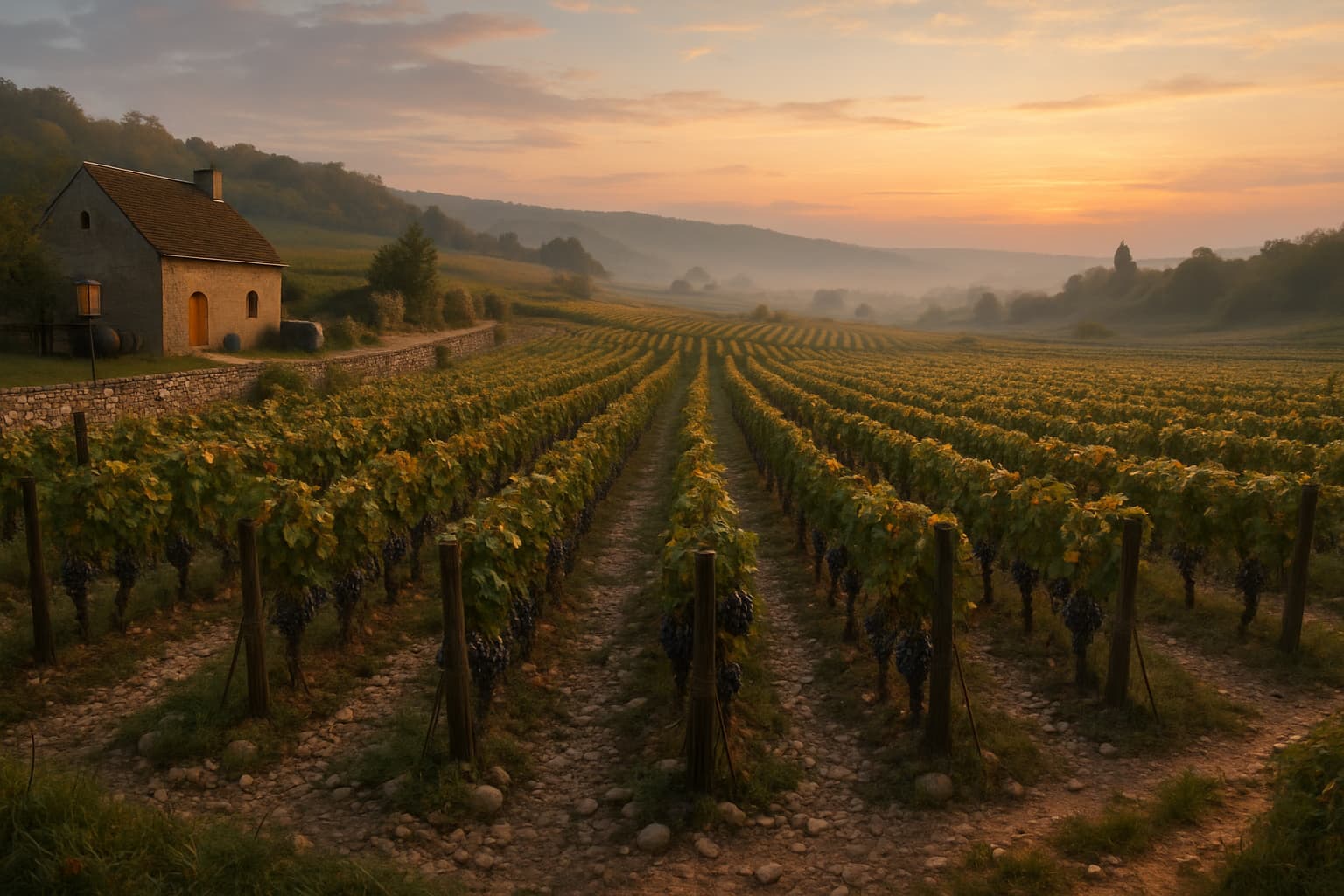
There are places on Earth where time does not merely pass, it settles—layer upon layer—into the soil, the stones, and even the silence between the vines. Burgundy is one such place. To walk its vineyards at dawn, as the mist lifts from the Côte d’Or, is to feel that you are not simply observing a landscape, but entering a long, unfolding story written in limestone, climate, and human patience.
This is no ordinary wine region. It is a narrow, shimmering thread of land in eastern France, yet its influence on the world of wine is vast—disproportionate, almost improbable. Here, with only two principal grapes—Pinot Noir and Chardonnay—humankind has learned to translate the subtlest variations of earth and exposure into liquid narratives of place. To journey inside Burgundy is to witness how geology becomes culture, how weather becomes memory, and how a glass of wine becomes a lens through which we glimpse deep time itself.
Long before a single vine was planted, Burgundy was being prepared by forces unimaginably old. The Côte d’Or—literally the “Golden Slope”—is the exposed edge of an ancient limestone plateau, fractured by tectonic shifts, sculpted by oceans that retreated millions of years ago, and dusted by glacial deposits.
Beneath your feet lie:
It is this geological mosaic that gives Burgundy its most defining concept: terroir—the intricate interplay of soil, subsoil, slope, aspect, climate, and human practice. Here, terroir is not a marketing term. It is a lived reality, a daily negotiation between vine and environment, expressed in minute differences from one vineyard row to the next.
A few meters up or down the slope can mean the difference between a wine of simple charm and one of haunting profundity. In few other places on Earth does geology so insistently declare itself in the glass.
The story of Burgundy is not only geological; it is monastic. From the Middle Ages onward, Benedictine and Cistercian monks observed, tasted, and recorded with a devotion bordering on the scientific.
In an era without modern instruments, these monks became the first great cartographers of terroir. Over centuries, they noticed that wine from one corner of a hillside differed consistently from wine produced just a few steps away. They tasted:
By patient observation, they began to delineate what we now call climats—precisely defined vineyard sites, each with its own character. These were not arbitrary lines drawn on a map, but boundaries traced along the contours of taste and time.
Their legacy endures. The climats of Burgundy, meticulously shaped and refined over a thousand years, are today recognized by UNESCO as a World Heritage treasure. Each climat is a tiny, storied universe: an interplay of sun, stone, wind, and human habit, preserved and passed down across generations.
To look upon a vineyard map of Burgundy is to see not broad estates, but a mosaic of minuscule holdings—slivers of land, sometimes no larger than a garden.
This fragmentation is the result of Napoleonic inheritance laws, which required estates to be divided equally among heirs. Over centuries, this process carved up vineyards into hundreds of tiny parcels, each with its own owner, its own philosophy, its own interpretation of the same place.
Thus, within a single famed vineyard such as Clos de Vougeot, dozens of producers may work side by side. The soil beneath their vines is similar, the climate shared. Yet the wines they produce differ—sometimes subtly, sometimes dramatically—shaped by choices in pruning, harvest date, fermentation, and aging.
Burgundy, then, is not merely a landscape of terroirs; it is a landscape of perspectives. Each bottle is not just a reflection of a plot of earth, but of a particular human mind and hand at a particular moment in time.
To navigate Burgundy is to learn its hierarchy of appellations—a carefully structured system that mirrors the region’s deep respect for place.
At the base of the pyramid are regional wines, such as Bourgogne Rouge and Bourgogne Blanc. These wines can be made from grapes grown across large swathes of Burgundy. They offer a general impression of the region’s style, a first whisper of what Pinot Noir and Chardonnay can be when shaped by this land.
Here, the focus is less on a single plot and more on accessibility—wines that introduce the novice to Burgundy’s voice.
Step closer, and we find village appellations—wines labeled simply as Gevrey-Chambertin, Meursault, Puligny-Montrachet, or Volnay. These wines must come from vineyards within the boundaries of that village.
Each name carries its own personality:
Village wines are the heartbeat of Burgundy, capturing the broader character of a place while still allowing nuance.
Within each village, certain vineyards have long been recognized as producing wines of superior distinction. These are designated Premier Cru (1er Cru).
A label might read:
Here we see the dual identity of the wine: village and vineyard, community and climat. These are wines of greater concentration, complexity, and often longer aging potential. They are the result of centuries of human observation, a quiet consensus that certain slopes speak with a clearer, more compelling voice.
At the summit are the Grand Cru vineyards—names that resonate like ancient incantations: Romanée-Conti, La Tâche, Le Chambertin, Montrachet, Corton-Charlemagne.
These are not simply great wines; they are distilled expressions of singular places. The boundaries of Grand Cru vineyards are tiny, their yields often modest. They demand patience, often slumbering for years or decades before revealing their full symphony of aromas and textures.
In Burgundy, greatness is not defined by power alone, but by precision, length, and the ability to evoke place with astonishing clarity. A Grand Cru from a great year can feel less like a beverage and more like an encounter.
It is one of Burgundy’s quiet miracles that with just two primary grapes, an entire universe of nuance is revealed.
Pinot Noir is thin-skinned, temperamental, and notoriously difficult to grow. It ripens early, fears rot, and is sensitive to every climatic whim. Yet, in Burgundy, it finds its spiritual home.
In its youth, a Burgundy Pinot Noir might show:
With age, it can evolve into something more haunting:
Above all, Pinot here is a lens: it does not impose itself upon the terroir, but reveals it, like clear water over river stones.
Chardonnay in Burgundy is equally revealing, though in a different register. In the mineral-rich hills of Chablis, it becomes taut and saline, evoking seashells and wet stones—a memory of the ancient ocean that once lay here.
Further south, in the Côte de Beaune, Chardonnay takes on more generosity:
Oak, when used, is often a sculptor rather than a mask—shaping texture, adding spice, but rarely overshadowing the voice of the vineyard.
To understand Burgundy, one must watch it through the turning of the year. Each season leaves its signature on the vintage.
Each vintage becomes a chapter in Burgundy’s ongoing chronicle. Some years are generous, others austere; some praised, others quietly overlooked. Yet even in the humblest vintage, there is a story of resilience and adaptation.
To drink a wine from Burgundy is to engage in a kind of listening. The color, the aroma, the taste—all are signals from a particular patch of earth at a particular moment in history.
A thoughtful taster might ask:
Over time, patterns emerge: the flinty edge of Chablis, the silken charm of Chambolle-Musigny, the muscularity of Pommard, the golden breadth of Meursault. One begins to recognize not just wines, but places—like old friends with distinct voices.
Burgundy’s greatness is not guaranteed. It is the product of countless fragile equilibria: between vine and climate, tradition and innovation, demand and authenticity.
Climate change brings earlier harvests, riper fruit, and new challenges of balance and freshness. Rising global demand has driven prices ever upward, risking the transformation of living terroirs into distant luxuries. Young growers struggle with land costs; old vineyards face the pressures of modernization.
And yet, amidst these tensions, there is renewal. Many domaines embrace organic and biodynamic farming, seek restraint in oak use, and prioritize clarity of terroir over sheer power. New generations return to ancestral plots with fresh eyes and reverence for the past.
Burgundy endures because it is not static. It is a conversation between history and the present, between stone and root, between human intention and the uncontrollable wildness of weather.
In the end, Burgundy is not merely about wine. It is about our desire to understand the world beneath our feet—to trace how a fossilized shell in limestone, a gentle eastern slope, a cool morning breeze, and a monk’s observation from centuries ago can culminate in the fragrance of a single glass.
To step inside Burgundy is to witness a rare alchemy: geology, climate, culture, and time, all converging in something at once humble and profound. A vine, a cluster of grapes, a barrel, a bottle.
Lift that bottle to the light, and you are holding more than fermented juice. You are holding a fragment of landscape, a year’s weather, generations of labor, and millions of years of Earth’s slow, patient work.
And as you taste, if you listen closely, you may hear it speak—not loudly, not with fanfare, but with the soft, persistent voice of a place that has spent centuries learning how to reveal itself.
Tannins are astringent compounds found in wine that contribute to its texture and aging potential, often causing a drying or puckering sensation in the mouth. They are derived from grape skins, seeds, and stems, as well as from oak barrels used during aging.
/ˈtænɪnz/
Malic acid is a naturally occurring organic acid found in grapes that contributes to the tart, green apple-like flavor and crispness in wine. It plays a significant role in the taste and acidity of wine.
/mælɪk ˈæsɪd/
Filtration in winemaking is the process of removing solid particles from wine to clarify and stabilize it before bottling, using various types of filters to achieve different levels of clarity and remove unwanted elements like yeast, bacteria, and sediment.
/fɪlˈtreɪʃən/
Oxidation in wine is a chemical reaction between the wine and oxygen that can change its flavor, aroma, and color. This process can be beneficial or detrimental depending on the extent and context of the exposure.
/ˌɒksɪˈdeɪʃən/
Microclimate refers to the unique climate conditions of a small, specific area within a larger region, significantly influencing grapevine growth and the characteristics of the resulting wine.
/ˈmīkrōˌklīmit/
Get weekly wine recommendations, vineyard news, and exclusive content delivered to your inbox.