Wine Literature and Media
“Where every bottle tells a story”
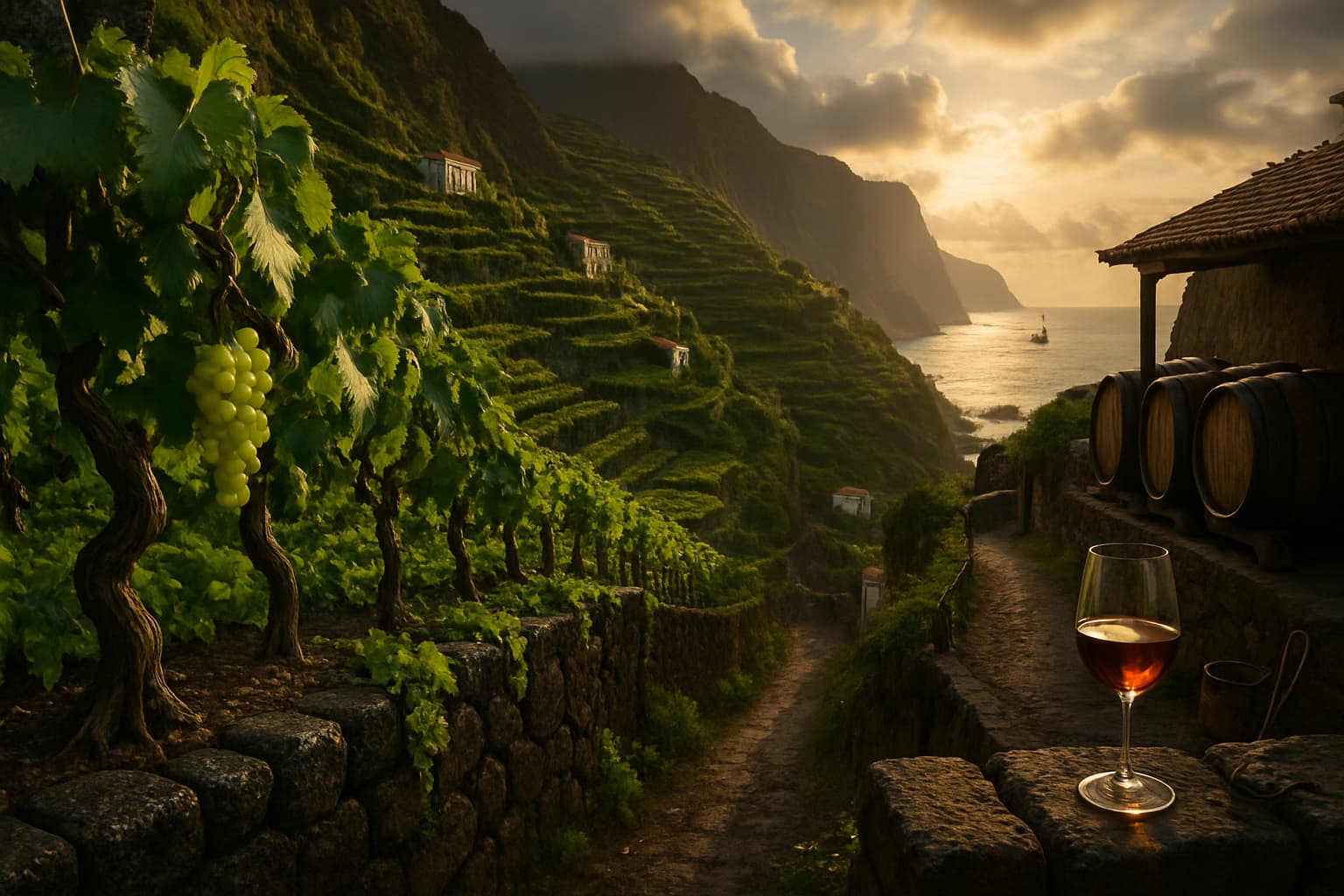
It is a truth not universally acknowledged—but which deserves to be—that a small volcanic island in the Atlantic may possess a consequence in the history of wine far exceeding its size upon the map. Madeira, perched upon the western ocean like a dark emerald, has long occupied a place in the glass, the mind, and even the politics of Europe and America quite out of proportion to its modest acreage. If ever there were an island whose destiny was to be decanted, it is this one.
In speaking of Madeira, we do not merely speak of a wine, but of a manner of life, a style of commerce, and an art of patience. It is a liquid archive of empire and trade, of storms survived and revolutions toasted, of casks that have seen more oceans than many gentlemen. To understand Madeira is to understand how a harsh rock in the sea contrived, by ingenuity and stubbornness, to become an island vineyard of almost mythic renown.
Were a lady of delicate nerves to be deposited upon Madeira’s shores, she might be forgiven for supposing that Nature had not intended the place for cultivation at all. The island is steep, craggy, and dramatic, its cliffs plunging into the ocean with a vigour that seems almost indecorous. Yet it is precisely this severity that has made it so singular a cradle for wine.
Madeira rises from the Atlantic as the summit of a submerged volcano, its soils dark and mineral, its slopes precipitous. The climate is one of gentle mildness: never truly cold, seldom intolerably hot, with the perpetual caress of maritime breezes. Vineyards cling to terraces—poios—cut into the hillsides, like green embroidery upon black stone. One might almost imagine the vines as characters in a novel of perseverance, clinging where no sensible plant would choose to grow, and yet rewarding such obstinacy with wines of extraordinary stamina.
The island’s isolation, some 600 miles from Portugal and far nearer to Africa than to Lisbon, has always made it both vulnerable and independent. From this geographic peculiarity arose its destiny: too remote for easy overland trade, yet perfectly placed for ships venturing to the New World, to the East Indies, and beyond. Madeira became not merely an island with wine, but an island because of wine.
Many of the best discoveries in life arise from some fortunate mischance, and Madeira is no exception. In the age when sailing ships stitched the oceans together, barrels of the island’s wines were used as ballast, stowed in hot holds for voyages that might last many months and cross both equator and tempest.
Upon their return, merchants observed something astonishing: the wines that had spent long weeks in the tropical heat, rocking in their casks like infants in a cradle, had not spoiled. On the contrary, they had improved. They were more complex, more intense, with a curious and delightful character of roasted nuts, dried fruits, and a tang of acidity that enlivened the palate. The wine had endured the voyage as a heroine endures adversity—transformed, deepened, and rather more interesting than when she set out.
Thus arose the practice known as vinho da roda—“round-trip wine”—sent out on long voyages precisely to acquire this character. It was a most extravagant form of maturation, but it conferred such prestige that wealthy customers clamoured for it. Eventually, human ingenuity, which dislikes leaving profit at the mercy of the weather and the waves, contrived to imitate this maritime education on land. Wine was deliberately heated in lofts under the tiles, or in specially constructed rooms and vessels, to reproduce the effects of a tropical voyage. The art of estufagem—heat treatment—was born.
To this was added fortification: the practice of adding neutral grape spirit to arrest fermentation and preserve sweetness while increasing strength. The combination of robust acidity, warming alcohol, and the peculiar seasoning of heat made Madeira nearly indestructible. Where other wines would fade, Madeira merely cleared its throat and continued.
If Madeira could speak, it would converse in many languages and recount the secrets of merchants and ministers alike. Its fate was bound to the sea-lanes of empire. British, Portuguese, Dutch, and later American traders all found in Madeira a companion for their ventures.
The British, in particular, established a firm presence on the island, their merchant houses becoming pillars of the Madeira trade. They encouraged a style of wine suited to distant markets: durable, ship-worthy, and capable of arriving in the West Indies, India, or the American colonies not only unspoiled but improved.
In the American colonies, Madeira achieved a distinction almost romantic. It was the wine of toasts and treaties, of inaugurations and insurrections. It is said that it was drunk in celebration of the signing of the Declaration of Independence; it certainly flowed freely in the glasses of men such as Washington and Jefferson. Madeira, like an amiable but spirited aunt, was present at the birth of a nation, offering courage in the glass and a sense that one was participating in something of consequence.
Its popularity in the New World was not solely a matter of taste. Madeira, being produced on a Portuguese island and often shipped directly, could sometimes circumvent the more irksome of British trade restrictions. It was, in a sense, a wine of lawful mischief—legal enough to pass muster, but sufficiently independent to appeal to colonial sensibilities. Thus did a remote Atlantic vineyard find itself entangled in the politics of liberty.
A lady of sense, upon being introduced to Madeira, will wish to know its varieties and dispositions, just as she might inquire into the character of a new acquaintance. Madeira, obligingly, offers a range of personalities, each defined by its grape and level of sweetness.
Historically, four noble white varieties presided over the island, each lending its name to a style:
Sercial – The driest and most austere, grown at higher altitudes where the air is cooler. Its wines are bright, piercing, and finely etched, with a bracing acidity that recalls a sharp remark delivered in excellent taste. Sercial is often served as an aperitif, awakening the palate rather than lulling it.
To these one might add Terrantez, once nearly lost, now cherished for its haunting, bittersweet character, and Tinta Negra, the adaptable workhorse grape that, in modern times, has proven capable of refinement when treated with respect.
The genius of Madeira lies in the tension between sweetness and acidity, richness and fire. Even the sweetest style is never merely syrupy; a bright, almost electric line of acidity runs through it, keeping the wine upright and alert. The fortification lends warmth and structure, like a well-boned gown beneath an elegant dress.
In most regions, heat is the sworn enemy of fine wine. In Madeira, it is a conspirator. The island’s winemakers long ago discovered that their wines, unlike more delicate cousins on the continent, could endure—and even benefit from—conditions that would ruin others.
Two principal methods of maturation now prevail:
Estufagem, in which the wine is gently heated in tanks or rooms for a period of months. This is the more practical method, often used for younger, more modest wines.
Canteiro, the nobler approach, where casks are stored in warm lofts or warehouses and allowed to age slowly, sometimes for decades, under the influence of ambient heat. The wine ascends, both literally and figuratively, occupying the upper floors where the warmth is greatest.
Over time, the wine undergoes a slow transformation. Oxidation, normally a foe, becomes an ally, conferring aromas of roasted nuts, dried fruits, spice, and a certain rancio character—an almost savoury complexity difficult to describe yet instantly recognisable. The colour deepens from pale gold to burnished amber, then to mahogany. The texture becomes silkier, the flavours more concentrated, yet the wine remains vigorous, its acidity like a spine that refuses to stoop with age.
It is this peculiar education in heat and air that grants Madeira its legendary longevity. Bottles a century old can be as lively as many wines of ten years; those of two centuries may still display freshness, like an elderly gentleman whose eyes retain a youthful sparkle.
In a world where most wines must be coddled—protected from light, temperature, and the slightest draught—Madeira stands apart as a creature of iron constitution. Once opened, a bottle may be enjoyed over weeks or even months with little loss of character. It is a wine that does not take offence at being left on the sideboard.
Historically, this durability made it ideal for long voyages and uncertain storage. In the present day, it offers the modern household a rare convenience: a wine that may be sipped occasionally without fear of waste. A small glass after dinner, another a fortnight later, and the Madeira will still greet you with perfect composure.
Yet fashion is as fickle in wine as in dress. Madeira, which once enjoyed universal esteem in courts and colonies, fell from favour in the 19th and 20th centuries, eclipsed by the rise of table wines and changing tastes. Disease in the vineyards, shifts in trade, and the devastation of phylloxera all conspired against it. For a time, one might have feared that Madeira would become a mere historical curiosity, known only from the pages of old novels and the footnotes of treaties.
Happily, there has been a revival of interest. Connoisseurs and collectors, always alert to what is rare and characterful, have rediscovered Madeira’s charms. Producers have restored old vineyards, revived noble varieties, and released venerable casks. The island vineyard, though once thought passé, has returned to the conversation, not as a fashionable novelty but as a venerable classic.
To drink Madeira is to enter into a dialogue not only with the present, but with the past. Each glass carries within it the memory of storms weathered, of warehouses warm with summer air, of barrels that travelled more widely than their makers. It is a wine that rewards patience and reflection, and is therefore perhaps ill-suited to those who hurry through their pleasures.
One might enjoy it in many ways: a dry Sercial before dinner, a Verdelho with a well-seasoned soup, a Boal or Malmsey with dessert, or any of them alone, as a companion to reading, letters, or quiet thought. It does not demand attention with vulgar insistence, but once noticed, it seldom relinquishes its hold.
If there is a lesson in Madeira, it is that adversity—heat, distance, time—need not be a sentence of ruin. Properly understood and patiently managed, these very trials may become the source of strength and distinction. The island itself, with its steep terraces and perilous cliffs, has turned its apparent disadvantages into a singular virtue. So too has its wine.
In an age that prizes novelty and instant gratification, Madeira stands as a gentle rebuke and an elegant alternative. It invites us to slow our pace, to consider the long view, and to take a certain satisfaction in what endures. The island vineyard, remote yet influential, rugged yet refined, continues to pour forth wines that taste not only of grapes and stone and sea, but of history itself—decanted, warmed by the sun, and offered in a small, shining glass.
Tannins are astringent compounds found in wine that contribute to its texture and aging potential, often causing a drying or puckering sensation in the mouth. They are derived from grape skins, seeds, and stems, as well as from oak barrels used during aging.
/ˈtænɪnz/
Malic acid is a naturally occurring organic acid found in grapes that contributes to the tart, green apple-like flavor and crispness in wine. It plays a significant role in the taste and acidity of wine.
/mælɪk ˈæsɪd/
Verdelho – A step richer, yet still decidedly fresh. Verdelho Madeiras combine a pleasing weight with lively acidity, offering notes of dried citrus, smoke, and spice. They occupy a middle ground—neither too severe nor too indulgent—much like a well-bred gentleman of moderate fortune.
Boal (or Bual) – Sweeter and fuller, with a darker hue and flavours of caramel, roasted nuts, and figs. Boal’s richness is balanced by the island’s signature acidity, preventing any descent into cloying sentimentality. It is a wine for contemplation and dessert, or perhaps for a letter written late at night.
Malvasia (Malmsey) – The richest and most opulent of all, a dessert wine of considerable sweetness and great complexity. Malmsey Madeira is unashamedly indulgent, with notes of toffee, chocolate, and dried fruits, yet always enlivened by a cleansing tang. It is the dowager duchess of Madeiras: grand, elaborate, and difficult to forget.
Filtration in winemaking is the process of removing solid particles from wine to clarify and stabilize it before bottling, using various types of filters to achieve different levels of clarity and remove unwanted elements like yeast, bacteria, and sediment.
/fɪlˈtreɪʃən/
Oxidation in wine is a chemical reaction between the wine and oxygen that can change its flavor, aroma, and color. This process can be beneficial or detrimental depending on the extent and context of the exposure.
/ˌɒksɪˈdeɪʃən/
Microclimate refers to the unique climate conditions of a small, specific area within a larger region, significantly influencing grapevine growth and the characteristics of the resulting wine.
/ˈmīkrōˌklīmit/
Get weekly wine recommendations, vineyard news, and exclusive content delivered to your inbox.