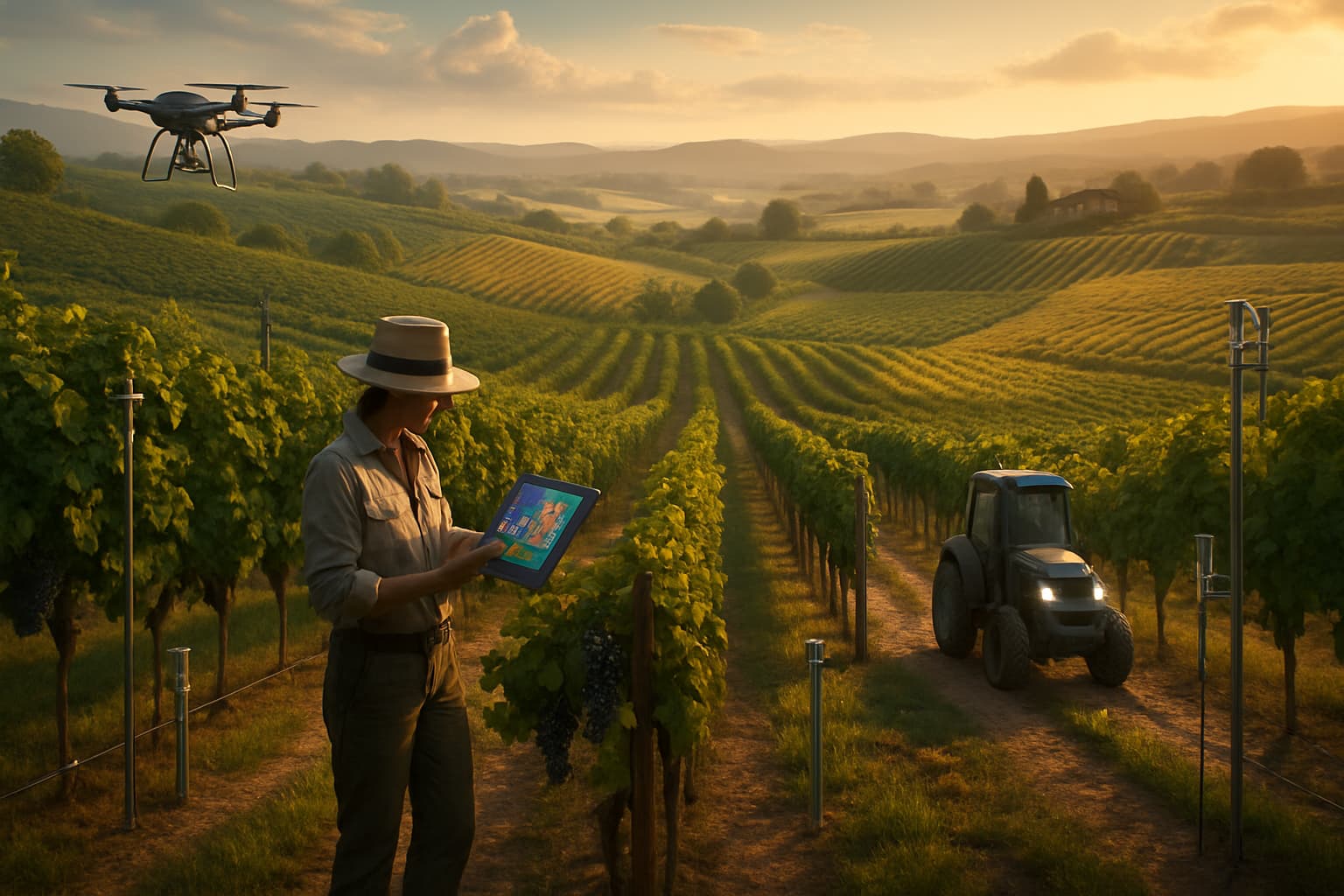
Wine Technology and Innovation
“Where every bottle tells a story”
There is a moment, standing in a vineyard just before dawn, when the air is so still you can almost hear the grapes breathing. The leaves hold the night’s cool like silk fresh from the laundry line, and somewhere between the soil and the stars, a year’s worth of weather, worry, and whispered hope hangs in the balance.
For centuries, winegrowers have trusted their eyes, their hands, and their instincts to guide them. They’ve tasted berries from different rows, watched the sky with a kind of anxious devotion, and made decisions that were as much about feel as about fact. But now, quietly and almost seductively, a new kind of winemaking is taking shape: one that brings satellites, sensors, and algorithms into the vineyard—yet still, at its heart, is about flavor, feeling, and that first sip that makes you close your eyes.
This is the world of precision viticulture and smart vineyard management: not a sterile lab experiment, but a more intimate way of listening to the vines, hearing their secrets more clearly, and responding with exquisite care. Think of it as moving from cooking by vague memory to cooking with both instinct and the most beautifully written recipe—measuring, adjusting, and still leaving room for a little magic.
Walk through a traditional vineyard, and it may look like a single, sweeping landscape: rows of vines, evenly spaced, marching towards the horizon. But in reality, it’s more like a patchwork quilt of micro-worlds. One corner might be cooler, another drier; a slight rise might drain water more quickly, a hollow might trap cold air.
Precision viticulture begins with a simple, almost sensual acknowledgment: not all vines in a vineyard are the same, and they shouldn’t be treated as if they are.
Instead of thinking, “This is my vineyard,” the grower starts to think, “This is my collection of small, distinct places.” Each block, sometimes each row, even each cluster, becomes a character with its own needs, moods, and potential.
To reveal these differences, technology steps in like a kindly, hyper-observant friend:
The result is a detailed portrait of the vineyard—less a static picture, more a living, breathing map that changes with the seasons.
If vines could speak, they might complain of thirst, shiver with cold, or sigh with the luxury of just-enough water and just-enough sun. Precision viticulture, in essence, is about giving them a voice.
The tools are technical, yes, but their purpose is deeply human: to understand and respond.
Soil Moisture Sensors
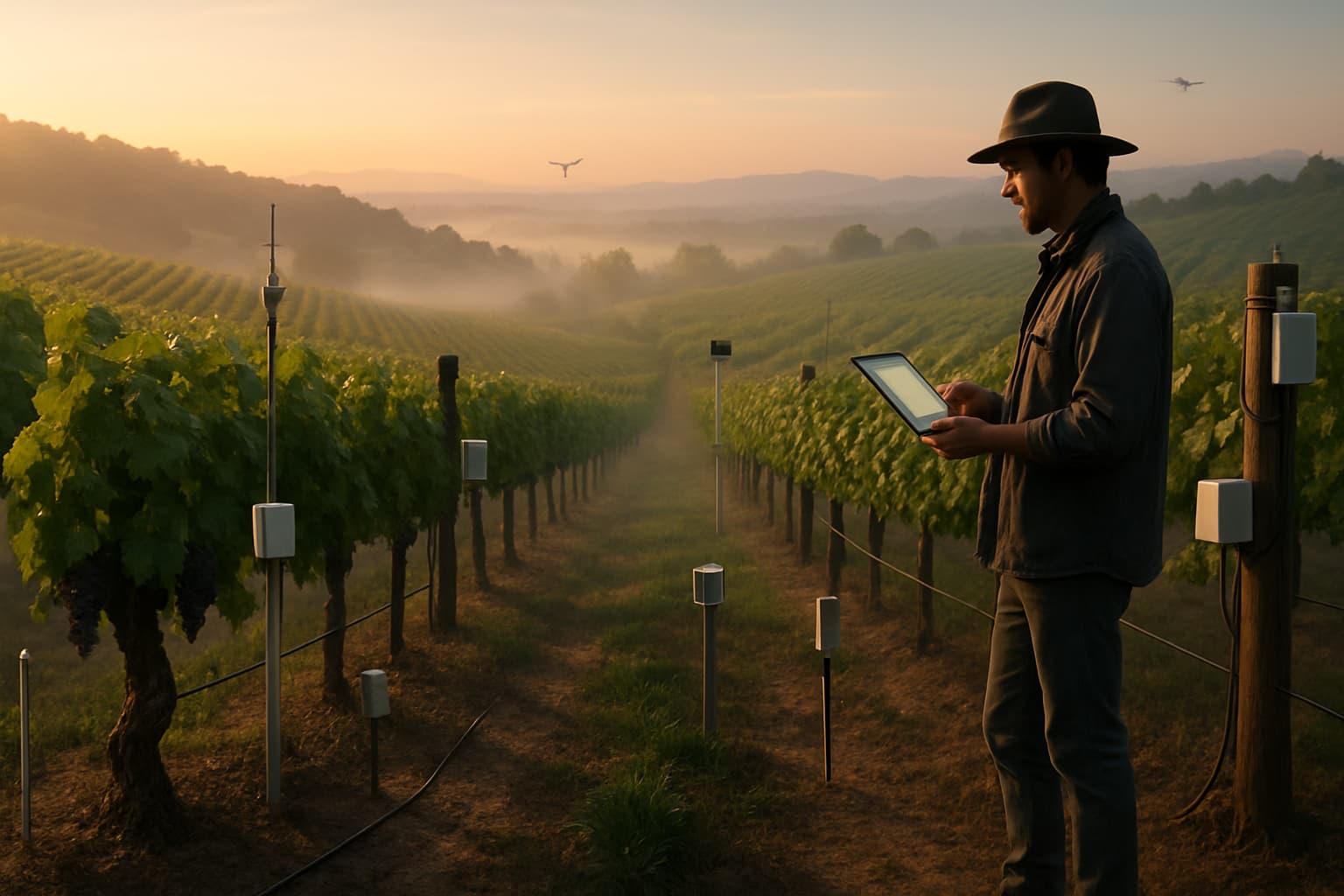
Buried like truffles in the earth, these sensors measure how much water is actually available to the roots. Instead of watering by habit (“We always irrigate on Thursdays”), growers can irrigate by need. One block might be perfectly quenched, while another, on lighter soil, is parched. Water can then be delivered with the same care as a cook adding stock to a risotto—ladle by ladle, and only where it’s needed.
Canopy and Vine Health Sensors
Mounted on tractors, drones, or satellites, these systems read the color and density of the vine canopy. They pick up subtle changes in leaf greenness, vigor, and stress—like noticing the faint paling of a basil leaf before it wilts. These readings can be translated into maps showing which areas are thriving and which are struggling, guiding everything from pruning to fertilizing.
Weather and Climate Stations
Tiny, tireless guardians, these stations record temperature, humidity, wind, and rainfall, often in real time. Their data can feed models that predict disease risk—powdery mildew, botrytis, and other fungal foes that love certain combinations of warmth and moisture. Instead of spraying the entire vineyard “just in case,” the grower can act only when and where the risk is real.
Remote Sensing and NDVI
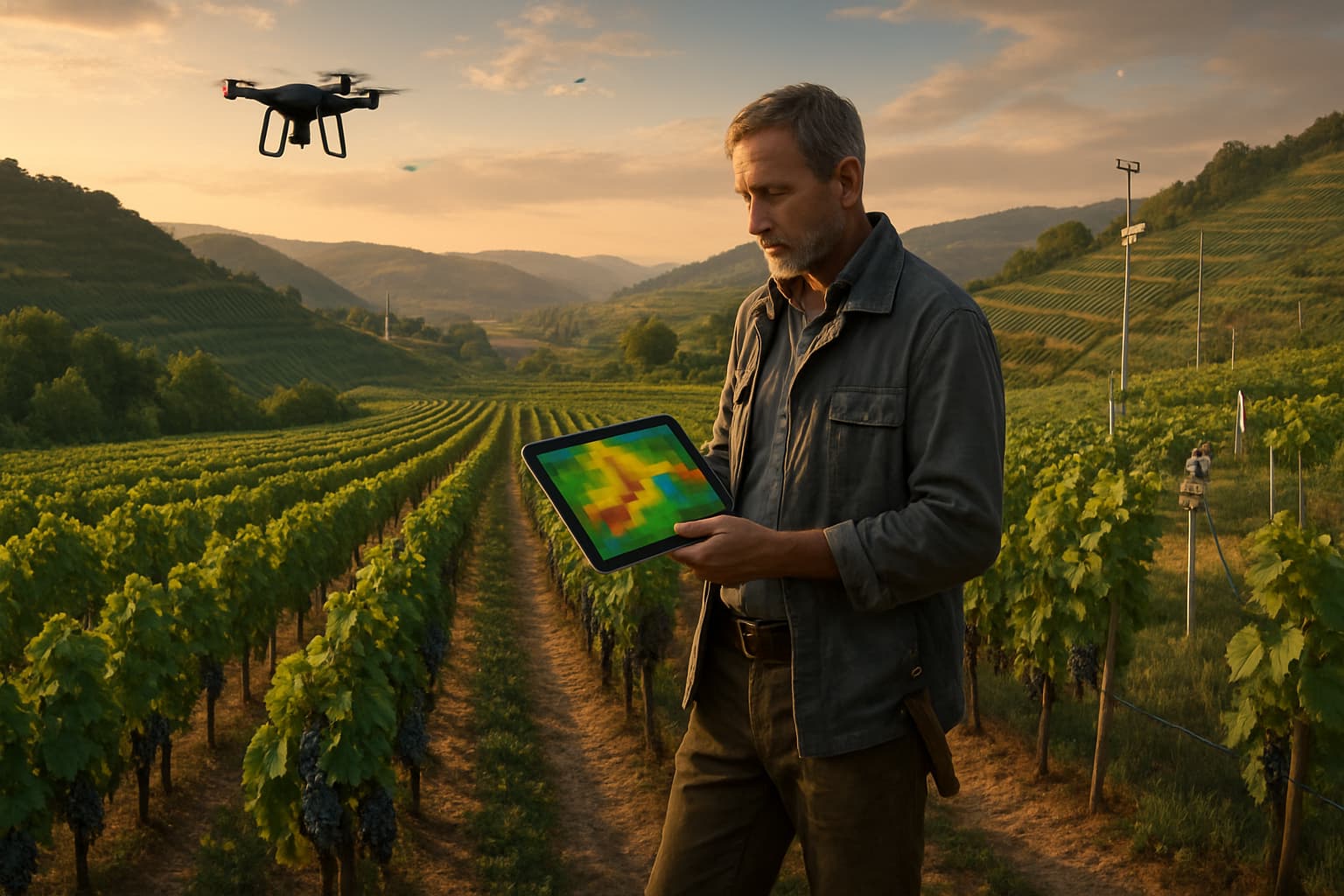
One of the most quietly glamorous tools in this world is NDVI (Normalized Difference Vegetation Index)—a mouthful of a name for something very simple: measuring how lush and active the vines are. Drones or satellites capture images that show, in color-coded swirls, which areas are strong and which are weak. It’s like seeing the vineyard in thermal vision, but for plant health rather than heat.
Taken together, these sensors turn the vineyard into a murmuring chorus of data. But data alone is dry; the artistry lies in how it’s used.
Water in the vineyard is like salt in the kitchen: essential, powerful, and dangerous in excess. Too much, and the vines grow leafy and lazy, diluting flavor. Too little, and they shut down, berries shrivel, and the promise of the season withers.
Smart vineyard management uses variable-rate irrigation to treat water with the reverence it deserves.
Instead of flooding every row equally, growers can:
Imagine seasoning a dish not with a single dramatic gesture of the salt shaker, but with small, attentive pinches at just the right moments. That is what precision irrigation offers: nuance.
It is also a quiet act of responsibility. In a warming world, where droughts are no longer rare visitors but recurring guests, using water with care is both practical and profoundly ethical.
Harvest is the vineyard’s climax, the moment all the months of watching and waiting must resolve into a single decision: to pick, or not to pick.
Traditionally, this has been a dance of tasting berries, checking sugar levels (Brix), and reading the weather forecast like tea leaves. Today, precision viticulture adds layers of insight:
This makes selective harvesting possible: picking cooler, slower-ripening sections later for freshness and acidity, while harvesting warmer, earlier-ripening pockets for richness and depth. The result can be wines with more complexity, a kind of layered flavor that reflects not a single uniform field, but a tapestry of places.
And yet, for all the charts and graphs, there is still that final, nerve-tingling decision: the winemaker or grower in the vines, tasting a berry, feeling the crunch of the skin, the sweetness of the juice, the ripeness of the seeds, and deciding: “Tomorrow.” Precision doesn’t replace that moment; it simply makes it surer, more informed, and perhaps a touch less sleepless.
There is a delicious elegance in doing more with less. Precision viticulture is, in many ways, the culinary principle of “no waste” applied to land and life.
By knowing exactly where to act, growers can:
These are not merely technical tweaks; they are moral choices, made manifest in daily decisions. A vineyard managed with precision and care is not just a factory for grapes; it becomes a landscape that can endure, year after year, vintage after vintage.
There is a temptation, when we talk of sensors and satellites, to imagine the vineyard becoming cold, clinical, stripped of romance. But that is to mistake the tools for the intention.
In truth, precision viticulture can deepen the intimacy between grower and vine. The technology does not replace the human hand; it sharpens it.
Think of it as moving from cooking in the half-light to cooking with the kitchen fully illuminated. You still stir, taste, and adjust by feel—but you can see more clearly what’s happening in the pan.
And crucially, style and philosophy still matter. Some growers will use precision tools to chase purity and freshness; others will use them to push ripeness and opulence. The data is neutral. The choices, like seasoning, are personal.
All of this—every buried sensor, every drone flight, every weather station—must ultimately justify itself in the glass. Otherwise, it is just cleverness for its own sake.
When precision viticulture is done well, you might notice:
You may not taste “sensor” or “satellite,” of course. What you taste is harmony: a wine that feels composed rather than chaotic, confident rather than lucky.
As climate change tightens its grip, vineyards will face fiercer heat, stranger storms, and more erratic seasons. Precision viticulture and smart vineyard management are not futuristic frills; they are part of a new, necessary language of resilience.
The romance of wine has always been entwined with struggle: against frost, against drought, against rot and ruin. What is changing now is not the struggle itself, but the tools we bring to it. Instead of stoic endurance alone, there is now listening, anticipating, adjusting—treating the vineyard not as a battlefield, but as a living partner.
In the end, this quiet revolution is not about replacing soul with software. It is about giving soul better shoes for the journey. The grower still walks the rows, still breaks open a grape between finger and thumb, still looks at the sky with a mixture of hope and apprehension.
But now, alongside the intuition and the inherited wisdom, there’s a softly glowing screen, a map of colors, a chart of curves—all whispering, “Here, look closer. This block is thirsty. That corner is struggling. This, right here, is where beauty might be coaxed into being.”
And when you finally pour the wine, watch it slip into the glass with its ruby or golden sheen, and lift it to your lips, you’re tasting not only sun and soil and season, but also an intricate, almost tender choreography of care.
Precision, in this world, is not cold. It is a kind of devotion. And every sip is its proof.
There are few spectacles in Europe more pleasing to the contemplative mind than a well-ordered vineyard: the rows of vines marching with military regularity across a hillside, the leaves trembling in...
Tannins are astringent compounds found in wine that contribute to its texture and aging potential, often causing a drying or puckering sensation in the mouth. They are derived from grape skins, seeds, and stems, as well as from oak barrels used during aging.
/ˈtænɪnz/
Malic acid is a naturally occurring organic acid found in grapes that contributes to the tart, green apple-like flavor and crispness in wine. It plays a significant role in the taste and acidity of wine.
/mælɪk ˈæsɪd/
Filtration in winemaking is the process of removing solid particles from wine to clarify and stabilize it before bottling, using various types of filters to achieve different levels of clarity and remove unwanted elements like yeast, bacteria, and sediment.
/fɪlˈtreɪʃən/
Oxidation in wine is a chemical reaction between the wine and oxygen that can change its flavor, aroma, and color. This process can be beneficial or detrimental depending on the extent and context of the exposure.
/ˌɒksɪˈdeɪʃən/
Microclimate refers to the unique climate conditions of a small, specific area within a larger region, significantly influencing grapevine growth and the characteristics of the resulting wine.
/ˈmīkrōˌklīmit/
Get weekly wine recommendations, vineyard news, and exclusive content delivered to your inbox.