Wine Literature and Media
“Where every bottle tells a story”
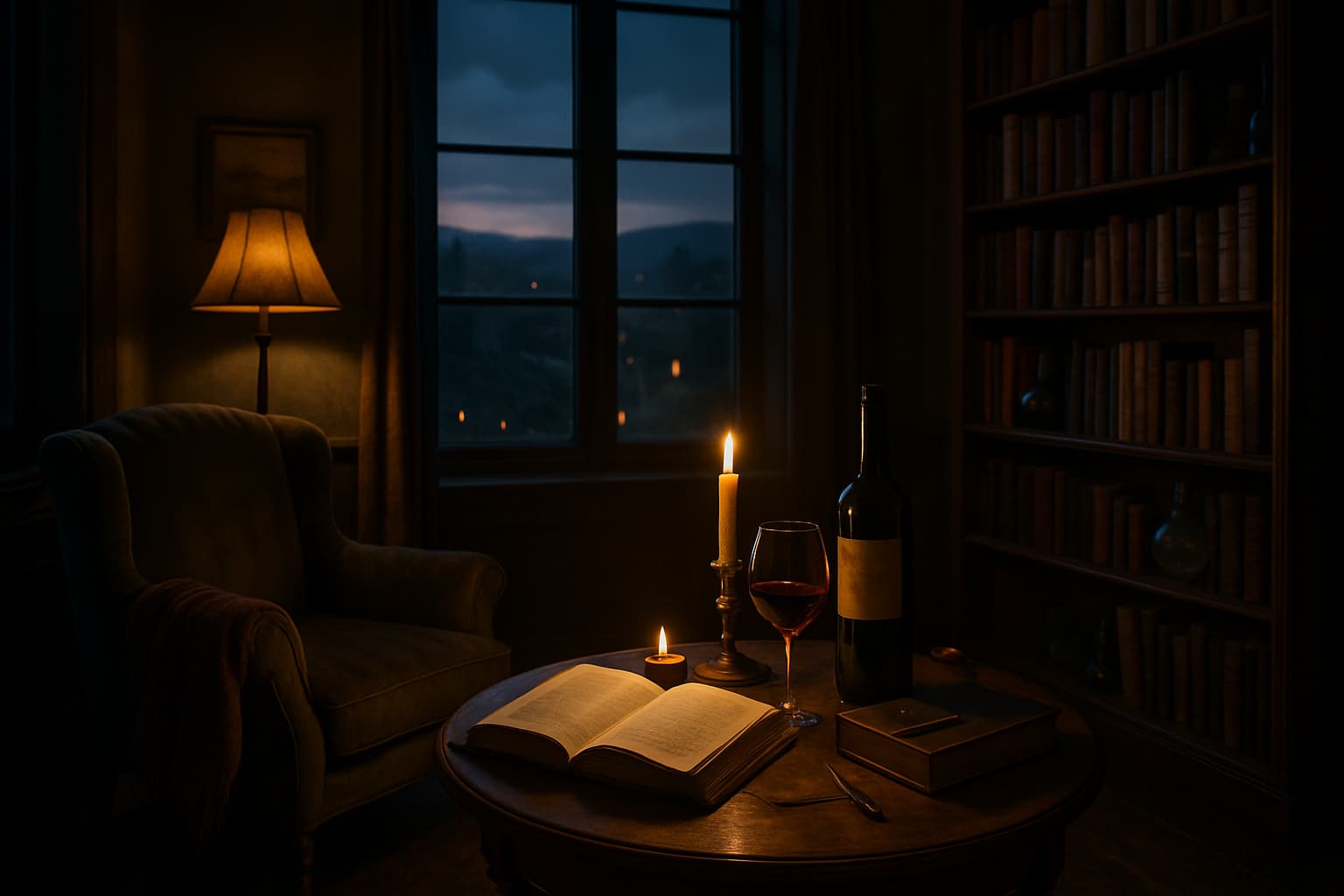
It is a truth not universally acknowledged, but very often felt, that a person in possession of a glass of wine must be in want of conversation. If no suitable companion is at hand, the thoughtful reader may turn, with no great loss, from the clink of crystal to the rustle of pages. Books and bottles, after all, have long been conspirators in our pleasures. They whisper, they reveal, they console—and, on occasion, they indiscreetly embolden.
To read about wine is to court a double enchantment. The first resides in the liquid itself—its colours, perfumes, and humours; the second in the words that attempt, with varying degrees of success and sobriety, to capture its character. Between vineyard and volume, between cellar and sentence, there exists a conversation as charming as any conducted in a drawing room, and often rather more honest. In what follows, we shall attempt to read between the wines: to consider how literature has used wine, how wine writing has become its own peculiar art, and how the attentive reader may derive equal satisfaction from the page and the glass, if only they are willing to pay proper court to both.
Many persons, when they encounter wine in novels, suppose it to be there merely as ornament—an agreeable prop, like a vase of flowers or an unremarkable aunt. This is a mistake. In the hands of a capable author, wine is no mere accessory; it is a character, a confidant, and sometimes a conspirator.
Observe how often a simple mention of claret, port, or champagne reveals an entire social arrangement. A modest country table, furnished with an honest if unremarkable Burgundy, suggests frugality, sincerity, and perhaps a touch of rustic pride. An overabundant cellar, groaning with grand cru and ancient Madeira, hints at wealth, ambition, and occasionally a desire to impress beyond one’s means. A character who drinks carefully chosen wines in moderation is very different from one who gulps whatever is poured with uncritical enthusiasm.
In literature, wine frequently serves as a truth serum more reliable than any confessional. A timid suitor, after a glass too many, may utter what he has long concealed. A calculating hostess may select her wines as she does her guests: some to flatter, some to disarm, some to expose. When an author places a particular bottle upon the table, it is rarely by accident. The vintage, the region, the manner in which it is poured—or refused—may reveal more about the company than a page of direct description.
To read well, then, is to attend to these details. When a novelist informs us that a character drinks “a rough country red” rather than “a delicate Bordeaux,” the distinction is not only of palate but of personality and circumstance. Wine is mood, class, aspiration, and sometimes rebellion, all decanted into a single glass.
There was a time when writing about wine consisted chiefly of merchants’ lists and gentlemen’s notes, scribbled in a small hand and understood by even fewer persons. “Good,” “sound,” and “poor” were considered sufficient judgments, and a man was thought quite extravagant if he ventured as far as “elegant” or “sturdy” in his descriptions.
How different is our present age, in which wine has acquired its own literature—guidebooks, memoirs, histories, and tasting notes that border upon poetry and, at moments, melodrama. Entire careers are built upon the attempt to explain to one’s fellow creatures why this particular liquid, grown upon that particular hill, in that particular year, is worthy of their attention and purse.
This transformation did not occur overnight. As travel became more convenient and trade more expansive, wine escaped the confines of local habit and entered the realm of comparative delight. With comparison came opinion; with opinion, controversy; and with controversy, the urgent need to write. Critics arose, armed not merely with noses and tongues, but with pens. They discovered that a well-turned phrase about a bottle might influence more fortunes than a well-aimed arrow in battle.
Thus was born the modern wine critic, that curious mixture of scholar, poet, and auctioneer. Their prose may be florid or restrained, technical or romantic, but its purpose is constant: to make the invisible visible. The reader cannot taste the wine before them; they can only taste the words. The success of wine writing, therefore, depends upon whether those words can evoke something so vivid that the reader feels almost intoxicated by imagination alone.
Perhaps no literary form is more peculiar—and more revealing—than the tasting note. On the surface, it is a modest creature: a few lines describing colour, scent, flavour, and finish. Yet within this narrow frame, whole dramas unfold.
There are writers who treat the tasting note as a scientific report, filled with references to acidity, tannin, and structure. Others approach it as a sonnet, summoning cherries, violets, leather armchairs, and the faint remembrance of a distant summer by the sea. One might suppose, reading certain descriptions, that the wine has spent its youth strolling through orchards, reclining upon velvet, and reading French poetry.
It is easy to mock such extravagances, and indeed they often invite a smile. But beneath the theatre lies a serious endeavour. Wine, unlike a painting or a symphony, cannot be reproduced or hung in a gallery. Each bottle is finite, each vintage unique. The tasting note becomes, therefore, an attempt at preservation—a little glass museum of sensations.
To read these notes wisely is to understand both their ambition and their limitation. They are not laws, but letters: one person’s account of a fleeting encounter. They reveal as much about the writer as about the wine. A critic who perpetually detects “dark, brooding fruit” may be confessing more than they intend about their own temperament. Another who sees only “playful berries and cheerful florals” might be equally betrayed by their adjectives.
The attentive reader will learn to read such notes as a kind of correspondence. Over time, one discovers which writers share one’s palate, just as one discovers which authors share one’s humour. To read between the wines, in this sense, is to recognise that every description is a conversation between tongue and mind, rendered in ink.
Beyond criticism, there exists a more expansive branch of wine literature: the stories of those who grow, make, sell, and drink it. These works range from historical accounts of great regions and châteaux to intimate memoirs of families who have staked their fortunes on a patch of stubborn soil.
Such books often follow a familiar pattern, not unlike a novel of manners. There is the venerable estate, proud of its lineage yet beset by modern challenges. There is the ambitious newcomer, determined to prove that excellence is not the exclusive right of ancient names. There are conflicts of generation, with children who question the customs of their parents, and parents who distrust the innovations of their children. Weather, that most indifferent of characters, plays its part with cruel impartiality, bestowing sunshine or hail as it pleases.
In reading these accounts, one soon discovers that wine is less a product than a narrative. Each bottle is the conclusion of a story that began long before the cork was driven in: in the geology of the soil, the temperament of the season, the choices of the winemaker, and the economics of the market. To drink without any knowledge of this story is possible, of course, just as one may attend a ball without inquiring into anyone’s history. Yet how much richer the experience becomes when one understands, if only a little, the dramas that led to this moment of enjoyment.
Memoirs of wine merchants and sommeliers offer another perspective, revealing the theatre of hospitality and the commerce of taste. Here we encounter anxious hosts, determined to impress; nervous diners, terrified of mispronouncing a foreign name; and professionals who must balance genuine passion with the practical necessity of selling what can be sold. In their hands, wine becomes a social instrument, capable of soothing tensions, celebrating unions, or, on rare and unfortunate occasions, provoking discord.
There are persons of severe disposition who insist that the proper study of wine must be conducted in a state of absolute sobriety, and that reading should be reserved for equally temperate conditions. Such people may be admirable in many respects, but they are perhaps not the most amusing company.
The harmony between reading and drinking lies in moderation. A glass of wine can soften the edges of the day, making the mind more receptive to nuance, more patient with description, more inclined to linger over a phrase. A good book, in turn, can prevent the glass from becoming an end in itself, reminding the drinker that pleasure is heightened by reflection.
Pairing wine with literature need not be an exact science—indeed, attempts at too much precision may lead to absurdity. Yet there is a certain charm in choosing, for example, a sturdy, honest red to accompany a novel of country life; a delicate, complex white for a work of subtle psychology; or a sparkling wine for a comedy of manners, where wit fizzes and bubbles with every exchange.
The essential point is that both activities encourage slowness. One does not gulp a well-made wine any more than one skims a finely crafted sentence. To read between the wines is to adopt a pace that allows flavours and ideas alike to unfold.
In an age abundant with opinions, the reader of wine literature faces a difficulty not unlike that of a young lady confronted with a ballroom full of suitors: everyone has something to say, and many of them contradict one another. How is one to choose?
A few principles may offer guidance:
By approaching wine literature with the same mixture of curiosity and scepticism that one applies to any other field of criticism, the reader may enjoy its pleasures without being overwhelmed by its passions.
In the end, the relationship between wine and literature is a courtship of equals. Each enhances the other, yet neither is wholly dependent. A poor book will not be redeemed by the best of vintages, nor will a great work of the mind be improved by excess in the glass. But when both are chosen with care, and approached with attention, they conspire to create an experience that is at once sensual and intellectual.
To read between the wines is to recognise that every bottle contains not only fermented juice, but history, labour, chance, and hope—and that every piece of writing about wine is an attempt, however imperfect, to honour that complexity. The thoughtful reader, glass in hand, may travel from Burgundy to Bordeaux, from Tuscany to the New World, without once leaving their chair; may observe the rise and fall of fortunes, the stubbornness of vines and vintners, the changing fashions of taste; and may come, in time, to understand that our preoccupation with wine is, at heart, a preoccupation with ourselves—our desires, our vanities, our longing for beauty, and our fear of its passing.
If the world must contain its share of noise and haste, then let there also be, in some quiet corner, a table with a book, a bottle, and a reader willing to linger. For in that modest arrangement lies a small but certain happiness: the chance to savour not only what is in the glass, but what is in the words—to read, as it were, not only the lines, but the wines between them.
Tannins are astringent compounds found in wine that contribute to its texture and aging potential, often causing a drying or puckering sensation in the mouth. They are derived from grape skins, seeds, and stems, as well as from oak barrels used during aging.
/ˈtænɪnz/
Malic acid is a naturally occurring organic acid found in grapes that contributes to the tart, green apple-like flavor and crispness in wine. It plays a significant role in the taste and acidity of wine.
/mælɪk ˈæsɪd/
Attend to clarity over cleverness. Writers who explain without obscuring, who instruct without condescension, are rarer than those who merely parade their knowledge. Prefer the former.
Observe consistency. Over time, does a particular critic’s judgement align with your own experience? If so, you have found a useful companion. If not, you may still enjoy their prose, but treat their recommendations as you would the opinions of a charming but unreliable cousin.
Beware of extremes. Writing that declares a wine to be either perfection incarnate or a catastrophe unfit for human consumption often reveals more drama than discernment. Most wines, like most people, occupy a middle ground of virtues and defects.
Value context. Good wine writing explains not only what is in the glass, but why it is so: the region, the climate, the traditions, the choices made in the vineyard and cellar. Such information enriches understanding far more than a torrent of adjectives.
Trust your own senses. No quantity of eloquent prose can overrule the verdict of your own palate. Reading should guide and inform, not dictate. The finest writers invite you to taste with them, not for them.
Filtration in winemaking is the process of removing solid particles from wine to clarify and stabilize it before bottling, using various types of filters to achieve different levels of clarity and remove unwanted elements like yeast, bacteria, and sediment.
/fɪlˈtreɪʃən/
Oxidation in wine is a chemical reaction between the wine and oxygen that can change its flavor, aroma, and color. This process can be beneficial or detrimental depending on the extent and context of the exposure.
/ˌɒksɪˈdeɪʃən/
Microclimate refers to the unique climate conditions of a small, specific area within a larger region, significantly influencing grapevine growth and the characteristics of the resulting wine.
/ˈmīkrōˌklīmit/
Get weekly wine recommendations, vineyard news, and exclusive content delivered to your inbox.