Wine Literature and Media
“Where every bottle tells a story”
You don’t set out to become a “wine person.”
You just want a drink.
Maybe it starts with a cheap house red at a neighborhood bistro, because beer feels too heavy and cocktails feel like trying too hard. Maybe it’s a glass someone hands you at a wedding, something vaguely “nice,” poured by a guy in a vest who says “notes of cherry” like he’s reading from a teleprompter. You swirl it, pretend to care, nod like you understand.
And then, one night, something changes.
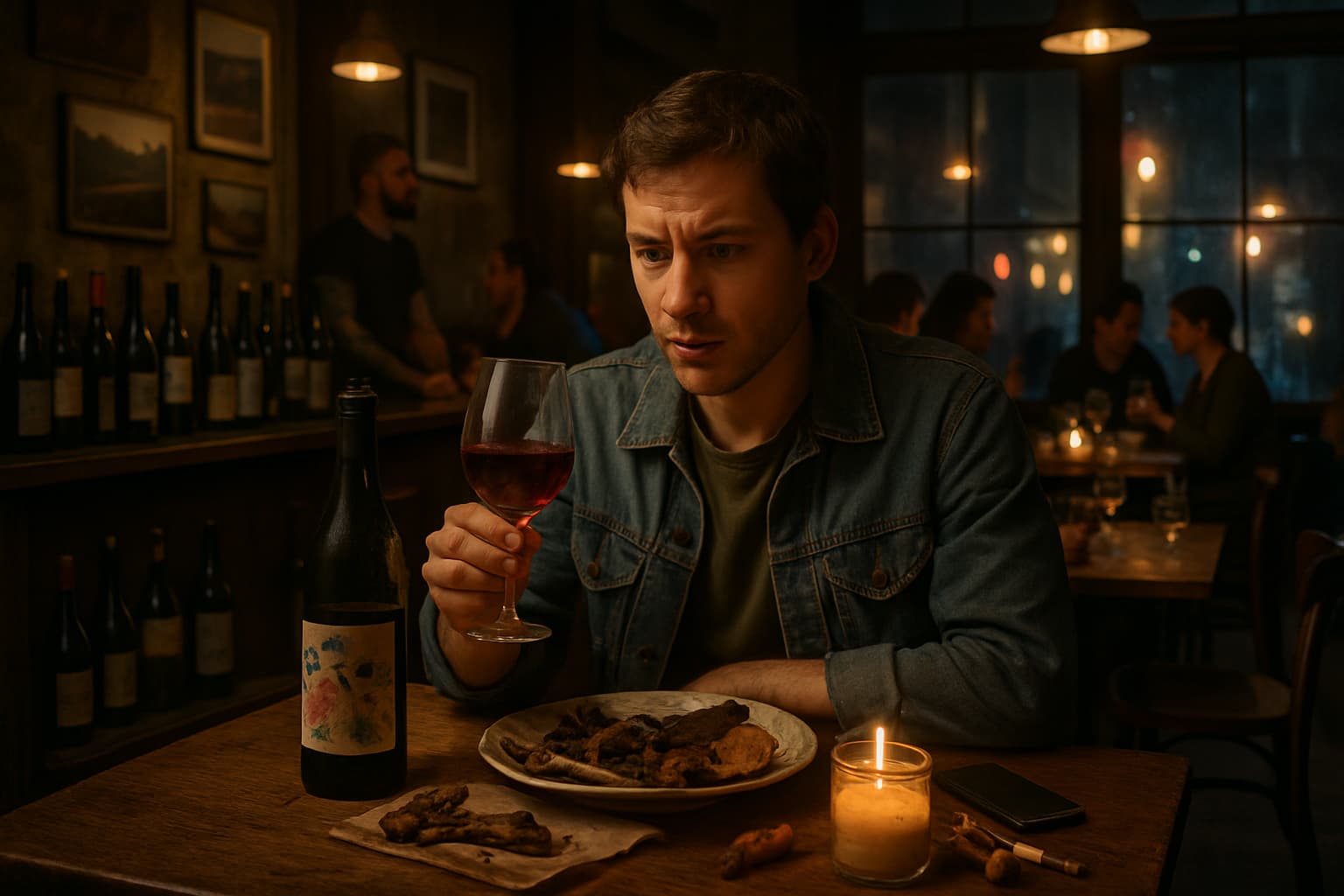
You’re halfway through a plate of something greasy—charred lamb, grilled sardines, pizza that’s seen better days—and the wine in your glass suddenly doesn’t taste like “wine” anymore. It tastes like something else. Something alive. Something that doesn’t match the label, the price, or the bullshit description written on the chalkboard.
You don’t know it yet, but this is how it happens.
This is how you become an accidental connoisseur.
The first real bottle is never planned.
You’re at a restaurant where the tables are too close together and the music’s a little too loud. The server—tattoos, nose ring, looks like they just got off a shift at a punk show—suggests a bottle you’ve never heard of from a place you can’t pronounce.
You shrug. “Sure. Whatever’s good.”
They bring out something cloudy, or pale, or darker than you expect. The label looks like it was designed by an art student on a hangover. You take a sip.
It’s… weird. But good-weird. Like licking a stone after a thunderstorm. Like cherries that got into a fistfight. Like salt and smoke and wildflowers and something slightly rotten in a way that makes you lean in, not back.
You look at the glass, then at the bottle, then back at the glass.
“What the hell is this?” you ask.
And that’s the first step. Not “Is this good?” Not “Is this expensive?”
But: “What the hell is this?”
Curiosity. That’s the gateway drug.
Wine, for most people, comes pre-packaged with an image:
Silk ties. White tablecloths. Some guy named Charles who says “Bordeaux” with a fake French accent and makes you feel like you’re being graded.
That’s the lie.
Wine did not start its life in a glass tower with a city view. It started in dirt. Real dirt. Under fingernails. In hands that prune vines at five in the morning while you’re still drooling on your pillow. Wine is agriculture, not alchemy. It’s farming, not magic.
The fancy bastard thing came later—sommeliers with lapel pins, collectors with climate-controlled cellars, critics assigning numbers like they’re judging Olympic gymnastics.
None of that is essential.
You don’t need a cellar. You need a glass.
You don’t need a wine education. You need a working nose and a half-awake brain.
You don’t need a “palate.” You have one. You’ve been training it your whole life on coffee, cheap takeout, street food, and bad decisions.
The accidental connoisseur is born the moment you realize wine isn’t a status symbol.
It’s a story in a bottle. And you’re allowed to read it.
Wine people love to talk. Sometimes that’s the problem.
You’ll hear words like “terroir,” “structure,” “tannins,” and “minerality” tossed around like confetti at a rich kid’s birthday party. It sounds intimidating. It’s supposed to. It’s a gatekeeping strategy as old as time: invent a language, then act superior for knowing it.
But you don’t need the full dictionary to read the book.
You don’t have to say, “I detect cassis and graphite.”
You can say, “This tastes like cherries and pencil shavings, and I’m oddly into it.”
The accidental connoisseur doesn’t memorize. They notice. They pay attention. They build a private vocabulary that makes sense to them: “beach wine,” “pizza wine,” “breakup wine,” “call-your-ex wine,” “I’ve-survived-another-Monday wine.”
You don’t need to sound smart. You need to be honest.
Sooner or later, curiosity turns into a map.
You start recognizing words on labels.
Not the flowery English nonsense—“velvety,” “elegant,” “sublime”—but the places.
You don’t sit down and study this like a textbook. You drink it.
You notice that the wine from the cool, foggy place feels sharper, more angular. The wine from the sunny valley is lush, round, almost sweet with ripe fruit. The one from the rocky hillside tastes like someone threw gravel into the fermenter.
You start to connect dots: weather, soil, grapes, people.
You realize wine is geography you can pour into a glass.
Congratulations. You’re learning more about the world than half the people who post inspirational travel quotes on Instagram.
Here’s something nobody tells you in the glossy wine magazines:
A lot of winemakers look less like aristocrats and more like mechanics.
They wear work boots, not loafers. Their hands are rough. They drive battered trucks, not Porsches. They worry about frost, mildew, and whether the rain will come at the wrong time and screw up their year.
You start hearing words like “organic,” “biodynamic,” “natural.” Some of it is marketing. Some of it is real. The accidental connoisseur doesn’t buy the story blindly—but they care that there is one.
You meet people who:
You realize you’re not just drinking a beverage. You’re drinking someone’s risk—their gamble against nature, weather, and economics.
You don’t have to canonize them as saints. Some are jerks. Some cut corners. Some talk about “tradition” while quietly adding all kinds of crap in the cellar.
But once you see the people, you can’t unsee them.
And your relationship to what’s in the glass changes for good.
It starts small.
You find yourself taking a picture of a bottle because you don’t want to forget it. You start following a wine bar on social media. You overhear someone say “skin-contact” at a party and don’t immediately roll your eyes.
Then one day you realize:
You are not a collector. You are not a critic. You are not swirling and spitting in some sterile tasting room under fluorescent lights.
You are just… into it. Deeply. Quietly. Completely.
You open a bottle and think: Where did you come from? Who made you? Why do you taste like this?
That’s connoisseurship. Not the score. Not the flex.
The questions.
Wine doesn’t exist in a vacuum.
A cheap red on a plastic chair in a back alley in Lisbon might taste better than a grand cru in a hotel ballroom. Because context matters.
The accidental connoisseur understands this instinctively. They don’t chase “the best wine.” They chase the right wine for the moment.
There’s a time for a serious, brooding bottle that demands your full attention. There’s a time for something cold, cheap, and fizzy that you drink out of tumblers while eating potato chips and watching bad movies.
Both count. Both matter. Both are part of the education.
You’re not building a trophy case. You’re building a life where flavor means something.
There’s a danger in all of this.
One day you’re happily drinking whatever’s poured. The next, you’re the asshole at the table lecturing everyone about sulfur levels and carbonic maceration while their eyes glaze over and their food gets cold.
Don’t be that person.
A few rules to survive your own growing obsession:
Connoisseurship should expand your world, not shrink it.
If all it does is make you harder to please, you’re doing it wrong.
One day, without fanfare, you’ll realize something:
You can walk into a wine shop, look around, and not feel lost.
You’ll scan the shelves, see a bottle from a small producer in Sicily, and think, Volcanic soil, probably some wild, salty thing—this could be fun. You’ll see a dusty Rioja and know it’ll taste like dried fruit and leather and regret in a good way. You’ll pick a Beaujolais because you’re making roast chicken and you know, deep down, that they belong together.
You’re not an expert. You’re not a master. You’re not a sommelier.
You’re just… comfortable. A little dangerous. Capable of choosing something that will make the night better.
That’s enough. More than enough.
There’s no diploma. No final exam. No moment where someone hands you a certificate that says, “Congratulations, you now understand wine.”
There’s just another bottle.
Another dinner. Another barstool. Another glass poured by a stranger who says, “You should try this. It’s interesting.”
You lift it to your nose. You smell smoke, or roses, or gasoline, or the inside of a forest after rain. You taste it. You let it sit on your tongue. You think about the place it came from, the hands that made it, the weather that year, the food in front of you, the person beside you, the mess of your life swirling quietly in the background.
You nod.
“Yeah,” you say. “That’s something.”
You don’t need to call yourself a connoisseur. You don’t need the word at all.
You just need the willingness to pay attention, to be surprised, to care about what’s in your glass and why it tastes the way it does.
You started out just wanting a drink.
Now you have a passport made of corks and memories.
And whether you meant to or not, somewhere along the way, you became the thing you never thought you’d be:
A person who actually gives a damn about wine.
An accidental connoisseur, drinking their way—one honest glass at a time—through the strange, beautiful chaos of the world.
Tannins are astringent compounds found in wine that contribute to its texture and aging potential, often causing a drying or puckering sensation in the mouth. They are derived from grape skins, seeds, and stems, as well as from oak barrels used during aging.
/ˈtænɪnz/
Malic acid is a naturally occurring organic acid found in grapes that contributes to the tart, green apple-like flavor and crispness in wine. It plays a significant role in the taste and acidity of wine.
/mælɪk ˈæsɪd/
Share, don’t preach.
If someone asks, tell the story. If they don’t, shut up and drink with them.
Remember where you came from.
The first wine that blew your mind probably wasn’t a $500 bottle. Respect the cheap stuff that opened the door.
Stay curious, not judgmental.
You like what you like. Someone else likes something else. Nobody’s wrong. Taste is personal, not a moral ranking.
Never let the label matter more than the experience.
If the wine is “important” but the moment sucks, you’ve wasted both.
Keep some mystery.
You don’t have to dissect every glass. Sometimes it’s okay to just say, “This is good,” and leave it at that.
Filtration in winemaking is the process of removing solid particles from wine to clarify and stabilize it before bottling, using various types of filters to achieve different levels of clarity and remove unwanted elements like yeast, bacteria, and sediment.
/fɪlˈtreɪʃən/
Oxidation in wine is a chemical reaction between the wine and oxygen that can change its flavor, aroma, and color. This process can be beneficial or detrimental depending on the extent and context of the exposure.
/ˌɒksɪˈdeɪʃən/
Microclimate refers to the unique climate conditions of a small, specific area within a larger region, significantly influencing grapevine growth and the characteristics of the resulting wine.
/ˈmīkrōˌklīmit/
Get weekly wine recommendations, vineyard news, and exclusive content delivered to your inbox.