Wine Literature and Media
“Where every bottle tells a story”
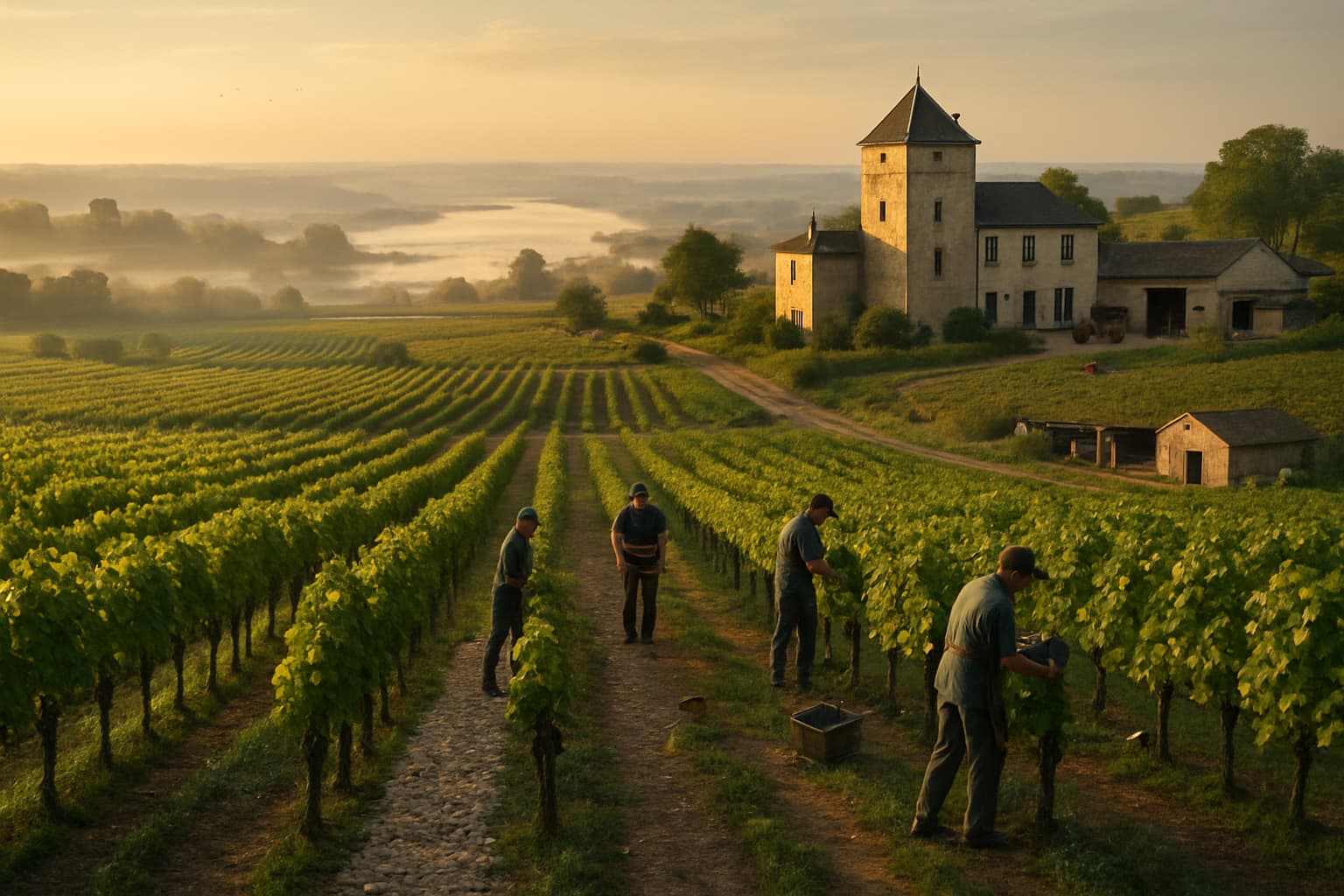
In the soft, slanting light of an Atlantic morning, a mist rises from the Garonne and Dordogne rivers, curling gently over rows of vines that have stood here for centuries. This is not merely a place on a map, but a living organism of soil, climate, tradition, and human patience. This is Bordeaux – a region where time itself seems to ferment, slowly, into something profound.
To understand Bordeaux is to embark on a journey through geology and history, through the hands of growers and the whims of weather, through wars, revolutions, fashions, and fads. It is to watch, as one might watch a coral reef or a rainforest, how a complex ecosystem maintains its identity while constantly evolving.
Let us walk, quietly, through this landscape of wine and story.
Long before a single vine was planted, Bordeaux was shaped by ancient seas. Over millions of years, sediments settled, rivers shifted, and the land rose and fell. The result is a patchwork of soils so varied that even neighbouring vineyards can yield strikingly different wines.
On the Left Bank, along the Médoc and Graves, we find deep beds of gravel – pebbles and stones washed down by rivers and ancient glaciers. These gravels store heat during the day and release it at night, gently warming the vines and helping grapes to ripen in this relatively cool, maritime climate. Here, Cabernet Sauvignon thrives, its thick skins and late ripening perfectly matched to the stony, free‑draining soils.
Across the rivers, on the Right Bank, the land changes. Clay and limestone dominate, heavier and cooler, holding water more tightly. These are the favoured conditions of Merlot and Cabernet Franc, grapes that ripen a little earlier and respond to the deeper, denser soils with wines of plush fruit and sometimes haunting perfume.
Between these two great flanks lies the Entre‑Deux‑Mers, literally “between two seas,” though it is rivers, not seas, that frame it. Here, rolling hills and mixed soils yield both crisp white wines and increasingly ambitious reds.
This geological diversity is not mere background. It is the script from which Bordeaux’s great drama is read: terroir, that elusive interplay of soil, climate, topography, and human touch. Each vineyard, each parcel, is a subtle variation on a theme composed over aeons.
If the soils set the stage, it is human history that fills the amphitheatre.
In the Middle Ages, a political union between England and Aquitaine turned Bordeaux into England’s wine cellar. Ships laden with barrels sailed from the port of Bordeaux to London and beyond, carrying what the English called “claret” – then a lighter, paler wine than we know today. Trade blossomed, fortunes were made, and vineyards spread.
Later, in the 18th and 19th centuries, as merchant houses grew powerful, a more structured hierarchy emerged. In 1855, at the request of Napoleon III, Bordeaux’s most prestigious wines of the Médoc (and one from Graves) were ranked in the famous Classification of 1855. Châteaux were arranged from First Growths (Premiers Crus) down to Fifth Growths, not by taste alone, but by the prices their wines commanded on the market – a reflection of reputation, consistency, and demand.
This classification, remarkably, still shapes Bordeaux today. Names such as Lafite, Latour, Margaux, Haut‑Brion, and Mouton Rothschild have become almost mythological, like ancient temples in a cultural landscape. Yet they are not static relics; they are working estates, each harvest a new chapter in a long‑running saga.
Through phylloxera in the 19th century, two World Wars, economic crises, and changing tastes, Bordeaux adapted. Vines were replanted on American rootstocks; cellars modernised; appellation laws written. Each challenge was met with a blend of tradition and innovation, as if the region itself understood that survival demands both memory and change.
To wander through Bordeaux’s wines is to encounter a family of styles, each shaped by its place.
On the Left Bank, in appellations such as Pauillac, Saint‑Julien, Margaux, Saint‑Estèphe, and Pessac‑Léognan, Cabernet Sauvignon is the commanding presence. It brings structure, tannin, and a remarkable capacity to age.
Blended with Merlot, Cabernet Franc, and occasionally Petit Verdot, these wines often show aromas of blackcurrant and cedar, graphite and tobacco, with a firm backbone that can feel almost austere in youth. But given time – sometimes decades – they unfold, like a slow‑opening flower, into something complex and harmonious.
These are wines that do not rush. They ask of us patience, and in return they offer a lesson in how time can sculpt flavour as surely as it carves a canyon or polishes a pebble.
Across the water, in Saint‑Émilion and Pomerol, the tone softens. Here, Merlot often takes the lead, joined by Cabernet Franc. The wines can be lusher, rounder, with plum and cherry, floral notes, and a velvety texture.
The limestone plateau of Saint‑Émilion and the clay of Pomerol are quieter, more intimate landscapes than the grand gravel plains of the Médoc, and the wines seem to mirror that intimacy. Some, such as the famed estates of Pétrus or Cheval Blanc, have become as revered as any Left Bank First Growth, yet their character remains distinct: powerful, yes, but often enveloping rather than imposing.
South of the city of Bordeaux, along the Garonne, another story unfolds – one of mist and mould, of decay transformed into beauty.
In Sauternes and Barsac, morning mists rise from the cool Ciron River and meet the warmer Garonne air. This contrast creates the perfect conditions for Botrytis cinerea, the so‑called “noble rot”. This fungus pierces the grape skins, slowly dehydrating the berries and concentrating sugars, acids, and flavours.
The result is a nectar of extraordinary intensity: sweet, yes, but balanced by vibrant acidity. Aromas of apricot, honey, saffron, marmalade, and exotic fruits swirl in the glass. These wines, made primarily from Sémillon, with Sauvignon Blanc and Muscadelle, are among the most laborious to produce. Grapes are often harvested berry by berry, in multiple passes through the vineyard, selecting only those touched by noble rot.
To taste a mature Sauternes is to taste time itself, distilled into liquid gold.
Beyond the famous names, Bordeaux is also home to more modest yet vital wines – the lifeblood of local tables and bistros.
In Entre‑Deux‑Mers and parts of Graves, dry whites made from Sauvignon Blanc and Sémillon offer citrus, herbs, and minerality, refreshing and precise. Meanwhile, appellations such as Bordeaux and Bordeaux Supérieur provide approachable reds that can be enjoyed young – accessible windows into the region’s character without the need for a cellar or a long wait.
These wines remind us that, beneath the grandeur, Bordeaux is also a place where people simply drink wine with dinner, where bottles are opened not to impress, but to accompany life’s ordinary, precious moments.
If we were to stay here, among the vines, for a full year, we would witness a cycle as intricate and dependable as the migrations of birds.
In winter, the vines stand bare, pruned back by hand, their energy conserved in gnarled trunks and roots. As spring arrives, tiny buds burst forth – a vulnerable time, when a late frost can undo months of careful work in a single night.
Summer brings flowering, then the setting of fruit. The grapes swell and change colour in a process called veraison, gradually accumulating sugar and flavour. Heatwaves, storms, hail – all can come, testing the resilience of both plant and grower.
Finally, in autumn, the harvest begins. The air is alive with the scent of fermenting juice, the clatter of crates, the murmur of pickers in the rows. Decisions made now – when to pick, how to sort, how to ferment – will echo for years, even decades, in the wines that result.
Through it all, the maritime climate – tempered by the Atlantic Ocean and protected by the Landes forest – plays its unpredictable role. Some years are generous, others cruel. Bordeaux’s greatest vintages are often born from a delicate balance of stress and relief, sun and rain.
For all its history, Bordeaux is not frozen in time. In cellars that may be centuries old, we now find stainless steel tanks, temperature control, optical sorting machines, and careful vineyard mapping using satellite imagery and soil analysis.
Yet, at the heart of this modernisation lies an ancient objective: to express, as faithfully as possible, the character of each vineyard. Many estates are moving towards sustainable, organic, or even biodynamic farming, reducing chemical inputs, encouraging biodiversity, and treating the vineyard as an ecosystem rather than a factory.
The wines themselves are evolving too. Where once some châteaux pursued ever more power and extraction, there is now a quiet shift towards finesse, freshness, and balance. Alcohol levels are watched more carefully; oak is used more judiciously. The aim is not to impress in a single sip, but to sustain interest over an entire bottle and, indeed, over many years of ageing.
In this way, Bordeaux is learning from its own long history: that what endures is not fashion, but harmony.
For the uninitiated, Bordeaux’s system of names and rankings can feel as complex as a rainforest’s food web. Yet, with a little patience, a pattern emerges.
There is the 1855 Classification of the Médoc and Sauternes; the Graves Classification of 1953; the dynamic, regularly updated Saint‑Émilion Classification; and numerous appellations – each a legally defined area with its own rules on grape varieties, yields, and production methods.
These structures serve as guides, not absolute truths. A high classification often signals long‑established quality, but it does not guarantee personal pleasure. Nor does the absence of a grand title mean a wine is unworthy. Indeed, some of the most exciting wines in Bordeaux today come from lesser‑known appellations and ambitious, smaller estates.
Like any ecosystem, Bordeaux is richer than its most famous species.
Faced with such diversity, how might one begin?
One path is chronological: tasting young wines, then those with a few years of age, then older bottles, to perceive how time transforms structure into silk, and fruit into complexity. Another path is geographical: comparing Left Bank to Right Bank, gravel to clay, Sauternes to dry white.
But perhaps the most rewarding approach is simply curiosity. Seek out both the great names and the unfamiliar. Try a modest Bordeaux Supérieur alongside a classified growth from the same vintage. Taste a dry white from Pessac‑Léognan next to one from Entre‑Deux‑Mers. Let your own palate, rather than reputation alone, be your guide.
For in the end, wine is not a competition, but a conversation – between you, the land, the vintage, and the people who coaxed those grapes into being.
As the sun sets over the Gironde estuary, the vineyards of Bordeaux fall into shadow, their rows now quiet after the day’s work. Yet, beneath the surface, life continues: roots probing deeper into the soil; microorganisms breaking down organic matter; barrels in cool cellars gently breathing as wine matures.
Bordeaux is not just a collection of famous labels or a chapter in a wine textbook. It is a living tapestry, woven from geology and weather, from centuries of commerce and conflict, from the choices of countless growers, winemakers, and drinkers.
To explore it is to witness how a landscape and its people can, together, create something that endures beyond any single lifetime – an ongoing story in which each bottle is a fleeting, fragile, yet profoundly meaningful page.
And so, when next you raise a glass of Bordeaux, pause for a moment. Consider the ancient seas that laid down its gravels, the rivers that carved its banks, the mists that brought noble rot, the hands that pruned, picked, and pressed. Within that wine lies not just flavour, but the echo of centuries – a quiet testament to the remarkable dialogue between nature and human patience.
Tannins are astringent compounds found in wine that contribute to its texture and aging potential, often causing a drying or puckering sensation in the mouth. They are derived from grape skins, seeds, and stems, as well as from oak barrels used during aging.
/ˈtænɪnz/
Malic acid is a naturally occurring organic acid found in grapes that contributes to the tart, green apple-like flavor and crispness in wine. It plays a significant role in the taste and acidity of wine.
/mælɪk ˈæsɪd/
Filtration in winemaking is the process of removing solid particles from wine to clarify and stabilize it before bottling, using various types of filters to achieve different levels of clarity and remove unwanted elements like yeast, bacteria, and sediment.
/fɪlˈtreɪʃən/
Oxidation in wine is a chemical reaction between the wine and oxygen that can change its flavor, aroma, and color. This process can be beneficial or detrimental depending on the extent and context of the exposure.
/ˌɒksɪˈdeɪʃən/
Microclimate refers to the unique climate conditions of a small, specific area within a larger region, significantly influencing grapevine growth and the characteristics of the resulting wine.
/ˈmīkrōˌklīmit/
Get weekly wine recommendations, vineyard news, and exclusive content delivered to your inbox.