Wine Literature and Media
“Where every bottle tells a story”
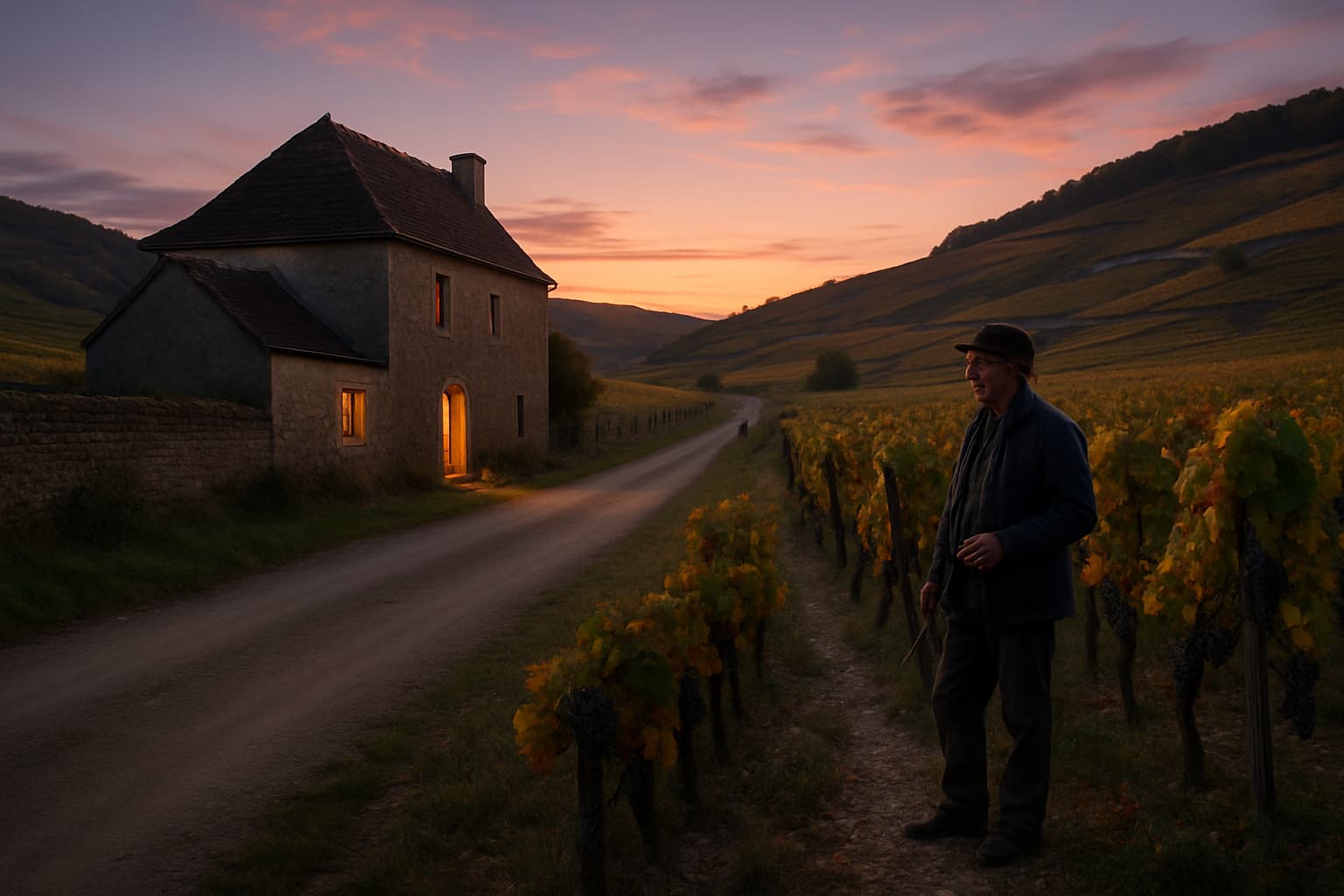
There’s a quiet road that runs from Dijon down to Santenay, a ribbon of tarmac laid gently at the feet of limestone slopes. On either side, vines march in tight, soldierly rows. You could drive it in less than an hour. But if you listen closely—to the wind, to the soil under your feet, to the people who’ve worked this land for centuries—you’ll realize that this short stretch of earth contains an entire universe.
That universe is Burgundy. And at its center, like distant but blazing stars, stand the great domaines—families and estates whose names have become shorthand for excellence, devotion, and sometimes obsession. Their wines are not just beverages; they are stories, arguments, prayers, and memories captured in glass.
Let’s walk, slowly, through that universe.
Burgundy is small. Too small, some might say, for the size of its legend. From north to south, the heart of Burgundy’s Côte d’Or is little more than a narrow hillside, broken into a mosaic of vineyards with names that sound like whispered spells: Romanée-Conti, La Tâche, Montrachet, Musigny, Chambertin.
What makes this place different isn’t just the grapes—Pinot Noir for reds, Chardonnay for whites—but the way the land has been divided, studied, and cherished over centuries. Here, the concept of terroir isn’t marketing. It’s scripture. Every parcel, every climat, is treated as a distinct voice in a choir.
The great domaines are the conductors of that choir. Some are centuries old, with cellars that have seen revolutions come and go. Others are younger, but led by men and women who’ve devoted their lives to understanding the nuances of each row of vines.
In Burgundy, greatness is not simply a matter of price or scarcity, though those often follow close behind. A great domaine is defined by three intertwined threads:
These domaines don’t just make wine. They preserve memory. They carry forward the lessons of monks, peasants, and vignerons who came long before, and they leave footprints for those yet to come.
If there is one name that rises above all others in Burgundy—indeed, in the entire world of wine—it is Domaine de la Romanée-Conti, often simply called DRC.
This estate, based in Vosne-Romanée, farms some of the most hallowed ground on earth. The crown jewel is Romanée-Conti itself, a small vineyard of just over 1.8 hectares. In human terms, that’s about the size of a city block. From that tiny patch, the domaine produces wines that can sell for thousands of dollars a bottle. And yet, in the glass, they are anything but loud or ostentatious.
DRC’s wines are known for their finesse—for a perfume that seems to rise out of nowhere, for a texture that feels less like a liquid and more like a whisper. Their power isn’t in brute force, but in the depth and persistence of their flavor.
The domaine’s approach is almost monastic: low yields, organic and biodynamic farming, careful handwork in the vineyard, and a deep respect for time. These are wines that don’t rush. They unfold. They remind you that patience, in Burgundy, is not a virtue; it is a requirement.
Travel a little further north and you come to Gevrey-Chambertin, home to Domaine Armand Rousseau. Here, the wines carry a different sort of power. Rousseau’s Chambertin and Clos de Bèze are like symphonies: broad, structured, and built to last. They show that Burgundy can be both delicate and commanding at the same time.
Rousseau was a pioneer in bottling and labeling estate wines in the early 20th century, helping to create the very idea of the domaine as we know it. Today, their work in the vineyard—low yields, respectful farming, and attentive cellar practices—continues that legacy.
Further south, in Chambolle-Musigny, Domaine Georges Roumier offers another expression of greatness. Chambolle is often described as the most “feminine” of Burgundy’s villages, but that word doesn’t quite do it justice. Roumier’s wines are silken yet intense, floral yet grounded. They seem to float, and yet they never feel fragile.
These domaines, along with others like Domaine Leroy, Domaine Mugnier, and Domaine Dujac, uphold a tradition in which the goal is not to impose style, but to reveal character. Each bottle is a conversation between grape, soil, and time.
If the reds of the Côte de Nuits are Burgundy’s heartbeat, then the whites of the Côte de Beaune and Chablis are its cool, clear breath.
In Meursault, Domaine Coche-Dury has become a near-mythical name. Their whites crackle with energy—intense, smoky, nutty, yet always alive with acidity. These wines show how Chardonnay, in the right hands, can be both rich and electric, powerful and precise.
In Puligny-Montrachet, Domaine Leflaive has long stood as a benchmark. Their wines from vineyards like Chevalier-Montrachet and Bâtard-Montrachet are models of balance: minerality, fruit, oak, and texture woven together so seamlessly that no single element dominates. Leflaive has also been a leader in biodynamic viticulture, showing that respect for the environment can go hand in hand with the pursuit of greatness.
To the north, in the cool, windswept vineyards of Chablis, Domaine Raveneau and Domaine Dauvissat interpret Chardonnay through a different lens. Here, the wines are taut, saline, and etched with the memory of ancient seas. Their Grand Crus—Les Clos, Valmur, Blanchot—are like stone tablets, inscribed with the story of limestone and fossilized shells.
These domaines remind us that Burgundy’s greatness is not confined to red wine alone. It is a spectrum, and Chardonnay is one of its brightest colors.
In many wine regions, great estates own large, contiguous vineyards. In Burgundy, the story is different.
Centuries of inheritance laws—most notably the Napoleonic Code, which divided land among all heirs—have fractured vineyards into tiny parcels. One Grand Cru might be shared among a dozen, even twenty, owners, each with their own approach and philosophy.
This means that two bottles from the same vineyard can be dramatically different, depending on the domaine. Romanée-Saint-Vivant from DRC does not taste like Romanée-Saint-Vivant from another producer. The vineyard is the stage; the domaine is the director.
The great domaines distinguish themselves not by monopolizing land, but by how they farm and interpret their portion of it. They prune differently, pick at different times, sort grapes with varying strictness, and use different barrels and techniques in the cellar.
In Burgundy, greatness is often measured in hectares—but not by how many you own, rather by how well you know each one.
For all their differences, the great domaines of Burgundy share a common belief: the best winemaking is often the least visible.
They tend to favor:
Many have embraced organic or biodynamic farming, not as a trend but as a logical extension of their duty as custodians of the land. They understand that healthy soil creates healthy vines, and healthy vines tell clearer stories.
Their goal is not to make a “big” wine or a “modern” wine. It is to make a true wine—true to its vineyard, its vintage, and its lineage.
Behind every great domaine, there are faces and voices, arguments and reconciliations, triumphs and mistakes. Burgundy is not just limestone and Pinot Noir. It is people.
Some domaines are now in the hands of the third, fourth, or fifth generation. Others are guided by a new wave of young vignerons returning from studies abroad, bringing fresh ideas while honoring old ones.
Transitions are rarely simple. A son or daughter might shift to organic farming, reduce new oak, or harvest earlier, changing the style that collectors grew up with. Sometimes this causes controversy. But Burgundy has always evolved—quietly, slowly, like the erosion of stone.
The great domaines endure because they balance continuity with adaptation. They listen to the past, but they don’t live in it.
There’s a hard truth that hangs over any discussion of Burgundy’s greatest domaines: most of their wines are now beyond the reach of the average drinker.
Global demand, limited production, and decades of critical acclaim have driven prices to heights that would have stunned earlier generations. Bottles that once traded on the strength of a village’s reputation now move in the rarefied air of auctions and private cellars.
But that doesn’t mean Burgundy’s story belongs only to the wealthy.
For every legendary Grand Cru, there are humbler bottles—Bourgogne Rouge, village-level wines, lesser-known climats—crafted by the same hands, with the same philosophy. They may not reach the same heights, but they carry the same DNA, the same sense of place.
And beyond the marquee names, there are countless rising domaines, young and old, who farm with the same devotion but whose labels have not yet become trophies. In their wines, the spirit of Burgundy is alive and well, and still within reach.
In the end, the great domaines of Burgundy matter for reasons that go beyond taste, beyond price, beyond prestige.
They remind us that:
When you open a bottle from one of these domaines, you’re not just tasting fruit and oak and acid. You’re tasting decisions made long before you were born. You’re tasting storms weathered, harvests lost, and seasons of quiet joy when everything went right.
If you ever find yourself in Burgundy, stand on one of those limestone slopes at dusk. The sun will be sinking behind the hills, throwing long shadows across the rows of vines. The air will smell of earth and leaves, maybe a hint of woodsmoke in the distance.
Look around you. The parcels are small. The names are many. The land is old.
Somewhere beneath your feet lies the reason people cross oceans, bid at auctions, and wait years for a single bottle to reach its peak. It isn’t luxury. It isn’t status. It’s the feeling that in this narrow strip of earth, human beings have learned to listen—to the soil, to the seasons, to each other—and to answer with something beautiful.
The great domaines of Burgundy are not monuments carved in stone. They are living stories, written vintage by vintage, vine by vine, hand by hand. And as long as there are people willing to rise before dawn, to prune in the cold, to harvest in the rain, and to wait, patiently, for time to do its quiet work, that story will go on.
In every glass, a small reminder: greatness doesn’t always shout. Sometimes, it’s just a soft voice from a small place, telling the truth as clearly as it can.
Tannins are astringent compounds found in wine that contribute to its texture and aging potential, often causing a drying or puckering sensation in the mouth. They are derived from grape skins, seeds, and stems, as well as from oak barrels used during aging.
/ˈtænɪnz/
Malic acid is a naturally occurring organic acid found in grapes that contributes to the tart, green apple-like flavor and crispness in wine. It plays a significant role in the taste and acidity of wine.
/mælɪk ˈæsɪd/
Filtration in winemaking is the process of removing solid particles from wine to clarify and stabilize it before bottling, using various types of filters to achieve different levels of clarity and remove unwanted elements like yeast, bacteria, and sediment.
/fɪlˈtreɪʃən/
Oxidation in wine is a chemical reaction between the wine and oxygen that can change its flavor, aroma, and color. This process can be beneficial or detrimental depending on the extent and context of the exposure.
/ˌɒksɪˈdeɪʃən/
Microclimate refers to the unique climate conditions of a small, specific area within a larger region, significantly influencing grapevine growth and the characteristics of the resulting wine.
/ˈmīkrōˌklīmit/
Get weekly wine recommendations, vineyard news, and exclusive content delivered to your inbox.