Wine Literature and Media
“Where every bottle tells a story”
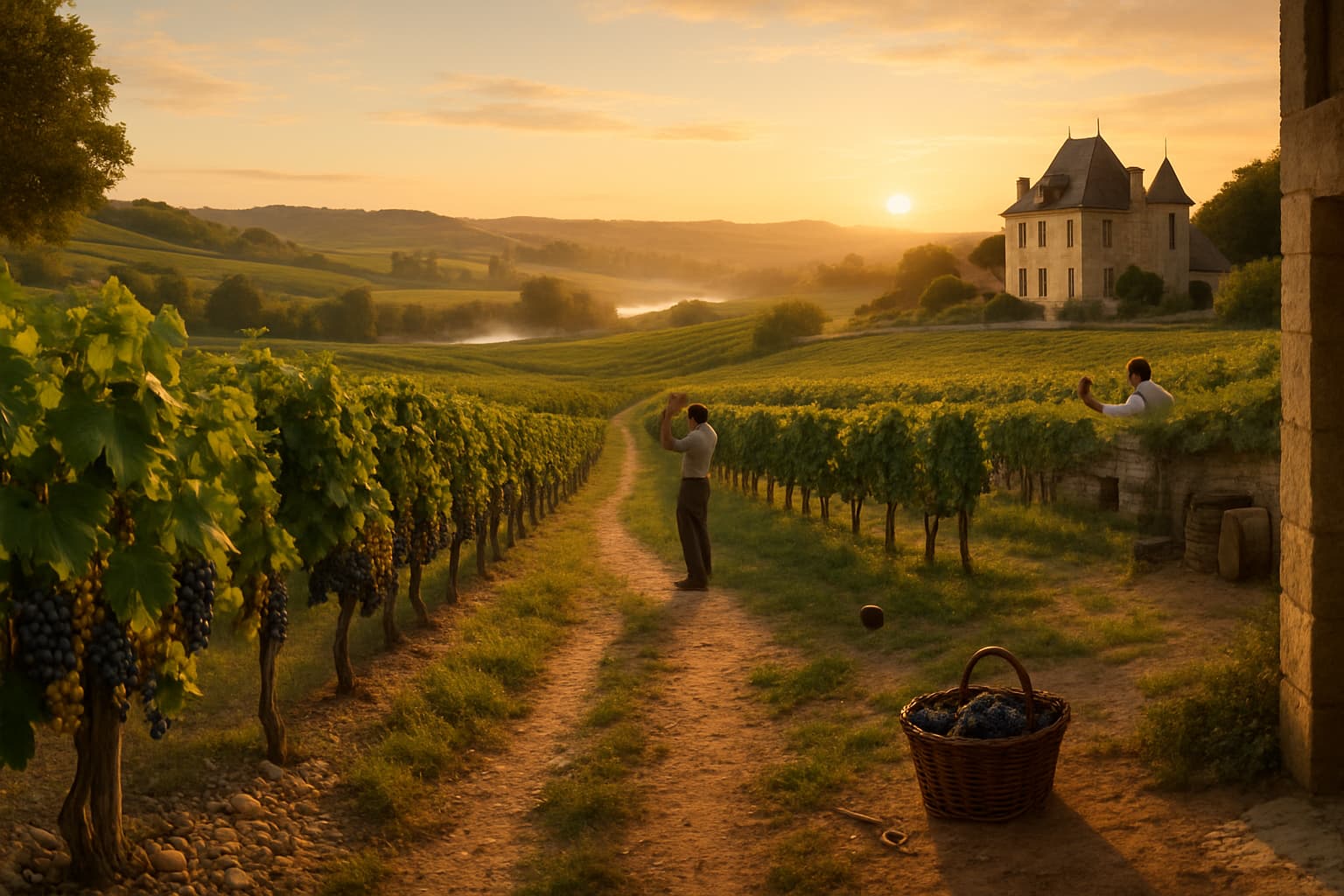
In the soft, slanting light of a late summer evening, as the sun sinks behind gentle hills and the air cools with a faint whisper from the Atlantic, there is a place where time itself seems to linger. Here, in a patchwork of vineyards stitched together over centuries, humans and nature have conspired to create something remarkable: wines that do more than merely please the palate. They tell stories—of soil and stone, of wind and water, of patience, chance, and unyielding devotion.
This place is Bordeaux.
To speak of Bordeaux is to speak of a landscape shaped by rivers and tides, by human ambition and natural constraint. It is a world where taste is not simply flavour, but the expression of an ecosystem—where every sip is a distilled moment from a living, breathing environment. Let us journey, then, through this ancient region and listen closely to the voices of its vineyards, its cellars, and its wines.
If we were to rise above Bordeaux, high into the sky, and look down, we would see a region defined not by borders on a map, but by water. The Garonne and the Dordogne rivers sweep down from the heart of France, finally joining to form the Gironde estuary, a vast tidal funnel that opens to the Atlantic Ocean.
These waters do more than carve the land; they temper the climate. The ocean’s influence softens extremes of heat and cold, while the rivers reflect light, moderate temperatures, and shelter the vines from frost. Mist rises at dawn, cloaking the banks in a silvery veil. It is in such delicate balances that Bordeaux finds its soul.
Beneath the greenery, the earth itself is a mosaic. Gravel ridges, laid down by ancient rivers, provide perfect drainage and store the day’s warmth to release gently through the night. Clay retains moisture, sustaining vines through dry summers. Limestone, once part of a prehistoric seabed, lends a subtle, stony freshness to the wines.
Each of these soils—gravel, clay, limestone, sand—forms a different stage on which the same cast of grape varieties performs in subtly different ways. The great tastes of Bordeaux are, in truth, the voices of these soils, translated by vines and interpreted by human hands.
In many regions, a single grape variety takes centre stage. But in Bordeaux, the story is one of ensemble and harmony. Here, blending is both an art and a philosophy.
On the Left Bank, where gravel dominates, we find:
On the Right Bank, where clay and limestone prevail, the leading role shifts:
For the whites, a different cast:
Together, these grapes form the vocabulary with which Bordeaux speaks. But it is how they are blended—how one is emphasised over another—that creates the region’s astonishing diversity of taste.
The rivers of Bordeaux do more than carry water; they divide styles, histories, and philosophies.
To the west of the Gironde and Garonne lies the Left Bank, home to the famed appellations of the Médoc, Haut-Médoc, Pauillac, Margaux, Saint-Julien, Saint-Estèphe, and the Graves.
Here, gravel soils are king. Cabernet Sauvignon flourishes, its roots reaching deep among pebbles and stones, drawing strength and concentration. The resulting wines are often described as:
In the Médoc, the wines of Pauillac can be powerful and imposing, like a storm building over the estuary—dense, muscular, and profound. Margaux, by contrast, often shows a more perfumed, ethereal side: violets, fine tannins, and a haunting elegance that seems to hover on the palate.
Further south, in the Graves and Pessac-Léognan, red wines are joined by some of the world’s finest dry whites: structured, mineral, and capable of aging gracefully. Here, Sauvignon Blanc and Sémillon combine to produce wines of citrus, smoke, flint, and subtle oak—wines that seem to capture the cool, dawn air over gravelly soils.
Across the Dordogne and up the gentle slopes of the Right Bank, the mood shifts. In Saint-Émilion and Pomerol, clay and limestone dominate, favouring Merlot and Cabernet Franc.
The wines here are often:
In Saint-Émilion, vineyards cling to limestone plateaus and slopes, their roots probing into ancient rock. The wines can be both powerful and refined, with a mineral backbone beneath their ripe fruit. In Pomerol, on small, often family-owned estates, Merlot reaches extraordinary heights, producing wines of silken texture, dark fruit, and a quiet, almost contemplative depth.
These two banks—Left and Right—are not rivals, but counterparts. One speaks in firm, architectural lines; the other in curves and contours. Together, they form a dialogue about balance, structure, and pleasure.
As autumn advances and the rivers cool, a remarkable phenomenon unfolds along the Ciron and Garonne near Sauternes and Barsac. Morning mists rise from the confluence of warm and cool waters, enveloping the vineyards in a damp, ethereal shroud. By afternoon, the sun returns, drying the grapes.
In this delicate dance of moisture and warmth, a microscopic actor takes the stage: Botrytis cinerea, the “noble rot.”
Under precisely the right conditions, this fungus punctures the grape skins, allowing water to evaporate and concentrating sugars, acids, and flavours. The berries shrivel, turning golden, then amber, like tiny lanterns on the vine.
From these raisined grapes, painstakingly harvested berry by berry, come some of the world’s most extraordinary sweet wines:
These wines are a paradox: decadent yet ethereal, opulent yet balanced. They are the liquid memory of misty mornings and golden afternoons, of patience and risk. For in some years, the noble rot does not come; in others, it comes too fiercely. The growers of Sauternes live at the mercy of invisible spores and fickle weather, their livelihoods hanging on conditions that cannot be commanded, only awaited.
In a cool, dark cellar, rows of bottles lie motionless, their contents undergoing a slow, silent transformation. Bordeaux, perhaps more than any other region, has built its reputation on the capacity of its wines to age.
In youth, many of the great red wines can seem tight, their tannins firm, their aromas reserved. But with time—five, ten, twenty years or more—the structure softens, and new layers emerge:
Aged Bordeaux is not simply “better” than young Bordeaux; it is different. It speaks less of fruit and more of earth, less of immediacy and more of memory. It is, in a sense, the wine’s autobiography, written slowly over time.
Even the whites of Bordeaux, both dry and sweet, can develop extraordinary complexity: nutty, waxy, honeyed notes in Sémillon-based wines; smoky, flinty subtleties in the best barrel-aged Sauvignons.
To drink Bordeaux young is to witness potential. To drink it aged is to witness fulfilment.
Behind every bottle of Bordeaux stands not just a winemaker, but a lineage. Romans first planted vines here. Medieval merchants, particularly from England and the Low Countries, helped spread Bordeaux’s fame. Over centuries, trade routes, wars, alliances, and technological advances have all left their imprint.
The 1855 Classification, commissioned for the Paris Exposition, ranked many Left Bank estates into “growths” or crus, creating a hierarchy that still shapes perception today. Other appellations, like Saint-Émilion, established their own systems, periodically revised.
Yet classifications and labels tell only part of the story. Bordeaux is also a landscape of humble vignerons, of families tending small plots for generations, of quiet experiments in the vineyard and cellar. Today, many are turning to organic and biodynamic practices, reducing chemicals, encouraging biodiversity, and seeking to express their terroir with greater fidelity and less intervention.
Climate change, too, has begun to leave its mark. Warmer summers, earlier harvests, and shifting weather patterns challenge the delicate balance that Bordeaux has long relied upon. Winemakers adapt—adjusting canopy management, experimenting with varieties, rethinking harvest timing—all in an effort to preserve the region’s signature freshness and elegance.
In this way, Bordeaux is not a static monument, but a living system, constantly negotiating with its environment.
To truly appreciate the great tastes of Bordeaux is to approach them not as mere beverages, but as voices in a chorus. When you raise a glass, you might ask:
Swirl the glass gently. Inhale. You may detect blackcurrant and cedar, plum and truffle, citrus and smoke, honey and saffron. But beneath these specific aromas lies something more elusive: a sense of place, of time, of human intention intersecting with natural constraint.
Bordeaux is not a single taste, but a spectrum—from the stern grandeur of a great Pauillac to the silken caress of Pomerol, from the crystalline brightness of a Pessac-Léognan white to the golden opulence of Sauternes. To explore it is to embark on a journey, each bottle a different vantage point from which to observe the same landscape.
In the end, the greatness of Bordeaux does not lie solely in prestige, nor in price, nor in centuries of fame. It lies in the way this region has become a lens through which we can see the intricate connection between humans and their environment.
The rivers that moderate the climate, the soils that shape the vine’s struggle, the mists that invite noble rot, the patient hands that prune, harvest, and blend—all these forces converge in a glass of wine.
When we speak of the “great tastes” of Bordeaux, we are really speaking of great relationships: between grape and ground, between weather and will, between past and present. Each bottle is a fragile, fleeting vessel of these relationships, a moment captured and preserved, waiting to be released when the cork is drawn.
To taste Bordeaux thoughtfully is to listen—to the murmur of gravel beneath root, the sigh of mist over river, the quiet determination of those who have tended these vines for generations. It is, in its own way, to witness an ongoing natural history, written not in ink or stone, but in the deep, resonant language of wine.
Tannins are astringent compounds found in wine that contribute to its texture and aging potential, often causing a drying or puckering sensation in the mouth. They are derived from grape skins, seeds, and stems, as well as from oak barrels used during aging.
/ˈtænɪnz/
Malic acid is a naturally occurring organic acid found in grapes that contributes to the tart, green apple-like flavor and crispness in wine. It plays a significant role in the taste and acidity of wine.
/mælɪk ˈæsɪd/
Filtration in winemaking is the process of removing solid particles from wine to clarify and stabilize it before bottling, using various types of filters to achieve different levels of clarity and remove unwanted elements like yeast, bacteria, and sediment.
/fɪlˈtreɪʃən/
Oxidation in wine is a chemical reaction between the wine and oxygen that can change its flavor, aroma, and color. This process can be beneficial or detrimental depending on the extent and context of the exposure.
/ˌɒksɪˈdeɪʃən/
Microclimate refers to the unique climate conditions of a small, specific area within a larger region, significantly influencing grapevine growth and the characteristics of the resulting wine.
/ˈmīkrōˌklīmit/
Get weekly wine recommendations, vineyard news, and exclusive content delivered to your inbox.