Wine Literature and Media
“Where every bottle tells a story”
The first time you meet Trockenbeerenauslese, you think it’s a typo or a prank—a cruel German compound word cooked up by some demented bureaucrat in the Rheingau to terrify tourists and confuse importers. Then you taste it—if you’re lucky, if the gods are in a good mood, if the bottle hasn’t been hoarded into oblivion—and you realize you’re not dealing with a wine anymore. You’re dealing with some kind of late-harvest religious experience that’s been weaponized.
This is not a drink for the sane or the cautious. This is syrup from grapes that have been deliberately allowed to rot, shrivel, and nearly die on the vine, then resurrected in the bottle by mad monks in lab coats. And the literature around it—the stories, the tasting notes, the collector hysteria, the long German sentences that read like legal indictments—has grown into its own strange, sticky universe.
Let’s walk into that universe. Bring a glass and a notebook. Leave your dignity at the door.
First, the word. Trocken–Beeren–Auslese.
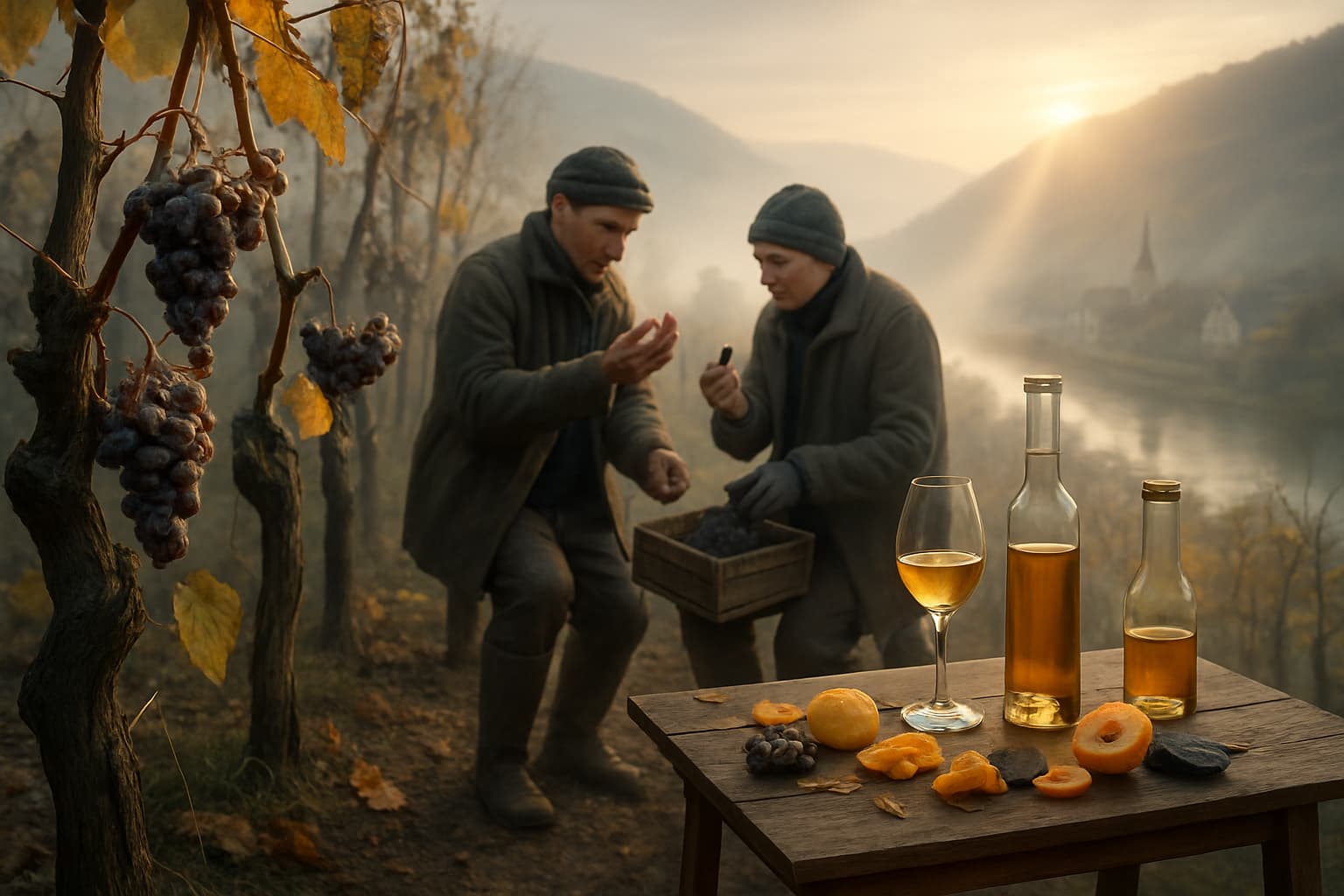
Put it together and you get: “selection of dried berries”—grapes so overripe and shriveled that they look like something you’d scrape off a forgotten fruit bowl. Except these have been attacked by Botrytis cinerea, the noble rot, the mold that destroys ordinary vineyards and turns certain chosen ones into liquid gold.
In German Prädikat law, Trockenbeerenauslese (TBA if your tongue is tired) sits at the summit of ripeness classifications—above Auslese, above Beerenauslese, above the usual mortal wines. It’s not just “sweet wine.” It’s concentrated essence. It’s the distortion pedal cranked all the way up on the guitar of Riesling, Scheurebe, or whatever poor grape was sacrificed.
To understand the literature, you have to understand the madness that produces the wine. No sane person would invent this process.
You need:
The botrytis fungus pierces the grape skins, evaporating water and concentrating sugar, acid, and flavor. The result is a grape that looks like a raisin that’s seen too much, but inside: nuclear flavor density.
Harvesting? That’s where the true lunacy begins. Workers go through the vineyard berry by berry, selecting only those perfectly botrytized grapes. Not bunches. Individual grapes. Imagine doing that in late October fog while your fingers go numb and your boots sink into the mud. It’s like gold panning with frostbite.
The juice that comes out is thick, viscous, almost reluctant to move. Sugar levels are obscene—often 180+ Oechsle. Fermentation can take ages. Yeasts struggle and die in the sugar swamp. Alcohol levels stay low; sweetness stays high. The result lands in tiny bottles, often 375 ml, because nature can only produce so much of this madness.
Once something is this rare, this bizarre, and this expensive, people start writing about it as if it were a deity. And in a way, it is. The literature of TBA is full of reverence, hysteria, and a peculiar German precision that borders on the pathological.
You find:
TBA isn’t just wine. It’s narrative fuel. Every bottle has a story of risk, weather, fungus, and human stubbornness, and the literature leans into that like a novelist on deadline.
Germans write about wine the way they build highways: structured, categorized, and slightly terrifying.
You see it in:
And yet, the wine itself is pure chaos harnessed: rot, decay, weather roulette. The literature feeds off this tension—German order vs. fungal anarchy. Writers lean into it, describing TBAs as “miracles of nature,” “acts of God,” “gifts of a benevolent rot.” They’re not wrong.
It’s the same instinct that drives people to write epics about volcanoes or hurricanes. You stare at something that shouldn’t exist, and your brain starts reaching for metaphors like a drowning person for driftwood.
If you want to see wine writing lose its mind, read tasting notes on great TBAs. The usual polite vocabulary collapses under the weight of what’s in the glass.
Confronted with a top-tier Mosel or Rheingau TBA, the critic becomes a kind of gonzo field reporter, trying to document an experience that doesn’t fit the form:
This is where the literature of TBA gets interesting: it exposes the limits of language. You can list flavors all night, but it never really captures the shock of that first sip—the density, the acid cutting through the sugar like a scalpel, the way it hangs in your mouth like a hallucination that refuses to leave.
The best writers lean into the absurdity. They acknowledge that they’re trying to describe a thunderstorm with a ballpoint pen.
Anywhere you find scarcity and obsession, you find money. And where you find money, you find a new genre of writing: the literature of price and prestige.
In auction catalogs, newsletters, and collector forums, TBAs are treated like:
The language shifts from sensory to financial: “rare,” “museum piece,” “benchmark,” “investment-grade.” Producers like Egon Müller, J.J. Prüm, Dönnhoff, and a handful of others become recurring characters in this saga—half artisans, half demigods.
In this corner of the literature, the wine is almost secondary. The bottle is a symbol: of patience, power, and the ability to drop four figures on 375 ml of fermented raisin juice without blinking.
Every decadent thing spawns its own backlash literature. TBAs are no exception.
You see essays and think pieces muttering:
There’s a puritan streak in wine culture—people who believe in dry, linear, serious wines that behave themselves at the dinner table. TBA laughs at that. It’s not here for your grilled fish pairing. It’s here to hijack the evening and possibly your soul.
So the literature splits:
This tension gives the writing energy. The best critics wrestle with it on the page, torn between the sheer hedonistic thrill of the wine and the suspicion that anything this intense must be a little sinful.
The real madness sets in when you realize that great TBAs don’t just survive decades—they evolve into something else entirely. And that means the literature becomes a long-running serial, revisiting the same bottles over time.
Tasting notes from:
Writers chase these bottles through time, updating their impressions like war correspondents returning to old battlefields. The wine becomes a character aging in real time, and the literature becomes its biography.
Some TBAs outlive their authors. That’s when the whole thing tips into mythology. A 1959 or 1976 TBA becomes a ghost story passed from writer to writer: “I never tasted it, but those who did said…”
At the core, the literature of Trockenbeerenauslese exists because TBA is a perfect storm of everything that drives people to write about wine in the first place:
You can’t just shrug and say, “Yeah, it was nice.” You either go all in, or you walk away. And the writers who go all in leave a paper trail of metaphors, tasting notes, essays, auction blurbs, and half-mad odes to botrytized Riesling.
In a world of predictable beverages and focus-grouped flavor profiles, TBA is a glitch in the matrix—a reminder that nature can still produce something inconvenient, impractical, and utterly unnecessary that nonetheless feels like a small miracle.
In the end, Trockenbeerenauslese is proof that decay can be transcendent and that human beings, given enough time and obsession, will build an entire literary universe around a handful of moldy grapes.
The vineyard workers picking shriveled berries in the November fog are the unsung protagonists. The winemakers coaxing impossible fermentations are the alchemists. The critics, collectors, and deranged scribblers circling these tiny bottles are the chorus, trying to translate the untranslatable.
If you ever get the chance—an ounce, a sip, a stolen pour from someone else’s glass—take it. Not because it’s rare or expensive or legendary, but because it’s one of those things that forces language to stretch and crack and reinvent itself. You taste it, and suddenly all those wild, borderline insane tasting notes make sense.
The literature of Trockenbeerenauslese is just humanity’s long, rambling footnote to a single, stunned reaction:
“How in God’s name did this end up in a glass?”
Tannins are astringent compounds found in wine that contribute to its texture and aging potential, often causing a drying or puckering sensation in the mouth. They are derived from grape skins, seeds, and stems, as well as from oak barrels used during aging.
/ˈtænɪnz/
Malic acid is a naturally occurring organic acid found in grapes that contributes to the tart, green apple-like flavor and crispness in wine. It plays a significant role in the taste and acidity of wine.
/mælɪk ˈæsɪd/
Filtration in winemaking is the process of removing solid particles from wine to clarify and stabilize it before bottling, using various types of filters to achieve different levels of clarity and remove unwanted elements like yeast, bacteria, and sediment.
/fɪlˈtreɪʃən/
Oxidation in wine is a chemical reaction between the wine and oxygen that can change its flavor, aroma, and color. This process can be beneficial or detrimental depending on the extent and context of the exposure.
/ˌɒksɪˈdeɪʃən/
Microclimate refers to the unique climate conditions of a small, specific area within a larger region, significantly influencing grapevine growth and the characteristics of the resulting wine.
/ˈmīkrōˌklīmit/
Get weekly wine recommendations, vineyard news, and exclusive content delivered to your inbox.