Wine Literature and Media
“Where every bottle tells a story”
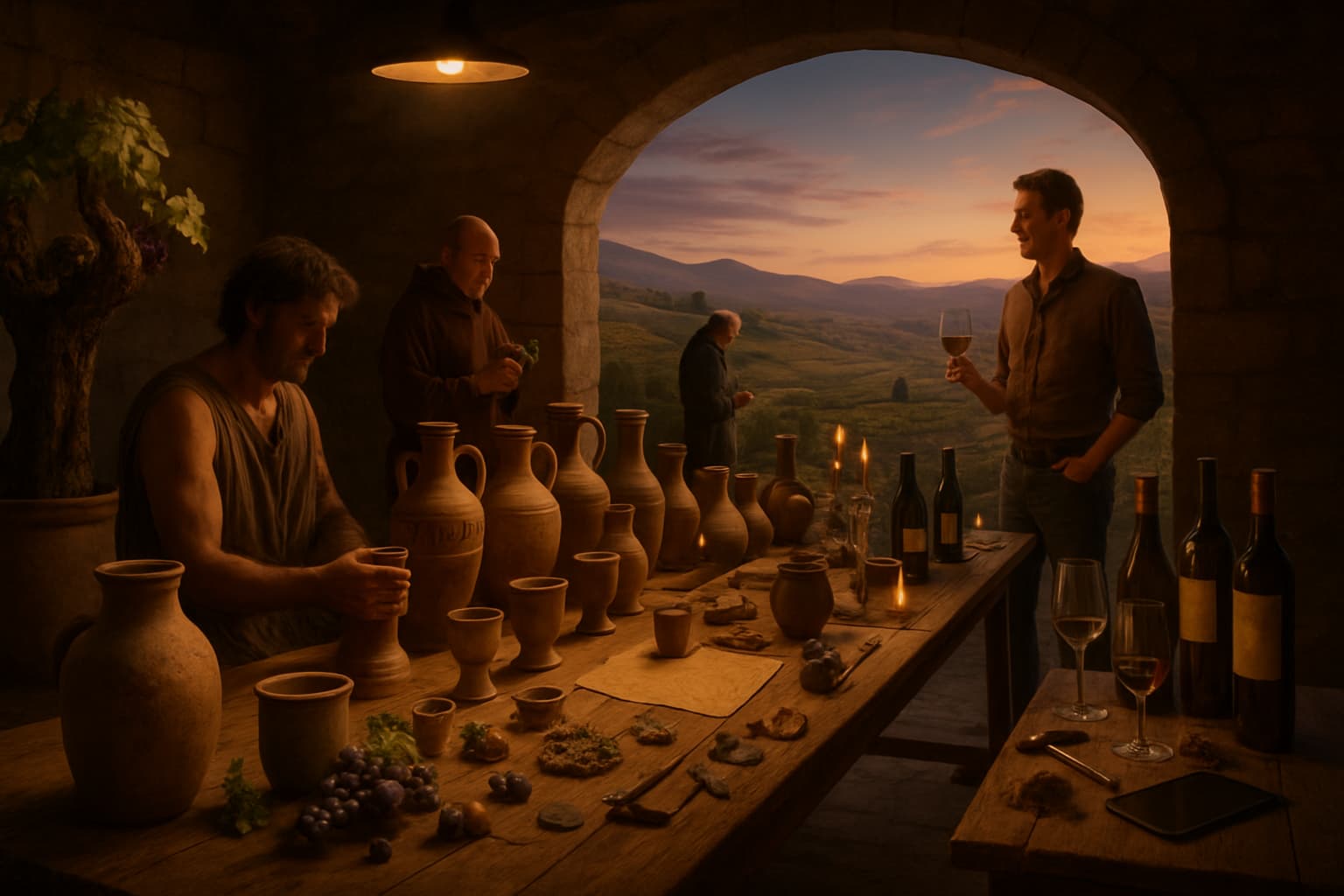
For as long as humans have stood beneath the stars and wondered at their place in the universe, they have cultivated a small, unassuming fruit and coaxed from it something extraordinary. This is not merely a drink, but a distillation of landscape, of climate, of culture and memory. It is wine—and its story is, in many ways, the story of civilization itself.
From the first wild vines curling through ancient forests to the vast, manicured vineyards of today, wine charts a remarkable journey through time. To follow that journey is to watch humanity learn to listen to the earth, to experiment, to celebrate, and to seek meaning in a simple cup of fermented juice.
Let us, then, walk—quietly—through this long narrative. Listen closely, and you may hear the echo of amphorae clinking in distant ports, the murmur of monks in cool stone cellars, and the soft rustle of leaves in a vineyard at dusk, as another vintage begins its slow, patient becoming.
Long before the first written word, wild grapevines clung to rocky hillsides across the Caucasus, the Near East, and the Mediterranean basin. These early vines were not planted in neat rows, nor pruned with care. They sprawled and climbed as part of the forest canopy, their fruit a seasonal gift to animals and early humans alike.
At some point—perhaps by accident, perhaps by design—grapes were gathered, crushed, and left in a vessel. Natural yeasts, invisible and ever-present on grape skins and in the air, began their quiet work. Sugar became alcohol. Juice became something more enduring, more complex, and more mysterious.
Archaeological evidence suggests that the earliest known winemaking took place around 6000–7000 BCE in the region we now call Georgia and parts of Iran and Armenia. Clay jars stained with wine residue, ancient pressing tools, and even grape pollen trapped in old sediments tell us that, very early on, humans recognized that this transformation was worth repeating.
In those first experiments, wine was not a luxury; it was a revelation. Here was a drink that could be stored, traded, and shared, one that changed mood and perception, and that seemed to carry with it the very essence of the land where it was born.
As human societies settled and agriculture blossomed in the Fertile Crescent, the wild vine was tamed. Vitis vinifera, the species that would become the backbone of nearly all the world’s fine wines, was brought under cultivation. People learned to select the most promising vines, to propagate them, and to guide their growth.
In ancient Mesopotamia and the Levant, wine became a symbol of status and ritual. Clay tablets record wine rations and trade agreements; reliefs show rulers feasting with goblets in hand. In Egypt, wine was reserved at first for the elite and the divine. Tomb paintings depict orderly vineyards along the Nile, workers harvesting grapes, and winemakers trampling fruit in great vats.
Egyptian amphorae bear some of the world’s earliest wine labels: inscriptions noting the vineyard, the vintage, and sometimes the winemaker. Even then, people understood that wine was not a uniform product. It bore the stamp of its place and its year, and these differences mattered enough to record.
Wine also became entangled with mythology. It was seen as a gift from the gods, a substance that bridged the human and the divine. In this, early civilizations were perhaps more perceptive than they knew: wine does indeed carry something of the ineffable, a sense that more is present in the glass than science alone can fully explain.
As we move across the Mediterranean to ancient Greece, wine steps onto a larger stage. Here, it becomes not just a drink but a central pillar of social life, commerce, and thought.
The Greeks planted vines across their colonies, from the Aegean islands to southern Italy and beyond. They understood that different sites produced different wines: some lighter, some powerful, some sweet, some austere. They spoke of soil and sun, of slopes and breezes—early murmurs of what we now call terroir.
Wine accompanied the symposium, that distinctive Greek gathering where citizens reclined, discussed philosophy and politics, recited poetry, and played games. Yet wine was never drunk carelessly. It was almost always diluted with water, a recognition that balance—between sobriety and intoxication, between reason and ecstasy—was essential.
Dionysus, the god of wine, represented both sides of this coin: the joy and fertility of the vine, and the wild, potentially dangerous abandon of excess. In honoring him, the Greeks acknowledged that wine, like nature itself, must be respected.
Greek merchants carried amphorae of wine across the Mediterranean, seeding new vineyards and new tastes wherever they went. In their wake, wine became not just a local product, but a shared cultural language.
If the Greeks taught the Mediterranean how to think about wine, the Romans taught it how to scale it.
Under the Roman Empire, vineyards spread relentlessly. Hillsides in Gaul, Hispania, and along the Rhine and Danube were planted with vines. Wine became a staple of daily life for soldiers, citizens, and slaves alike. It was safer than many water sources and easier to transport than grain.
The Romans were meticulous observers. Writers like Pliny the Elder catalogued grape varieties, vineyard sites, and winemaking techniques. They identified superior regions—Falernian, Caecuban, and others—whose wines were prized and aged for decades. Amphorae were stamped with origin marks, an early form of branding and appellation.
Roman innovation extended to technology: improved presses, storage vessels, and shipping methods allowed wine to move throughout the vast empire. With every legion that marched, vines followed, and with them, a new relationship between people and their land.
Yet even as wine became ubiquitous, it retained a certain magic. Banquets celebrated not only military victories but the bounty of the earth, with wine as a central symbol of both conquest and cultivation.
With the fall of Rome, much of Europe fragmented. Trade routes faltered. Cities shrank. Yet in cool, quiet cloisters, another chapter of wine’s story unfolded.
Christian monastic orders, particularly in what is now France, Germany, and Italy, became the custodians of viticulture. Wine was essential for the Eucharist, and so the Church had both a spiritual and practical interest in maintaining vineyards.
Monks observed their vines with patient, almost scientific attention. Over centuries, they noted which slopes ripened earliest, which soils yielded the most concentrated wines, which plots withstood frost or rain. In Burgundy, this long, careful observation led to the delineation of tiny, walled vineyards—clos, or crus—each with its own identity and reputation.
These were early cartographers of terroir, though they would not have used that term. They understood that a vineyard was not merely a field, but a unique intersection of geology, climate, and human care. In their records, we see the beginnings of the modern idea that a wine can express a place as vividly as a poem or a painting.
As Europe emerged from the Middle Ages into the Renaissance and Enlightenment, wine’s role expanded yet again. Trade revived. Glassmaking advanced, allowing for bottles and, eventually, cork closures that could age wine more reliably.
In Bordeaux, merchants from England and the Low Countries fostered a sophisticated wine trade, classifying wines by origin and quality. In Champagne, an accidental secondary fermentation—once considered a flaw—evolved into a prized style, associated with celebration and power.
Thinkers and scientists began to study fermentation more rigorously. Yet even as chemistry advanced, the language of wine remained poetic. Writers compared wines to landscapes, to music, to human character. A great wine was not just delicious; it was profound.
In salons and courts, wine became a marker of refinement and taste. To know one’s vintages, regions, and producers was to signal education and discernment. The story of wine intertwined with the story of class and culture.
With European exploration and colonization came the spread of grapevines to new continents. Spanish missionaries planted vines in the Americas; settlers brought cuttings to South Africa, Australia, and New Zealand.
In many of these regions, the vine encountered climates and soils unlike those of its ancestral home. Some struggled; others thrived beyond expectation. Over time, these lands developed their own viticultural identities: the bold reds of Argentina’s high altitudes, the sun-drenched wines of Australia’s Barossa Valley, the cool, precise whites of New Zealand’s Marlborough.
Yet the global story of wine was not one of simple transplantation. It was also a story of adaptation and resilience. In the late 19th century, the tiny aphid-like pest phylloxera devastated European vineyards, feeding on vine roots and bringing once-great regions to their knees. Salvation came from an unlikely source: American vine species, resistant to the pest, onto which European vines were grafted.
In this crisis, the interconnectedness of global wine became apparent. The vine, like humanity, survived by learning, sharing, and embracing diversity.
Today, wine stands at a fascinating crossroads. It is at once deeply traditional and highly modern. Laboratories analyze yeast strains and phenolic compounds; satellites monitor vineyard health from space. Yet the essential act—a human hand lifting a glass to the light, inhaling its aromas, and tasting the liquid history within—remains unchanged.
The 20th century saw the rise of powerful new wine regions: California’s Napa Valley, Chile’s Maipo, South Africa’s Stellenbosch, among many others. Technology allowed for more consistent, cleaner wines, accessible to more people than ever before. Wine democratized; it was no longer the exclusive domain of aristocrats and connoisseurs.
At the same time, a countercurrent emerged: a renewed fascination with terroir, authenticity, and minimal intervention. Many growers began to see themselves less as manufacturers and more as caretakers of a living ecosystem. Organic and biodynamic practices, cover crops between rows, and careful water use all reflected a growing awareness that the health of the land is inseparable from the quality of the wine.
Wine literature and media blossomed as well. From classic texts that mapped the world’s vineyards to modern documentaries, podcasts, and blogs, wine’s story is told and retold in countless voices. Critics and writers gave language to sensations that might otherwise remain elusive, helping drinkers connect what they taste with where it comes from and how it was made.
Yet beneath the swirl of reviews and ratings, the core narrative remains remarkably simple: grape, place, time, and human touch.
To trace the story of wine is to hold up a mirror to humanity and to the planet itself.
Climate change now alters the pattern of ripening, shifts the boundaries of viable regions, and forces growers to rethink long-standing practices. Some traditional regions grow warmer; new, cooler zones appear on the wine map. Grape varieties once marginal in certain areas now leap to prominence; others struggle.
In this, wine becomes a sensitive barometer of environmental change. A vineyard records, in the rings of old vine wood and in the chemistry of its grapes, the passing of seasons and the warming of the world. Each vintage is a data point, but also a story, of drought or rain, of heat spikes or gentle autumns.
Culturally, wine continues to evolve. It is no longer bound to formality. It appears in casual gatherings, picnics, and street festivals, as well as in grand tastings and cellars lined with rare bottles. New generations approach it with curiosity and fewer preconceptions, sometimes challenging old hierarchies and embracing overlooked regions and styles.
Yet, whether poured into a crystal glass in a quiet restaurant or sipped from a simple tumbler on a hillside at sunset, wine still performs the same subtle magic: it slows us down. It invites us to notice—aroma, flavor, company, place. It gently insists that time, like fermentation, cannot be rushed without losing something essential.
In the end, wine is more than fermented grape juice. It is a liquid archive.
Within a single bottle lies the memory of a particular year: the spring frosts that nipped at young shoots, the summer storms that threatened, the late sun that ripened the fruit. There is the imprint of the soil—limestone or granite, clay or sand—and of the hands that tended the vines, pruned the canopy, decided when to harvest.
When we drink wine, we participate in a chain stretching back thousands of years—to the first wild vines of the Caucasus, to the amphorae of Egypt and Greece, to Roman banquets and monastic cloisters, to explorers crossing oceans with cuttings wrapped in damp cloth, to modern growers walking their rows at dawn, listening to the quiet murmur of leaves.
The story of wine is, ultimately, a story of relationship: between humans and plants, between culture and nature, between past and present. It reminds us that we do not stand apart from the landscapes we inhabit; we are shaped by them, just as surely as a vine is shaped by its hillside.
So, the next time you raise a glass, pause for a moment. Look at the color, breathe in the aroma, take a small, attentive sip. Somewhere within that modest vessel, entire epochs stir: ancient forests, forgotten empires, patient monks, intrepid sailors, and the careful, hopeful work of countless growers.
In that moment, you are not merely drinking wine. You are tasting time itself—and listening, in your own quiet way, to the ongoing, ever-unfolding story of the vine and of the world that sustains it.
Tannins are astringent compounds found in wine that contribute to its texture and aging potential, often causing a drying or puckering sensation in the mouth. They are derived from grape skins, seeds, and stems, as well as from oak barrels used during aging.
/ˈtænɪnz/
Malic acid is a naturally occurring organic acid found in grapes that contributes to the tart, green apple-like flavor and crispness in wine. It plays a significant role in the taste and acidity of wine.
/mælɪk ˈæsɪd/
Filtration in winemaking is the process of removing solid particles from wine to clarify and stabilize it before bottling, using various types of filters to achieve different levels of clarity and remove unwanted elements like yeast, bacteria, and sediment.
/fɪlˈtreɪʃən/
Oxidation in wine is a chemical reaction between the wine and oxygen that can change its flavor, aroma, and color. This process can be beneficial or detrimental depending on the extent and context of the exposure.
/ˌɒksɪˈdeɪʃən/
Microclimate refers to the unique climate conditions of a small, specific area within a larger region, significantly influencing grapevine growth and the characteristics of the resulting wine.
/ˈmīkrōˌklīmit/
Get weekly wine recommendations, vineyard news, and exclusive content delivered to your inbox.