Wine Literature and Media
“Where every bottle tells a story”
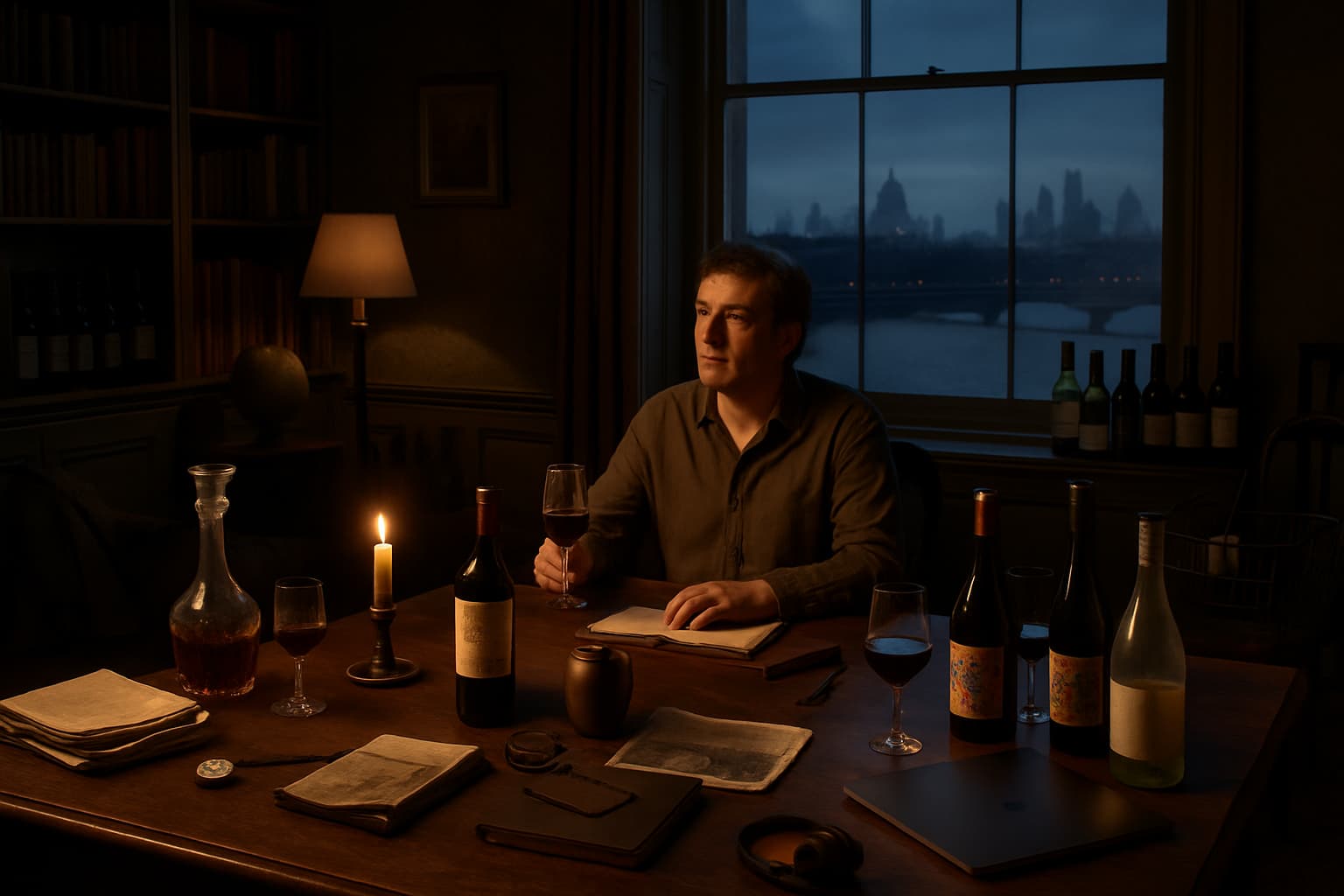
There are newspapers, and then there is that old, trench‑coated beast squatting on the Thames, muttering in received pronunciation and ink fumes. For more than a century it has been quietly committing acts of vinous subversion between the obituaries and the cricket scores—smuggling fermented fruit and French heresy onto the breakfast tables of the British middle class. I’m talking about the wine columns, those polite little dispatches that look tame on the page but, read in sequence, form a long, spiraling psychodrama of Empire, class, booze, and the slow, sticky collapse of certainty.
Line them up—decades of them, yellowed and brittle—and what you have is not just a record of what claret cost in 1937, but a running X‑ray of the British psyche under the influence of alcohol. A historical anthology of these columns is less “wine writing” and more a controlled experiment in national intoxication. The lab rats can conjugate Latin, quote T.S. Eliot, and know the exact year Lafite went sideways, but they’re still rats in the maze, chasing the same sugar‑high in different vintages.
Let’s walk through the maze.
The early wine columns weren’t about pleasure so much as order. They were written for men who believed the world was a filing cabinet: claret under “Bordeaux,” Burgundy under “France,” and France under “Foreign—Manageable.” Wine was a matter of logistics and hierarchy. You didn’t “enjoy” it; you placed it—on the table, in the cellar, in the social pecking order.
The first regular wine pieces in the paper emerged in the late 19th and early 20th centuries, orbiting around three obsessions:
Claret as class passport – Bordeaux, especially from the great châteaux, functioned as liquid heraldry. To know your vintages was to know your place in the system, and more importantly, to signal that you belonged near the top of it. The columns read like dispatches from a private club: “The 1899 is sound, if a touch austere; the 1900 remains the real thoroughbred.” Translation: “If you can’t tell the difference, you’re not one of us.”
The cellar as fortress – The columnists wrote for men who hoarded wine like munitions. Cases of port and claret, laid down for decades, were insurance policies against chaos—war, revolution, or, worse, the possibility of having to serve inferior drink to one’s guests. The tone was calm, clipped, and faintly martial. Wine was not yet pleasure; it was preparedness.
These columns were not wild or passionate. They were cool, almost bureaucratic. But underneath the starch and the cufflinks, you can sense the hum of something more dangerous: the recognition that this fermented juice had the power to bend reality, soften edges, and rearrange the furniture inside a man’s skull.
Then came the 20th century in full—World War I, the Depression, World War II. The wine columns didn’t stop. They adapted, like a butler calmly changing the tablecloth while the house burns.
Rationing and ruin crept into the prose. The writers still talked about claret and port, but now they did it with the brittle nostalgia of men describing a vanished continent. Whole vintages were swallowed by history—bottles bombed, cellars looted, estates bankrupt. Yet the column kept appearing, a weekly act of denial and defiance: civilization persists, because we still argue about the 1928 versus the 1929.
The tone shifted. There was more:
The wine column became a strange psychological object: a little padded room where the reader could pretend that continuity and taste still existed, even as the rest of the front page screamed about rubble and ration books.
By the 1950s and 60s, Britain was pulling itself upright, straightening its tie, and discovering that the world had changed while it was busy nearly dying. So had wine.
The columnists now had to grapple with two terrifying phenomena:
The post‑war wine column became an uneasy hybrid: half manual, half memoir. The writer was still the expert, the guide through a bewildering landscape of labels and vintages, but the audience was no longer a narrow caste. It was anyone with a few spare pounds and a thirst.
By the late 20th century, wine writing had become a blood sport. Critics were stars. Scores were weapons. The column in the paper was no longer just a genteel note from the cellar; it was a weekly proclamation from the bench of taste.
This era’s wine columns are different beasts entirely:
Subjective and confessional – The writer’s palate, preferences, and prejudices moved to the center. “I have never loved this estate,” “I confess a weakness for mature Rioja,” “I find this style cloying.” The mask slipped. The critic stepped forward as a character.
Global in scope – One week: Loire Chenin Blanc. Next week: Barossa Shiraz. Then Oregon Pinot, South African Chenin, Argentine Malbec. The map exploded. The old binary of “France vs. Not‑France” was dead. The column became a travelogue written from behind a tasting glass.
Consumer‑driven – Prices, availability, supermarket promotions, online merchants—this was now part of the story. The reader wasn’t a collector with a butler; they were a civilian with a shopping basket and a budget. The column had to help them navigate a fluorescent‑lit battlefield of half‑truths and marketing lies.
And yet, paradoxically, the column also became more philosophical. When you have the whole world in your glass, you start asking stranger questions:
Some writers leaned into the romance. Others into the science. Some turned the column into a weekly sermon about organic viticulture, biodynamics, and the ethics of farming. Others treated wine as a pure hedonistic sport: chase the best, drink the rarest, damn the consequences.
In an anthology, laid out year after year, you’d see these voices arguing with each other across time, all under the same masthead.
A historical sweep of these columns isn’t just about what people drank. It’s about who got to define what “good” meant.
From the early aristocratic dispatches to the later supermarket‑friendly guides, the same questions keep resurfacing:
Read across time, the anthology reveals a culture trying to talk about its own need to escape itself—politely, with decanters.
Then comes the internet—blogs, forums, Instagram sommeliers, TikTok wine hacks. Suddenly, the weekly print column looks like a telegram in an age of neural implants.
The more recent wine columns in the paper have to fight for relevance:
And yet, the column persists. Why?
Because when done properly, it offers what the algorithm cannot:
In a full historical anthology, the late‑stage columns would read like dispatches from a besieged outpost of long‑form thinking, still trying to connect the dots between a 1961 claret and a 2021 natural wine from the Jura, still insisting that context matters, that taste is learned, that pleasure is richer when you know where it comes from.
Put the whole thing together—decades of columns, from dusty claret worship to orange‑wine debates—and what you have is not just a record of wines, but a record of ways of being:
A historical anthology of these columns is a time machine with a hangover. You watch language evolve: “cordial” and “sound” give way to “fruit‑forward” and “minerality.” You watch prejudices erode: the sneering at New World wines softens into admiration, then acceptance, then dependence. You watch the critic’s mask slip: from anonymous authority to named personality to semi‑celebrity.
Most of all, you watch a culture negotiate its relationship with intoxication, status, and pleasure—one bottle, one paragraph at a time.
In the end, the real subject of these columns is not wine. It’s control versus surrender.
The anthology shows a century‑plus of people trying to choreograph that dance, to ritualize it, to make it safe, respectable, even noble. Sometimes they succeed. Sometimes they just get drunk in very expensive ways.
But reading those columns in sequence, you realize something bracing: for all the changes in style, price, region, and rhetoric, the basic human project has not shifted an inch. We are still the same animals, staring into a glass of fermented grape juice and asking it to make the world a little softer, a little stranger, a little more bearable.
And every week, on that thin slab of newsprint, someone tried to explain how.
Tannins are astringent compounds found in wine that contribute to its texture and aging potential, often causing a drying or puckering sensation in the mouth. They are derived from grape skins, seeds, and stems, as well as from oak barrels used during aging.
/ˈtænɪnz/
Malic acid is a naturally occurring organic acid found in grapes that contributes to the tart, green apple-like flavor and crispness in wine. It plays a significant role in the taste and acidity of wine.
/mælɪk ˈæsɪd/
France as holy ground – The early writers treated French wine regions like a map of sacred sites. Bordeaux and Burgundy were not just places; they were articles of faith. Italy barely existed, Spain was a rumor, and the New World might as well have been brewing grape‑flavored gasoline.
The democratization of wine
Wine was no longer the exclusive plaything of the landed and the lunatic. Supermarkets began to stock bottles. Restaurants, even modest ones, had wine lists. People who did not own country houses—people who might not even own ties—were drinking the stuff.
The tone of the columns loosened. Suddenly, there were pieces on:
This was the beginning of the end of wine as a private code. The writers had to translate an aristocratic dialect into something approaching common speech.
The rise of the New World
The first serious mentions of Australian, Californian, and later Chilean wines hit the page like UFO sightings. The old guard approached them with suspicion: “surprisingly drinkable,” “lacking in finesse but offering robust fruit.” These are not tasting notes; they are immigration reports.
Underneath the hedged praise, though, you can feel the tectonic plates shifting. The columns started to admit a possibility that would have been heresy fifty years earlier: good wine might not require French soil or a British accent to describe it.
Who is this column for?
In the beginning, the answer was simple: the already initiated. Later, it became more complicated. The column had to balance expertise with accessibility, authority with humility. Sometimes it succeeded. Sometimes it read like a man in a tuxedo explaining cheap wine to the help.
What is the critic’s real job?
Is it to:
Across the decades, you can watch the answer mutate. Early on, the critic is a gatekeeper. Later, a guide. Later still, a kind of therapist for confused consumers drowning in choice.
How honest can anyone be about intoxication?
The columns rarely say it outright, but the real subject is not tannins or acidity. It’s the altered state. Wine is a legal, socially sanctioned way to change your consciousness. The column is a coded public conversation about private chemical experiments.
The early pieces describe wines as “stimulating,” “comforting,” “fortifying.” Later writers talk about “joy,” “melancholy,” “meditative wines,” “party wines.” Underneath all the tasting notes, the same truth hums: people are hunting for a feeling, not a flavor wheel.
Filtration in winemaking is the process of removing solid particles from wine to clarify and stabilize it before bottling, using various types of filters to achieve different levels of clarity and remove unwanted elements like yeast, bacteria, and sediment.
/fɪlˈtreɪʃən/
Oxidation in wine is a chemical reaction between the wine and oxygen that can change its flavor, aroma, and color. This process can be beneficial or detrimental depending on the extent and context of the exposure.
/ˌɒksɪˈdeɪʃən/
Microclimate refers to the unique climate conditions of a small, specific area within a larger region, significantly influencing grapevine growth and the characteristics of the resulting wine.
/ˈmīkrōˌklīmit/
Get weekly wine recommendations, vineyard news, and exclusive content delivered to your inbox.