Wine Literature and Media
“Where every bottle tells a story”
There are wine books that taste like homework, and then there are wine books that taste like a life. This one is the second kind.
You don’t need to care about tannins or terroir or whether your glass is shaped like a tulip or a test tube. This is a story about a father and a daughter, about ambition and insecurity, about class and taste and the weird, snobby, intoxicating world that built modern American wine culture. The bottles are just the props. The real intoxication is memory, regret, and the need to be seen.
Welcome to the world of Clifton Fadiman and his daughter, Anne. One of them became the voice of cultured mid‑century America. The other spent a lifetime trying to understand the man behind the voice—and the wine he loved more than almost anything else.
Clifton Fadiman was one of those guys who used to exist before the internet blew everything up: a public intellectual. A literary host. A man whose job was to be smart on the radio and TV, to sound like the kind of person who always knew the right book, the right quote, the right bottle.
He was born poor, Jewish, and painfully aware of it—New York immigrant stock. He was smart enough to claw his way into Columbia. Smart enough to edit at Simon & Schuster. Smart enough to host “Information Please,” a radio quiz show where he played the unflappable, witty, all‑knowing gentleman scholar—America’s idea of class, in a suit and tie, with a martini and a well‑thumbed copy of the classics.
But underneath that polished diction and urbane charm was a man who never stopped feeling like an outsider: a kid who’d been mocked for his background, his name, his accent. Someone who spent his entire life trying to sand down the rough edges, to pass as something smoother, whiter, more refined.
Wine became one of his tools. Not just something to drink, but a ladder. A language. A way to move from the tenement to the tasting room, from the margins to the center of the table.
His daughter, Anne, grew up in the long shadow of that performance.
For Clifton, wine wasn’t just fermented grape juice. It was aspiration in a bottle.
He fell for it hard in the years when Americans still drank like they were afraid of flavor: whiskey, beer, maybe a jug of red that tasted like regret. The idea that wine could be subtle, layered, intellectual—that was foreign. European. Exotic.
He embraced it. Promoted it. Wrote about it. Hosted it. He helped mid‑century Americans think of wine not as something suspicious and foreign, but as a sign that you were civilized. Cultured. One of the people who “got it.”
He loved French wine most of all: Bordeaux, Burgundy, the old‑country classics. For him, France was the promised land, and wine was its scripture. He believed that if you knew your vintages, your châteaux, your appellations, you weren’t just a guy from Brooklyn anymore. You were something else. Something better.
Wine became his costume of belonging. Every bottle was an audition for the role of “real American gentleman”—the kind who got invited to the right parties and never had to explain where he came from.
That’s the thing about wine in America: it’s never just about taste. It’s about class. About who’s in and who’s out. Clifton understood that better than most. He built a life out of that understanding.
Now imagine being his kid.
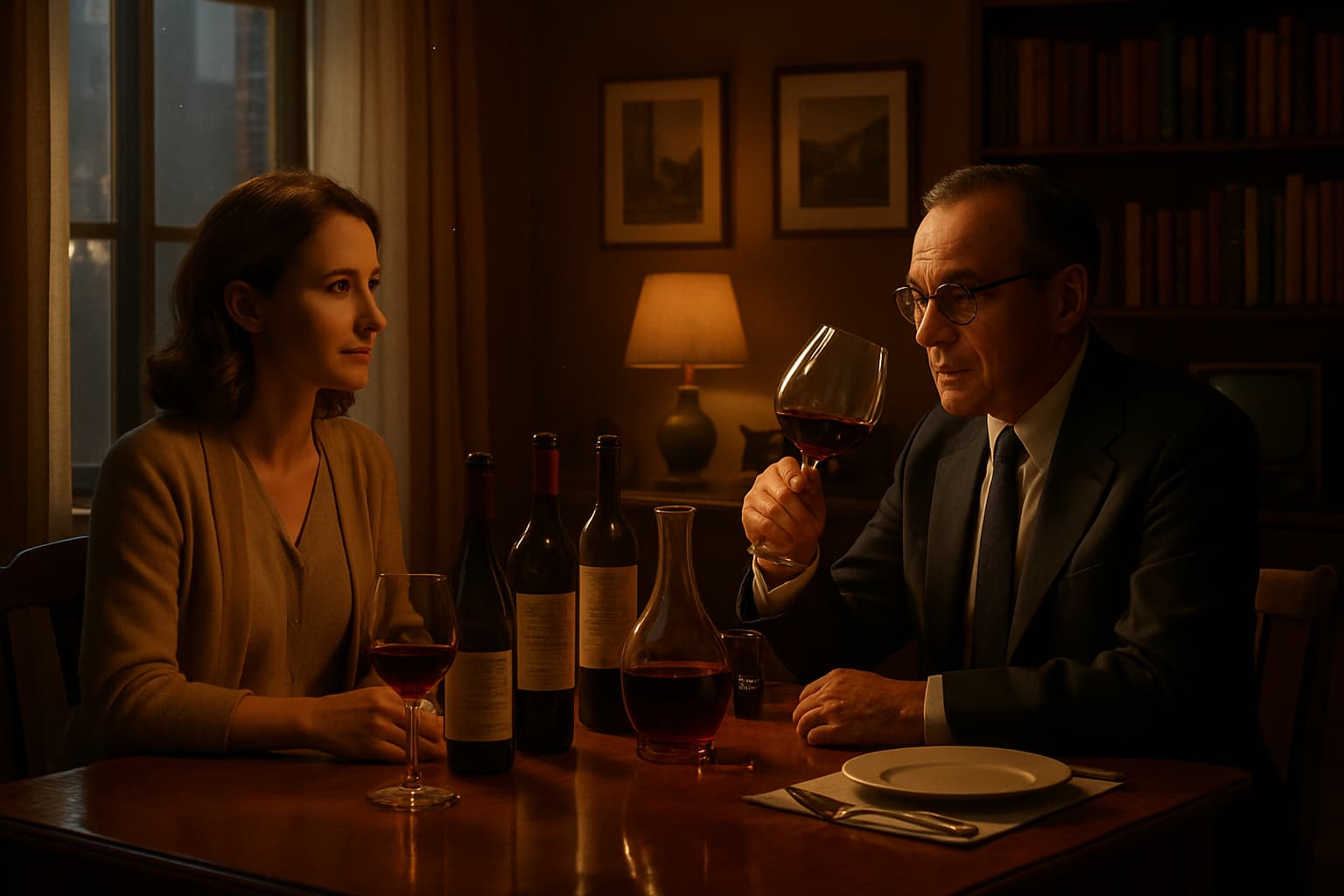
You’re sitting at the dinner table. You’re young. You’re watching your father swirl and sniff and pronounce judgment on whatever’s in his glass like a Supreme Court justice of the palate. He’s eloquent, sharp, funny. He’s in his element. He’s glowing in the reflected light of his own expertise.
And you? You don’t really like wine.
That’s Anne’s situation. The book isn’t written by some sommelier trying to flex. It’s written by a woman who grew up around wine, under the gaze of a father who worshipped it, and never quite shared his religion. She didn’t hate it. It just wasn’t her thing.
What she did understand was this: wine was the axis around which a lot of her father’s identity spun. It shaped who he knew, how he talked, how he moved through the world. It was his comfort, his pride, his proof that he’d made it.
He’d pour, he’d lecture, he’d educate. He was generous with his bottles, but not always with his emotions. Wine was easier to talk about than feelings. Vintage notes were safer than vulnerability.
So she grew up half inside that world, half outside it. Watching. Noticing. Filing away the details. Later, she’d turn those details into a book that’s less about wine and more about what it means to love someone who’s brilliant, flawed, and never entirely at ease in his own skin.
You can’t understand this story without understanding the raw nerve of class and identity running through it.
Clifton was a Jewish kid who grew up in a time and place where that mattered in all the worst ways. Doors closed. Eyes rolled. Names changed. Clubs didn’t admit “your kind.” Ivy League schools took you, but only so many of you. The message was clear: you can come in, but don’t get too comfortable.
He wanted in anyway. Deeply. Desperately. And he was willing to reinvent himself to get there.
He softened his accent. He polished his manners. He learned the codes—what to read, how to talk, what to drink. He married a non‑Jewish woman. He downplayed his background. He leaned into being “Clifton Fadiman, man of letters,” not “Clifton Fadiman, son of poor Jewish immigrants.”
Wine fit perfectly into that project. It was coded “European,” “refined,” “gentlemanly.” It was the drink of the people he wanted to join.
The tragedy—small, human, and incredibly common—is that he never stopped feeling like he was faking it. No matter how many books he edited, shows he hosted, or bottles he opened, there was always that little voice: You don’t really belong here.
Anne, writing decades later, doesn’t let him off the hook. She sees how his internalized shame shaped his choices. She sees how his need to belong sometimes made him cruel, snobbish, or blind. But she also sees the fear underneath the performance—the kid still desperate not to be laughed at.
Wine, in this telling, isn’t just a drink. It’s a coping mechanism. A way to drown out the old humiliation with a new, more palatable intoxication.
By mid‑century, Clifton wasn’t just a guy who liked wine. He was one of the people telling America how to think about it.
He wrote introductions to wine books, praised the right regions, and helped shape the idea that wine could be part of everyday American life—if your everyday life included opera and hardcover books and dinner parties where people actually used the right fork.
He wasn’t a sommelier. He wasn’t a winemaker. He was a translator between worlds: between the French château and the American living room, between old‑money rituals and new‑money aspirations.
In public, he was smooth. Effortless. The kind of man who could describe a Burgundy with just the right amount of metaphor and authority. In private, though, the doubts never quite left. The wine knowledge was real, but it was also a shield.
That’s one of the more brutal truths the book underlines: a lot of what we call taste is theater. You learn the lines. You memorize the script. You hit your marks. You hope nobody notices how hard you’re trying.
Clifton knew the show better than most. He’d helped write it. But he was still, always, acting.
This isn’t a takedown. It’s an autopsy of love.
Anne doesn’t just catalog her father’s flaws. She does something harder: she turns them over, looks at them from every angle, and asks why. Why did he feel so driven to be respectable? Why was he so uneasy about his heritage? Why did he cling so tightly to the rituals of wine and culture and “good taste”?
She writes about his charm and his cruelty, his generosity and his blind spots. About the way he could be dazzling in public and emotionally distant in private. About how his love came filtered through intellect and commentary, rarely raw or unmediated.
She’s not neutral. You can feel the ache in every chapter—the longing for a father who could have been a little less concerned with being the smartest man in the room and a little more concerned with simply being a father. But she’s also fair. She understands the time he lived in, the pressures he faced, the prejudices that shaped him.
And she never forgets the wine: the bottles he loved, the way he poured, the way his face lit up at a great vintage. The way he used wine as both a bridge and a wall—bringing people together at the table, but keeping his own vulnerability safely locked away behind the label.
Strip away the radio shows, the book contracts, the literary gossip, and you’re left with something simple and uncomfortable: wine as a mirror.
Clifton’s story shows how a drink can become a symbol of everything we want to be—sophisticated, accepted, safe from the past. It shows how taste can be weaponized—against ourselves, against others. How we use what we drink, read, and know to build distance from the parts of ourselves we don’t like.
It also shows the limits of that strategy. You can drink first‑growth Bordeaux until your liver gives out; it won’t erase where you came from. It won’t silence the ghosts. It won’t fix the part of you that still thinks you’re not enough.
If you’re into wine, this book gives you something most tasting notes never will: context. It reminds you that behind every tasting room and critic and carefully curated cellar, there’s a human story—usually messy, often insecure, always hungry for something more than what’s in the glass.
If you’re not into wine, it still works. Because it’s not really about wine. It’s about a father and a daughter trying, and only half succeeding, to understand each other before time runs out.
When the bottles are empty and the father is gone, what’s left?
For Anne, what’s left is a complicated inheritance: a love of words, a skepticism about snobbery, a sharp eye for the ways class and culture twist people into shapes they were never meant to take, and a lifelong awareness that one man’s passion can be another person’s burden.
The story she tells isn’t tidy. There’s no grand reconciliation, no final glass raised where everything suddenly makes sense. Real life rarely offers that kind of neat closure.
Instead, what you get is something more honest: a long, slow decanting of memory. A daughter pouring out what she knows, what she guesses, what she’ll never know. Letting it breathe. Tasting it again, years later, to see what’s changed.
In the end, the book leaves you with this: wine is just fermented grape juice. It’s also history, class anxiety, aspiration, and family drama in a bottle. It’s a prop, a crutch, a love language, and a mask. It can bring people together at a table, and it can give them something to hide behind.
Clifton spent his life trying to become the kind of man who knew the right wines and belonged in the right rooms. His daughter spent hers trying to understand the cost of that transformation—and to tell the truth about it.
The result isn’t pretty. It’s better than that. It’s human. And like any good bottle, it leaves a finish that hangs around long after the last sip.
Tannins are astringent compounds found in wine that contribute to its texture and aging potential, often causing a drying or puckering sensation in the mouth. They are derived from grape skins, seeds, and stems, as well as from oak barrels used during aging.
/ˈtænɪnz/
Malic acid is a naturally occurring organic acid found in grapes that contributes to the tart, green apple-like flavor and crispness in wine. It plays a significant role in the taste and acidity of wine.
/mælɪk ˈæsɪd/
Filtration in winemaking is the process of removing solid particles from wine to clarify and stabilize it before bottling, using various types of filters to achieve different levels of clarity and remove unwanted elements like yeast, bacteria, and sediment.
/fɪlˈtreɪʃən/
Oxidation in wine is a chemical reaction between the wine and oxygen that can change its flavor, aroma, and color. This process can be beneficial or detrimental depending on the extent and context of the exposure.
/ˌɒksɪˈdeɪʃən/
Microclimate refers to the unique climate conditions of a small, specific area within a larger region, significantly influencing grapevine growth and the characteristics of the resulting wine.
/ˈmīkrōˌklīmit/
Get weekly wine recommendations, vineyard news, and exclusive content delivered to your inbox.