Wine Literature and Media
“Where every bottle tells a story”
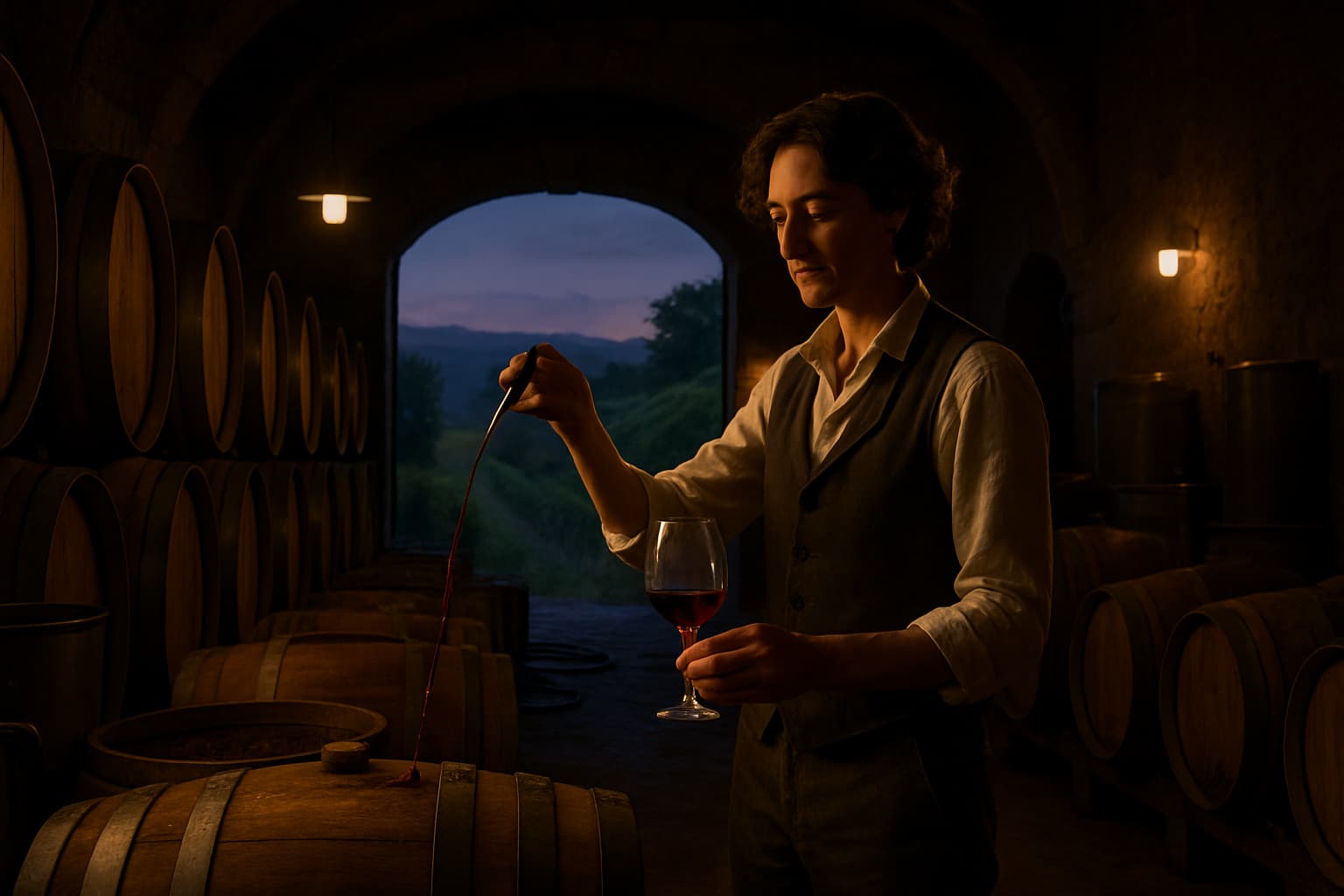
It is a truth not universally acknowledged, but very much felt by those who have once perceived it, that a glass of wine, properly attended to, is capable of revealing more of human nature than an evening’s conversation in the most respectable drawing-room. For in that modest vessel there resides not merely a beverage, but the history of a landscape, the temperament of a season, and the character—good or ill—of the person who has coaxed it from grape to bottle. To observe a winemaker at work is, therefore, to witness a kind of dance: a continual negotiation between will and circumstance, art and accident, patience and desire.
In these pages, we shall not speak of wine as a mere luxury for the idle, nor as a catalogue of flavours to be recited with solemn vanity. Rather, we shall attend to the choreography behind it—the movements, visible and invisible, by which fruit is persuaded into something more enduring, more eloquent, and, if one may be allowed the expression, more truly itself.
Those who imagine that wine is made in the winery alone are as mistaken as a young lady who supposes her future happiness to depend entirely upon the furniture of a parlour. Character, in wine as in people, is principally formed long before its formal introduction into society.
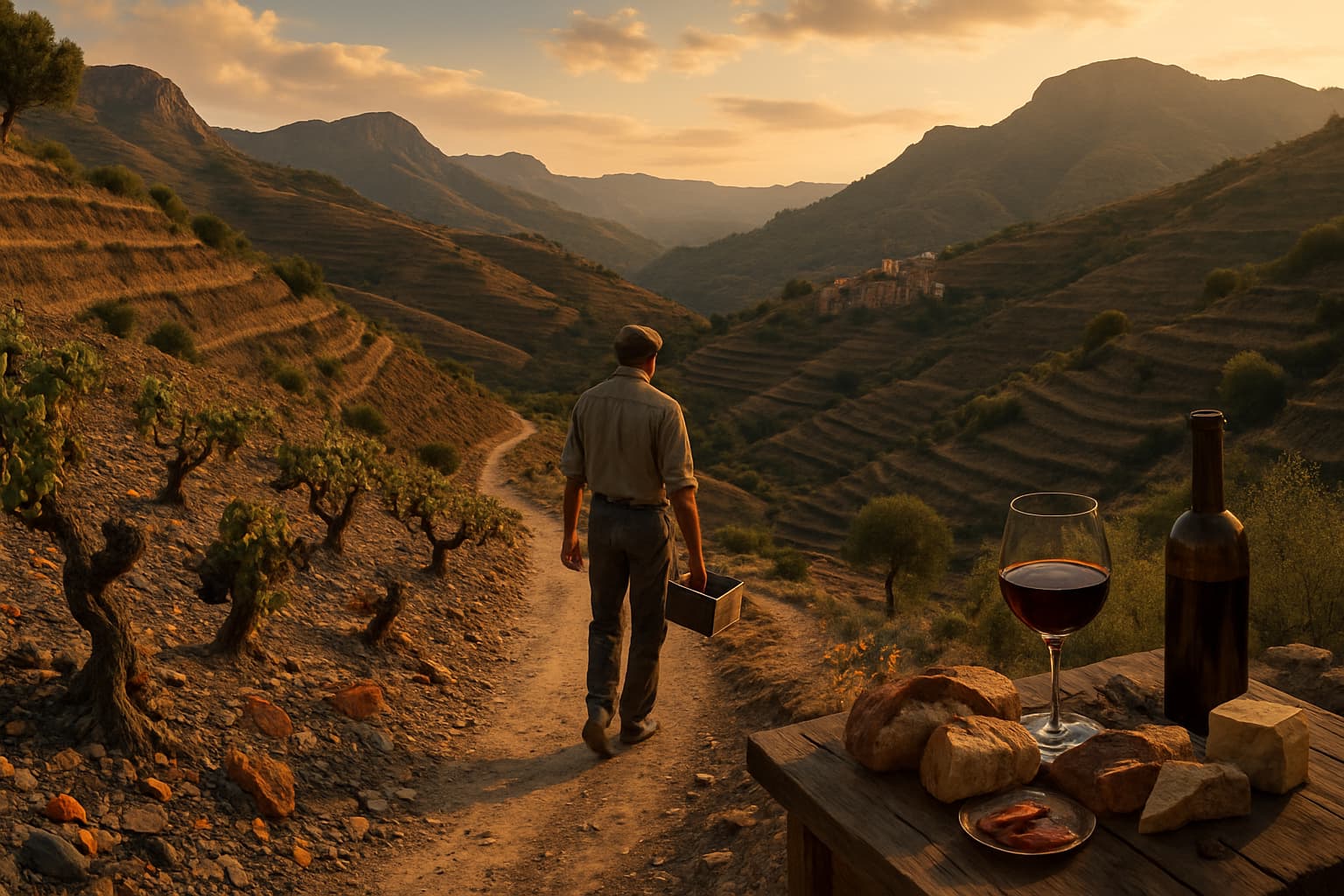
The vineyard is the nursery of this character. Soil, that humble substance so often trodden underfoot without regard, exerts its quiet influence upon the vine. A chalky hillside will impart one sort of refinement, a stony slope another; a rich, heavy clay may produce wines of more substance than delicacy, rather as a gentleman of large fortune may be more solid than sprightly. Climate, too, plays its part, like the society in which a young mind is raised—too harsh and it may harden; too indulgent and it may render flabby and insipid.
The winemaker, in these early chapters, is less a master than a guardian. Pruning, canopy management, the judicious denial of excess water—these are not acts of tyranny but of guidance, like a sensible aunt who prevents her charge from dancing every reel and thereby fainting before supper. The finest winemakers understand that the grape must be neither overindulged nor neglected; it must be permitted to struggle just enough to reveal its true strength.
Thus, the first steps in this dance are not exuberant but subtle: a leaf removed here, a cluster thinned there, a watchful eye upon the sky. One might almost say that the winemaker is engaged in a long, silent conversation with the vines, conducted entirely through gesture and restraint.
There arrives each year a season of heightened expectation, when the vineyard hangs heavy with fruit and the air grows thick with the speculations of those who pretend to know whether the vintage shall be extraordinary or merely agreeable. This is the time of harvest, and it is as delicate a matter as any proposal of marriage.
To pick too early is to condemn the wine to a life of thinness and severity, all angles and no charm. To delay too long, in the hope of greater richness, is to flirt with ruin: rain may come, rot may spread, and the grapes, like an overripe flirt, may lose their freshness and acquire a vulgar excess.
The winemaker, therefore, walks the rows with the anxious composure of a gentleman considering his declaration. He tastes berries, measures sugar and acidity, observes seeds and skins, and listens—yes, listens—to the murmurs of the season. The decision to harvest is never made by numbers alone; it is a judgment of balance, of promise, and of what the year is willing, not merely able, to give.
When at last the moment is chosen, the dance turns lively. Bins and baskets, clippers and crates, the bustle of pickers at dawn—there is a festive air, but beneath it a deep seriousness. For once the grapes have left the vine, they have left childhood behind. What follows will not correct what has been neglected; it can only reveal, refine, or, alas, exaggerate.
If the vineyard is the nursery and the harvest the proposal, then the cellar is the ballroom where all masks are removed. It is here that the winemaker’s dance becomes most visible, though the partners are the most unlikely: juice, skins, yeasts, temperature, and time.
Fermentation, that mysterious conversion of sugar into alcohol, is often described in the driest of scientific terms. Yet anyone who has stood in a winery at the height of the season knows it to be a living, breathing affair. Tanks and barrels bubble and hiss; caps of grape skins rise and fall like the skirts of dancers; aromas of fruit, flowers, and something wilder fill the air.
The winemaker must decide how vigorously to lead. Some prefer a light touch, allowing native yeasts—those inhabitants of the vineyard and cellar—to conduct the fermentation at their own pace, trusting in the wisdom of nature. Others, wary of unpredictability, introduce cultured yeasts, chosen for their reliability and particular talents. Neither approach is inherently virtuous or vicious; the question is whether the choice is made from understanding or from mere fashion.
Temperature, too, must be guided. Too warm, and the wine may become coarse and fatigued, its finer perfumes driven away; too cold, and it may languish, sluggish and incomplete. The winemaker adjusts cooling jackets, opens or closes doors, stirs or refrains from stirring, all in the effort to keep the ferment in that fortunate condition where vigour is tempered by control.
Every action—punching down the cap, pumping over the juice, deciding the length of maceration—is a step in the choreography. A heavy hand may produce wines of great colour and extraction, impressive at first meeting but soon exhausting; a lighter hand may yield wines of grace that reveal themselves slowly, like a reserved but intelligent companion whose conversation improves with acquaintance.
When the frenzy of fermentation subsides, there follows a period of apparent repose, which the inexperienced might mistake for idleness. Yet, as in any well-regulated household, the most significant transformations often occur in quiet.
The choice of vessel—oak barrel, concrete egg, stainless steel tank—is not unlike the choice of a finishing school. Each imparts its own influence. Oak, especially when new, may contribute notes of spice, vanilla, or toast, but in excess it risks overwhelming the wine’s native voice, as a governess too fond of her own opinions may stifle the individuality of her pupil. Older barrels, more reticent, serve instead to soften and oxygenate gently, allowing the wine to grow in composure without acquiring a foreign accent.
Stainless steel, cool and neutral, preserves freshness and purity; concrete, with its curious porosity, marries stability with a whisper of breath. The reflective winemaker does not choose a vessel for its fashionability, but for its suitability to the grape, the place, and the desired style. A delicate white may be ruined by ostentatious oak, while a robust red may feel naked and unpolished without some time in wood.
During this maturation, the winemaker tastes with a frequency that might, in another context, suggest greed. Yet each sip is an inquiry: Has the wine integrated its components? Is the tannin still brusque, or has it learned civility? Are the aromas timid or expressive? Decisions regarding racking (the gentle removal of wine from its sediment), blending of different parcels, and the length of ageing are all made in this period, with as much consequence as any decision of marriage or estate.
It is here that the winemaker’s patience is most tested. For there is always the temptation to hurry, to bottle early in order to satisfy markets and accounts. Resisting this impatience, when the wine itself asks for more time, is one of the quietest forms of courage in the trade.
There comes at last the day when a wine must leave the security of barrel and tank and present itself to the world. Bottling is a moment of both pride and anxiety, resembling nothing so much as a young lady’s first formal season. All the preparation, guidance, and correction have led to this introduction; from here, the wine must speak for itself.
The winemaker decides upon the final blend, the level of sulphur to guard against spoilage, the type of closure—cork, screwcap, or something more experimental. Each choice carries consequences, and each reveals the maker’s philosophy: whether one favours tradition over innovation, longevity over immediate charm, or the reverse.
Once sealed and labelled, the wine departs the cellar and enters the judgmental gaze of merchants, critics, and consumers. Some will praise its elegance; others will lament its lack of power, or complain of its restraint. The winemaker, if wise, listens with interest but not servility. To alter one’s entire style at every fashionable opinion would be as foolish as changing one’s principles with every rumour in the village.
For the true measure of a wine, like that of a character, is not taken in a single, hurried encounter, but over time. A bottle opened too young may seem shy or awkward; another, ten years later, may reveal depths of complexity and grace that were only hinted at in youth. The winemaker’s dance, then, extends even into the cellars of strangers, where the wine continues its slow evolution long after its maker has ceased to intervene.
Beneath the practical labours of pruning, picking, fermenting, and ageing lies a question of philosophy: what is the proper relationship between the winemaker and nature? On one side stand those who would impose their will, extracting maximum ripeness, colour, and flavour by every technological means. On the other, those who insist that the winemaker should do almost nothing, allowing the vintage to express itself with minimal interference.
As in most matters, the truth lies not at the extremes but in the quality of attention. The finest winemakers act neither as tyrants nor as absentees, but as partners in a dance where leadership is constantly negotiated. They observe, they respond, they sometimes refrain. They accept that no vintage will be perfect, just as no human character is without flaw, and they learn to value authenticity above spectacle.
Such humility is not much celebrated in an age fond of grand declarations and points on a scale. Yet it is precisely this modesty—this willingness to listen to the vineyard, to the season, to the ferment—that allows a wine to become something more than an alcoholic beverage. It becomes a conversation between place, time, and person, carried across years and continents in a single bottle.
When we raise a glass to our lips, we seldom consider the multitude of decisions, accidents, and quiet labours that have conspired to produce that moment. We speak of cherry and plum, of flowers and earth, as if these things had simply appeared by magic. Yet behind every aroma lies a choice: to pick early or late, to ferment cool or warm, to age in oak or steel, to blend or not to blend.
To understand wine as a dance is to drink with greater attentiveness and gratitude. One begins to perceive not only the fruit and the structure, but the personality behind them—the cautious winemaker who favours precision, the bold one who courts risk, the patient one who allows time to do its work. One tastes, in short, not only what is in the glass, but the story of how it came to be.
In an age of haste and noise, there is something profoundly civilising in this slow, intricate choreography. It reminds us that excellence rarely arises from force alone, nor from neglect, but from a sustained and intelligent engagement with the world as it is: imperfect, changeable, and yet capable of beauty.
Thus, the next time a bottle is opened and the wine swirls in the glass, let us imagine, if only for a moment, the unseen figures who have guided its steps—from the first pruning cut in winter to the final decision at bottling. For in that quiet, shimmering liquid, the whole dance is present: the vineyard’s voice, the season’s caprice, and the winemaker’s patient, purposeful grace.
Tannins are astringent compounds found in wine that contribute to its texture and aging potential, often causing a drying or puckering sensation in the mouth. They are derived from grape skins, seeds, and stems, as well as from oak barrels used during aging.
/ˈtænɪnz/
Malic acid is a naturally occurring organic acid found in grapes that contributes to the tart, green apple-like flavor and crispness in wine. It plays a significant role in the taste and acidity of wine.
/mælɪk ˈæsɪd/
Filtration in winemaking is the process of removing solid particles from wine to clarify and stabilize it before bottling, using various types of filters to achieve different levels of clarity and remove unwanted elements like yeast, bacteria, and sediment.
/fɪlˈtreɪʃən/
Oxidation in wine is a chemical reaction between the wine and oxygen that can change its flavor, aroma, and color. This process can be beneficial or detrimental depending on the extent and context of the exposure.
/ˌɒksɪˈdeɪʃən/
Microclimate refers to the unique climate conditions of a small, specific area within a larger region, significantly influencing grapevine growth and the characteristics of the resulting wine.
/ˈmīkrōˌklīmit/
Get weekly wine recommendations, vineyard news, and exclusive content delivered to your inbox.