Wine Literature and Media
“Where every bottle tells a story”
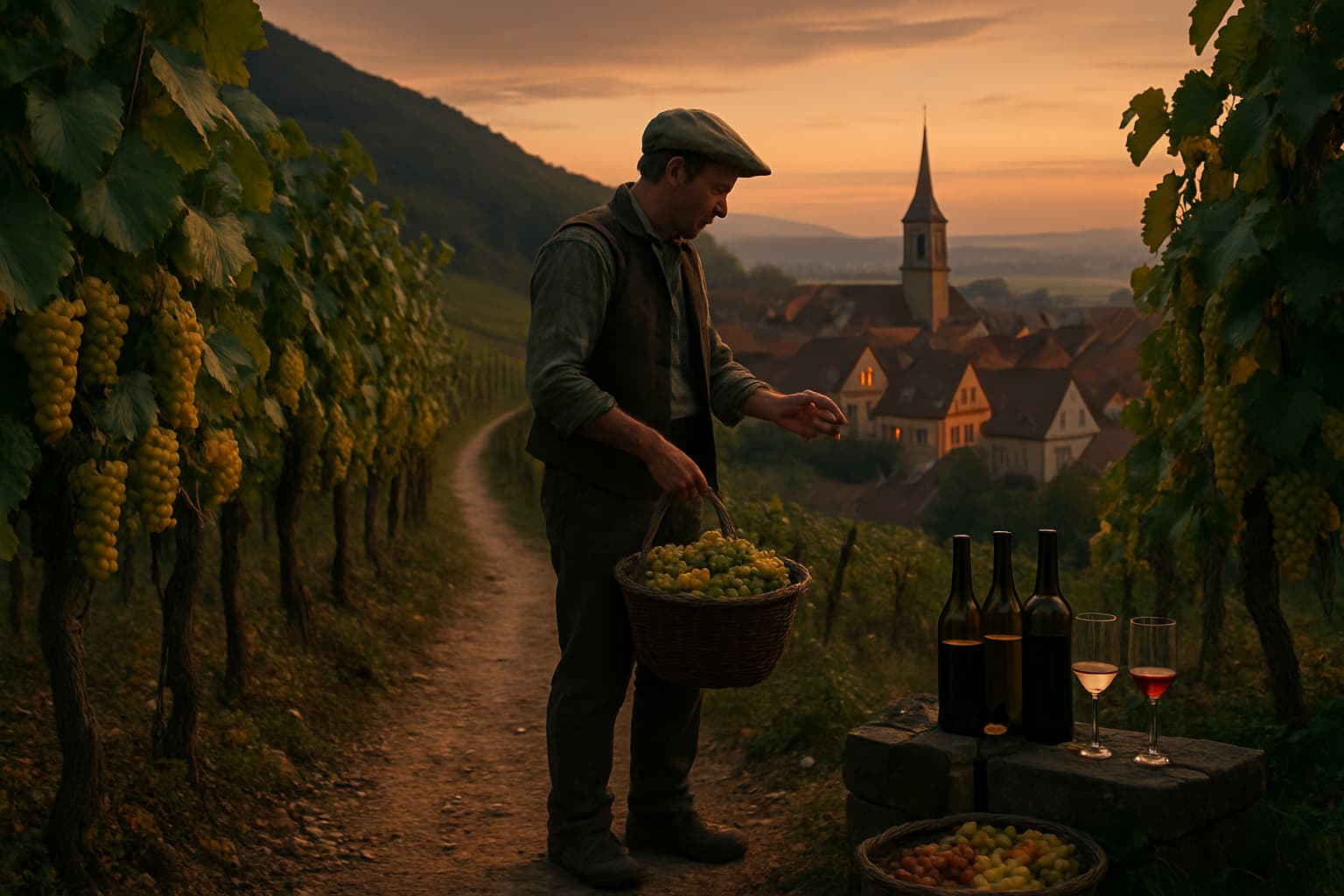
There’s a narrow strip of land in eastern France, pressed gently against the shoulder of the Vosges Mountains and gazing across the Rhine toward Germany. Vines cling to its hillsides like old stories to an elder’s memory. This is Alsace—a place where wine is not just a drink, but a language, spoken fluently by the land, the weather, and the people who’ve tended it for centuries.
Sit with me a while, and let’s walk through those vineyards together.
Alsace has always lived between worlds—between France and Germany, between Latin warmth and Teutonic precision, between sunlit slopes and cool mountain shadows. You can taste that tension, that balance, in every glass.
Geographically, Alsace lies in northeastern France, cradled between the Vosges Mountains to the west and the Rhine River to the east. The Vosges cast a long rain shadow, sheltering the vineyards from Atlantic storms. As a result, Alsace is one of the driest wine regions in France, bathed in sunlight yet tempered by cool nights. It’s this contrast—warm days and cool evenings—that lets grapes ripen slowly, building deep flavors while preserving their vivid acidity.
Beneath those vines, the earth shifts and changes. Granite, limestone, clay, marl, sandstone, and volcanic soils all share the stage. In just a few steps, a vine’s roots can move from one geological age to another. That mosaic of soils gives Alsace wines their remarkable diversity of character—sometimes steely and sharp, sometimes broad and generous, sometimes perfumed like a spring garden after rain.
This is a region shaped by history, too. Alsace has changed hands between France and Germany more than once. Its architecture, its language, its food—all bear the imprint of both cultures. So do its wines: French in their elegance and sense of terroir, German in their love of aromatic white grapes and expressive purity.
Every wine region has its cast of characters. In Alsace, they are mostly white, mostly aromatic, and each speaks with a distinct voice.
If one grape could narrate the soul of Alsace, it would be Riesling. Dry, precise, and laser-focused, Alsace Riesling is a different creature from its often off-dry German cousins. Here, it usually stands tall and dry, with a spine of acidity and a mineral edge that can feel like wet stone or cold steel.
You might find notes of lime, lemon zest, green apple, white peach, and sometimes smoke or petrol as it ages. Riesling in Alsace is not showy; it’s honest. It tells you about the slope it grew on, the rock beneath it, the sun it saw, and the rain it missed. It’s a wine that ages gracefully, its sharpness softening into something deeper and more contemplative over time.
Then there’s Gewurztraminer, the extrovert of the family. Its name comes from “gewürz,” meaning “spiced,” and that’s exactly what it offers: a heady swirl of lychee, rose petals, ginger, and exotic spices. The texture is fuller, more opulent, sometimes with a gentle sweetness, often with a warmth that lingers.
In the glass, Gewurztraminer is like a richly told tale—sensual, layered, sometimes overwhelming if you’re not ready for it. Yet in the hands of a skilled grower, it can be sculpted into something balanced and profound, especially in the best sites.
Pinot Gris in Alsace is no pale, neutral whisper. It’s a wine of weight and quiet intensity, often with aromas of ripe pear, quince, smoke, honey, and mushrooms. It can be dry, off-dry, or richly sweet, but it almost always carries a sense of depth—like a voice speaking from a place of experience.
On certain soils, especially volcanic and marl-rich ones, Pinot Gris becomes almost architectural: broad, structured, and capable of aging into something hauntingly complex.
Alsace Muscat is like biting into a cluster of grapes on a summer afternoon. Unlike many Muscats around the world that lean sweet, Alsace Muscat is often dry, crisp, and startlingly pure. It smells and tastes like fresh grapes, flowers, and herbs, with a brightness that makes it a beautiful companion to spring vegetables and light fare.
Pinot Blanc, often blended with Auxerrois, provides the region’s gentler, more easygoing wines. These are the bottles you might find on a family table in a village inn: soft, round, lightly fruity, with notes of apple, pear, and almond. They may not demand your attention, but they reward it when given—reliable, versatile, and quietly charming.
Sylvaner once covered more of Alsace’s vineyards than it does today. It’s a modest grape, often delicate, with green apple, citrus, and herbal notes. In lesser sites, it can seem simple, but in the right places—and with care—it can be surprisingly refined, a whisper rather than a shout, but clear and true.
While Alsace is a world of white, there is one red voice that speaks up: Pinot Noir. As the climate has warmed, Alsace Pinot Noir has grown more confident, more expressive. You’ll find light, bright, cherry-scented versions meant for early drinking and, increasingly, more serious, oak-aged examples with depth, spice, and structure.
It’s as if the region, long known for its whites, is slowly discovering a new chapter in its story.
If you’re used to French wine labels that speak in terms of villages and châteaux, Alsace may surprise you. Here, the name of the grape is usually front and center.
Most wines carry the simple designation “Alsace AOC.” On these labels, you’ll see the grape variety—Riesling, Gewurztraminer, Pinot Gris, and so on. Unlike many regions, varietal labeling here is the norm. When you see a single grape name, the wine must be at least 100% that variety.
Then there are the Grand Crus—the region’s most revered vineyards. These are not brands but places: names like Rangen, Schlossberg, Brand, Hengst, and many others. Each Grand Cru has its own geology, slope, and microclimate, and each shapes the grapes grown there in its own way.
On a Grand Cru label, you’ll see three key pieces of information:
These wines are often richer, more concentrated, and more ageworthy. They are the region’s most articulate storytellers, expressing not just a grape, but a very specific piece of earth.
Alsace also has a special way of marking its sweetest, most precious wines.
These are not everyday wines. They’re wines for memory—for anniversaries, for milestones, for quiet nights when you want to taste time itself.
Alsace is a region where food and wine live side by side like old friends. The local cuisine—hearty, flavorful, often rich—has grown up hand in hand with its wines.
In Alsace, wine is not an ornament; it’s a participant in the meal, a voice in the conversation.
Behind every bottle from Alsace is a family, a lineage, a set of hands that have pruned vines in winter’s cold and harvested grapes in autumn’s golden light. Many domaines here are small, family-run estates, some with histories stretching back centuries.
Over time, the people of Alsace have learned to listen to their land. Many now farm organically or biodynamically, seeking to preserve the delicate balance of their vineyards and express their terroirs with clarity. They know that the world is changing—the climate, the market, the tastes of those who drink their wines—and they adapt, but slowly, thoughtfully, with respect for what came before.
The wines themselves are changing too. Pinot Noir is gaining ground. Styles of sweetness are evolving, with more producers emphasizing dry, food-friendly profiles even for grapes historically associated with richness. Yet through all of this, the core identity of Alsace remains: aromatic whites of character and purity, rooted in a patchwork of ancient soils.
If you’re just stepping into this world, you don’t need a map as much as you need curiosity.
Start with a dry Riesling from a reputable producer—something labeled simply “Alsace” or from a named village or vineyard. Notice the clarity, the tension, the way it feels both sharp and complete.
Then try a Gewurztraminer and see how different a white wine can be: exotic, perfumed, almost tactile on the tongue. Move on to a Pinot Gris and feel the shift in weight and texture. Taste a Muscat on a spring day, or a Pinot Blanc with a simple meal. If you can, seek out a Grand Cru bottle and see how the volume turns up—not in alcohol or flash, but in depth and detail.
One day, when the occasion feels right, open a Vendanges Tardives or a Sélection de Grains Nobles. Pour it slowly. Let it breathe. Taste the concentrated sunlight of a late harvest, the patient work of noble rot, the long years of cellaring. You’ll find that time itself has a flavor.
As the sun sets behind the Vosges and the sky over Alsace turns a soft, lingering gold, the vineyards fall quiet. The rows of vines, the small villages with their half-timbered houses, the church spires rising above the rooftops—they all settle into a kind of stillness.
But in the bottles resting in cellars and on tables around the world, the region is still speaking.
Alsace is a place of edges and in-betweens, of tension and harmony. Its wines carry the imprint of mountain shadows and river light, of French finesse and German precision, of ancient soils and modern hands. They are wines that tell stories—of land, of history, of patience.
When you raise a glass from this narrow, storied strip of earth, you’re not just tasting a grape or a label. You’re listening to a landscape that has spent centuries learning how to speak.
All you have to do is take a sip, and listen back.
Tannins are astringent compounds found in wine that contribute to its texture and aging potential, often causing a drying or puckering sensation in the mouth. They are derived from grape skins, seeds, and stems, as well as from oak barrels used during aging.
/ˈtænɪnz/
Malic acid is a naturally occurring organic acid found in grapes that contributes to the tart, green apple-like flavor and crispness in wine. It plays a significant role in the taste and acidity of wine.
/mælɪk ˈæsɪd/
Filtration in winemaking is the process of removing solid particles from wine to clarify and stabilize it before bottling, using various types of filters to achieve different levels of clarity and remove unwanted elements like yeast, bacteria, and sediment.
/fɪlˈtreɪʃən/
Oxidation in wine is a chemical reaction between the wine and oxygen that can change its flavor, aroma, and color. This process can be beneficial or detrimental depending on the extent and context of the exposure.
/ˌɒksɪˈdeɪʃən/
Microclimate refers to the unique climate conditions of a small, specific area within a larger region, significantly influencing grapevine growth and the characteristics of the resulting wine.
/ˈmīkrōˌklīmit/
Get weekly wine recommendations, vineyard news, and exclusive content delivered to your inbox.