Wine Literature and Media
“Where every bottle tells a story”
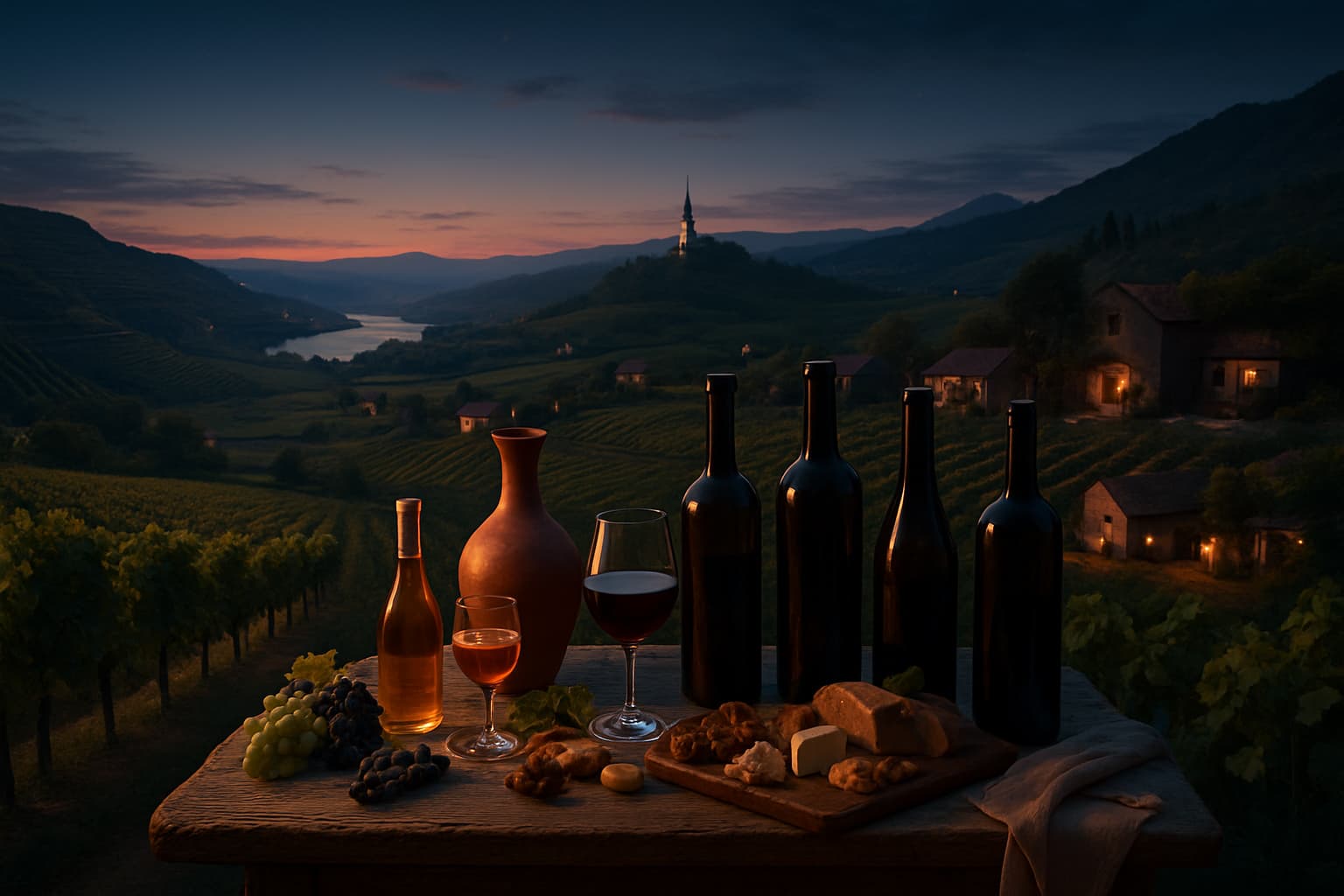
On the far eastern edges of Europe, where empires once rose and fell like seasons in a vineyard, there lies a constellation of wine regions that, for much of the modern world, has remained in shadow. Yet here, in these quiet valleys and wind-swept plains, some of the oldest winemaking traditions on Earth continue, patiently, as they have for millennia.
To explore the wines of Eastern Europe is to step not merely into a marketplace of flavors, but into a living archive of human history. Each bottle is a small time capsule: of forgotten kingdoms, of ancient grape varieties, of soils shaped by vanished seas and restless mountains. Come, then, and let us wander together through this landscape of vines and memory.
When many people think of wine, their minds drift instinctively toward France, Italy, or Spain. Yet the story of wine begins far to the east, in the rugged arc between the Caucasus Mountains and the Black Sea. Here, in what is now Georgia, Armenia, and parts of neighboring countries, archaeologists have uncovered traces of winemaking stretching back more than 8,000 years.
From these primordial experiments with wild grapes and clay vessels, the culture of wine slowly radiated outward—across the Balkans, up the Danube, along the Carpathians, and into the heart of Europe. Eastern Europe is not a newcomer to wine; it is one of its original homelands.
For much of the 20th century, however, this heritage was obscured. Under communist regimes, many vineyards were pressed into service for mass production. Quality, individuality, and local character were often sacrificed to volume and uniformity. But vines, like people, have long memories.
In the last three decades, as political systems have changed and borders have opened, a quiet renaissance has taken place. Ancient grape varieties have been rediscovered. Old cellars have been restored. Young winemakers have returned from abroad with new ideas, while elders have shared the old ways. The result is one of the most dynamic and intriguing wine regions on the planet—at once ancient and newly awakened.
In Georgia, wine is not merely a drink; it is a cultural backbone, a spiritual metaphor, almost a member of the family. Here, the vine appears in folk songs, in religious art, in the very language itself.
At the heart of Georgian wine culture lies the qvevri—large, egg-shaped clay amphorae buried in the earth. Into these vessels go crushed grapes, skins, stems, and sometimes even seeds. The wine ferments and ages underground, in a stable, cool environment, shielded from light and temperature swings.
This method, unchanged for thousands of years, produces wines of remarkable texture and character. White wines, macerated on their skins for weeks or months, take on a deep amber hue, with flavors of dried apricot, tea, walnut, and wild herbs. These are often called “amber” or “orange” wines in modern parlance, though for Georgians, they are simply wine as it has always been.
Key native grapes include:
To drink Georgian wine is to taste a tradition continuous from the Neolithic to the present day—an unbroken thread of human ingenuity.
Across the mountains, in Armenia, the story is similarly ancient. At the Areni-1 cave complex, archaeologists discovered what is believed to be one of the oldest known wineries, dating back over 6,000 years: stone presses, clay jars, even the remnants of grape seeds.
The Areni grape, grown on steep, rocky slopes at high altitudes, gives wines of striking purity: red fruits, spice, and a taut, mineral backbone. The harsh continental climate—scorching summers, frigid winters—demands resilience from both vine and vigneron. Yet from this struggle emerge wines of precision and energy.
Armenian producers, like their Georgian counterparts, are reviving the use of clay vessels (here called karas) alongside more modern techniques. The result is a fascinating juxtaposition: stainless steel and ancient stone, international expertise and local legend, all converging in the glass.
Moving westward, the landscape shifts. The Caucasus gives way to the Balkan Peninsula—a complex mosaic of mountains, rivers, and coasts, where Roman legions, Ottoman armies, and Austro-Hungarian bureaucrats once marched. Each empire left its imprint, not only on language and architecture, but on vineyards and cellars.
Along Croatia’s jagged Adriatic coast and scattered islands, vines cling to limestone terraces that plunge toward the sea. Here, salty breezes and bright sunlight produce wines of remarkable intensity.
Inland, in Slavonia and other regions, cooler climates give rise to crisp whites and elegant reds. It was here that the story of Zinfandel’s origins was finally traced. Genetic research revealed that the beloved American variety is identical to Croatia’s ancient Tribidrag (also known as Crljenak Kaštelanski)—a grape that emigrated under a new name, only to be rediscovered centuries later, like a long-lost relative returning home.
Slovenia, small but remarkably diverse, lies at the crossroads of Alpine, Mediterranean, and Pannonian climates. Its wine culture is deeply influenced by both Central Europe and Italy, yet retains its own distinct identity.
Regions such as Brda, Vipava Valley, and Štajerska produce:
Slovenia was among the first in the region to embrace low-intervention and organic viticulture, and its orange wines—skin-contact whites—have become celebrated on the world’s natural wine stage.
Further south and east, in Serbia, North Macedonia, Bosnia and Herzegovina, and Montenegro, a tapestry of native grapes thrives:
These regions, warmed by continental suns yet cooled by mountains and rivers, are quietly crafting wines that balance richness with freshness, and tradition with experimentation.
As we move north and west into Central Europe, the climate cools, and the wines become more linear, more etched. Here, rivers are the great sculptors of terroir: the Danube, the Tisza, the Bodrog.
In the misty hills of northeastern Hungary lies Tokaj, one of the world’s most storied wine regions. Here, late-harvest grapes are kissed by Botrytis cinerea, the “noble rot” that concentrates sugars and acids, transforming humble berries into shriveled, golden jewels.
The resulting Tokaji Aszú wines, made from grapes such as Furmint and Hárslevelű, are astonishing: honeyed yet vibrant, with flavors of apricot, marmalade, saffron, and wet stone. For centuries, they graced the tables of European courts, praised as “the wine of kings, the king of wines.”
But Hungary is not only about sweetness. Modern dry Furmint has emerged as a world-class white: steely, mineral, and age-worthy, akin in some ways to fine Riesling or Chenin Blanc. Elsewhere in the country, varieties like Kékfrankos (Blaufränkisch), Kadarka, and Olaszrizling (Welschriesling) express a wide range of styles, from juicy and approachable to serious and structured.
Across the border in Slovakia and Czechia, vineyards dot rolling hills and river valleys, producing:
In Moravia (the main Czech wine region), sparkling wines and crisp, food-friendly whites are increasingly recognized for their quality.
Further north, in Poland, climate change has opened new possibilities. While still a marginal region, careful site selection and hardy varieties now yield fresh, light wines that speak of cool breezes and long summer evenings—an emerging frontier at the northern edge of Europe’s vinous map.
In the broad sweep of the Carpathian arc and the plains that spill toward the Black Sea, three countries—Romania, Bulgaria, and Moldova—hold vast viticultural potential.
Romania is one of Europe’s largest wine producers, yet much of its output has long been consumed domestically. Today, ambitious producers are bringing native grapes to a global audience:
From the cool hills of Transylvania to the sun-drenched vineyards of Muntenia and Moldova (the Romanian region, distinct from the neighboring country), Romania’s terroirs are as varied as its folklore.
Once a powerhouse of inexpensive, exported wine during the communist era, Bulgaria is reinventing itself. Native grapes such as:
stand alongside international varieties like Cabernet Sauvignon and Merlot. The Thracian Lowlands and Danubian Plain, with their warm climates and diverse soils, provide ample stage for this quiet transformation.
Tiny Moldova, nestled between Romania and Ukraine, has one of the highest ratios of vineyard land to total area in the world. Beneath its rolling hills lie vast underground cellars—some stretching for kilometers—remnants of a long, if turbulent, wine history.
Native varieties such as Rara Neagră and Fetească Neagră share the stage with European classics. As the country looks westward, many producers are focusing on quality, sustainability, and a clearer expression of local identity.
What sets Eastern Europe apart, perhaps more than anything, is its extraordinary wealth of indigenous grape varieties. While much of the world has converged on a familiar cast—Cabernet, Chardonnay, Merlot—these regions still harbor hundreds of local cultivars, many of them unknown outside their home valleys.
Names like Tamjanika, Žilavka, Crna Gora, Cserszegi Fűszeres, Juhfark, Graševina, and Kadarka may sound unfamiliar, but each represents a unique adaptation to climate, soil, and culture. They are, in a sense, living species in an ecological niche—a biodiversity of flavor.
For the curious wine drinker, Eastern Europe offers an invitation: to step beyond the familiar, to taste not only new flavors but new histories, new ways of thinking about the relationship between humans and the vine.
As Eastern Europe integrates more closely with global markets, its winemakers stand at a delicate crossroads. There is the temptation to plant international varieties and emulate the styles that have proven commercially successful elsewhere. Yet there is also a rising confidence in what is unique and irreplaceable: the old grapes, the old methods, the old stories.
Many of the region’s most exciting wines today come from producers who blend tradition with thoughtful innovation:
These choices are not merely technical; they are philosophical. They ask: Should wine be a standardized product, predictable and uniform? Or should it be, as it has been for most of human history, a local expression—of climate, of culture, of the particularities of a single hillside?
In Eastern Europe, this question is being answered, bottle by bottle.
For those eager to explore, the journey need not be intimidating. One might begin with:
Each bottle is a small expedition, a field trip in a glass. With every sip, one can imagine the landscapes: the quiet fogs of Tokaj’s hills, the blazing summers of Dalmatian islands, the cool, stony vineyards of Slovenia, the clay-buried cellars of Kakheti.
In the end, the wines of Eastern Europe are not merely beverages. They are stories—of survival through political upheaval, of old vines clinging to terraces built by forgotten hands, of languages and customs preserved in the names of grapes and villages.
To drink these wines is to listen to a chorus of voices, some ancient, some newly awakened, all speaking of the same enduring partnership between humans and the vine. It is to recognize that wine, at its deepest level, is not about prestige or fashion, but about our relationship to the land and to time itself.
As you lift a glass from Georgia, from Hungary, from Croatia or Armenia, you are, in a small but profound way, participating in this grand, ongoing narrative. The liquid before you has passed through soil and root, sun and season, hand and history. It carries with it the memory of places that, for too long, lay at the margins of the wine world’s attention.
Now, as their voices grow louder, we have the rare privilege of discovering them almost anew—like a hidden valley revealed when the morning mist finally lifts, and we see, spread before us, row upon row of vines, glinting softly in the first light of day.
Tannins are astringent compounds found in wine that contribute to its texture and aging potential, often causing a drying or puckering sensation in the mouth. They are derived from grape skins, seeds, and stems, as well as from oak barrels used during aging.
/ˈtænɪnz/
Malic acid is a naturally occurring organic acid found in grapes that contributes to the tart, green apple-like flavor and crispness in wine. It plays a significant role in the taste and acidity of wine.
/mælɪk ˈæsɪd/
Filtration in winemaking is the process of removing solid particles from wine to clarify and stabilize it before bottling, using various types of filters to achieve different levels of clarity and remove unwanted elements like yeast, bacteria, and sediment.
/fɪlˈtreɪʃən/
Oxidation in wine is a chemical reaction between the wine and oxygen that can change its flavor, aroma, and color. This process can be beneficial or detrimental depending on the extent and context of the exposure.
/ˌɒksɪˈdeɪʃən/
Microclimate refers to the unique climate conditions of a small, specific area within a larger region, significantly influencing grapevine growth and the characteristics of the resulting wine.
/ˈmīkrōˌklīmit/
Get weekly wine recommendations, vineyard news, and exclusive content delivered to your inbox.