Wine Literature and Media
“Where every bottle tells a story”
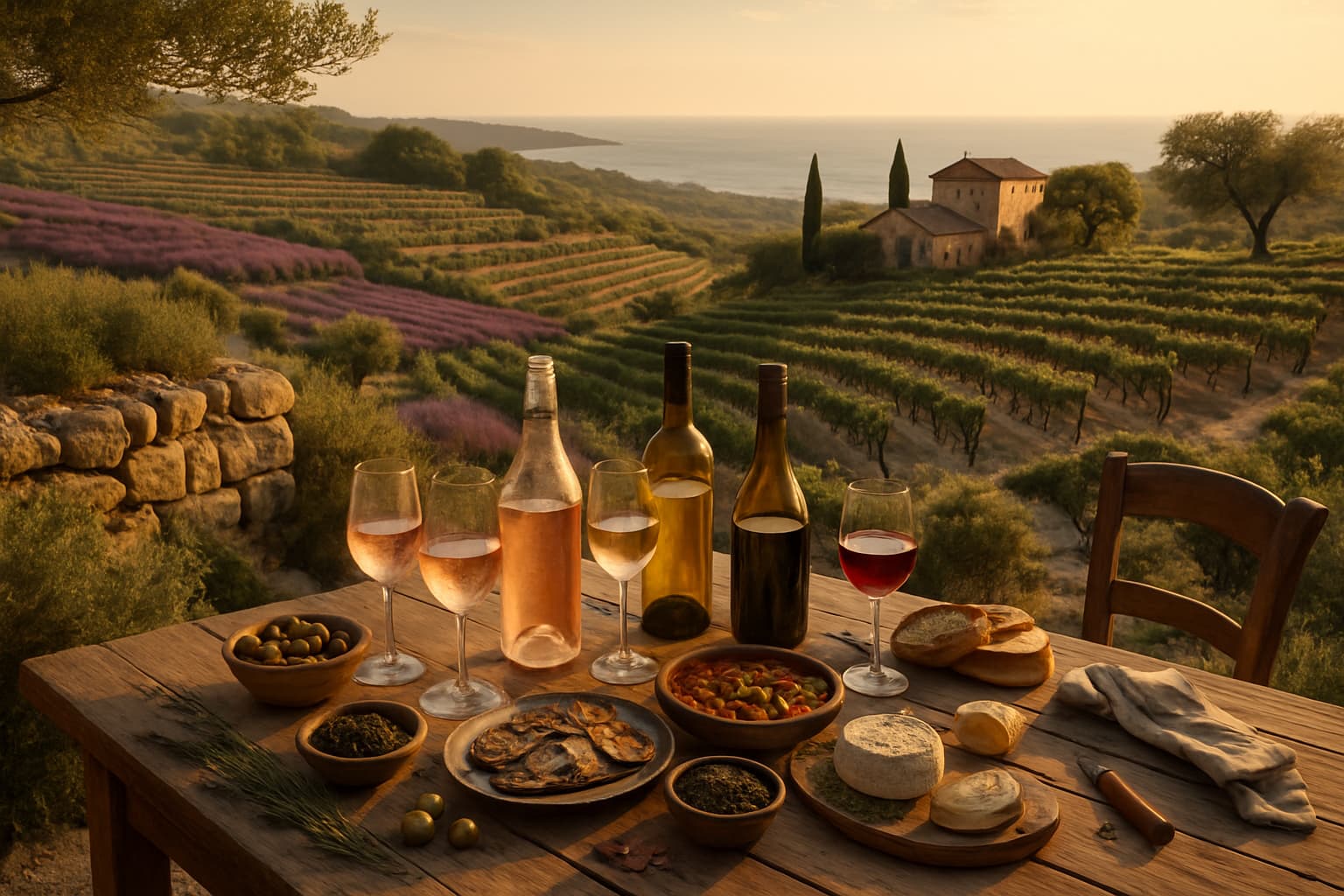
There are places in this world where time seems to walk a little slower, where the light falls softer, and where the simple act of raising a glass becomes a kind of quiet prayer. Provence is one of those places.
You can almost hear the cicadas when you pour a Provençal wine. You can feel the sun that ripened those grapes, see the lavender fields in the pale pink of a rosé, and taste the salty breath of the Mediterranean in every sip. These are not just wines; they are liquid memories of an ancient land that has been telling its story, harvest after harvest, for more than two thousand years.
Let’s walk through that story together.
To understand the wines of Provence, you have to start with the land itself.
Provence stretches along the southeastern corner of France, from the Rhône River in the west to the Italian border in the east, and from the Mediterranean coast up into the foothills of the Alps. It’s a region of contrasts: shimmering coastline, rugged limestone hills, terraced vineyards, and scrubby garrigue—those low, fragrant bushes of thyme, rosemary, and wild herbs that perfume the air.
The climate is Mediterranean: hot, dry summers; mild winters; and a sky that seems to spend most of the year cloudless and blue. Then there’s the mistral, a powerful, cold wind that barrels down from the north, sweeping the sky clean, drying the vines after rain, and keeping disease at bay. It’s harsh, but it’s a guardian too.
Underfoot, the soils are as varied as the landscape: limestone and clay, schist and quartz, sandy riverbeds and rocky terraces. Each soil, each slope, each exposure nudges the grapes in a different direction, shaping the character of the wines in ways that are quiet but profound.
In Provence, nature doesn’t whisper. It speaks clearly, and the wines are its echo.
Long before Provence was Provence, the Greeks sailed up to this sunlit shore around 600 BC and founded Massalia—modern-day Marseille. They brought with them vines, cuttings from their homeland, and with those slender branches they planted the first chapter of French wine history.
The Romans followed, as they often did, and expanded the vineyards, building roads and trade routes that carried Provençal wine across the empire. Through centuries of war, plague, and shifting borders, the vines remained, tended by monks, farmers, and families whose names never made it into the history books, but whose hands shaped the landscape one harvest at a time.
By the Middle Ages, Provence was already known for its pale, refreshing wines. The nobility favored them; the ports exported them. In a world of rough, rustic reds, the wines of Provence stood out for their delicacy and light.
Today, when the world thinks of rosé, it thinks of Provence. It’s not a fashion for them. It’s a tradition that goes back to the region’s earliest days. The rest of us are just catching up.
Rosé is the beating heart of Provence. It accounts for the vast majority of the region’s production, and it has a style so distinctive that you can almost recognize it with your eyes closed.
This is not sweet, sticky wine. This is rosé that tastes like sunlight and sea breeze.
Color and Style
Provençal rosé is typically very pale—often described as onion skin, salmon, or the soft blush of a sunset fading into evening. That delicate color comes from a short, carefully controlled contact between the grape skins and the juice, sometimes just a few hours.
The wines are almost always dry: crisp, refreshing, and light on their feet. They’re made to be drunk young, when their fruit is still bright and their aromas fresh.
Grapes in the Blend
You’ll find a cast of Mediterranean characters in these wines:
These grapes are often blended, each contributing a voice to the final chorus. The result is not one note, but a harmony.
Aromas and Flavors
In the glass, a Provençal rosé might remind you of:
It’s a style that seems tailor-made for long lunches, for tables spread with olives and grilled fish, for afternoons when the only thing on the schedule is conversation.
Rosé may be the star, but it’s not the whole story. Behind that pale curtain lie some compelling whites and reds that speak in quieter, but no less sincere, voices.
Provençal whites are often fresh, subtle, and mineral, made to accompany seafood pulled from nearby waters and vegetables plucked from sun-warmed gardens.
Common white grapes include:
These whites rarely shout. They don’t try to overpower the meal or the moment. They’re like a cool breeze drifting in from the coast—felt more than announced.
The reds of Provence are shaped by sun and stone. They’re often medium-bodied, savory, and herbal, with a rustic charm that feels honest and unvarnished.
Key red grapes include:
These wines can carry flavors of blackberries, cherries, dried herbs, and sometimes that wild, scrubby garrigue that defines the Provençal countryside. In the right hands, they can age gracefully, trading fruit for leather, tobacco, and forest floor.
Provence isn’t a single, uniform region. It’s a mosaic of appellations, each with its own character.
This is the largest and most widely recognized appellation, covering a broad sweep of the region. Most of the rosé you see on store shelves with “Provence” on the label comes from here.
Styles vary, but you can expect classic pale, dry rosés with bright fruit and herbal notes. Sub-zones like Sainte-Victoire, Fréjus, and La Londe bring their own nuances—altitude, proximity to the sea, or particular soils that leave their fingerprints on the wine.
Stretching west of Aix-en-Provence, this area is influenced by both the Mediterranean and the mistral. Rosé dominates, but reds and whites are also made. The wines often show a little more structure, sometimes a touch more spice, while still staying firmly in the Provençal tradition of freshness and drinkability.
If Provence has a strong, silent type, it’s Bandol.
Perched on terraces overlooking the Mediterranean, Bandol is red wine country at heart, built on Mourvèdre, a grape that loves heat and stone. Bandol reds are powerful, age-worthy wines with dark fruit, leather, and an almost animal intensity as they mature.
Bandol rosés, however, have become legends in their own right—richer, more structured, and more serious than many other rosés. They can age, developing savory, complex notes that remind you that rosé isn’t always just for summer.
Not to be confused with the blackcurrant liqueur of the same name, Cassis is a small appellation hugging the coast. It’s known for its whites—textured, aromatic, and saline, often made from Marsanne and Clairette. These are wines that seem born to sit beside a plate of grilled fish, looking out over the sea.
Tiny Palette, near Aix, and lesser-known appellations like Coteaux Varois en Provence and Les Baux-de-Provence add more colors to the picture: small-production wines, often from old vines, with deep roots in tradition and a stubborn sense of place.
In Provence, the idea of terroir—that mysterious blend of soil, climate, topography, and human touch—feels almost tangible.
The mistral wind, the stony soils, the relentless sun, the scent of wild herbs carried on the air: all of these things find their way into the glass. It’s not magic. It’s the slow accumulation of details—how the vines struggle in poor soils, how the wind dries the grapes after rain, how the nights cool just enough in the hills to preserve acidity.
Many growers in Provence have embraced organic and biodynamic farming—not as a marketing badge, but as a way to keep the land alive, to pass on vineyards that are healthier than they found them. There’s a quiet philosophy at work here: that wine should be an expression, not an invention.
Provençal wines rarely feel forced. They don’t demand your attention. They invite it.
If there’s one thing Provence understands, it’s that wine doesn’t live in a vacuum. It belongs at the table.
Rosé finds its greatest calling alongside:
Whites from the region pair beautifully with oysters, mussels, and delicate seafood, while reds stand up to lamb studded with garlic and rosemary, hearty stews, and game.
But beyond pairings and rules, there’s something more fundamental at work: a sense that wine is part of everyday life. In Provence, a glass of wine is not a performance. It’s a companion—to a meal, to a conversation, to the slow unfolding of a summer evening.
Provence has captured imaginations far beyond its borders. In books, films, and travel writing, it appears again and again as a kind of dreamscape: sunlit, romantic, timeless.
You see it in stories of city-dwellers escaping to crumbling farmhouses, in tales of second chances found among the vines. You see it in glossy magazine spreads of long tables under plane trees, bottles of pale rosé beading with condensation, laughter lingering in the air.
Wine literature and media often cast Provence as the embodiment of a certain ideal: the good life lived slowly. The wines themselves play a starring role—rosé as the symbol of leisure and lightness, reds and whites as the deeper chapters of a story that goes beyond the summer postcard.
Yet behind the romance, there are real people pruning vines in winter, rising before dawn at harvest, tasting, blending, and hoping that this year, like so many before it, the wine will be worthy of the land it comes from.
In the end, the wines of Provence are not about spectacle. They’re about grace.
They don’t need to be the loudest voice at the table. They don’t chase trends or shout for attention. They simply offer what they’ve always offered: a reflection of sun and stone, of wind and sea, of a culture that understands that joy is often found in simple things done well.
When you pour a glass of Provençal wine, you’re not just tasting grapes. You’re tasting history and landscape, labor and patience, the warmth of a place where people have been tending vines since before there was a France to put on the map.
You’re tasting a pause in the rush of time.
So the next time you find yourself holding a pale rosé from Provence, or a sturdy Bandol red, or a whispering white from Cassis, take a moment. Look at the color. Breathe in the scent. Listen, if you can, for the sound of cicadas in the distance.
Because in that glass, a whole region is speaking—softly, steadily, and with the kind of quiet authority that only comes from centuries of practice.
Tannins are astringent compounds found in wine that contribute to its texture and aging potential, often causing a drying or puckering sensation in the mouth. They are derived from grape skins, seeds, and stems, as well as from oak barrels used during aging.
/ˈtænɪnz/
Malic acid is a naturally occurring organic acid found in grapes that contributes to the tart, green apple-like flavor and crispness in wine. It plays a significant role in the taste and acidity of wine.
/mælɪk ˈæsɪd/
Filtration in winemaking is the process of removing solid particles from wine to clarify and stabilize it before bottling, using various types of filters to achieve different levels of clarity and remove unwanted elements like yeast, bacteria, and sediment.
/fɪlˈtreɪʃən/
Oxidation in wine is a chemical reaction between the wine and oxygen that can change its flavor, aroma, and color. This process can be beneficial or detrimental depending on the extent and context of the exposure.
/ˌɒksɪˈdeɪʃən/
Microclimate refers to the unique climate conditions of a small, specific area within a larger region, significantly influencing grapevine growth and the characteristics of the resulting wine.
/ˈmīkrōˌklīmit/
Get weekly wine recommendations, vineyard news, and exclusive content delivered to your inbox.