Wine Literature and Media
“Where every bottle tells a story”
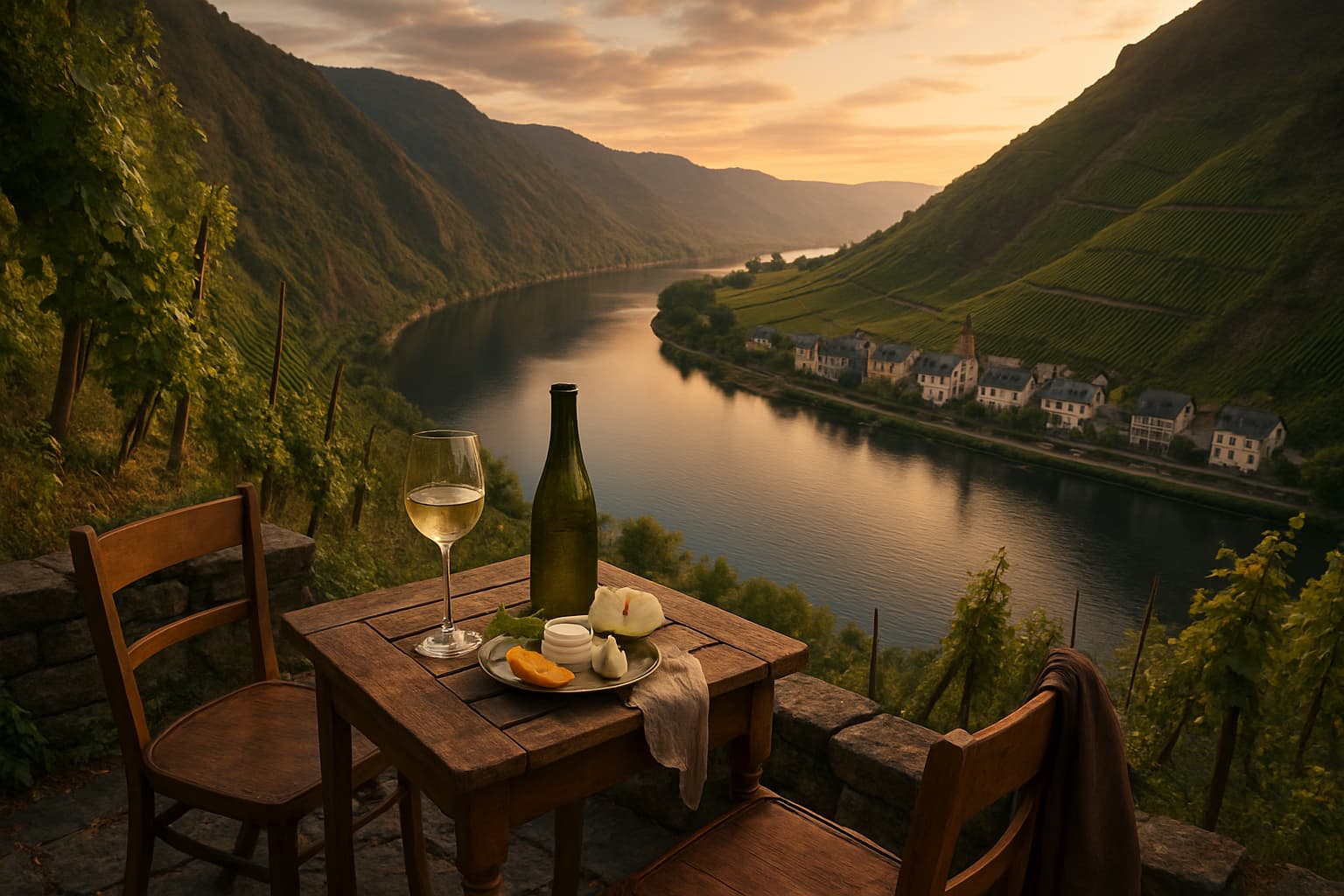
There are some landscapes that feel as if they were drawn not with pencil and ink, but with a wine glass and a slow, lingering sip. The Mosel is one of them. Imagine a river that doesn’t so much flow as coil and curl through a storybook valley; hills so steep they seem to lean in, conspiratorially, to see what you’re drinking; and vines clinging to slate like green calligraphy on black paper. This is not just a wine region; it is a love letter written in Riesling.
And if that sounds a touch indulgent, it’s because Mosel wine positively invites indulgence—not loud, swaggering indulgence, but something quieter, more insinuating. A cool, fragrant glass that smells of white flowers and lime zest, tastes like biting into a just-cut peach, and finishes with a shiver of slate and river stone. It is pleasure with poise; sweetness—sometimes—held in a taut embrace by acidity so pure it feels almost luminous.
Let’s wander, glass in hand, through this river valley of light, slate, and liquid poetry.
To understand Mosel wine, you must first understand the drama of its setting. The Mosel River (Moselle in French) begins in the Vosges Mountains in France, winds through Luxembourg, and then enters Germany, where it becomes the stage for one of the most distinctive wine regions on earth.
Here, the river doesn’t simply pass through; it performs. It twists and doubles back on itself, creating a necklace of bends and loops, each one catching the sun at a subtly different angle. On these looping banks rise vertiginous slopes—some of the steepest vineyards in the world—draped with vines that appear to defy gravity.
Beneath those vines lies the secret: slate. Blue slate, grey slate, red slate—crumbly, heat-retentive, and faintly glittering in the sun. During the day, the slate soaks up warmth like a stone hot-water bottle; in the cool evenings, it exhales that heat back to the vines, coaxing grapes towards ripeness in a climate that is, frankly, a bit marginal. The result is a slow, teasing ripening that builds aroma and tension rather than brute power.
If you taste carefully, you can feel that slate—not as a literal crunch of stone, of course, but as a flicker of minerality, a stony coolness that runs like a spine through the wines. It’s as if the river and the rock have collaborated on a kind of liquid call-and-response.
Germany is not, by any stretch, a sun-drenched Mediterranean idyll. The Mosel, in particular, is relatively cool, its summers gentle and its autumns often misty and drawn out. This is not a place where grapes loll about in the heat; they must work, slowly and steadily, to ripen.
This cool climate is the reason Mosel wines taste the way they do: the acidity is high, bright, and almost crystalline. That acidity is the backbone, the corset, the structure that allows Mosel wines to flirt with sweetness without ever collapsing into cloying heaviness. It’s the squeeze of lime on a ripe mango, the bite of green apple under a drizzle of honey.
Historically, the coolness of the region meant that grapes did not always fully ripen, and winemakers learned to cherish riper berries when they could find them. This is where Germany’s intricate ripeness-based classification system was born: a nuanced way of describing how ripe the grapes were at harvest, and therefore what style of wine might emerge.
But before we get lost in labels, let’s meet the star of the show.
If the Mosel were a novel, Riesling would be both narrator and heroine. This noble grape, so often misunderstood or underestimated, finds in the Mosel a home that lets it express all its mercurial charm.
Riesling is extraordinarily aromatic: it can smell of lime, lemon, green apple, white peach, apricot, jasmine, elderflower, and sometimes a faint whisper of petrol (or, more politely, kerosene), especially as it ages. That petrol note, far from being a flaw, is like the patina on an antique: a sign of character and time.
In the Mosel, Riesling is almost always the main act. Other grapes exist—Müller-Thurgau, Elbling, Pinot varieties—but it is Riesling that captures the landscape most faithfully. It is transparent in the best sense: what you taste in the glass is not just fruit, but place. A steep, slatey south-facing slope will speak differently from a cooler, shadier nook, and Riesling is eloquent enough to translate every nuance.
One of the great seductions—and confusions—of Mosel wine is sweetness. Not all Mosel wines are sweet, but some of the region’s most hauntingly beautiful examples are. To understand them is to understand balance.
Think of sweetness here not as sugary stickiness, but as texture and glow. When a Mosel Riesling has some residual sugar, that sugar wraps itself around the piercing acidity like silk around steel. You might taste ripe peach, baked apple, or candied citrus peel, but always with a thrilling, almost electric line of freshness.
German wine law, in its charmingly thorough way, offers a lexicon for these styles:
Kabinett – The ballerina of the family. Light, often delicate, with low alcohol and a featherlight touch of sweetness (or sometimes dry). Think green apple, lime, a hint of white blossom, and the sense that you could drink it—happily—at lunchtime or with a simple plate of grilled fish.
Spätlese – Literally “late harvest.” Grapes picked riper, so the wines are fuller, with more intensity. They can be dry, off-dry, or sweet, but always with more depth. Imagine biting into a perfectly ripe pear or peach, with a squeeze of citrus and a dusting of slate.
Auslese – “Selected harvest,” with bunches or berries chosen for their ripeness. Here, sweetness is more pronounced, but so is complexity. These wines can be dessert-like, yet still shimmering with acidity. Think honeyed apricots, baked apple, orange zest, and a lingering, almost meditative finish.
Beyond these lie the unashamedly sweet rarities: Beerenauslese, Trockenbeerenauslese, and Eiswein—wines of honeyed concentration, made from individually selected berries or frozen grapes. They are not everyday pleasures, but exquisite, occasional luxuries: a spoonful of golden nectar in a glass.
At the same time, modern Mosel winemakers are masters of dry (trocken) Riesling. These wines feel taut and racy: lime, green apple, crushed stone, and sometimes a hint of saltiness. They are superb with food, especially anything that appreciates a squeeze of citrus: think grilled prawns, roast chicken with lemon, or even a fragrant Thai curry.
One cannot talk about Mosel wine without a little awe for the people who make it. These are not vineyards you stroll through; they are vineyards you climb, sometimes with both hands.
Slopes can reach gradients of 60–70%, which is to say: terrifying. Harvesting here is done by hand, often with workers secured by harnesses or ropes. Machinery is limited; much of the work is manual, intimate, and back-breaking. Vines are tended one by one, like a collection of beloved, if demanding, houseplants—except they’re perched on a cliff.
The famous vineyard names—Bernkasteler Doctor, Wehlener Sonnenuhr, Ürziger Würzgarten, Scharzhofberger in the Saar—sound almost incantatory, and in a way they are. Each one conjures a particular angle of sun, a certain composition of slate, a microclimate shaped by the river’s curves. To taste a Mosel Riesling from a great site is to taste a specific patch of earth and sky, in a specific year, captured and preserved.
Mosel Rieslings, especially those with some sweetness, are astonishingly ageworthy. This is where their philosophical side reveals itself: the interplay of sweetness and acidity is not just immediate pleasure, but a promise.
In their youth, these wines are bright, zesty, almost crystalline: lime, green apple, white peach, and a barely-there hint of flowers. As they age, they deepen. Fruit shifts from fresh to preserved—lemon curd, baked apple, dried apricot—while honey, spice, and that intriguing petrol note begin to emerge. The texture, too, becomes more velvety, as if the wine itself has relaxed into its maturity.
A ten- or twenty-year-old Mosel Riesling can be one of the most quietly thrilling experiences in wine: not loud, not showy, but layered and contemplative, like reading a favourite novel for the third time and discovering a line you’d somehow missed before.
Part of the Mosel’s charm is its versatility at the table. Because these wines are rarely heavy and often low in alcohol, they feel more like a graceful companion than a domineering guest.
Dry Mosel Riesling loves anything that you might squeeze a lemon over: grilled fish, shellfish, schnitzel, roast chicken, asparagus, or a simple plate of goat’s cheese and salad. It is also sublime with sushi, sashimi, and ceviche—the acidity cuts through richness, while the minerality echoes the sea.
Off-dry and lightly sweet Kabinett or Spätlese are miracles with spicy food. Think Thai green curry, Vietnamese salads, or chilli-slicked prawns. The touch of sweetness soothes the heat, while the acidity keeps everything lively and bright.
Richer Spätlese and Auslese can be dessert’s best friend: fruit tarts, lemon drizzle cake, or a simple bowl of ripe peaches. But they are just as entrancing with blue cheese, foie gras, or pâté—where that sweet-savoury contrast becomes almost indecently delicious.
And, of course, there is the most important pairing of all: a quiet evening, a favourite chair, and a glass of Mosel Riesling that you allow yourself to sip slowly, without distraction. Some wines are for parties; Mosel wines, I think, are for conversations—sometimes with others, sometimes with yourself.
Like many classic wine regions, the Mosel has had its fashions and its follies. There were times when the world clamoured for cheap, sugary “German” wines, and the Mosel’s reputation became entangled with them. But beneath the noise, serious growers never stopped tending their precarious slopes and making wines of precision and beauty.
Today, there is a quiet renaissance. Younger generations are returning to family estates, rethinking vineyard practices, embracing organic and biodynamic methods, and exploring the full spectrum from bone-dry to lusciously sweet. Old vines—gnarled, deep-rooted, and low-yielding—are cherished. The aim is not to chase trends, but to express place with ever more clarity.
There is something deeply heartening about this: in a world that rushes, the Mosel remains deliberately slow. Grapes ripen slowly; wines develop slowly; reputations, too, are rebuilt slowly, one bottle at a time.
If you let it, the Mosel will seduce you gently rather than overwhelm you. Its wines are not about power or opulence; they are about tension, luminosity, and the quiet thrill of balance held just so. They speak of cool river air at dusk, of sun-warmed slate underfoot, of labour on steep slopes and the patient passage of time in bottle.
To drink a Mosel wine is to taste a landscape that has given itself, generously but not carelessly, to the vine. It is to feel sweetness and acidity in dialogue, fruit and stone intertwined, pleasure and precision in perfect poise.
And perhaps that is the true magic here: a reminder that delight need not be loud to be profound, that something light can still be deeply satisfying, and that a simple glass of pale, shimmering Riesling can hold within it a whole valley’s worth of stories—waiting, patiently, for you to take the next sip.
Tannins are astringent compounds found in wine that contribute to its texture and aging potential, often causing a drying or puckering sensation in the mouth. They are derived from grape skins, seeds, and stems, as well as from oak barrels used during aging.
/ˈtænɪnz/
Malic acid is a naturally occurring organic acid found in grapes that contributes to the tart, green apple-like flavor and crispness in wine. It plays a significant role in the taste and acidity of wine.
/mælɪk ˈæsɪd/
Filtration in winemaking is the process of removing solid particles from wine to clarify and stabilize it before bottling, using various types of filters to achieve different levels of clarity and remove unwanted elements like yeast, bacteria, and sediment.
/fɪlˈtreɪʃən/
Oxidation in wine is a chemical reaction between the wine and oxygen that can change its flavor, aroma, and color. This process can be beneficial or detrimental depending on the extent and context of the exposure.
/ˌɒksɪˈdeɪʃən/
Microclimate refers to the unique climate conditions of a small, specific area within a larger region, significantly influencing grapevine growth and the characteristics of the resulting wine.
/ˈmīkrōˌklīmit/
Get weekly wine recommendations, vineyard news, and exclusive content delivered to your inbox.