Wine Tourism
“Where every bottle tells a story”
There’s a particular kind of madness that takes hold the first time you roll into wine country with a tasting schedule, a rented car, and the smug conviction that “it’s just a few sips.” This is how good people end up sunburned, overserved, and arguing about tannins with a retired dentist from Ohio.
Wine tourism looks classy from a distance—vineyards like velvet, glasses catching the light, people murmuring about “structure” as if they’re inspecting cathedrals instead of fermented grape juice. But beneath the polished tasting bars and manicured rows of vines, there’s a very real code of behavior, an unspoken etiquette that separates the civilized visitor from the barbarian with purple teeth and a selfie stick.
This is your field manual—not for swirling and sniffing like a sommelier on cable TV, but for surviving the ritual of visiting wineries without making a complete ass of yourself or, worse, getting eighty-sixed from the estate before you’ve even made it to the good vintages.
The vineyard is not a theme park, no matter how badly your Instagram feed wants it to be. Behind every picturesque row of vines is someone who’s up at 4:30 a.m. dealing with frost, mildew, labor, and the existential horror of weather apps.
Treat the place like a farm with glassware.
What that means in practice:
Behind the romance of wine is a brutal reality: agriculture, money, and risk. Your role is guest, not conqueror. Act accordingly.
The days of rolling up unannounced at every winery on a Saturday afternoon and getting a private audience with the winemaker are largely dead—slain by crowds, influencers, and bachelor parties in matching shirts.
Make reservations whenever possible.
If you’re late, call. If you’re very late, accept that you may have missed your slot. Time in wine country is a finite resource, like sobriety. Don’t waste it.
Wine country style is a strange hybrid—half rustic, half aspirational. You’re going to a place where people drive tractors and pour $100 Cabernet in the same 24 hours.
Basic survival wardrobe:
Dress like you respect the place, but remember you are on terrain, not a runway. Function over peacocking.
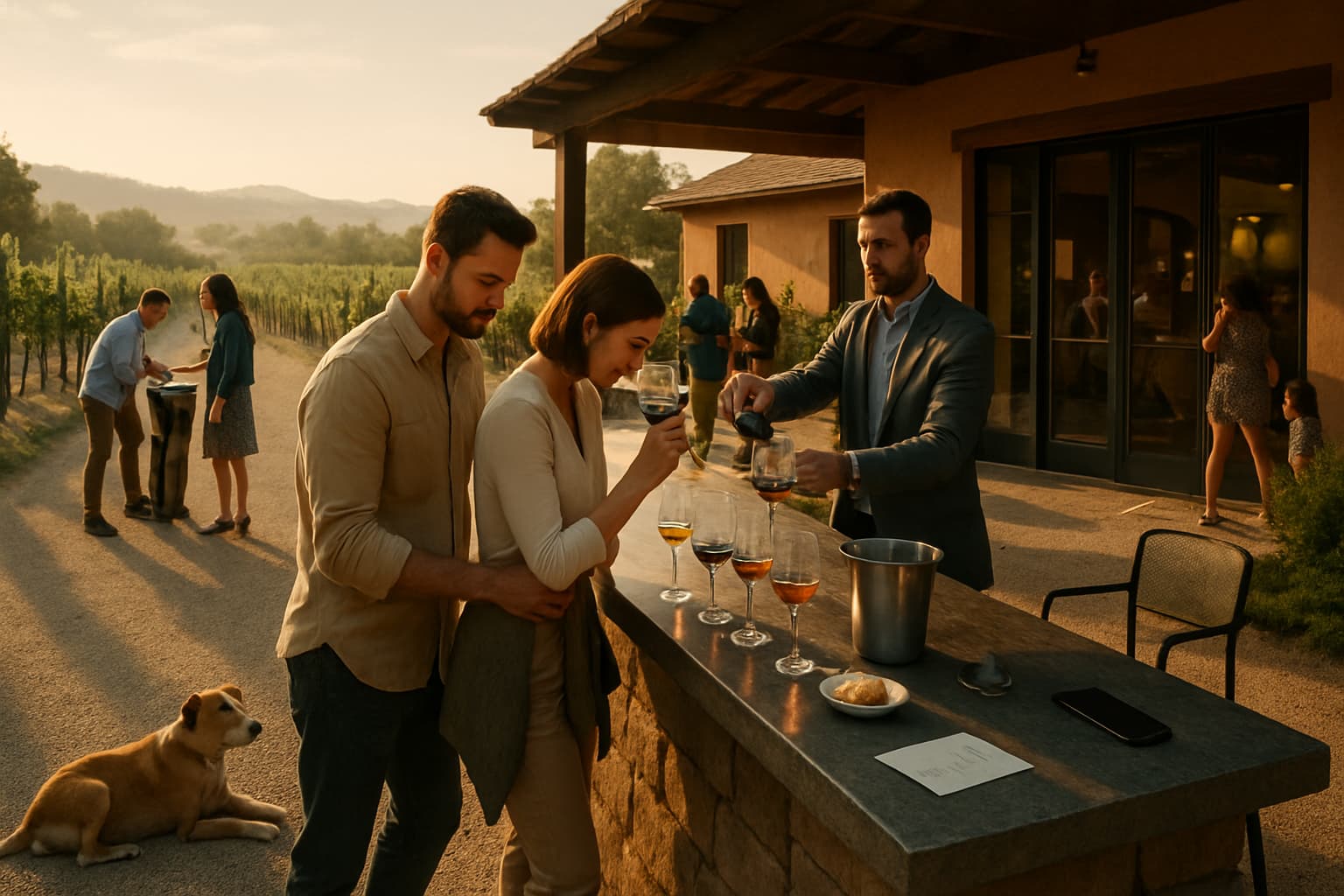
This is where the ceremony happens. The bar. The glass. The pour. The judgment.
The dance is simple, but the steps matter.
You don’t need to perform like a sommelier audition, but a basic ritual helps you actually experience what’s in the glass:
You’re not required to say anything profound. “I like this” or “this feels too sharp for me” is enough. The tasting room staff has heard every adjective known to humankind. They don’t need poetry; they need honesty and basic coherence.
The dump bucket is not a suggestion. It’s a lifeline.
If you’re visiting multiple wineries, spitting is not rude—getting drunk is. Professionals spit almost everything. That’s how they can taste a hundred wines and still drive home without seeing God.
If you’re starting to feel “a good buzz,” cut back. That’s your brain telling you the rest of the day’s tasting notes will be nonsense.
Wineries are cathedrals for people obsessed with soil, weather, and fermentation. Many of the people pouring your wine live for questions—honest ones.
Good questions to ask:
What not to do:
Curiosity is welcome. Ego is not.
Wine tourism is business wrapped in hospitality. You’re not just there for fun; you’re part of the economic engine that keeps the vines in the ground.
You are not required to buy. But if you loved a wine and can afford it, buy it. That’s the most direct way to show appreciation and support the place that just poured you half their lineup.
If you don’t buy, still be gracious. You are not obligated—but you are a guest.
This is a regional and cultural minefield.
When in doubt, look around or ask quietly at your hotel or with locals: “Is tipping at wineries customary here?” Then follow local norms instead of importing your own.
A small group—four to six people—can be charming. A large group—ten or more—can be a traveling disaster if not managed.
If you’re rolling deep:
Bachelor and bachelorette parties are tolerated in some places, loathed in others. If you must do the matching shirts and tiaras routine, at least pick wineries that explicitly welcome that circus. Don’t bring Vegas energy into a quiet, family-run estate where the winemaker’s grandmother is pouring your rosé.
Vineyards are photogenic; we all know this. But there’s a difference between capturing the moment and turning the tasting room into your personal film set.
If you post, tag the winery, and maybe mention a specific wine you liked. That’s free marketing for them and a digital breadcrumb trail for you.
The unromantic truth: wine tourism plus cars can end badly. Rural roads, unfamiliar routes, and three tastings deep is a recipe for headlines.
At its best, visiting wineries is a strange and beautiful ritual: you walk into someone’s life’s work, they pour it into a glass, and you drink the weather, the soil, the year, the gamble they took on a piece of land. It’s agriculture, art, chemistry, and commerce all tangled together in a bottle.
Your job is simple:
If you do this right, you’ll walk away with more than a few bottles and a mild hangover. You’ll have a sense—however fleeting—of the insane, romantic, doomed, and beautiful enterprise that is turning grapes into something that makes people sit down, shut up, and actually taste the world for a moment.
And that, more than the Instagram shots and the tasting notes, is what you’re really there for.
Tannins are astringent compounds found in wine that contribute to its texture and aging potential, often causing a drying or puckering sensation in the mouth. They are derived from grape skins, seeds, and stems, as well as from oak barrels used during aging.
/ˈtænɪnz/
Malic acid is a naturally occurring organic acid found in grapes that contributes to the tart, green apple-like flavor and crispness in wine. It plays a significant role in the taste and acidity of wine.
/mælɪk ˈæsɪd/
Filtration in winemaking is the process of removing solid particles from wine to clarify and stabilize it before bottling, using various types of filters to achieve different levels of clarity and remove unwanted elements like yeast, bacteria, and sediment.
/fɪlˈtreɪʃən/
Oxidation in wine is a chemical reaction between the wine and oxygen that can change its flavor, aroma, and color. This process can be beneficial or detrimental depending on the extent and context of the exposure.
/ˌɒksɪˈdeɪʃən/
Microclimate refers to the unique climate conditions of a small, specific area within a larger region, significantly influencing grapevine growth and the characteristics of the resulting wine.
/ˈmīkrōˌklīmit/
Get weekly wine recommendations, vineyard news, and exclusive content delivered to your inbox.