Wine Tourism
“Where every bottle tells a story”
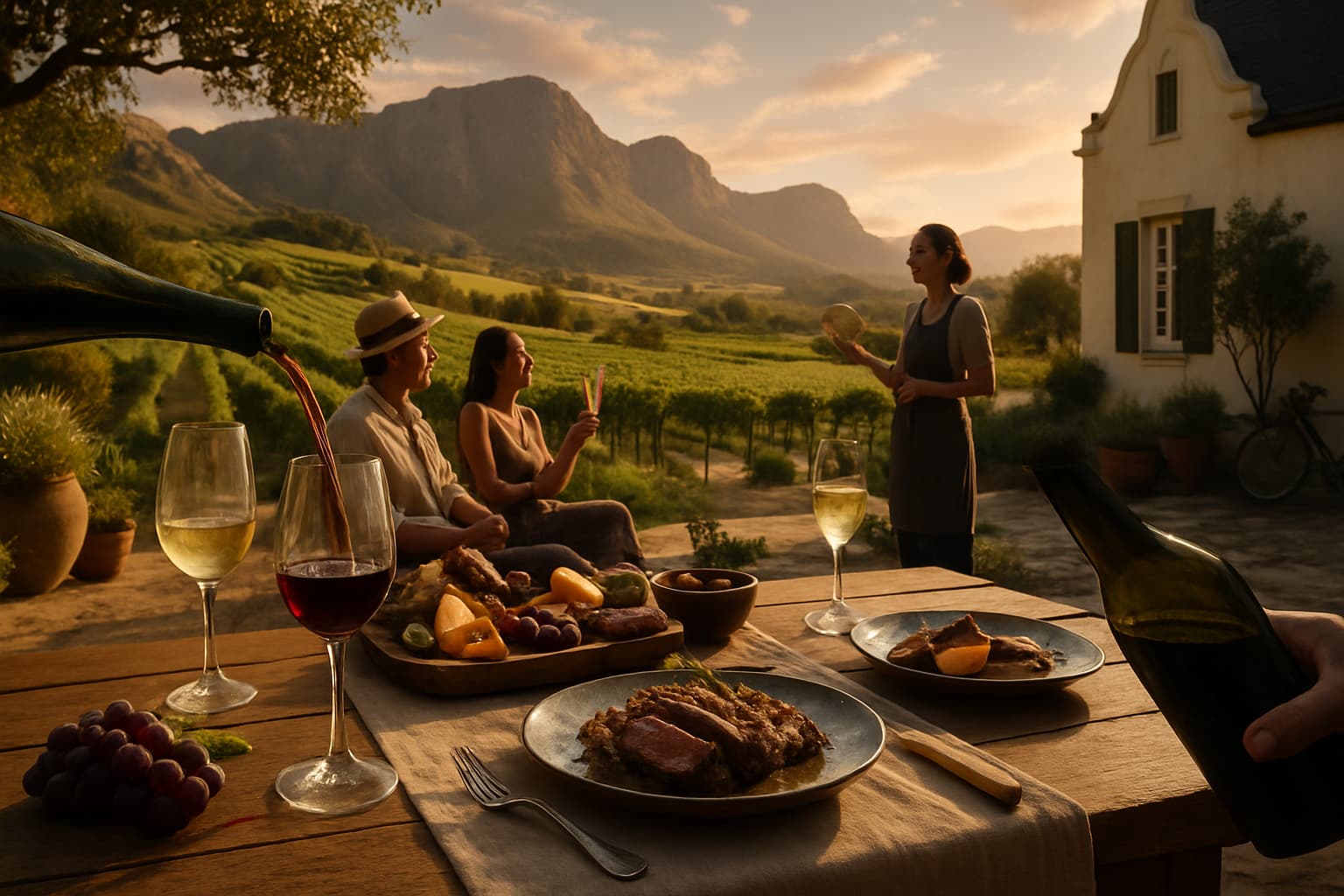
There are some journeys that feel less like travel and more like a slow, luxurious unfolding of the senses. South Africa’s wine country is exactly that: a place where sunlight tastes like honey, mountains brood at the edges of vineyards, and every glass of wine seems to hold a story—of soil, of struggle, of joy. This isn’t simply wine tourism; it’s an invitation to linger, to sip, to savour, to surrender to pleasure in the most deliciously unhurried way.
To understand wine in South Africa, you must first understand the stage on which it’s made. Picture this: swooping valleys stitched with vines, mountains rising in dramatic, rocky folds, and the particular clarity of light you only get where the land meets two oceans. The Cape Winelands are not coy; they’re gloriously, shamelessly beautiful.
The climate is Mediterranean in temperament—warm, sun-drenched days, cooling breezes, and crisp nights. It’s the sort of weather that coaxes grapes into ripeness with a gentle, persistent seduction. The soils, varied and ancient, lend their own quiet poetry: decomposed granite, shale, sandstone, each whispering different notes into the glass.
This is why wine tourism here feels so immersive. You’re not just tasting wine; you’re tasting landscape: the salty tang of a sea breeze in a coastal sauvignon blanc, the stony seriousness of a mountain-grown syrah, the sun-drenched generosity of a Stellenbosch cabernet. Every sip is a postcard from the place it came from.
South African wine has a past as layered and complex as a well-aged red.
The first vines arrived in the 17th century with the Dutch East India Company, planted to keep sailors fortified with something more cheerful than water. But it was under the French Huguenots, fleeing religious persecution, that winegrowing took on new finesse and ambition. They brought not just skills, but a philosophy: that wine could be an art, not merely a ration.
By the 18th and 19th centuries, the sweet wines of Constantia were the darlings of European courts, beloved by emperors and authors alike. Napoleon had Constantia shipped to his exile on St Helena; Jane Austen and Charles Dickens both wrote of it with a fondness that borders on flirtation.
Then came the darker chapters: phylloxera, economic hardship, and, of course, apartheid. For decades, South African wine existed in a kind of isolation—produced, but not truly seen, not allowed to take its place on the world stage. When apartheid ended and sanctions lifted, the industry emerged blinking into the light, ready to reinvent itself.
And reinvent itself it did. Today, South African wine is thrillingly modern yet deeply rooted, proud of its heritage but not shackled by it. For the wine tourist, this means something wonderful: you’re stepping into a story that’s still being written, and you’re invited to taste each new chapter.
Wine tourism here is best understood as a series of routes—each with its own personality, like a cast of characters in a novel you can drink.
Stellenbosch is the grande dame of South African wine regions: elegant, established, and quietly assured of her own allure. Oak-lined streets, Cape Dutch architecture, and a university town’s hum of youthful energy all frame a landscape of meticulously kept vineyards.
This is cabernet sauvignon country, though you’ll find everything from Bordeaux-style blends to chenin blanc and chardonnay. Many estates here have polished tasting rooms, art collections, and restaurants where wine pairings are not merely suggested but choreographed.
Think of a day here as a slow, luxurious meal: start with a structured tasting in the late morning, linger over a lunch of lamb, slow-roasted and perfumed with rosemary, paired with a velvety cabernet, then end with a cellar tour where the air smells of oak, cool stone, and potential.
If Stellenbosch is the classic, Franschhoek is the flirt. Cradled by dramatic mountains, this valley—its name meaning “French Corner”—was settled by French Huguenots, and their influence lingers like a soft accent.
Franschhoek is unabashedly indulgent. It’s where food and wine fall in love and decide never to part. Here, wine tourism becomes a choreography of pleasure: sparkling wine breakfasts, long lunches that stretch into late afternoon, and dinners that feel like celebrations, even on an ordinary Tuesday.
The Franschhoek Wine Tram is a particular delight: you can glide from estate to estate on a vintage-style tram, tasting your way through the valley without having to think about driving. It turns the day into a gentle, tipsy promenade.
Paarl often feels like the quieter sibling, but that’s part of its charm. It’s warmer, both in climate and in character, and it’s here that you’ll find robust reds and rich, sun-drenched whites.
The town takes its name from the granite “pearl” of a mountain that glows a soft, luminous pink at sunset. There’s a sense of groundedness here: family-run estates, long histories, and a generosity that extends from the tasting room to the plate. Expect hearty food, big-hearted wines, and the sort of unhurried hospitality that makes you feel less like a visitor and more like a guest who’s been expected.
Constantia is where Cape Town slips almost imperceptibly into vineyards—an old soul at the city’s doorstep. Some of South Africa’s oldest estates are here, their whitewashed gables standing against the green of manicured vines.
The wines are elegant, often cool-climate in character: sauvignon blanc with a saline snap, refined reds, and, of course, the revived sweet wines that once seduced European courts. It’s the perfect region if you want to blend city and vineyard life: a morning hike on Table Mountain, an afternoon tasting in Constantia, and dinner back in Cape Town, with the ocean murmuring nearby.
For those who like their wine tourism a little more exploratory, regions like Hemel-en-Aarde (literally “Heaven and Earth”) and Elgin offer a cooler-climate counterpoint.
Here, the wines speak in softer tones: pinot noir with a delicate, perfumed intensity; chardonnay that’s all subtlety and shimmer; syrah with peppery intrigue. The scenery is wilder, the roads more sinuous, and the overall feeling one of discovery—like you’re in on a secret.
Wine tourism is, at heart, about tasting. And in South Africa, there are certain wines you simply must meet.
Chenin blanc here is like a brilliant actor who can play any role. It can be crisp and citrus-bright, or rich and honeyed, or anything in between. Old-vine chenins, in particular, are a revelation: textured, layered, and humming with energy. Seek out single-vineyard bottlings; they’re like love letters from specific patches of earth.
Born in South Africa—a crossing of pinot noir and cinsaut—pinotage has had a tumultuous reputation. When mishandled, it can be rustic and awkward. But in the right hands, it’s deeply seductive: dark berries, smoke, spice, and a savoury complexity that makes it a wonderful companion to grilled meats and slow-cooked stews.
If you’ve been told you “won’t like pinotage,” let South Africa prove that wrong. Taste it at the source, where winemakers are reinterpreting it with newfound finesse.
Red blends are a particular strength here. Cape Blends often feature pinotage alongside international varieties, creating something distinctly South African. Bordeaux-style blends—cabernet sauvignon, merlot, cabernet franc, and friends—can be statuesque yet surprisingly graceful, especially from Stellenbosch and Paarl.
South Africa’s traditional-method sparkling wines, known as Méthode Cap Classique (MCC), are the sort of thing that makes you want to start every day with a toast. They’re crafted like champagne, with the bubbles born in the bottle, and range from crisp and linear to rich and biscuity. Franschhoek and Constantia, in particular, offer sparkling flights that can easily become the highlight of a trip.
To talk about wine tourism in South Africa without talking about food would be like describing a lover’s smile and forgetting to mention their eyes. The two here are inseparable.
The culinary scene in the Winelands is gloriously confident: farm-to-table without fussiness, local ingredients treated with both respect and imagination. Think slow-braised Karoo lamb, fragrant with herbs, beside a glass of syrah; fresh line fish with a lemony beurre blanc and a zesty sauvignon blanc; bobotie—spiced, savoury, faintly sweet—matched with a plush, fruit-forward red.
Many estates offer wine-paired tasting menus, where each course and each glass are designed to flirt shamelessly with one another. There are also more casual pleasures: cheese and charcuterie platters taken on a shaded terrace, picnics beneath oak trees, and braais (barbecues) where smoky aromas weave themselves into the evening air.
Wine tourism here is not confined to polished counters and tasting flights. It spills out into the vineyards, the kitchens, the very rhythm of daily life.
And always, there is the sense that this is not just an industry, but a way of life—one built on patience, seasonality, and the understanding that some things simply can’t be rushed.
There is a certain art to planning a wine trip that feels indulgent rather than exhausting.
Above all, allow room for serendipity: a last-minute recommendation from a winemaker, a side road that catches your eye, a lunch that stretches blissfully into late afternoon.
When you finally leave South Africa’s wine country, you don’t just remember the wines—though you will, with a fondness that borders on longing. You remember the warmth of the people who poured them, the way mountain shadows lengthened across vineyards at dusk, the perfume of fynbos on the breeze, the slow, sensual pleasure of days structured around tasting, eating, and simply being.
Wine tourism here is not about ticking off famous labels or racing through tastings. It’s about intimacy: with place, with flavour, with the present moment. It’s about learning that a glass of wine can hold history and hope, hardship and joy, all at once—and that the greatest luxury of all is time enough to savour it.
In South Africa’s wine country, you are invited not just to drink, but to dwell: in beauty, in flavour, in the delicious, lingering now. And once you’ve tasted that, it’s very hard to go back.
Tannins are astringent compounds found in wine that contribute to its texture and aging potential, often causing a drying or puckering sensation in the mouth. They are derived from grape skins, seeds, and stems, as well as from oak barrels used during aging.
/ˈtænɪnz/
Malic acid is a naturally occurring organic acid found in grapes that contributes to the tart, green apple-like flavor and crispness in wine. It plays a significant role in the taste and acidity of wine.
/mælɪk ˈæsɪd/
Filtration in winemaking is the process of removing solid particles from wine to clarify and stabilize it before bottling, using various types of filters to achieve different levels of clarity and remove unwanted elements like yeast, bacteria, and sediment.
/fɪlˈtreɪʃən/
Oxidation in wine is a chemical reaction between the wine and oxygen that can change its flavor, aroma, and color. This process can be beneficial or detrimental depending on the extent and context of the exposure.
/ˌɒksɪˈdeɪʃən/
Microclimate refers to the unique climate conditions of a small, specific area within a larger region, significantly influencing grapevine growth and the characteristics of the resulting wine.
/ˈmīkrōˌklīmit/
Get weekly wine recommendations, vineyard news, and exclusive content delivered to your inbox.