Wine Tourism
“Where every bottle tells a story”
You don’t come to Sicily for “notes of gooseberry” and a guided tour through a temperature-controlled warehouse. You come here to get your shoes dusty, your teeth stained, and your sense of what wine is—and what it’s for—blown to pieces and put back together again.
Sicily is not polite wine country. It’s volcanic, contradictory, occasionally chaotic. It’s ancient Greeks and Arab traders and Norman knights and Mafia lore and nonnas in black, all stacked on top of each other like sedimentary rock. The wine here tastes like that history—rough around the edges sometimes, but alive, loud, and unapologetic.
If you’re looking for a manicured, Instagram-optimized vineyard experience, Tuscany will hold your hand and give you a nice glass of Chianti. Sicily will hand you a plastic cup of something that smells like smoke and wild herbs, point toward a live volcano, and say, “Walk.”
Welcome to wine tourism in Sicily. Pack your curiosity, your tolerance for chaos, and a willingness to drink things you don’t recognize.
Sicily is the largest island in the Mediterranean, but it behaves more like its own planet. For centuries it was a crossroads: Greeks, Phoenicians, Romans, Byzantines, Arabs, Normans, Spanish—everyone came here, left something behind, and took something else away. Grapes were one of the things that stayed.
Wine in Sicily isn’t just a lifestyle accessory; it’s agriculture, survival, and stubborn pride. For a long time, the island was known for bulk wine—cheap, strong stuff shipped north to fix the color and alcohol levels of more “respectable” European wines. The good names were elsewhere; Sicily was the muscle behind the curtain.
Then something changed. A new generation of winemakers started looking at their grandparents’ vineyards—old bush vines clinging to volcanic rock, insane altitude, wild native grapes—and thought, “Why the hell are we trying to be Bordeaux?”
They stopped chasing international styles and started leaning into what the island actually is: sunburned, volcanic, salty, and unpredictable. The result is a wine scene that’s now one of the most interesting and least boring in Europe.
If you’re into wine tourism that feels like a glossy brochure—chauffeured vans, polished tasting rooms, laminated tasting sheets—this might offend you. If you want wine that tastes like a place and not a marketing meeting, Sicily will ruin you for a lot of other regions.
You can’t talk about Sicilian wine without talking about Etna, the active volcano that looms over the island like a god with anger management issues.
Driving up Etna, you pass black lava fields, scrubby brush, and vineyards that look like they’ve been planted on the moon. Old stone terraces cling to the slopes. Clouds move fast. The temperature drops. You feel small.
The vineyards here are planted on volcanic soils—ash, pumice, lava rock—at altitudes that would make a Burgundian winemaker clutch their pearls. Some vines are over a hundred years old, still on their own roots, because phylloxera (the tiny louse that destroyed most of Europe’s vineyards) took one look at this lava and said, “No thanks.”
The grapes:
The Etna wine scene is a mix of polished estates and tiny garages where a guy in muddy boots pours you something from a barrel and shrugs when you ask about tasting fees.
Expect:
You don’t come up here for a quick sip and a selfie. You come for half a day, minimum. You taste through multiple contrade (single-vineyard or district wines) and realize that a few hundred meters on a volcano can make the difference between something delicate and floral and something that tastes like licking a hot rock.
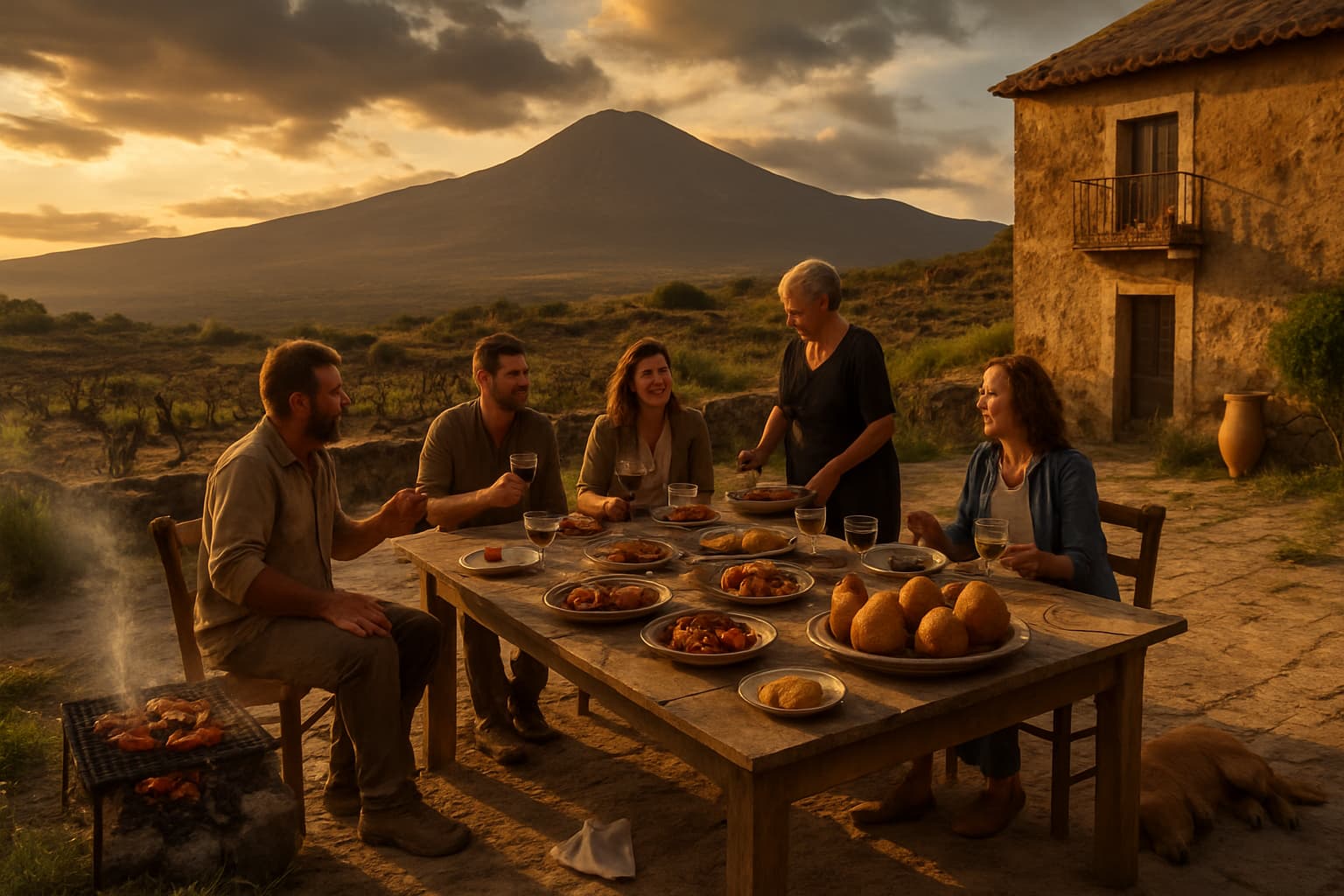
If you’re lucky, you’ll end up at a long table in someone’s courtyard, eating grilled sausage, roasted peppers, and bread soaked in olive oil while your glass keeps getting refilled with whatever they’re excited about that week. This is not a “flight.” This is lunch.
Etna gets all the press, but Sicily is a patchwork of wine regions that feel like different countries stitched together badly. That’s a compliment.
Marsala, on the western tip of the island, is one of those names that makes people think of dusty bottles in grandma’s kitchen, used to “cook with wine” in the worst possible way. The reality, when done right, is a fortified wine that can be complex, nutty, salty, and absolutely deadly with good cheese.
The landscape here is cinematic:
A lot of Marsala producers sold their souls to volume and cheap cooking wine decades ago. But there are a handful of serious producers quietly making traditional, barrel-aged Marsala that can stand next to Sherry and Madeira and not flinch.
Wine tourism here means:
And then there’s the dry stuff: Grillo, Catarratto, and Inzolia—white grapes that, when not abused for bulk production, can turn into bright, saline, citrus-and-herb-driven wines that taste like they were made to be drunk within view of the sea. Because they were.
Head down toward Noto, Ragusa, and Modica, and the vibe shifts. The architecture gets more baroque and theatrical, like the island decided to put on its best clothes. The wines here tend to be warmer, sun-drenched, and a little more hedonistic.
Wine tourism here is often more “estate visit followed by long lunch” than “climb a volcano,” but you still get that Sicilian edge—dusty roads, old farmhouses, and the sense that time moves slower, except in the kitchen, where everything moves fast and loud.
In the southeast, near Vittoria, there’s a DOCG (Italy’s top wine classification) for Cerasuolo di Vittoria, a blend of Nero d’Avola and Frappato.
Frappato is the grape that shows Sicily has a lighter hand when it wants to:
Blended with Nero d’Avola, it gives Cerasuolo di Vittoria this tension between juicy and serious, fruit and structure. It’s the kind of red you can chill slightly and drink on a hot afternoon without feeling like you’ve made a terrible life choice.
Wineries here tend to be smaller, often organic or biodynamic, with a mix of old-school families and idealistic young winemakers who look like they might also run a record label on the side.
If Sicily itself isn’t enough of an island for you, there are satellite islands making wines that taste like they were distilled from sun and salt and madness.
Pantelleria is closer to Tunisia than to mainland Italy. It’s a windswept rock where vines are trained low, almost hugging the ground, to avoid being beaten to death by the wind.
The grape here is Zibibbo (Muscat of Alexandria), and the calling card is Passito di Pantelleria—a sweet wine made from sun-dried grapes. Done well, it’s not cloying; it’s explosive: apricot, orange peel, jasmine, honey, and a salty edge that keeps it from turning into syrup.
You drink it with pastries, sure, but also with blue cheese, or just by itself while staring at the horizon, wondering why you ever thought spreadsheets were a good use of your life.
Places like Salina and Lipari grow Malvasia delle Lipari, another grape that can go sweet or dry, often with a smoky, saline note from the volcanic soils and sea exposure.
Wine tourism here is less about structured tastings and more about stumbling across someone’s vines, then finding out they also make a few hundred bottles of something that never leaves the island. Don’t over-plan. Show up, ask questions, be respectful, and things tend to appear: wine, food, stories.
If you want a neat classification system, Sicily will disappoint you. But there are some patterns:
If you like your wine predictable, this might unsettle you. If you like to be surprised, Sicily is your playground.
A few hard-earned guidelines if you want to drink your way across the island and still feel like a human being at the end.
Public transport won’t get you to most vineyards. You need a car. But:
Drink at tastings, sure, but pace yourself, spit when you can, and don’t try to rack up six wineries in a day like you’re in Napa on fast-forward. Three is ambitious. Two and a long lunch is civilized.
Most serious wineries are small operations. The winemaker might be pruning vines in the morning, racking barrels in the afternoon, and pouring for you in between. Call or email ahead. Don’t just roll up expecting a polished visitor center and a bus tour.
Wine on an empty stomach is a bad idea anywhere, but in Sicily—with its sun, heat, and generous pours—it’s suicidal. The good news: the food is ridiculous.
Expect:
Wine and food here are not separate categories. They’re part of the same sentence.
Yes, there are big-name producers. Some are excellent; some are coasting on reputation. What makes Sicily special is how many small, family-run, or slightly crazy operations are out there.
Ask:
You don’t need to be a wine geek to care. You just need to be curious about what’s in your glass and why it tastes the way it does.
You’ll probably leave Sicily with a suitcase full of bottles you swear you’ll save for “the right moment,” then end up opening on a random Tuesday because you’re tired and the world is stupid and you want to remember what it felt like to stand in a vineyard at dusk with ash on your shoes.
But the real thing you take home isn’t the wine. It’s a recalibrated sense of what wine tourism can be.
It doesn’t have to be precious. It doesn’t have to be a checklist of “top-rated estates” and “must-try vintages.” It can be:
Sicily doesn’t care about your tasting notes. It cares that you show up hungry, thirsty, and open to being surprised.
If you let it, the island will strip away the bullshit—scores, status, the idea that wine is some elite hobby for people with perfect cellars—and bring you back to the simple, dangerous truth:
Wine is farming. Wine is weather. Wine is people. Wine is a place in a glass.
And in Sicily, that place is loud, volcanic, salty, stubborn, and alive. Drink accordingly.
Tannins are astringent compounds found in wine that contribute to its texture and aging potential, often causing a drying or puckering sensation in the mouth. They are derived from grape skins, seeds, and stems, as well as from oak barrels used during aging.
/ˈtænɪnz/
Malic acid is a naturally occurring organic acid found in grapes that contributes to the tart, green apple-like flavor and crispness in wine. It plays a significant role in the taste and acidity of wine.
/mælɪk ˈæsɪd/
Filtration in winemaking is the process of removing solid particles from wine to clarify and stabilize it before bottling, using various types of filters to achieve different levels of clarity and remove unwanted elements like yeast, bacteria, and sediment.
/fɪlˈtreɪʃən/
Oxidation in wine is a chemical reaction between the wine and oxygen that can change its flavor, aroma, and color. This process can be beneficial or detrimental depending on the extent and context of the exposure.
/ˌɒksɪˈdeɪʃən/
Microclimate refers to the unique climate conditions of a small, specific area within a larger region, significantly influencing grapevine growth and the characteristics of the resulting wine.
/ˈmīkrōˌklīmit/
Get weekly wine recommendations, vineyard news, and exclusive content delivered to your inbox.