Wine Literature and Media
“Where every bottle tells a story”
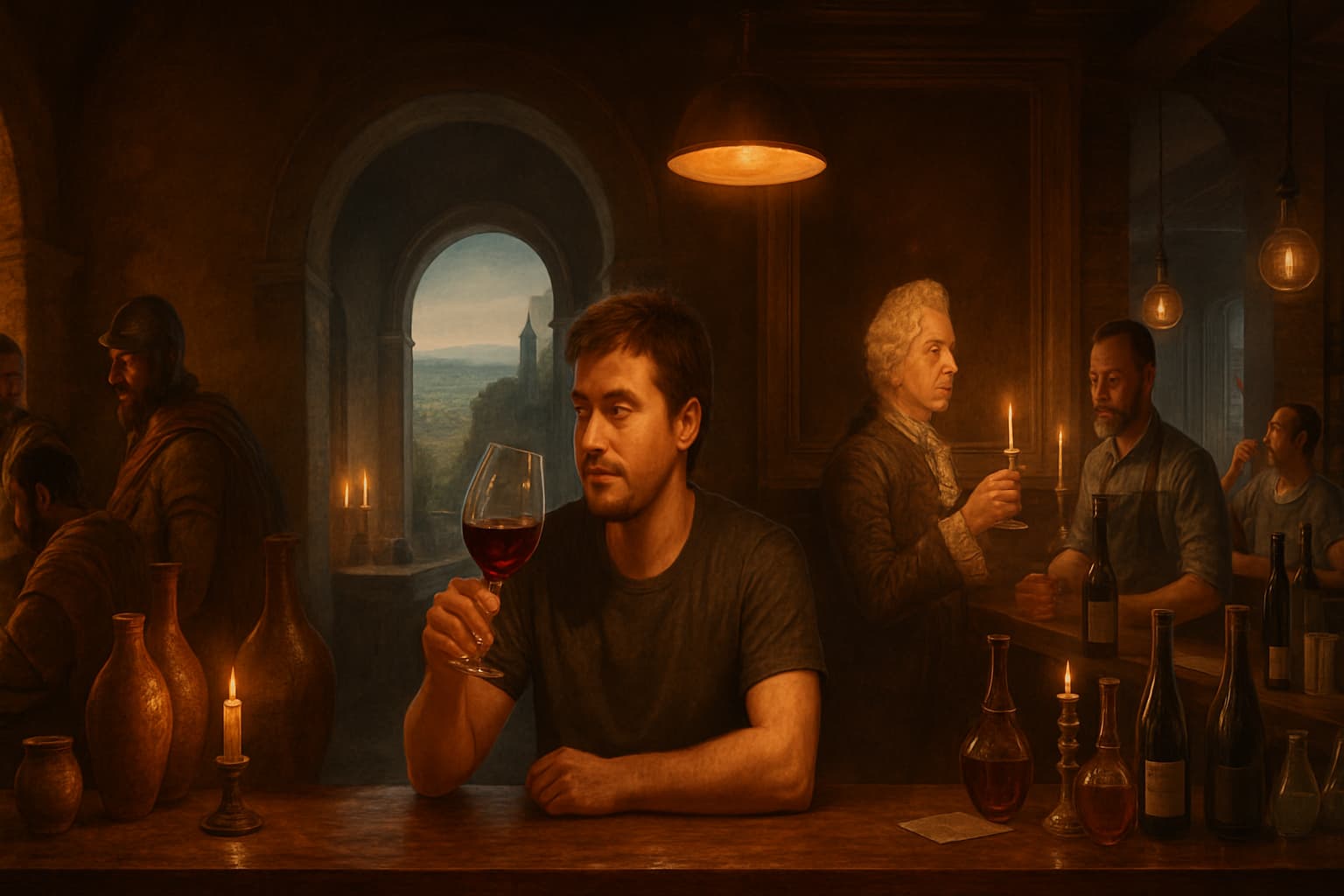
You’re sitting in a dim bar with a glass of red in front of you. You swirl it, sniff it, pretend to care about “notes of cassis and leather,” and try not to look like an idiot. Somewhere, a sommelier in a $300 apron is whispering about terroir. Somewhere else, a guy in a tank top is chugging boxed wine straight from the spout.
Both of them are part of the same story.
Wine has been everything: sacred blood, peasant fuel, aristocratic flex, hipster accessory, family business, global commodity, and hangover in a bottle. It’s older than your religion, more traveled than your favorite influencer, and more honest than most people you know—because if you drink enough of it, the mask slips. It always does.
This isn’t a love letter to tasting notes or a guide to impressing your date by saying “Burgundy” with the right nasal whine. This is the long, messy, human story of wine: how it followed us from ancient clay jars to Michelin-star dining rooms, from monastery cellars to supermarket shelves. How it shaped culture, and how culture shaped it right back.
Let’s open the bottle.
Long before there were sommeliers and decanters and people using “mineral-driven” in sentences, there were just humans, some grapes, and a universal desire to get out of their own heads for a while.
The earliest hard evidence of wine shows up around 6,000–7,000 years ago in the Caucasus and the Zagros Mountains—modern-day Georgia, Armenia, and Iran. Clay jars stained with tartaric acid, grape pollen, and the faint trace of somebody’s very good idea. People discovered that grapes left alone don’t just rot—they ferment. Sugar turns to alcohol. Suddenly, the world is a little warmer, the gods a little closer, and your problems a little softer around the edges.
In ancient Mesopotamia and Egypt, wine wasn’t just a drink. It was a status symbol and a religious tool. Beer was for the masses. Wine was for priests, royalty, and the well-connected. Egyptians buried the dead with jars of wine labeled with vintage, vineyard, and type—primitive wine labels scratched into clay, proof that even then, people wanted the good stuff in the afterlife.
The Greeks took it further. Dionysus—the god of wine, madness, and ecstasy—wasn’t some background deity. He was the headliner. Wine was the fuel for philosophy, theater, and politics. Men sat in symposia, drank, argued about ethics and war, recited poetry, and tried to pretend they weren’t hammered. They diluted their wine with water not because they were soft, but because getting blind drunk too fast was considered barbaric. Wine was about pacing the night, not ending it in a ditch.
The Romans industrialized it. They planted vineyards from Spain to Syria, shipped amphorae of wine across the Mediterranean, and built an empire with a wine buzz. They classified vineyards, noted which hillsides made better wine, and figured out that different soils gave different flavors. Sound familiar? That’s the skeleton of what we now call terroir.
Wine started as a sacred offering and ended up as a daily ration for Roman soldiers. Already, you can see the pattern: wine moves between the altar and the tavern, between the elite and the everyday. It never stays in one box.
The Roman Empire collapses. Barbarians show up. Roads fall apart. Libraries burn. But vineyards? Those survive—because monks have to drink too.
In medieval Europe, the Catholic Church becomes one of the biggest landowners and wine producers on the continent. Why? Because wine is literally part of the liturgy. Blood of Christ, poured daily. You can’t run a mass without something fermented.
Monasteries in Burgundy, Champagne, the Rhine, and beyond become quiet, obsessive laboratories. These monks weren’t just praying and chanting. They were taking notes. Centuries of notes: which slopes ripen first, which patches of dirt produce wines with more “nobility,” which vineyards survive the frost.
They didn’t have modern science, but they had time. And time plus attention equals knowledge. The idea that one small plot of land could produce a wine so distinct, so consistently, that it deserved its own name—that’s medieval. That’s monks in cold stone halls, tasting and comparing, season after season.
Meanwhile, in the secular world, wine was the everyday drink because water could kill you. In cities, water was sketchy. Wine—diluted, rough, sour, whatever—was safer. Kids drank it. Peasants drank it. Nobles drank better versions of it. But everyone drank something fermented.
The cultural divide deepened: on one side, wine as sacred, refined, carefully made. On the other, wine as fuel—calories and courage in a cup.
By the time you hit Renaissance and early modern Europe, wine has gone fully global. Trade routes stretch across oceans. Empires are built on sugar, spices, and yes, alcohol.
In France, wine becomes a weapon of soft power. The royal courts of Paris and Versailles turn it into an art form. Bordeaux wines are shipped to England, where claret becomes the drink of choice for the aristocracy. Burgundy seduces with perfume and finesse. Champagne turns bubbles into status.
In Italy, city-states like Florence and Venice develop their own wine cultures—rustic reds, sweet dessert wines, everything in between. In Spain and Portugal, fortified wines like sherry and port evolve to survive long sea journeys. Wine becomes not just a drink, but a trade good, a diplomatic gift, a sign of civilization.
This is where the wine snob is born—not the modern Instagram one, but the powdered-wig version. People start writing tasting notes. Poets and philosophers describe wine in flowery, almost erotic language. Glassware changes. Service rituals appear.
At the same time, colonialism spreads vines to the so-called New World. Spanish missionaries bring grapes to Mexico, then California, Chile, and Argentina. The Portuguese and French plant vines in South Africa. The British, always thirsty and not particularly picky, encourage vineyards in Australia.
Wine stops being just European. The vine becomes a migrant, clinging to new soils, new climates, new hands. Every time it moves, it adapts. Every time it adapts, it changes the culture around it.
In the 19th century, the wine world almost dies.
A tiny American insect called phylloxera hitches a ride to Europe and starts quietly murdering vineyards. Roots rot. Vines wither. Entire regions are wiped out. Imagine waking up and discovering your country’s main drink, your family’s livelihood, your region’s pride, is literally disintegrating underground.
The solution is both humiliating and genius: graft European vines onto American rootstock. Old World grapes on New World legs. The entire European wine industry is rebuilt on this hybrid foundation. Tradition, it turns out, is sometimes a Frankenstein monster with foreign feet.
Meanwhile, revolutions and wars tear through Europe. Empires fall. Borders shift. Vineyards are bombed, abandoned, replanted. Wine production crashes, then surges, then crashes again.
And then, in the 20th century, something strange happens: science shows up with a lab coat and a clipboard. Winemaking becomes less about superstition and more about chemistry and microbiology. Temperature-controlled fermentation. Stainless steel tanks. Selected yeasts. Filtration. The goal: cleaner, more consistent wine. Less risk. Fewer disasters.
At the same time, New World regions—California, Australia, Chile, South Africa, New Zealand—start flexing. They don’t have the same weight of tradition. They’re not bound by centuries of “this hillside is for this grape only.” They plant what they want, experiment, blend. They label by grape variety because it’s easier to market: Cabernet, Chardonnay, Merlot.
Wine becomes a global commodity. Supermarkets stock bottles from five continents. Ratings appear—100-point scales, critics with godlike power, magazines that can make or break a winery. A single number suddenly dictates what sells, what doesn’t, what people pretend to like.
Culture shifts again. Wine is no longer just local or sacred. It’s branded, scored, ranked, and shipped in container loads.
Walk into a modern wine bar in any big city: concrete walls, Edison bulbs, staff in denim aprons and tattoos. The list is a mix of natural wines with labels that look like indie band posters, classic Burgundy priced like rent, and orange wines from Georgia served in clay cups.
Wine today is identity. It’s performative. What you drink says something about you—or at least, you want it to.
You drink big, oaky Napa Cab? You’re either old money, tech money, or you just really like liquid lumber.
You drink cloudy, low-intervention wine from some forgotten hillside in Slovenia? You’re broadcasting that you care about authenticity and sustainability, and you probably have opinions about carbonic maceration.
You drink cheap boxed wine and don’t care? You’re either honest, broke, or both.
Wine has become a language. People use it to signal tribe: natural vs. conventional, Old World vs. New World, classic vs. experimental. It’s no longer just what’s in the glass, but the story behind it—who made it, how, where, and under what conditions.
The pendulum swings between reverence and rebellion. On one side: starched tablecloths, decanters, and wine lists the size of phone books. On the other: punk wine bars pouring funky, volatile, borderline-flawed juice and calling it “alive.”
Underneath the noise, something real is happening: a return to the idea that wine is agricultural. That it comes from a place, made by people, affected by weather and politics and economics. Climate change moves harvest dates earlier. Droughts, fires, floods—these aren’t abstract anymore. They’re in the glass: higher alcohol levels, riper fruit, different flavors from the same old vineyards.
The cultural story of wine has always been about tension: nature vs. control, ritual vs. pleasure, elite vs. everyday. Today, that tension is louder than ever.
Wine didn’t just stay in the bottle. It crawled into our books, our movies, our media diet.
From ancient poetry to modern novels, wine has been shorthand for everything: celebration, sorrow, seduction, failure. It’s in the Psalms and in Bukowski, in Rabelais and in Kermit Lynch’s travelogues. Writers use wine because it’s familiar, but also because it’s slippery. It can mean comfort one moment and self-destruction the next.
Modern wine media turned it into a spectator sport. Magazines like Wine Spectator and Decanter built empires on scores and cellaring advice. TV shows and documentaries romanticized vineyard life: golden-hour shots of people strolling through vines, swirling glasses, waxing poetic about limestone.
Then came the backlash. Films like Sideways mocked the pretension while accidentally tanking Merlot sales and boosting Pinot Noir. Documentaries about natural wine and small producers turned obscure farmers into cult heroes.
Every time we write about wine, film it, tweet it, or post it, we’re not just describing a drink. We’re adding a layer to its cultural meaning. We’re deciding what matters: the label, the land, the score, the story, or just the buzz.
Strip away the rituals, the glassware, the ratings, the hashtags, the arguments about sulfites and stem inclusion. What’s left?
A simple, ancient act: crushing fruit, letting it rot in a controlled way, and drinking the result with other humans.
Wine is fermented time. It’s weather in a bottle. It’s the memory of a year—too hot, too cold, just right—captured and poured. People have used it to talk to gods, to close deals, to toast victories, to numb pain, to make bad decisions, to fall in love, to say goodbye.
It’s been a weapon of class division and a bridge across cultures. It’s been a symbol of purity and a vehicle for excess. It’s been worshiped, banned, taxed, smuggled, counterfeited, fetishized, and chugged from Solo cups at 2 a.m.
The cultural history of wine isn’t really about wine. It’s about us. Our need for ritual. Our obsession with status. Our hunger for taste, for escape, for connection. Our talent for taking something simple and turning it into something absurdly complicated—and then, if we’re lucky, circling back to simplicity again.
So the next time you’re staring at a wine list, feeling out of your depth, remember this: nobody started out knowing what “garrigue” smells like. The first person who drank wine probably just thought, “This makes the world feel different. Let’s do that again.”
You don’t need to speak the language of sommeliers or memorize regions to be part of this story. You’re already in it, every time you raise a glass with someone you give a damn about.
Pour something—cheap, fancy, weird, whatever. Smell it, taste it, and understand that you’re participating in a ritual that’s older than your country, your language, your entire family tree.
It’s not just booze. It’s history, culture, geography, and human folly, all fermented together. And for all our pretension, all our snobbery, all our marketing bullshit, there’s still that core, ancient truth:
Wine is just one more way we try to make this strange, beautiful, terrifying life a little more bearable—and a little more worth remembering.
Tannins are astringent compounds found in wine that contribute to its texture and aging potential, often causing a drying or puckering sensation in the mouth. They are derived from grape skins, seeds, and stems, as well as from oak barrels used during aging.
/ˈtænɪnz/
Malic acid is a naturally occurring organic acid found in grapes that contributes to the tart, green apple-like flavor and crispness in wine. It plays a significant role in the taste and acidity of wine.
/mælɪk ˈæsɪd/
Filtration in winemaking is the process of removing solid particles from wine to clarify and stabilize it before bottling, using various types of filters to achieve different levels of clarity and remove unwanted elements like yeast, bacteria, and sediment.
/fɪlˈtreɪʃən/
Oxidation in wine is a chemical reaction between the wine and oxygen that can change its flavor, aroma, and color. This process can be beneficial or detrimental depending on the extent and context of the exposure.
/ˌɒksɪˈdeɪʃən/
Microclimate refers to the unique climate conditions of a small, specific area within a larger region, significantly influencing grapevine growth and the characteristics of the resulting wine.
/ˈmīkrōˌklīmit/
Get weekly wine recommendations, vineyard news, and exclusive content delivered to your inbox.