Wine Literature and Media
“Where every bottle tells a story”
It is a truth, perhaps not yet universally acknowledged, that a person in possession of a sound palate must be in want of a glass of wine. Yet how often is that glass accepted with all the blind confidence of a heroine accepting a proposal from a gentleman whose character she has scarcely examined? The world is full of wines and of opinions about them, but discernment, alas, is less common. It is therefore my present intention to offer, not a catalogue of bottles, but a brief course of instruction in tasting, that the reader may learn to distinguish between a merely agreeable acquaintance and a true and lasting attachment in the glass.
For wine, like society, is composed of character, breeding, and behaviour. Some wines are all show and no substance; others, shy at first acquaintance, reveal their virtues only upon patient conversation. To learn to taste is to learn to converse with wine—politely, attentively, and with a mind equally open to pleasure and to judgment.
Before one speaks of wines, one must say something of the taster; for a glass cannot be properly understood by a palate that is out of humour. The most exquisite Burgundy will be wasted upon a tongue numbed by peppermint, and the finest Champagne will appear insipid to one who has just devoured a quantity of sweetmeats.
A person who undertakes to taste with any seriousness ought therefore to observe a few modest proprieties:
Moderation of appetite
One should not taste on an entirely empty stomach, lest the wine make too rapid an impression on the head; nor after a heavy meal, when the senses are fatigued. A little bread, perhaps a morsel of cheese of no very strong character, is perfectly sufficient.
Neutrality of the palate
Coffee, tobacco, strong spices, and the sharper mints are the great enemies of discernment. They are like loud, talkative relations who will insist upon dominating every conversation. If one must encounter them, let it be well before the hour of tasting.
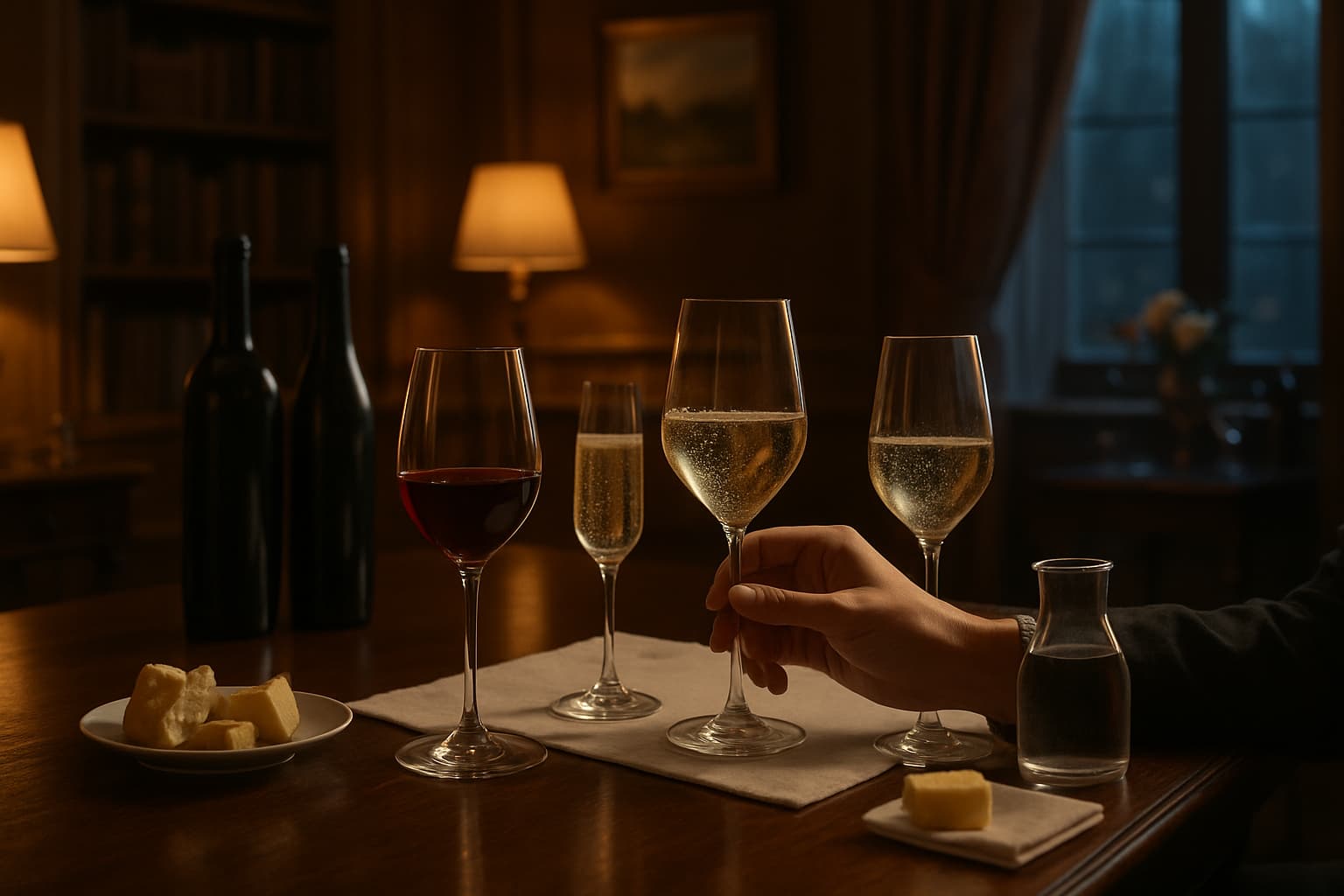
Just as no lady of sense would expect to shine at a ball in a gown entirely unsuited to her figure, so no wine can appear to advantage in an ill-chosen glass. The fashion for very small, ornamental vessels or those of coloured crystal may be charming at a distance, but for the purposes of study they are quite as impractical as dancing in boots.
The glass most to be recommended is clear, thin, and tulip-shaped, with a bowl sufficient to allow a modest swirl without catastrophe. Its advantages are three:
To hold the glass by its stem is not a mere affectation, but a mark of good sense and, one might add, of good breeding.
Before one sips, one must look. Wine, like a character of consequence in a drawing room, announces itself long before it speaks.
Hold the glass against a light background—white linen answers very well—and observe:
Colour
To taste without smelling is as absurd as judging a novel by its binding. The nose is the first true confidante of the wine’s character.
Having studied the wine with eye and nose, one is at last entitled to taste. But even here, haste is unbecoming. A sip taken and swallowed without reflection is like a letter read only to discover the signature.
To judge a wine solely by its power is as foolish as to admire a person only for their fortune. The true question is: are its parts in harmony?
When all is well proportioned, one may speak of balance—that most desirable of qualities, in wine as in life. Beyond balance lies character: those particular traits which make one wine memorable and another forgettable. A hint of wild herbs in a Mediterranean red, the stony coolness in a mountain white, the mysterious forest floor of an aged Burgundy—these are the touches that raise a wine from the merely correct to the truly engaging.
Though an exhaustive treatise would weary the most patient reader, it is useful to consider a few principal types of wine as if they were a varied company assembled in a drawing room.
No one becomes a discerning taster in a fortnight, any more than one becomes a master of the pianoforte after a single lesson. The art requires repetition, comparison, and, above all, humility. The palate is trained not by grand declarations, but by quiet attention.
A few principles may guide the student:
To undertake a course of tasting is not merely to learn a new vocabulary, nor to acquire a collection of opinions suitable for display at dinner. It is, rather, to cultivate a more attentive way of being in the world. Wine is nothing but the fermented juice of grapes, and yet in that simple transformation are gathered the labours of the vine-grower, the decisions of the winemaker, the character of the soil, the temper of the season, and the patience of years.
When we taste with care, we pay these things the compliment of our notice. We begin to perceive that a glass of wine, like a well-drawn character, is a creature of context: of climate, of culture, of chance. We learn to distinguish the modest but honest country wine that gives unaffected pleasure from the grand bottle whose reputation may exceed its merit. We discover that some wines, like some people, are best enjoyed in youth, while others reward the patience of long acquaintance.
If this little course has any true purpose, it is to encourage the reader to exchange hurried indulgence for thoughtful enjoyment; to replace intimidation with curiosity; and to approach each glass not as a test to be passed, but as a conversation to be entered into with civility and delight. For in the society of wines, as in that of persons, the greatest happiness is found where there is both pleasure and understanding.
Tannins are astringent compounds found in wine that contribute to its texture and aging potential, often causing a drying or puckering sensation in the mouth. They are derived from grape skins, seeds, and stems, as well as from oak barrels used during aging.
/ˈtænɪnz/
Malic acid is a naturally occurring organic acid found in grapes that contributes to the tart, green apple-like flavor and crispness in wine. It plays a significant role in the taste and acidity of wine.
/mælɪk ˈæsɪd/
Order and composure of mind
An agitated or distracted spirit rarely observes with accuracy. The taster must be prepared to attend to small differences, to note the faintest change of scent or flavour. In this, as in many other things, calmness is a great advantage.
Clarity
A well-made wine of good health is generally clear, not cloudy. A slight haze is not always a crime, particularly in wines made with minimal artifice; but heavy murkiness suggests either youth in need of settling or some defect in constitution.
Viscosity (the “legs” or “tears”)
When the wine is gently swirled, one may observe how it clings to the glass and descends. Thick, slow tears often indicate higher alcohol or sugar. Yet one must beware of drawing too many conclusions from such behaviour; a gentleman may walk slowly without being profound.
The first approach
Bring the glass to the nose without agitation and take a gentle breath. This is the wine’s greeting—its “How do you do?” One may sense freshness, fruit, or perhaps a certain shyness.
The swirl
Now give the glass a careful rotation, enough to awaken the scents without casting them upon your neighbours. Smell again. The bouquet should now be more expansive, more articulate.
Aromas to be observed
Wines, like people, display their origins and their histories in their conversation. Among the scents most commonly encountered are:
Faults and improprieties
Not all scents are to be welcomed. A strong odour of mouldy cork, acrid vinegar, or damp cellar may indicate a wine whose upbringing has been sadly neglected. In such cases, it is no sign of fastidiousness, but of sound judgment, to decline further acquaintance.
The attack
The first impression on the tongue—the initial “attack”—reveals the wine’s intensity and texture. Does it rush forward with boldness, or approach gently? Is it thin as a whispered rumour, or full as a well-told tale?
The structure
Beneath every wine’s agreeable or disagreeable surface there lies its structure, composed chiefly of:
Flavour and development
Allow the wine to travel about the mouth. One may gently draw in a little air between the lips to encourage the release of aromas. Observe how the flavours change from the first contact to the moment before swallowing or expectorating. A wine of real interest seldom remains exactly what it was at first sip; it develops, just as a character in a novel ought to do.
Finish
After the wine has left the mouth, consider how long its presence remains. Does its flavour vanish abruptly, like a caller who departs without taking leave? Or does it linger in a pleasant recollection, continuing the conversation in memory? Length of finish is one of the surest signs of quality.
Crisp Whites (Sauvignon Blanc, young Riesling, etc.)
Lively, fresh, sometimes a little sharp—like the clever cousin whose remarks are always spirited and occasionally cutting. They shine with seafood, salads, and lighter fare.
Rounded Whites (Chardonnay, Viognier, aged whites)
Fuller in body, sometimes touched by oak, they are the comfortable, well-established relations of the table—suited to poultry, cream sauces, and dishes of more substance.
Light Reds (Beaujolais, some Pinot Noir)
Charming, easy in conversation, more about fruit than solemnity. They may be served slightly cool and are most agreeable with charcuterie, poultry, and simple suppers.
Structured Reds (Bordeaux blends, Cabernet Sauvignon, Syrah)
These are the serious gentlemen of the cellar: firm in tannin, often improved by age, and best introduced to roasts, game, and cheeses of character.
Sparkling Wines (Champagne and its cousins)
The life of the party—bubbles like laughter, freshness like new gossip. Yet the best among them also possess depth enough for contemplation.
Sweet and Fortified Wines (Sauternes, Port, Sherry)
Rich, sometimes intense, they are the dessert course of society: best enjoyed in smaller quantities, but capable of great complexity and delight.
Filtration in winemaking is the process of removing solid particles from wine to clarify and stabilize it before bottling, using various types of filters to achieve different levels of clarity and remove unwanted elements like yeast, bacteria, and sediment.
/fɪlˈtreɪʃən/
Oxidation in wine is a chemical reaction between the wine and oxygen that can change its flavor, aroma, and color. This process can be beneficial or detrimental depending on the extent and context of the exposure.
/ˌɒksɪˈdeɪʃən/
Microclimate refers to the unique climate conditions of a small, specific area within a larger region, significantly influencing grapevine growth and the characteristics of the resulting wine.
/ˈmīkrōˌklīmit/
Get weekly wine recommendations, vineyard news, and exclusive content delivered to your inbox.